
Revisiting Euler-Angle Regression with Kolmogorov-Arnold Networks
Source: arXiv:2607.09650 · Published 2026-07-10 · By Yangting Sun, Zijun Cui, Yufei Zhang
TL;DR
This paper tackles the long-standing challenge of directly regressing Euler angles for 3D rotations in articulated systems such as robotics and biomechanics, where joint rotations are naturally parameterized by bounded-range Euler angles. Euler angles exhibit discontinuities and singularities (e.g., gimbal lock) that destabilize training and regression accuracy. The authors revisit Euler-angle regression by combining principled range constraints and domain-aware axis ordering with a novel regression architecture called Kolmogorov-Arnold Networks (KAN). KAN adapts learnable univariate activations along network edges, rather than fixed activations per node as in standard MLPs. The paper provides a theoretical analysis showing that bounded Euler ranges induce a near-additive functional structure in the target regression map, which aligns well with KAN's additive spline function form. Empirically, across controlled rotation regression, object pose estimation, robotic arm inverse kinematics, and biomechanical hand articulation, KAN+Euler representations outperform standard MLP+6D and MLP+Euler baselines in accuracy (up to 40% reduction in mean angle error), convergence speed, and computational efficiency. The work demonstrates that explicitly exploiting bounded Euler-angle domain constraints together with the adaptive function approximation properties of KAN yields a more accurate, stable, and sample-efficient 3D rotation regression framework compared to prior parameterizations and architectures.
Key findings
- KAN+Euler achieves 2.40° mean angle error (MAE) and 4.60° geodesic error (GE) on ModelNet10 object pose estimation, 40% and 34% lower than MLP+6D (4.02°, 7.01°).
- KAN+Euler runs at 0.45M parameters and 0.51M FLOPs for the rotation head, outperforming larger MLP+6D models with up to 7.3× more parameters and FLOPs in MAE.
- KAN+Euler converges faster and to lower errors than MLP+6D or MLP+Euler, particularly when Euler angle ranges exclude ±π/2 singularities.
- In Franka Panda robotic arm inverse kinematics on 1M samples with 3 active DoFs, KAN+Euler attains 0.16 cm forward kinematics error (FKE) and 100% success rate within 1cm, outperforming MLP+6D (0.83 cm, 71.6%) and MLP+Euler (1.16 cm, 52.5%).
- Tightening workspace constraints (bounding joint angle ranges) further improves KAN+Euler accuracy and success rates in robotic IK tasks.
- On the FreiHand biomechanical inverse kinematics dataset (33K training samples), KAN+Euler with range constraints achieves 2.53° MAE, 11.5% lower than KAN+6D (2.86°) and 5.6% lower than MLP+AA (2.68°).
- Data efficiency studies show KAN+Euler at 10% training data outperforms MLP+6D at the same fraction and matches full-data MLP+6D accuracy.
- Theoretical analysis quantifies that bounded Euler angle ranges induce a near-additive ANOVA functional structure with a small second-order interaction residual, which KAN's additive spline modules approximate efficiently.
Threat model
n/a - the paper addresses rotation regression accuracy and stability in bounded Euler-angle spaces, without modeling adversarial or attack threats. The focus is on the inductive biases and functional structures that improve training convergence and regression performance under natural domain constraints.
Methodology — deep read
The threat model is a standard regression learning setting with no adversarial or attack capabilities considered—focus is on stable, accurate rotation regression from sensor or kinematic observation data.
Data provenance comes from multiple real-world and synthetic sources: ModelNet10 object point clouds (889 train, 100 test), Franka Panda robot arm simulated kinematics (1 million pose-configuration pairs), and FreiHand hand articulation dataset (33K train, 4K test). Each dataset is split into train/test and subjected to fixed random seeds for reproducibility. Ground-truth Euler angles or 3D rotations are labeled or provided by simulators.
The core architectural innovation is the Kolmogorov-Arnold Network (KAN), which replaces fixed nonlinear activations in traditional fully connected MLP layers with learnable univariate functions assigned to each edge (connection) between neurons. These learnable functions are parameterized by degree-p B-spline expansions defined on bounded intervals, allowing each channel to adapt its nonlinear response to input features. The input features represent kinematic descriptors or encoded sensor data, and the output is a 3-vector of Euler angles constrained within known joint limits.
Training uses a supervised regression objective minimizing mean squared error (MSE) between predicted Euler angles and ground truth. The authors incorporate domain knowledge by enforcing tight Euler angle range constraints (intervals < 2π) and assigning rotation order such that the most constrained axis is in the middle angle slot, mitigating gimbal lock singularities. This results in a compact and singularity-free Euler-angle domain.
Empirically, KAN+Euler models are trained with stochastic gradient descent or Adam optimizers over multiple epochs, batch sizes, and seeds detailed in appendices (not fully specified in text). Matchings with MLP baselines are done controlling for parameter count (~100K or ~1.4M depending on task) and FLOPs. The model evaluation metrics include mean absolute angular error (MAE), geodesic rotation error (GE), forward kinematic position error (FKE) in robotic IK tasks, and success rates within error thresholds.
Ablations investigate the effect of Euler range tightening (scaling factor div) on regression accuracy and convergence, alongside comparisons of rotation parameterizations (Euler, 6D, axis-angle) coupled with KAN and MLP architectures. Range constraints and axis ordering are toggled to validate their contribution.
The paper’s theory derives Euler-angle regression as a function with additive univariate components plus a bounded interaction residual (ANOVA decomposition), proving that KAN spline functions approximate additive terms with error falling as O(K^{-p}) plus residual interaction error. This situates KAN’s architecture as better matched functionally than generic MLPs for bounded Euler angle regression.
Code release is planned but not publicly available at time of writing. Reproducibility depends on implementing spline-based KAN layers and applying range constraints as per the described methodology. The datasets are publicly accessible or known benchmarks.
Technical innovations
- Proposing Kolmogorov-Arnold Networks (KAN) that implement learnable univariate spline functions on edges, replacing fixed activations in rotation regression.
- Integrating bounded Euler-angle domain constraints and constraint-aware axis ordering to avoid singularities and discontinuities in Euler-angle regression.
- Theoretical demonstration that bounded Euler-angle regression maps decompose into an additive-plus-small-interaction structure, well approximated by KAN’s additive spline architecture.
- Empirically showing that KAN+Euler surpasses overparameterized 6D and axis-angle methods coupled with standard MLPs in accuracy, efficiency, and convergence across multiple real-world tasks.
Datasets
- ModelNet10 — 889 train / 100 test shapes — public point cloud object dataset
- Franka Panda Robotic Arm Simulator — 1 million pose–configuration samples — simulated datasets from robotics research
- FreiHand — 33K train / 4K test hand poses — public biomechanical hand articulation dataset
Baselines vs proposed
- MLP+6D: MAE = 4.02° vs KAN+Euler: MAE = 2.40° on ModelNet10 object pose estimation
- MLP+Euler: MAE = 3.15° (with range constraints) vs KAN+Euler: MAE = 2.53° on FreiHand inverse kinematics
- MLP+6D: FKE = 0.83 cm, SR@1cm = 71.6% vs KAN+Euler: FKE = 0.16 cm, SR@1cm = 100% on Franka Panda IK (3 DoFs)
- MLP+6D at 3.29M params: MAE = 3.67° vs KAN+Euler at 0.45M params: MAE = 2.98° in ModelNet10 pose estimation
- MLP+Euler (unconstrained): MAE = 3.72° vs MLP+Euler (constrained): MAE = 3.15° showing importance of Euler range constraints
Figures from the paper
Figures are reproduced from the source paper for academic discussion. Original copyright: the paper authors. See arXiv:2607.09650.
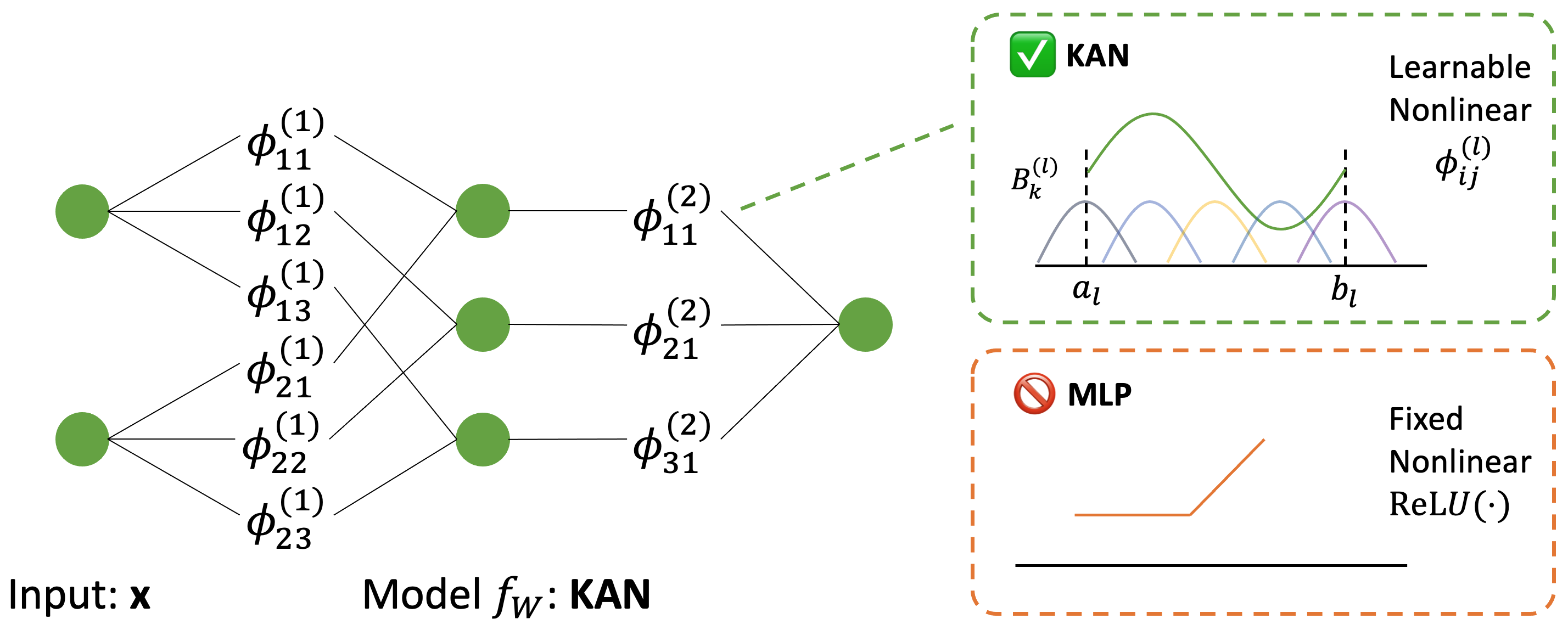
Fig 1: Illustration of Kolmogorov-Arnold Networks (KAN) and their advantages over MLPs.
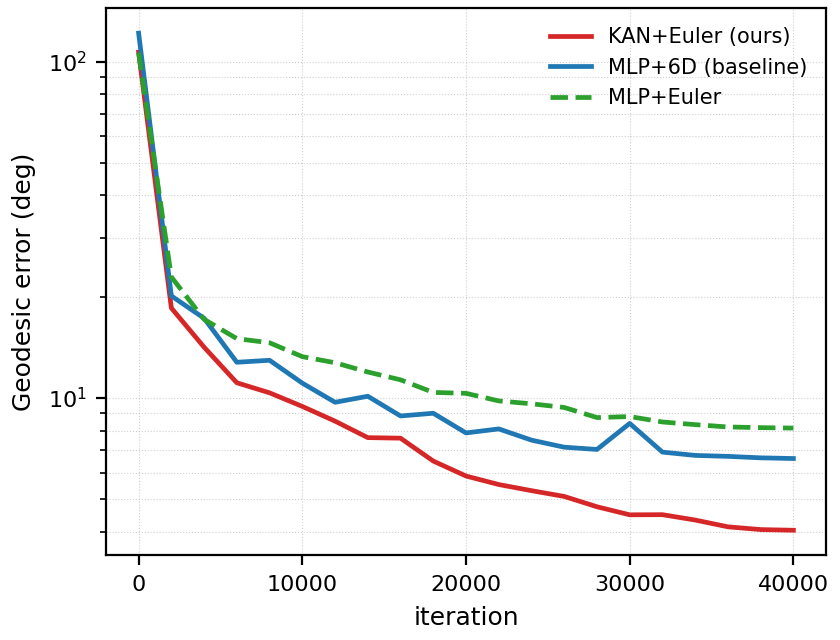
Fig 2: Object pose estimation.
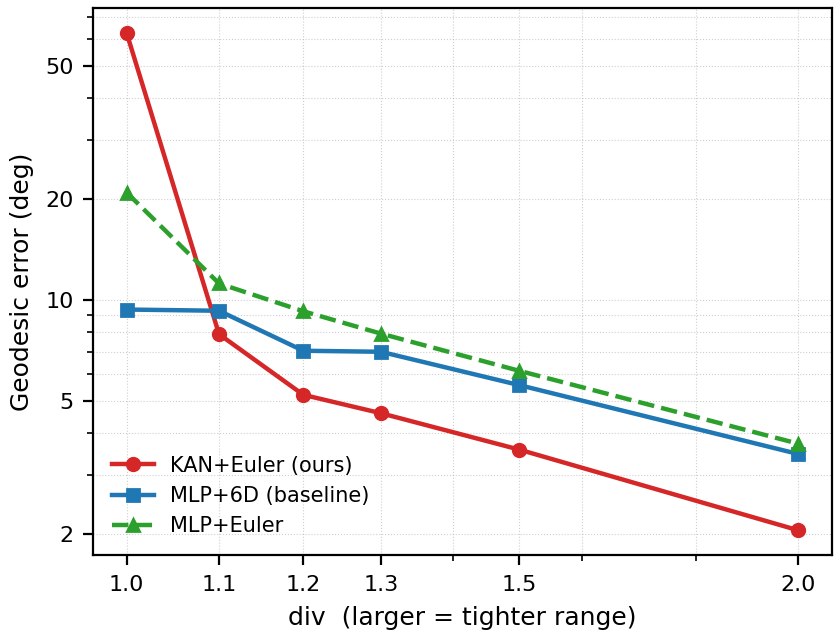
Fig 3 (page 9).
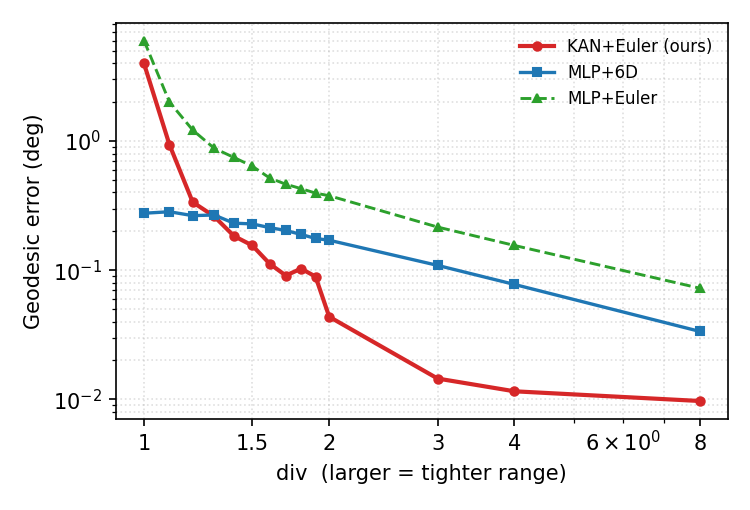
Fig 4: Figure 4: Effect of Euler-angle range. GE
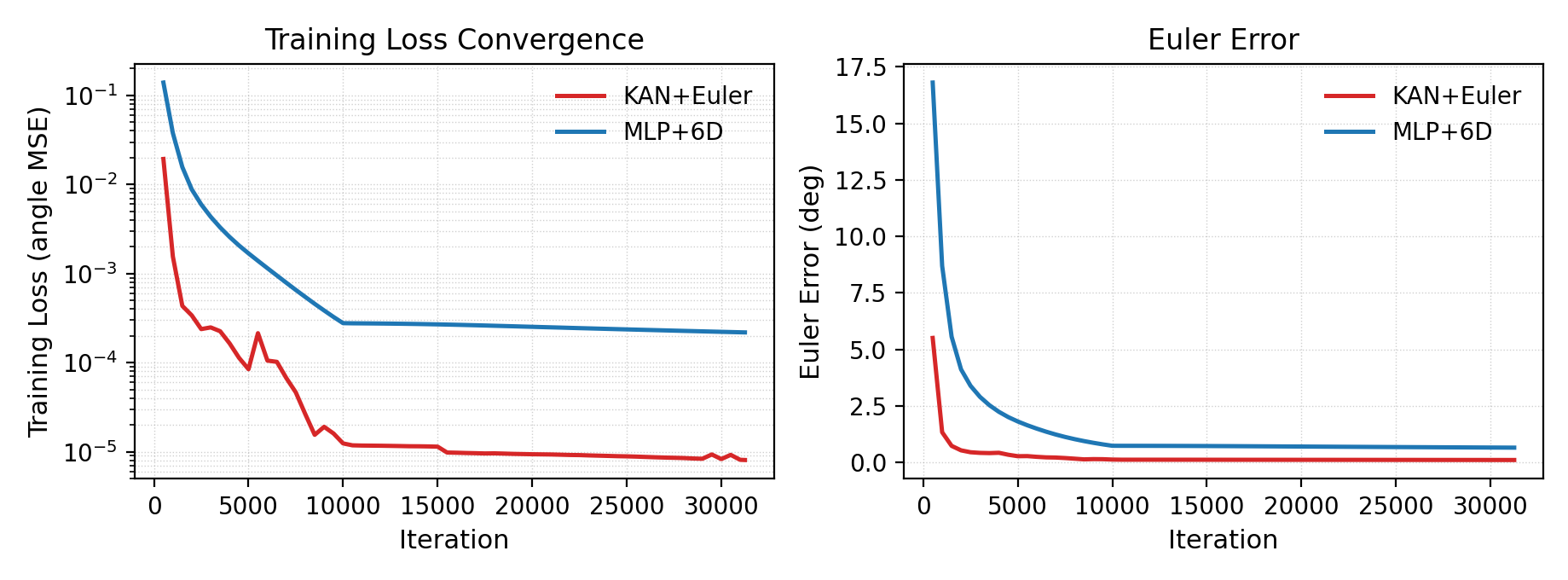
Fig 3: Optimization on controlled rotation regression. Both models are trained with the same
Limitations
- The theoretical analysis assumes smoothness and bounded Euler ranges; performance may degrade as angles approach singularities or periodic boundaries.
- The approach is empirically validated on tasks with relatively tight joint-angle constraints; applicability to arbitrary full-range rotations is less clear.
- No explicit adversarial robustness or generalization to out-of-distribution rotations is evaluated.
- KAN spline parameters introduce additional representational complexity and potential risk of overfitting without large datasets.
- Evaluation focuses on regression accuracy; downstream control or physical validation of the articulated models using predicted angles is not extensively tested.
- Code release is pending, so reproducibility depends on future availability of implementation details.
Open questions / follow-ons
- How does KAN+Euler perform under large-angle rotations or unconstrained Euler-angle domains containing singularities?
- Can the KAN architecture be extended or adapted to other rotation representations with more complex or higher-dimensional manifolds?
- How robust is KAN+Euler to sensor noise, missing data, or real-world operational perturbations common in robotics and biomechanics?
- Would integration with equivariant or Lie-group respecting neural architectures further improve regression stability or generalization?
Why it matters for bot defense
For bot-defense and CAPTCHA practitioners, this work highlights the value of leveraging domain-specific coordinate constraints and custom function approximators to improve regression stability and accuracy. Although rotations and articulated pose estimation are relatively niche compared to common CAPTCHA tasks, the principle of carefully matching model inductive biases (e.g., architecture, activations) with data structure and domain constraints applies broadly. Specifically, the KAN approach suggests a way to replace fixed activations with learned univariate functions to capture angular or cyclic structures more effectively, which could extend to modeling complex user interaction features involving rotational or temporal patterns.
Moreover, the demonstration of how bounded domain constraints can mitigate discontinuities and singularities offers useful insight for CAPTCHA systems handling orientation-sensitive data or behavioral signals that inherently lie on manifolds with periodicity or singular points. Overall, this paper emphasizes the interplay between representation, architecture, and domain constraints to stabilize nonlinear regression tasks—a valuable concept for improving robustness in security-related machine perception pipelines. However, direct application requires domain adaptation and possibly integrating adversarial robustness, which this paper does not address.
Cite
@article{arxiv2607_09650,
  title={ Revisiting Euler-Angle Regression with Kolmogorov-Arnold Networks },
  author={ Yangting Sun and Zijun Cui and Yufei Zhang },
  journal={arXiv preprint arXiv:2607.09650},
  year={ 2026 },
  url={https://arxiv.org/abs/2607.09650}
}