
Confinement drives valley splitting above 4K in buried silicon quantum wells
Source: arXiv:2607.09570 · Published 2026-07-10 · By Davide Degli Esposti, Emma Catherine Brann, Asser Elsayed, Davide Costa, Mark Friesen, Giordano Scappucci
TL;DR
This paper addresses the challenge of valley degeneracy limiting silicon spin qubit performance, particularly for scalable and high-temperature operation. The authors investigate buried 28Si/SiGe quantum wells engineered for low disorder and enhanced valley splitting via electrostatic confinement. They measure key energy scales—orbital energy, single-electron valley splitting, and two-electron singlet-triplet splitting—across a linear array of four quantum dots at 150 mK. A strong positive correlation is found between orbital energy (electrostatic confinement strength) and valley splitting for three of the dots, while one dot achieves a notably high valley splitting of 0.76 meV with low correlation to orbital energy, setting a new benchmark for buried quantum wells comparable to SiMOS devices. Two-electron singlet-triplet splittings are consistently lower than single-electron valley splittings, suggesting the influence of electron-electron interactions. The results show that confinement is a viable knob to enhance valley splitting in low-disorder silicon quantum wells, enabling more robust qubits suitable for shuttling and large-scale architectures.
Key findings
- Measured average orbital energy across four dots: 2.4(2) meV
- Average single-electron valley splitting EV: 0.40(6) meV
- Average two-electron singlet-triplet splitting EST: 0.24(7) meV
- Strong positive correlation between EV and EO in three dots with Pearson correlation ≈ 0.7
- Linear coefficient relating EV to EO approx. 0.22(4) meV/meV, indicating confinement boosts EV by hundreds of µeV
- One dot (P2) shows highest valley splitting EV = 0.76(2) meV with low correlation to EO (~0.3)
- Two-electron singlet-triplet splitting EST is significantly lower than single-electron valley splitting EV
- Pauli-Spin-Blockade spectroscopy singlet-triplet splitting EP_SB ≈ 0.42(2) meV measured, consistent with magnetospectroscopy results
Threat model
n/a — This work does not address an adversarial threat model but focuses on physical energy scales controlling qubit leakage and decoherence due to valley degeneracy.
Methodology — deep read
Threat model & assumptions: The paper focuses on engineering quantum dot energy scales in 28Si/SiGe heterostructures relevant for silicon spin qubits, assuming low-disorder material but grappling with unavoidable alloy disorder. The adversary or error source here is leakage from near-degenerate valley states blocking high-fidelity qubit operation and scaling.
Data: Devices were fabricated on isotopically purified 28Si quantum wells grown by RP-CVD on Si(001) substrates with SiGe barriers. Four quantum dots in a linear array (P1-P4) were electrostatically defined with overlapping gates and shallow buried wells 30 nm below surface. Measurements were conducted at 150 mK. Various spectroscopy techniques were applied—detuning axis pulsed spectroscopy (DAPS) for single-electron state energies; magnetospectroscopy and Pauli spin blockade for two-electron states. Lever arm calibrations were performed via temperature-activated broadening and tunnel coupling was kept low for isolated dots. Additional data was collected from 17 lithographically identical dots across four devices and two wafers for singlet-triplet splitting statistics.
Architecture / algorithm: The physical system is electrostatically confined quantum dots in Si/SiGe, with focus on valley splitting EV and orbital energy EO. Electrostatic gate voltages (plunger and barrier gates) modulate confinement. Linear correlation EV = αEV/EO * EO + b is fit to data to quantify influence of confinement. Theoretical modeling incorporates alloy disorder and electric fields to generate valley splitting probability density functions, fit to data to estimate disorder parameters.
Training regime: Not applicable; this is an experimental physics characterization. Instead, the measurement protocol involved scanning relevant gate voltages under stable cryogenic conditions, pulsed gate sequences for resonant tunneling spectroscopy, and magnetospectroscopy under applied in-plane fields. Statistical correlations were computed across multiple confinement settings per dot.
Evaluation protocol: Key metrics include extracted valley splitting EV, orbital energy EO, charging energy EC, singlet-triplet splitting EST and EP_SB. Pearson correlation coefficients and p-values quantified significance of EO-EV linearity. Kernel Density Estimation (KDE) characterized distribution of EST values across devices. Comparison to theoretical distributions from alloy disorder models was performed. Consistency checks included lever arm measurements with multiple methods and reproducibility from identical devices.
Reproducibility: Some device parameters are detailed in Supplementary Information, including gate virtualization matrices and microscopy images. Theoretical modeling details are provided. Raw measurement data and code release were not explicitly stated, so full reproduction may require contacting authors or labs.
Concrete example end-to-end: For a given dot (e.g., P1), DAPS maps tunneling as function of detuning and waiting times to resolve resonant peaks corresponding to ground and excited valley and orbital states. Peak separations, converted via calibrated lever arms, yield EO and EV. This procedure is repeated across barrier gate voltages to tune confinement strength, showing EV increases linearly with EO. Subsequently, magnetospectroscopy is performed by sweeping magnetic field across one- to two-electron transition, fitting the kink in charging line to extract singlet-triplet splitting EST. Pauli-Spin-Blockade spectroscopy confirms singlet-triplet splittings through charge sensor signal splitting near the (1,1)-(2,0) anticrossing. Statistical distributions over multiple devices underpin the conclusions.
Technical innovations
- Demonstration that electrostatic confinement in buried Si/SiGe quantum wells can enhance valley splitting linearly by ~0.22 meV/meV of orbital energy, effectively tuning EV by several hundred µeV.
- Achievement of valley splitting as high as 0.76(2) meV in buried quantum wells, previously thought limited by alloy disorder and shallow confinement.
- Combined use of detuning axis pulsed spectroscopy, magnetospectroscopy, and Pauli-Spin-Blockade spectroscopy to fully characterize single- and two-electron energy scales within the same low-disorder quantum well devices.
- Empirical observation that two-electron singlet-triplet splitting EST is substantially lower than single-electron valley splitting EV, suggesting Wigner molecule formation limits singlet-triplet excitations.
Datasets
- Measured data from 4 quantum dots in linear array (P1-P4) — device fabricated on 28Si/SiGe heterostructure with buried quantum well
- Additional singlet-triplet splitting data set: 17 lithographically identical quantum dots across 4 devices and 2 wafers — experimental measurements
Baselines vs proposed
- SiMOS devices reported up to EV ≈ 0.8 meV [38]: current buried quantum well dot achieves EV = 0.76(2) meV
- Typical valley splitting previously below 0.2 meV predicted by alloy disorder theory: measured EV average = 0.40(6) meV, up to 0.76(2) meV
- Two-electron singlet-triplet splitting EST average = 0.24(7) meV vs single-electron EV average = 0.40(6) meV
- Pauli-Spin-Blockade singlet-triplet splitting EP_SB ≈ 0.42(2) meV consistent with magnetospectroscopy EST
Figures from the paper
Figures are reproduced from the source paper for academic discussion. Original copyright: the paper authors. See arXiv:2607.09570.
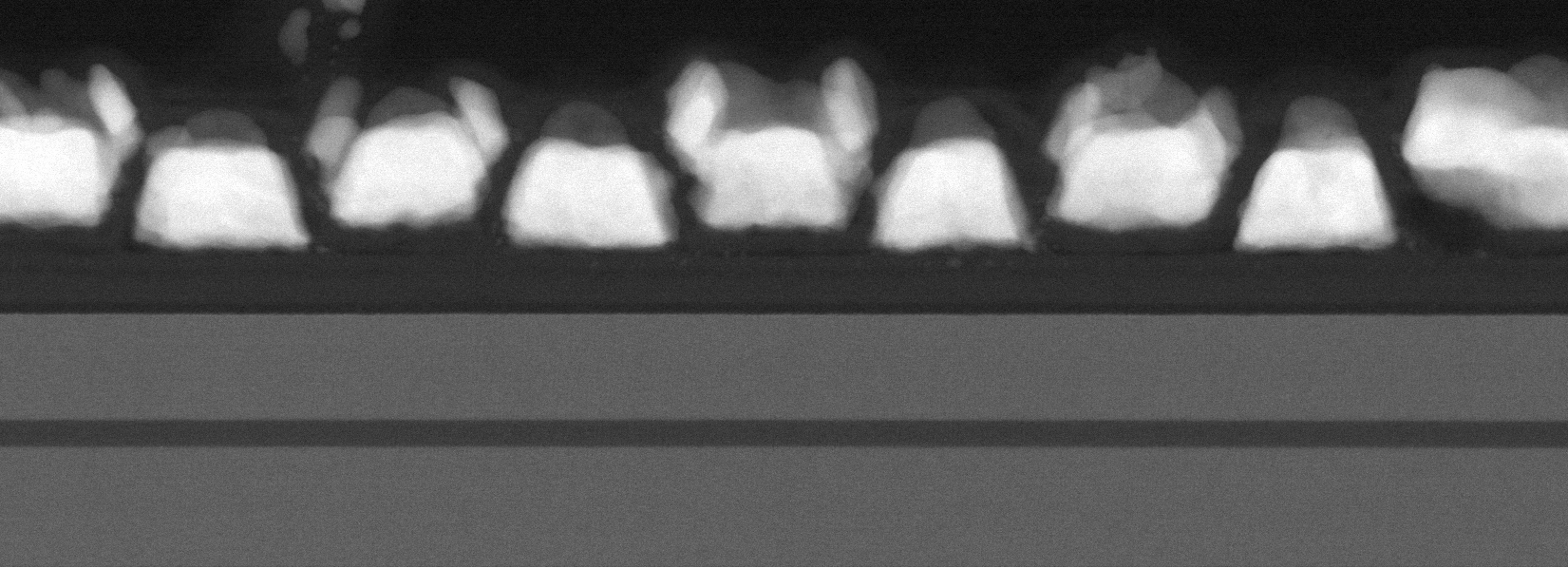
Fig 1: Heterostructure and quantum dot gate stack a Quantum dot gate layout and voltage configuration used to
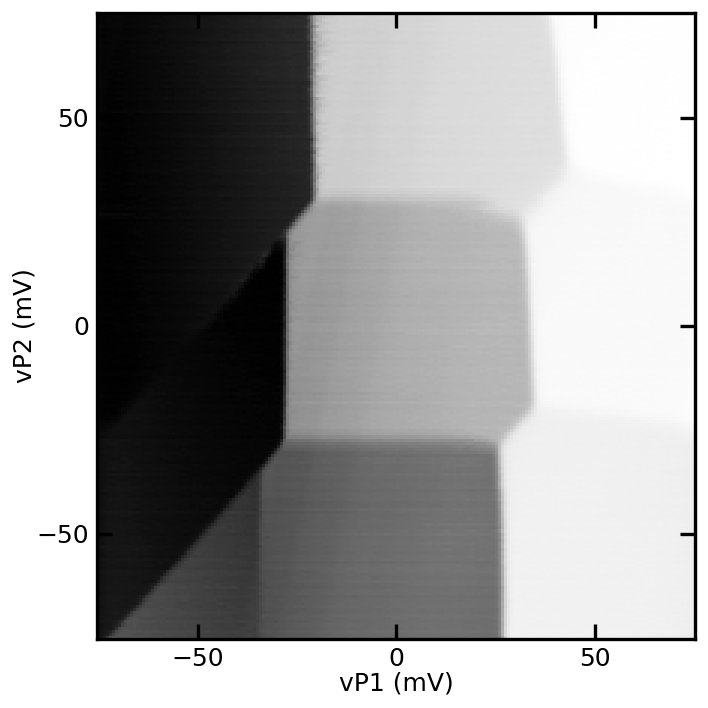
Fig 2: Single-electron spectroscopy a Detuned axis

Fig 3: Two-electron spectroscopy.
Limitations
- Singular device measurements at mK temperatures may not directly translate to elevated temperature or runtime conditions needed for scaled qubit operation.
- The model cannot definitively distinguish microscopic origin of low correlation in dot P2’s valley splitting; disorder pinning effects remain speculative.
- No explicit adversarial or noise/injection attack testing since focus is on material/device physics rather than security.
- Limited dataset size for valley splitting versus orbital energy correlation — only four dots from one array plus supporting stats.
- Theoretical modeling based on alloy disorder does not fully account for high measured EV values, indicating incomplete understanding.
- No direct demonstration of qubit coherence or gate fidelities in these devices correlating to valley splitting improvements.
Open questions / follow-ons
- What is the precise microscopic mechanism enabling the unusually high valley splitting observed in dot P2?
- How do these valley splittings and confinement tuning translate into actual improvements in qubit coherence times and gate fidelities under realistic operating conditions?
- Can device fabrication methods be optimized to reproducibly achieve high valley splitting without introducing detrimental disorder?
- How do elevated temperature operations (above mK) affect valley splitting and two-electron state energies in these buried quantum wells?
Why it matters for bot defense
For a bot-defense or CAPTCHA practitioner relying on silicon spin qubit technologies, this paper indicates that buried silicon quantum wells can be engineered via electrostatic confinement to significantly improve valley splitting—a major source of quantum state leakage. Enhanced valley splitting above 0.5 meV reduces the risk of error channels that would threaten qubit stability, potentially enabling longer coherent operation and more robust qubit shuttling strategies. Understanding and controlling such low-level energy scales in silicon qubits is essential for building scalable quantum hardware that might underpin future cryptographically secure protocols or quantum-resistant authentication methods. Though this work is primarily physics-focused, the methodology and findings underscore the importance of material and device design in the foundational stability of any silicon qubit-based security system. However, direct application to bot-defense puzzles or CAPTCHA challenges is indirect; the research helps raise confidence in silicon qubits’ physical scalability and reliability, which may form a future backbone of quantum-secure verification methods.
Cite
@article{arxiv2607_09570,
  title={ Confinement drives valley splitting above 4K in buried silicon quantum wells },
  author={ Davide Degli Esposti and Emma Catherine Brann and Asser Elsayed and Davide Costa and Mark Friesen and Giordano Scappucci },
  journal={arXiv preprint arXiv:2607.09570},
  year={ 2026 },
  url={https://arxiv.org/abs/2607.09570}
}