
A Cloud-Accessible Open-Source Framework for the Electromagnetic Modelling of Applied Superconductors
Source: arXiv:2607.09572 · Published 2026-07-10 · By Yusen Guo, Alberto Paganini, Harold S. Ruiz
TL;DR
This paper introduces H-cloud, an open-source, cloud-accessible finite-element framework for electromagnetic modeling of type-II superconductors using the well-established H-formulation. The novelty lies in expressing the fully nonlinear, time-dependent superconducting electromagnetic problem as a curl-conforming variational weak form in the H(curl) space, implemented in a scripted Python workflow using Firedrake, UFL, and PETSc solvers. This approach explicitly incorporates the tangential applied magnetic field boundary condition, nonlinear E-J power-law constitutive relation, and implicit time discretization all at the variational level, allowing for transparent, modifiable, and reproducible modeling across local and cloud environments (e.g., Google Colab). The framework is verified against the classical Bean-cylinder full penetration magnetization benchmark and benchmarked against an independently constructed commercial COMSOL multiphysics model for a high temperature superconducting Bi2212 wire. Results demonstrate close agreement within ~1% relative error between H-cloud and COMSOL, with peak errors below 1.5%, while the cloud-executable workflow reproduces local numerical solutions with modest additional runtime. By exposing the full weak formulation and solver structure, the method also provides a natural starting point for PDE-constrained optimization and adjoint-based inverse design of superconductors.
Key findings
- The H-cloud framework reproduces canonical magnetization loops of a cylindrical superconducting benchmark within approximately 1% relative error compared to Bean's analytical full-penetration scale.
- Relative peak error in magnetization loops compared to COMSOL Multiphysics remains below 1.5% across matched mesh and timestep studies.
- The cloud-executable implementation on Google Colab preserves numerical accuracy within the same error margins as a local Firedrake implementation, confirming reproducibility in reduced-resource cloud environments.
- Run times on a local Apple M3 8-core CPU are comparable to a commercial COMSOL run on an Intel i5-12400 6-core CPU for the same problem size and mesh (e.g., 12–407 seconds depending on mesh resolution).
- Cloud runtimes on Google Colab with 2 logical CPU cores are approximately four times slower than local runs due to reduced hardware but still practical for demonstration and reproducibility.
- Using curl-conforming Nédélec finite elements ensures tangential continuity of the magnetic field H and prevents spurious surface currents, a key requirement for accurate electromagnetic modeling.
- Finite-domain truncation effects on the applied-field boundary condition were explicitly quantified, showing that an insufficiently large air domain suppresses flux penetration and delays full penetration.
- The unified variational residual formulation supports embedding forward simulation into PDE-constrained optimization using automated adjoint differentiation (via Pyadjoint) for scalable inverse design of superconducting devices.
Methodology — deep read
The authors first define a magneto-quasi-steady regime for applied superconductors using Maxwell's equations, neglecting displacement current and formulating the governing equations in terms of the magnetic field intensity H within the computational domain Ω, which contains superconducting (Ω_sc) and non-superconducting (Ω_nsc) subdomains. The nonlinear constitutive E-J relation for type-II superconductors, modeled via a power-law resistivity ρ(J), is incorporated explicitly. The boundary condition is imposed through the tangential trace operator on H, mapping to a physically meaningful Dirichlet condition on the domain boundary, representing an applied transverse magnetic field.
They express the governing PDEs in variational (weak) form over the curl-conforming Hilbert space H(curl; Ω), suited to Maxwell problems. The finite-element discretization uses Nédélec edge elements to enforce tangential continuity of H, thus avoiding spurious numerical effects common in Lagrange nodal elements. Time discretization employs a fully implicit backward-Euler scheme, yielding a nonlinear discrete residual at each timestep representing the governing equations.
This residual, encoded directly in the Unified Form Language (UFL), serves as the central computational object for forward solves via nonlinear PETSc solvers controlled through the Firedrake Python finite-element framework. The resulting computational workflow is scripted (no GUI) and parameterizable, preserving control over mesh, timestep, constitutive law, and solver settings, facilitating reproducibility and transparency.
The authors verify the framework against the classical superconducting cylinder magnetization benchmark under Bean penetration conditions. They perform sensitivity analyses regarding finite domain truncation effects and validate that the numerical penetration scale matches analytical predictions. They further benchmark against a COMSOL Multiphysics implementation over matched mesh resolutions (coarse to fine) using a practical Bi2212 high-temperature superconductor wire model with realistic material parameters.
Evaluation metrics focus on normalized magnetization loops, comparing discrete L2 and L∞ norms of the trajectory against COMSOL results to quantify average and peak deviations. The workflow's reproducibility and portability are assessed by comparing identical script runs on local hardware (Apple M3 and Linux) and cloud (Google Colab) environments with modest computational resources.
Additionally, the variational residual formulation is presented in the context of PDE-constrained optimization, whereby control variables (e.g., spatially varying material parameters) can be optimized using adjoint-based sensitivity analysis computed automatically via Pyadjoint. This enables scalable gradient computation for high-dimensional inverse design problems, though the current work focuses on forward simulation verification.
Code and workflows are provided as open-source Python Jupyter notebooks, ensuring full transparency and allowing direct execution both locally and in the cloud without reformulation.
Technical innovations
- Formulating the nonlinear superconducting H-formulation explicitly as a curl-conforming weak variational residual using Nédélec finite elements, preserving tangential boundary conditions transparently at the mathematical level.
- Encoding the entire superconducting electromagnetic forward problem in a scripted UFL-based finite元素 framework (Firedrake) allowing identical execution on local and cloud platforms without modifying the mathematical formulation.
- Linking the forward H formulation residual directly as an equality constraint in PDE-constrained optimization with automated adjoint sensitivity computation via Pyadjoint, enabling gradient-based inverse design of superconducting components.
- Demonstrating that computational reproducibility and parity with commercial multiphysics software (COMSOL) can be achieved with free and open-source tools in modest cloud environments, thus lowering entry barriers for applied superconductor modeling.
Baselines vs proposed
- COMSOL Multiphysics: normalized magnetization loop error metrics eM = reference; proposed H-cloud local implementation eM = 7.75×10^-3 (coarse mesh) to 1.428×10^-2 (fine mesh).
- COMSOL peak magnetization error epeak = reference; proposed H-cloud local implementation epeak below 1.5% across meshes.
- COMSOL runtime (local i5-12400, 6 cores): 13 s (coarse) to 392 s (fine) vs H-cloud local runtime (Apple M3, 8 cores): 12 s (coarse) to 407 s (fine).
- COMSOL runtime (local) vs H-cloud cloud runtime (Google Colab, Xeon 2 logical cores): cloud runtimes approximately 4× slower due to reduced CPU cores but maintain numerical accuracy.
Figures from the paper
Figures are reproduced from the source paper for academic discussion. Original copyright: the paper authors. See arXiv:2607.09572.
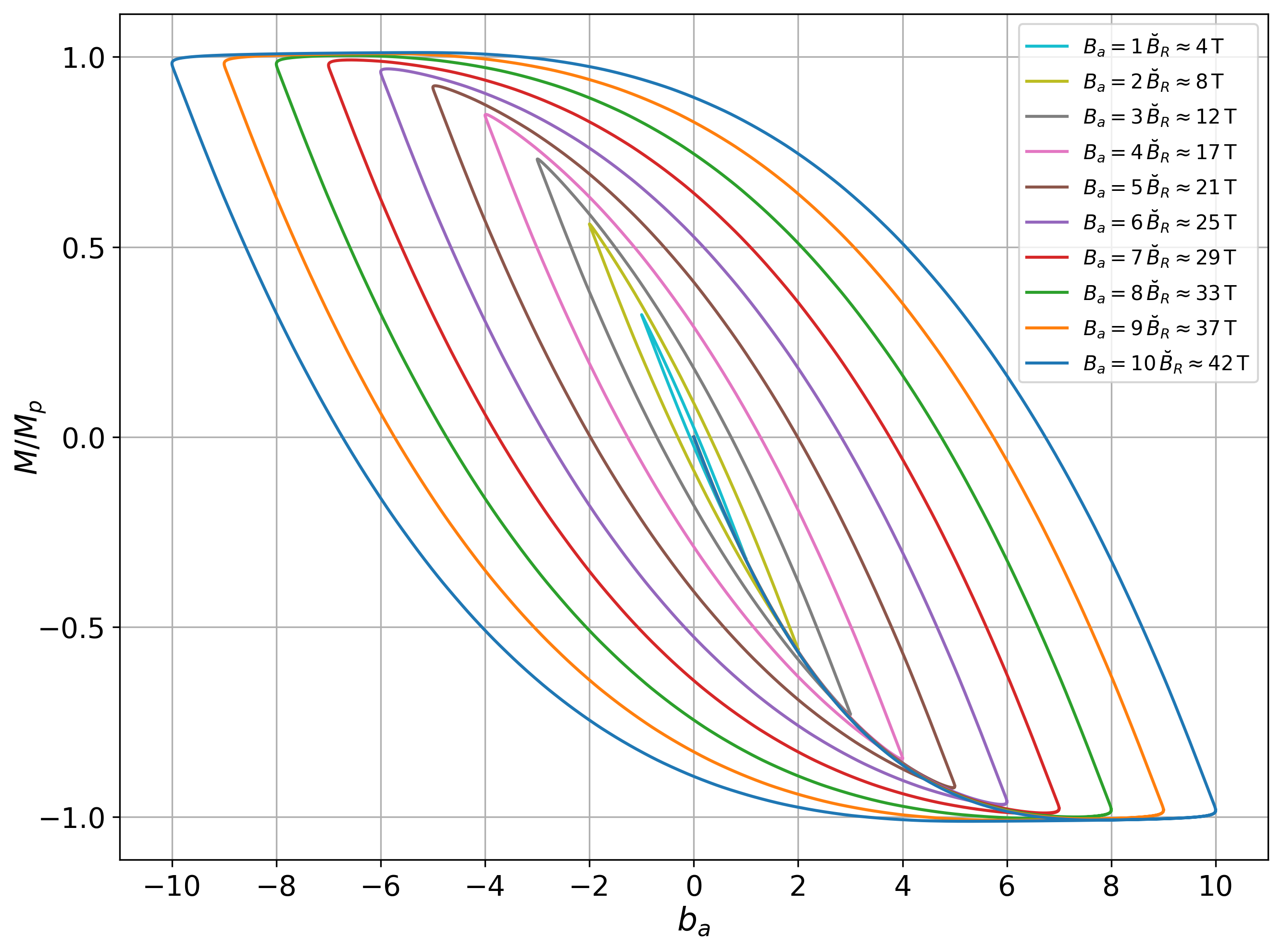
Fig 1: Calculated magnetization loops within the H-cloud formalism for the cylindrical superconducting
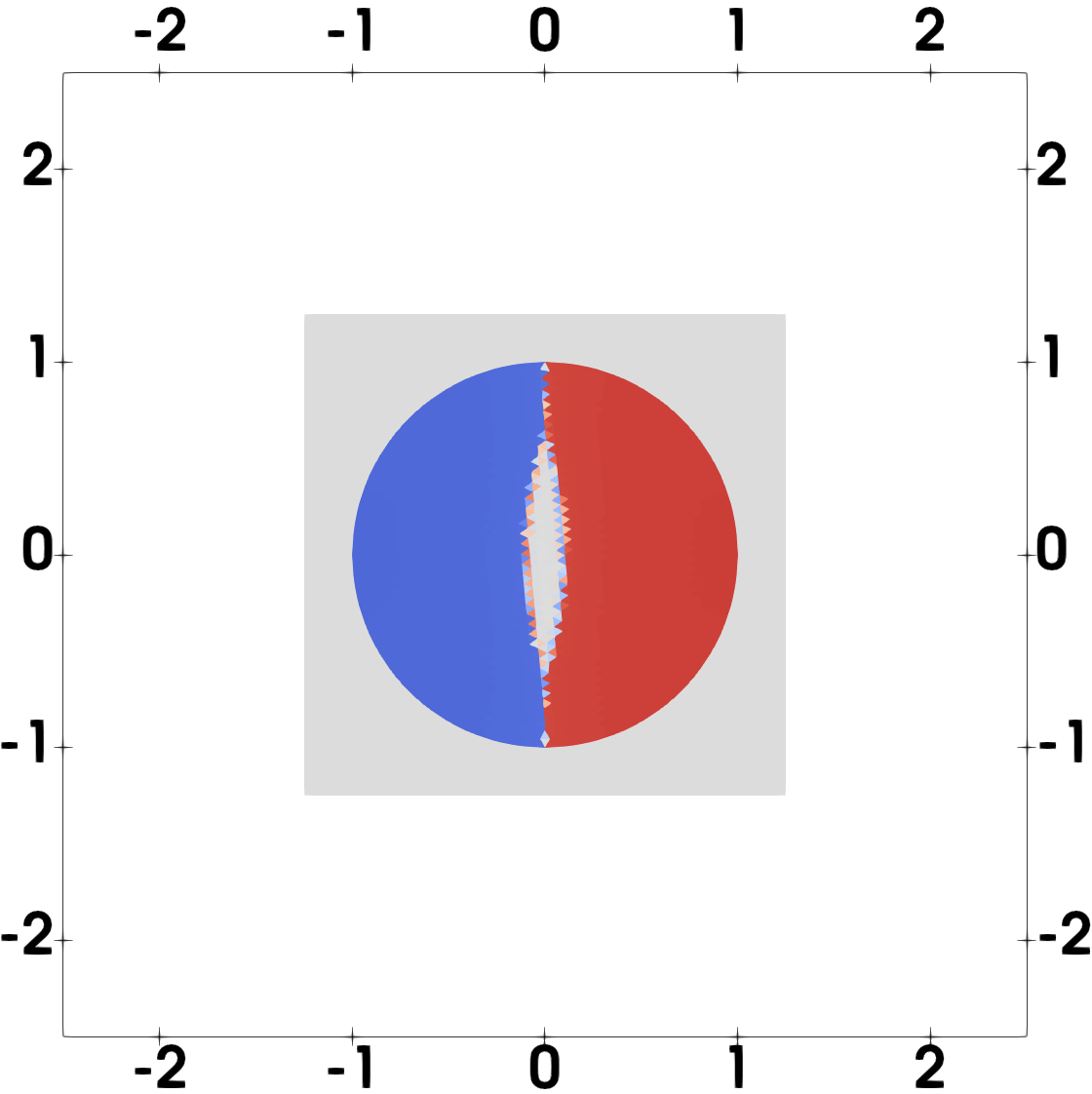
Fig 2: Current density profiles at Ba = Bp = 8 ˇBR with the SC wire centred at (0, 0), for three
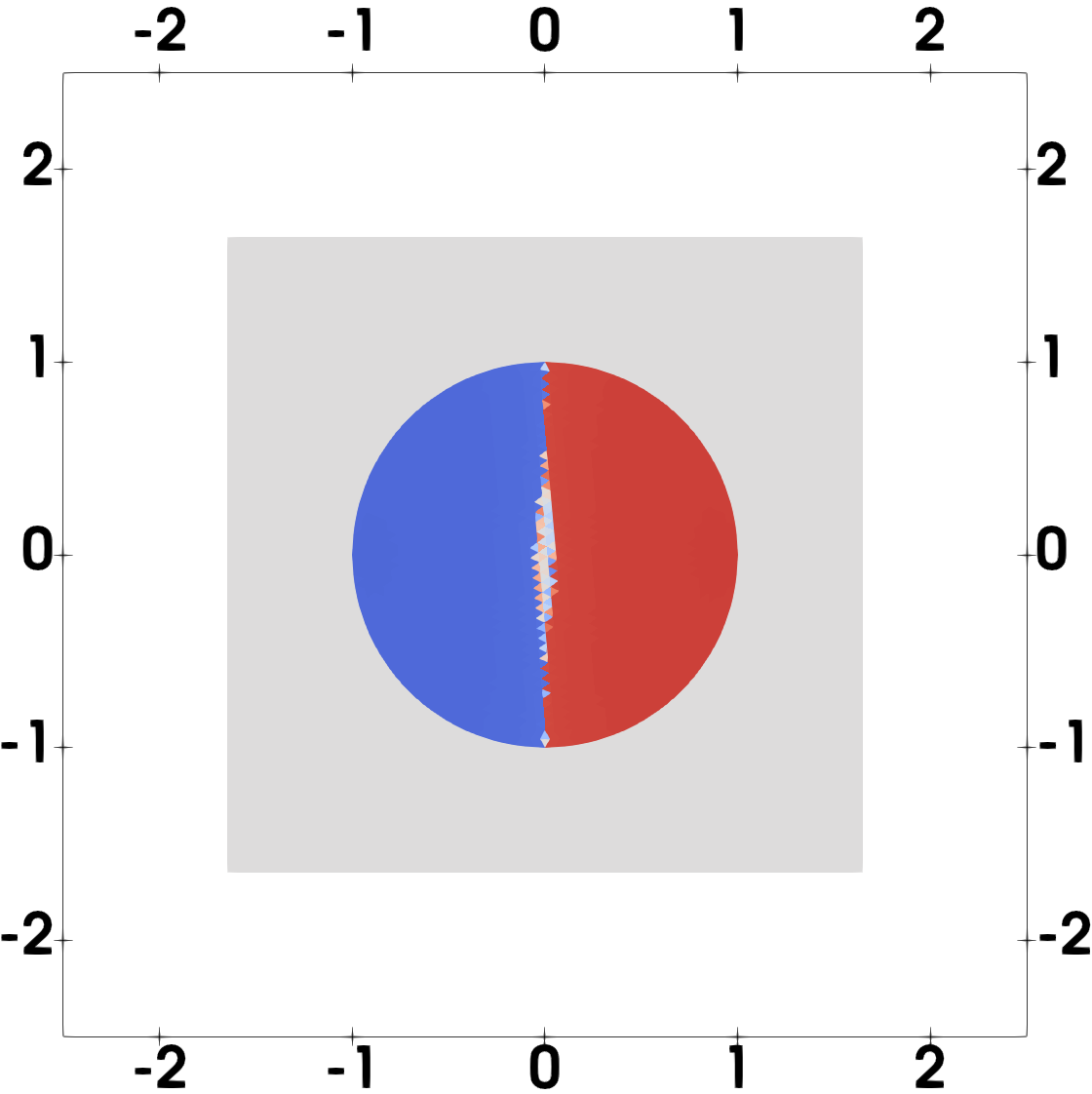
Fig 3 (page 7).
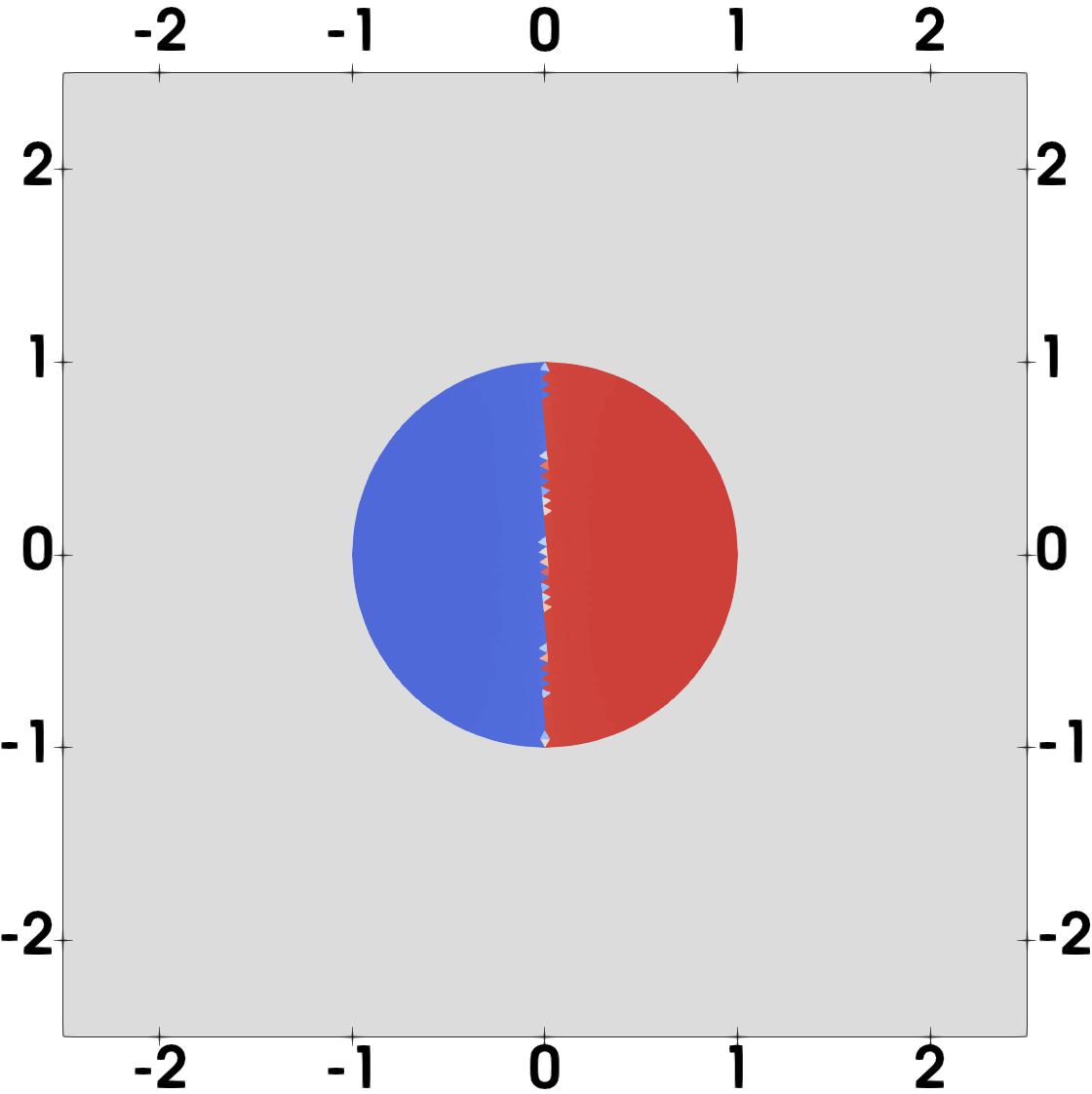
Fig 4 (page 7).
Limitations
- Benchmarking and verification limited to canonical cylindrical magnetization problem and a single high-Tc wire model; generalization to other geometries and multi-physics scenarios not demonstrated.
- Cloud runtime results constrained by free-tier hardware limitations in Google Colab; no large-scale or 3D HPC execution experiments presented.
- No adversarial evaluation or robustness testing against numerical instabilities or solver failures under extreme parameter regimes.
- The PDE-constrained optimization framework is conceptually described but not empirically validated or benchmarked in this paper.
- The use of a high-power exponent n in the E-J power law approximates, but does not exactly reproduce, the critical state model leading to slight deviations from ideal analytical solutions.
Open questions / follow-ons
- How well does the H-cloud framework perform on more complex 3D superconducting device geometries with multi-material interfaces and transport current constraints?
- Can GPU acceleration and stronger cloud computing resources scale the approach to larger, real-world superconducting assemblies in reasonable runtimes?
- How effective and stable is the automated PDE-constrained optimization capability in inverse design tasks for superconducting device function and loss minimization?
- Can the residual-based curl-conforming formulation be extended to incorporate additional physics such as thermal effects and flux creep models comprehensively?
Why it matters for bot defense
While this paper addresses electromagnetic modeling of superconductors rather than interactive challenges like CAPTCHAs, the principles of transparent, reproducible, and cloud-executable computational workflows are broadly relevant to bot defense research. Techniques that make complex, nonlinear forward models fully scripted and portable help foster reliable benchmarking and comparative evaluation pipelines in security-critical domains. In CAPTCHA development, maintaining modular, open, and easily auditable workflows could similarly improve robustness against automated solver attacks and enhance trust in challenge designs. Moreover, the use of PDE-constrained optimizations and adjoint methods for inverse problem-solving parallels emerging strategies in CAPTCHA generation to optimize parameters for human solvability and bot resistance. However, the technical content here remains domain-specific to superconducting physics and finite-element electromagnetic simulation, so immediate direct application to CAPTCHA or bot detection pipelines is limited.
Cite
@article{arxiv2607_09572,
  title={ A Cloud-Accessible Open-Source Framework for the Electromagnetic Modelling of Applied Superconductors },
  author={ Yusen Guo and Alberto Paganini and Harold S. Ruiz },
  journal={arXiv preprint arXiv:2607.09572},
  year={ 2026 },
  url={https://arxiv.org/abs/2607.09572}
}