
Wat3R: Underwater 3D Geometry Learning without Annotations
Source: arXiv:2607.08772 · Published 2026-07-09 · By Jiangwei Ren, Xingyu Jiang, Zijie Song, Wei Xu, Hongkai Lin, Dingkang Liang et al.
TL;DR
This paper addresses the challenging problem of estimating 3D geometry in underwater environments, where traditional RGB-based reconstruction struggles due to light attenuation, scattering, and the scarcity of large-scale annotated 3D datasets. Existing feed-forward 3D reconstruction models trained on abundant air-domain data fail to generalize underwater because of severe domain shifts and lack of underwater geometric labels. To overcome this, the authors propose Wat3R, a semi-supervised cross-domain adaptation framework that transfers on-land pretrained models (VGGT) to underwater scenes without requiring any underwater 3D annotations. Wat3R leverages a teacher-student mean-teacher paradigm where labeled synthetic underwater-style data generated by underwater image formation models simulate degradations, combined with abundant unlabeled real underwater videos to adapt the student model. A novel cross-view consistency loss enforces multi-view geometric coherence to compensate for underwater image degradation and missing cues in individual views. The authors additionally construct Water3D, a large diverse underwater multi-view dataset with depth and accurate camera pose annotations designed for evaluation. Experimental results demonstrate that Wat3R substantially improves multi-view depth estimation, point cloud reconstruction, camera pose estimation, and monocular depth estimation on several challenging underwater benchmarks compared to prior state-of-the-art methods, with improvements of 11-34% across metrics. Qualitative results also show more complete and consistent 3D reconstructions.
Key findings
- Wat3R improves relative depth error (Rel) by over 12% and δ1 accuracy by up to 6.2% compared to VGGT on Sea-thru dataset (Table 1).
- On FLSea Stereo, Wat3R achieves 13.1% Rel improvement and 4.2% δ1 improvement over VGGT (Table 1).
- Point map reconstruction on Water3D shows 8.6% better accuracy and 46.3% better completeness than VGGT (Table 2).
- Camera pose estimation AUC@5° improves by 37.8%, and AUC@30° by 7.5% compared to VGGT (Table 3).
- Monocular depth estimation improves Rel error by 24.5% to 44.8% and δ1 accuracy by 3.6% to 27% across four underwater datasets versus VGGT (Table 4).
- Training with unlabeled real underwater videos and cross-view consistency loss provides significant gains over synthetic-only supervised training (Sec 4.6 Ablations).
- Underwater image enhancement preprocessing does not improve multi-view depth estimation, often degrading results (Table 1 shaded rows).
- Sequence-level data augmentation and static mask for cross-view loss bring robust improvements in training stability and accuracy (Sec 4.6).
Threat model
The adversary is the difficult underwater visual domain that causes light attenuation and scattering, disrupting geometric information consistency and making collection of ground-truth 3D labels impractical. The model must generalize from clean air-domain geometric priors to degraded underwater inputs without direct annotation supervision. The model is not robust against active adversarial attacks but faces natural image degradation and domain shifts inherent in underwater imaging.
Methodology — deep read
The threat model assumes a challenging underwater environment where the 3D geometry must be estimated from multi-view underwater RGB images subjected to unknown light attenuation and scattering. The adversary here is the underwater domain shift that undermines geometric feature consistency and annotation availability.
Data consists of: (1) labeled synthetic underwater-style data generated by applying a physics-based underwater image formation model to existing large-scale annotated on-land multi-view datasets. This involves simulating attenuation and backscatter with spatially varying parameters while preserving geometric ground truths (camera poses, depth, point maps). (2) Unlabeled real underwater video footage collected from multiple public sources, filtered for quality, containing 359k frames from 5,504 clips with sufficient static scene overlap.
The base model is VGGT, a recent feed-forward multi-view geometry reconstruction network predicting camera pose (9D parameters), per-view depth maps, and point maps. VGGT is pretrained on on-land annotated datasets, learning strong geometric priors. Wat3R adapts this using a teacher-student Mean Teacher semi-supervised framework: The teacher generates pseudo labels (depth, camera, point maps) for unlabeled underwater frames, which train the student.
Key novel components are:
- Cross-view consistency loss: Projects pixels from teacher predictions across views using reprojection operators and static masks to compute multi-view geometric coherence via L1 depth loss. Static masks are generated by clustering depth maps to remove unreliable background and dynamic regions.
- Sequence level augmentation: Randomly samples 24-36 frames shuffled for teacher and subsamples 2-12 frames with rotation/transform augmentations for the student to increase viewpoint diversity and prevent collapse.
Training uses 4 NVIDIA RTX 4090 GPUs for 19,200 steps with a peak learning rate of 5e-6 for the backbone and 5e-5 for heads. Initial 6,400 steps use only labeled synthetic data, then unsupervised loss weight ramps up to 0.5 at step 12,800. Batch images have a longest side resized to 518 pixels. Weak and strong augmentations are applied respectively to teacher and student inputs.
Evaluation is conducted on five public underwater datasets (Sea-thru, FLSea Stereo/VI, SQUID, SeaThru-NeRF) plus the newly constructed Water3D dataset of 42 real underwater scenes with depth and pose annotations. Metrics include absolute relative depth error, RMSE, δ threshold percentages for depth; accuracy, completeness for point maps; and AUC of pose angular error thresholds.
Baselines compare to recent feed-forward models (VGGT, DA3, π3, MapAnything) and underwater-specific models where available. Ablations remove/add components progressively to isolate gains from real underwater video, consistency loss, and masking.
Results are averaged over multiple test sequences with controlled shuffling and alignment to ground truth depth scale. Code and dataset are publicly released for reproducibility. The paper provides detailed equations for the underwater image formation model, loss formulations, and masking procedure to enable precise replication.
Technical innovations
- Use of a cross-domain Mean Teacher semi-supervised learning paradigm to adapt feed-forward 3D geometry networks from air to underwater scenes without requiring underwater 3D annotations.
- Design of a novel cross-view consistency loss that enforces geometric coherence across multi-view predictions to compensate for severe underwater image degradation.
- Synthetic underwater data generation via a physics-based underwater image formation model that applies spatially varying light attenuation and backscatter with estimated dense depth maps from monocular models.
- Construction of Water3D, an underwater multi-view dataset with accurate depth and camera pose annotations spanning diverse underwater conditions and water bodies.
- Sequence-level augmentation strategy for unlabeled videos to increase viewpoint diversity and avoid degenerate solutions during semi-supervised training.
Datasets
- Sea-thru — 1,205 RGB-D images across 5 natural underwater scenes — public
- FLSea Stereo — 7,341 synchronized stereo image pairs from 5 shallow underwater scenes — public
- FLSea VI — underwater video sequences from Mediterranean and Red Seas — public
- SQUID — 57 stereo pairs with stereo-derived ground truth depth — public
- SeaThru-NeRF — 5 underwater scenes with camera pose annotations — public
- Water3D — 42 real underwater scenes with multi-view depth and camera pose annotations — constructed by authors, partially from UVEB and authors' own data
Baselines vs proposed
- VGGT: Rel (Sea-thru) = 0.190 vs Wat3R: 0.167 (-12.1%)
- VGGT: δ1 (Sea-thru) = 0.891 vs Wat3R: 0.946 (+6.2%)
- VGGT: Rel (FLSea Stereo) = 0.137 vs Wat3R: 0.119 (-13.1%)
- VGGT: δ1 (FLSea Stereo) = 0.849 vs Wat3R: 0.885 (+4.2%)
- VGGT: Overall point map accuracy (Water3D) = 0.624 vs Wat3R: 0.427 (+31.6%)
- VGGT: Pose Estimation AUC@5° = 0.392 vs Wat3R: 0.540 (+37.8%)
- VGGT: Monocular Depth Rel (FLSea VI) = 0.107 vs Wat3R: 0.061 (-43.0%)
- DA3 (best pose baseline): AUC@5°= 0.731 vs Wat3R: 0.540 (lower, but higher than VGGT)
- Underwater Image Enhancement + VGGT baseline shows no improvement or mild degradation compared to VGGT alone.
Figures from the paper
Figures are reproduced from the source paper for academic discussion. Original copyright: the paper authors. See arXiv:2607.08772.
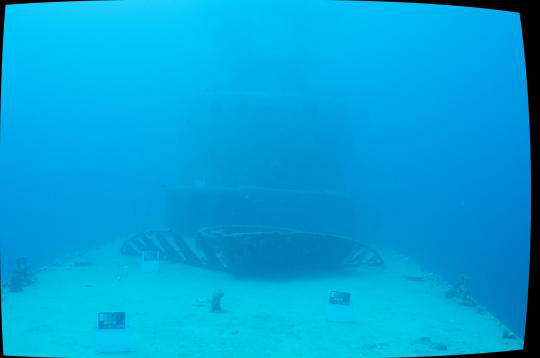
Fig 1: Wat3R reconstructs from the open-domain underwater images in a feed-
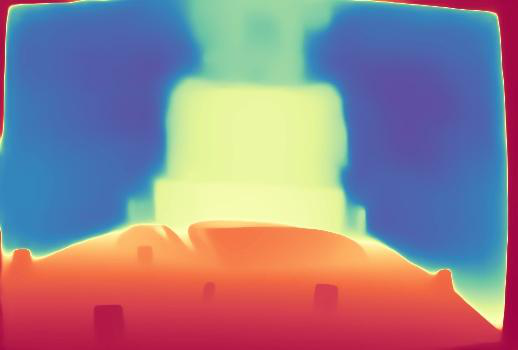
Fig 2: Overview of our constructed Water3D dataset. Left: point cloud visu-
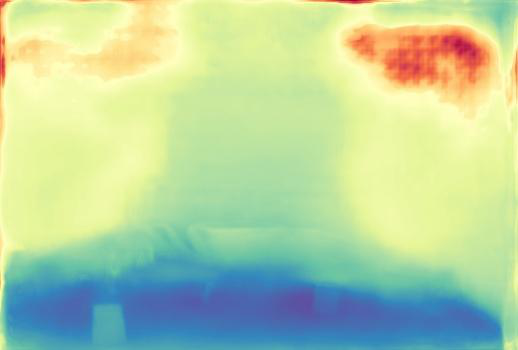
Fig 3 (page 2).
Fig 4 (page 2).
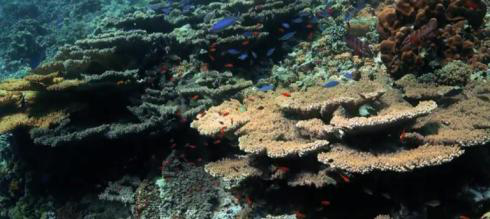
Fig 5 (page 2).
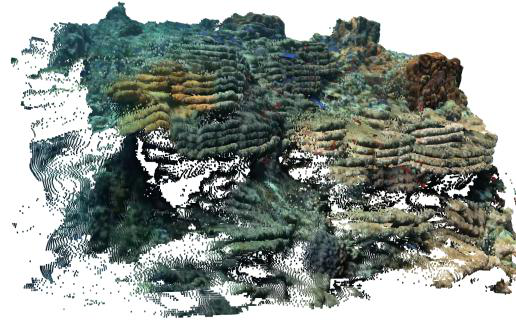
Fig 6 (page 2).
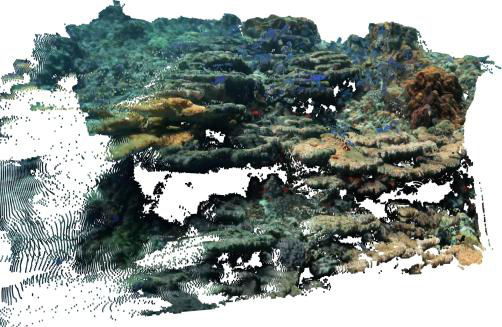
Fig 7 (page 2).
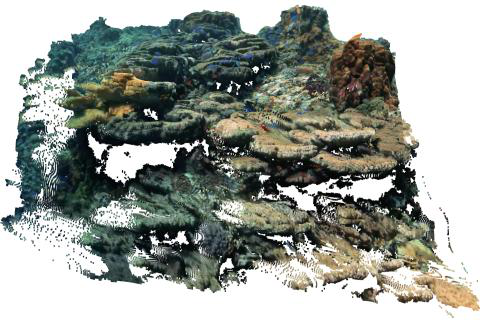
Fig 8 (page 2).
Limitations
- Relies on accurate synthetic underwater data generation; simulation parameters might not cover all real underwater variability.
- Teacher pseudo-label quality depends on pretrained model and may propagate errors during adaptation.
- Cross-view consistency loss requires sufficient multi-view overlap and static scenes; dynamic or highly turbid scenes may challenge the mask quality.
- Evaluation does not include adversarial or fully unseen underwater environments beyond datasets presented.
- Pose estimation still lags behind specialized depth-ray models (e.g., DA3) in high accuracy thresholds.
- Some datasets (e.g., Water3D) were constructed partially from training data environment, potential minor train-test leakage possible.
Open questions / follow-ons
- How would the framework perform under extreme turbidity or strongly dynamic underwater scenes with moving objects?
- Can the approach be extended to jointly learn underwater image enhancement and geometry estimation end-to-end?
- What are the impacts of integrating more explicit physical underwater image formation models into the reconstruction network?
- How well does the method generalize to other challenging optical domains (e.g., fog, smoke) beyond underwater?
Why it matters for bot defense
For bot-defense and CAPTCHA practitioners, Wat3R demonstrates a robust approach to learning 3D geometric representations in highly degraded visual domains without relying on costly or infeasible annotation collection. The cross-view consistency loss idea could inspire multi-view consistency constraints for detecting or mitigating image-based spoofing or synthetic content under variable conditions. Furthermore, the semi-supervised teacher-student paradigm shows a practical way to leverage abundant unlabeled real-world data when labeled mesoscale datasets are impossible to obtain. While the application domains differ, the core contributions around cross-domain adaptation, semi-supervised geometric learning, and tailored view-consistency are transferable design concepts when building systems robust to domain shifts and noisy real-world data.
Cite
@article{arxiv2607_08772,
  title={ Wat3R: Underwater 3D Geometry Learning without Annotations },
  author={ Jiangwei Ren and Xingyu Jiang and Zijie Song and Wei Xu and Hongkai Lin and Dingkang Liang and Xiang Bai },
  journal={arXiv preprint arXiv:2607.08772},
  year={ 2026 },
  url={https://arxiv.org/abs/2607.08772}
}