
WaspMOT: A Benchmark for Long-Term Multi-Object Tracking of Trichogramma Wasps
Source: arXiv:2607.08729 · Published 2026-07-09 · By Tomasz Stanczyk, Yuan Gao, Hardik Agarwal, Seongroo Yoon, Tiantao Zhang, Vincent Calcagno et al.
TL;DR
WaspMOT addresses a key gap in multi-object tracking (MOT) benchmarks by focusing on long-term identity preservation over extended durations. Unlike existing popular MOT datasets that consist of short video sequences lasting tens of seconds, WaspMOT comprises 10 long sequences of approximately 12,000 frames each (over 8 minutes at 25 FPS), featuring Trichogramma wasps in a controlled ecological arena. This setting forms a closed-set tracking scenario where all individuals remain present throughout, demanding consistent identity assignment across thousands of frames despite frequent abrupt jumps, occlusions, and nearly identical appearances—factors which severely challenge existing trackers.
The dataset provides oracle detections extracted from ground truth annotations, isolating the tracking association problem from detection errors. The authors benchmark five recent tracking-by-detection methods, including ByteTrack, BoT-SORT, C-BIoU, OC-SORT, and McByte, under a unified evaluation protocol. Results reveal that all methods exhibit substantial identity fragmentation even with perfect detections, underscoring the difficulty of long-term tracking beyond typical MOT benchmarks. Incorporating a simple spatial tracklet stitching baseline to reconnect fragmented trajectories improves performance across all methods, demonstrating significant potential for future improvements geared toward long-term identity consistency.
WaspMOT thus serves as a novel benchmark exposing limitations of current association strategies in long-duration ecological tracking scenarios, motivating methodology advances for long-term tracking consistency, and supplying well-annotated sequences and code for research use.
Key findings
- WaspMOT sequences average 12,033 frames each (~8 minutes at 25 FPS), an order of magnitude longer than MOT17 (802.5 frames) or MOT20 (1676 frames).
- Each video contains about 21.4 wasps present for the full duration, forming a closed-set scenario with full-length trajectories.
- Tracking methods evaluated with oracle detections showed all suffer significant identity fragmentation, with IDF1 scores below 58 despite perfect detections.
- McByte achieved the highest baseline IDF1 of 51.1 and HOTA of 60.6, outperforming ByteTrack (IDF1=47.2) and BoT-SORT (IDF1=45.4).
- Applying a simple spatial tracklet stitching baseline improved IDF1 by +6.6 to +9.0 points and HOTA by +2.5 to +4.0 across all methods.
- MOTA remained largely stable (~74.4 to 74.5) due to oracle detections, indicating main improvements arise from better association rather than detection.
- Appearance-based methods like BoT-SORT did not outperform simpler motion-based methods, highlighting difficulty of exploiting appearance cues for small, visually similar wasps.
- Abrupt jumps and occlusions cause large trajectory fragmentations, shown by frequent jump and co-occurring jump events in all sequences.
Threat model
The adversary is the tracking algorithm challenged to maintain identity consistency of tracked wasps over long video sequences despite abrupt motion, occlusions, and nearly identical appearances. The evaluation assumes no detection errors (oracle detections), focusing purely on association errors. The tracker cannot use external identity information or temporal annotations beyond current frames.
Methodology — deep read
Threat Model & Assumptions: The adversary can be interpreted as the tracking algorithm itself aiming to correctly associate identities over long video sequences. The study isolates errors arising from association under perfect detection (oracle detections provided). The tracker must assign consistent IDs over thousands of frames despite challenges such as abrupt jumps, occlusion, and nearly identical appearance of wasps.
Data: WaspMOT contains 10 sequences recorded in controlled lab settings with Trichogramma wasps inside 3.5cm×2cm experimental arenas. Two species and three strains were used, each video lasting about 8 minutes (12,000 frames at 25 FPS), recorded at 3840×2160 resolution. Ground truth manual annotations of wasp bounding boxes are provided in MOTChallenge format, totaling 120,330 annotated frames and 2,569,527 object instances. Annotations cover 15-28 individuals per video that remain present continuously (closed-set scenario).
Architecture/Algorithm: Five representative tracking-by-detection methods were benchmarked, all using oracle detections without further detector training:
- ByteTrack: Kalman filtering for motion prediction, IoU-based spatial matching.
- BoT-SORT: Extends ByteTrack with appearance embeddings trained to differentiate wasps.
- C-BIoU: Enlarged bounding box IoU for better matching with fast motion.
- OC-SORT: Observation-centric Kalman filter updates improving nonlinear motion modeling.
- McByte: Like ByteTrack but incorporates temporally propagated segmentation masks for stronger geometric constraints during association.
A spatial tracklet stitching baseline was added as a post-processing step: endpoints of fragmented trajectories were linked based on spatial proximity and temporal continuity, with Hungarian matching enforcing one-to-one correspondence.
Training Regime: No additional training of detection or tracking models was performed since oracle detections were provided. Appearance embeddings in BoT-SORT were adapted from original methods but this detail is limited. All tracking methods ran with default hyperparameters.
Evaluation Protocol: Metrics: HOTA (overall quality combining detection and association), IDF1 (identity preservation), and MOTA (detection accuracy plus tracking errors). Evaluation used TrackEval toolkit, maintaining MOTChallenge standards. Comparison was done pre- and post- spatial stitching across all methods. No adversarial or distribution shift analysis reported.
Reproducibility: The dataset, annotations, evaluation protocol, and code (including baseline stitching) will be publicly released at https://github.com/tstanczyk95/WaspMOT/ upon acceptance. Oracle detections are included enabling exact replication of evaluation.
Technical innovations
- Introduction of WaspMOT, a novel long-duration MOT benchmark emphasizing full-length trajectory tracking with a closed-set of visually similar and highly mobile insect targets.
- Provision of oracle detections to isolate evaluation of association capabilities independent from detector performance, enabling precise study of long-term identity preservation.
- Demonstration that current state-of-the-art tracking-by-detection methods, including recent spatial and appearance-based approaches, suffer substantial identity fragmentation over long sequences despite perfect detections.
- Development and use of a simple spatial tracklet stitching baseline that boosts association metrics significantly by reconnecting fragmented trajectories, establishing an effective post-processing strategy for long-term tracking consistency.
Datasets
- WaspMOT — 10 videos, 12,000 frames each (approx. 120,330 frames total), 2,569,527 annotated bounding boxes — controlled lab ecological recordings, with MOTChallenge format ground truth and oracle detections
Baselines vs proposed
- ByteTrack: HOTA = 49.3, IDF1 = 47.2, MOTA = 74.4 vs ByteTrack + stitch: HOTA = 53.1 (+3.8), IDF1 = 56.0 (+8.8), MOTA = 74.4 (+0.0)
- BoT-SORT: HOTA = 47.9, IDF1 = 45.4, MOTA = 74.4 vs BoT-SORT + stitch: HOTA = 51.7 (+3.8), IDF1 = 54.4 (+9.0), MOTA = 74.5 (+0.1)
- C-BIoU: HOTA = 51.3, IDF1 = 50.5, MOTA = 74.4 vs C-BIoU + stitch: HOTA = 53.8 (+2.5), IDF1 = 57.1 (+6.6), MOTA = 74.5 (+0.1)
- OC-SORT: HOTA = 50.5, IDF1 = 46.8, MOTA = 74.5 vs OC-SORT + stitch: HOTA = 54.5 (+4.0), IDF1 = 55.5 (+8.7), MOTA = 74.5 (+0.0)
- McByte: HOTA = 60.6, IDF1 = 51.1, MOTA = 99.7 vs McByte + stitch: HOTA = 63.3 (+2.7), IDF1 = 58.3 (+7.2), MOTA = 99.8 (+0.1)
Figures from the paper
Figures are reproduced from the source paper for academic discussion. Original copyright: the paper authors. See arXiv:2607.08729.
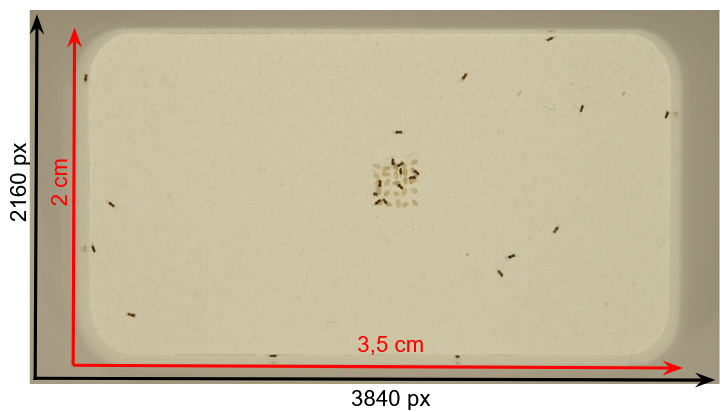
Fig 1: Sample frame of a video with individuals inside an experimental
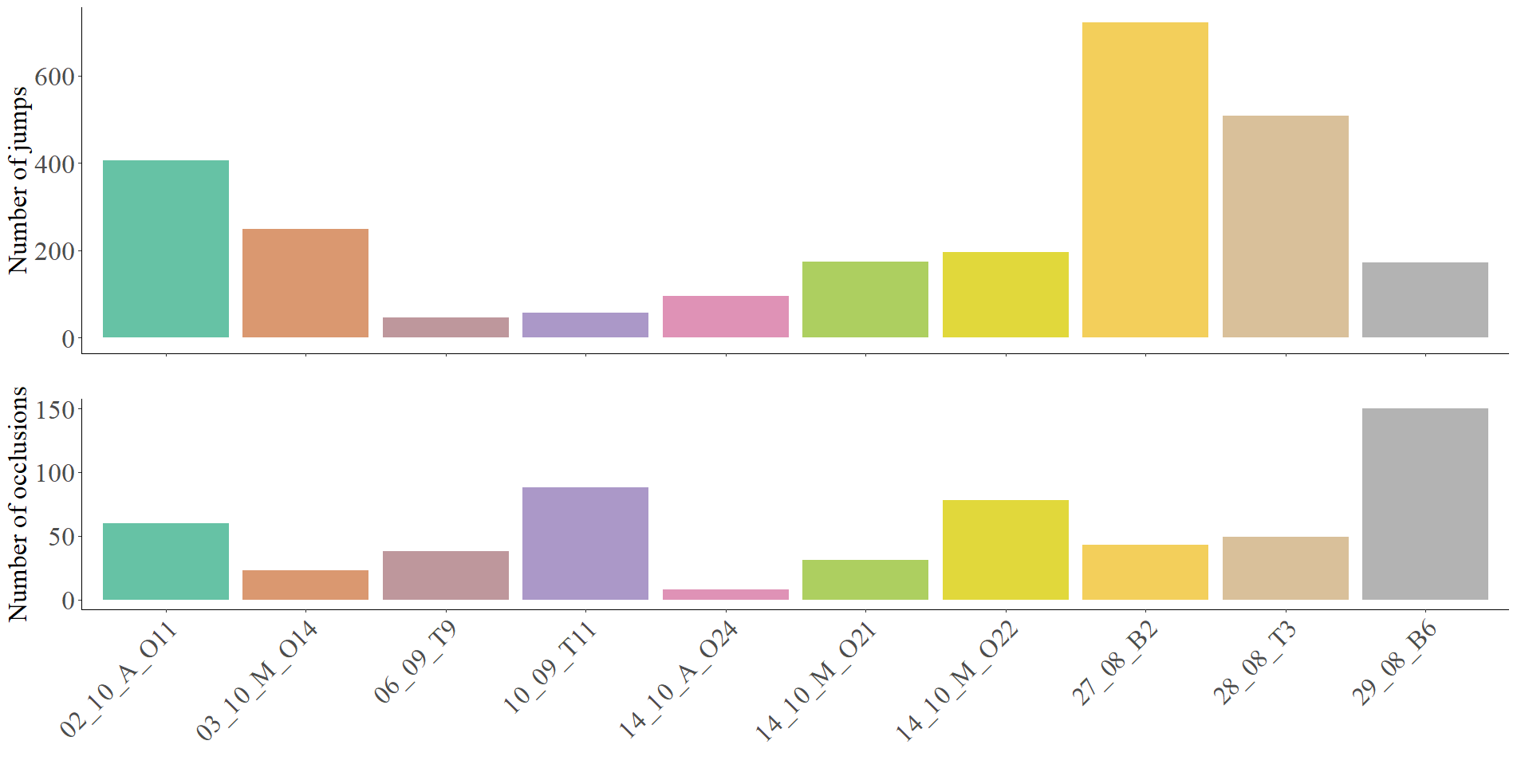
Fig 2: Number of occlusion and jump events for each video. Original video
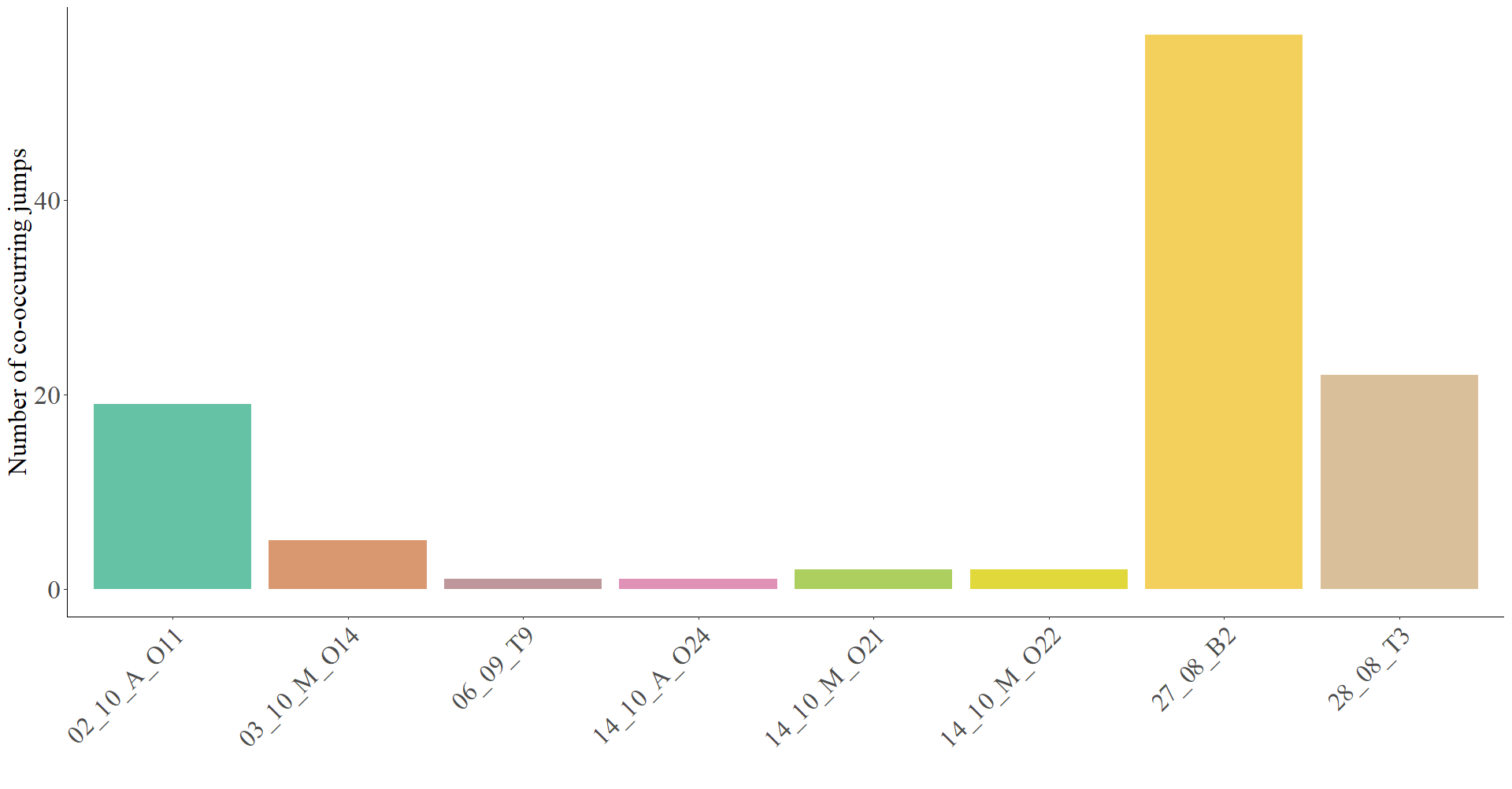
Fig 3: Number of co-occurring jump events for each video. Original video
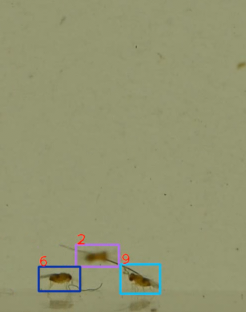
Fig 4: An example of an individual Trichogramma wasp performing an
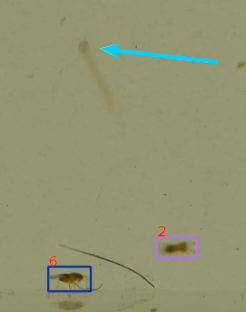
Fig 5 (page 5).
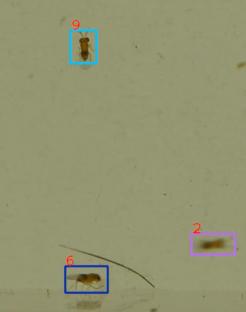
Fig 6 (page 5).
Limitations
- The dataset focuses on a closed-set scenario with continuous presence of all individuals, which may not generalize to open-world or more diverse tracking settings.
- Appearance features are inherently limited due to small, visually similar targets, restricting exploration of appearance-based association methods.
- Evaluations were conducted only with oracle detections, so interaction effects with detector errors in real-world conditions remain unexplored.
- No adversarial robustness testing or domain shift evaluations were included, limiting insights into generalization.
- The simple spatial stitching baseline, while effective, does not constitute a learned or adaptive long-term association model.
- Limited exploration of hyperparameter tuning or training strategies for appearance embeddings constrains conclusions about their usefulness.
Open questions / follow-ons
- How can long-term association models surpass the simple yet effective spatial stitching baseline to further reduce identity fragmentation?
- Can learned appearance features or behavioral cues be better optimized to distinguish visually similar small targets like wasps over thousands of frames?
- How will tracking performance vary when integrating detector errors or applied in open-set, uncontrolled natural ecological environments?
- What model architectures or temporal reasoning mechanisms best capture identity consistency across abrupt jumps and occlusions observed in WaspMOT?
Why it matters for bot defense
For bot-defense and CAPTCHA practitioners, WaspMOT highlights the significant challenges of maintaining consistent object identities over long durations under conditions of abrupt movement and visually homogeneous objects. This has parallels to tracking malicious automated clients who may change behaviors rapidly or mimic legitimate users to evade detection. The benchmark demonstrates that standard short-sequence MOT approaches, even with perfect detection, can suffer from identity fragmentation, signaling that long-term reasoning and robust association mechanisms are essential.
Practitioners might derive insights for designing verification tasks or heuristic detectors that account for identity permanence over time rather than relying on short, snapshot-based cues. The effectiveness of spatial tracklet stitching suggests that simple yet global spatial-temporal consistency constraints can significantly improve long-term identity tracking, which could motivate analogous post-processing or behavioral consistency checks in bot detection pipelines. Overall, WaspMOT serves as a useful reference for testing and evolving long-term association techniques critical in persistent bot defense scenarios.
Cite
@article{arxiv2607_08729,
  title={ WaspMOT: A Benchmark for Long-Term Multi-Object Tracking of Trichogramma Wasps },
  author={ Tomasz Stanczyk and Yuan Gao and Hardik Agarwal and Seongroo Yoon and Tiantao Zhang and Vincent Calcagno and Francois Bremond },
  journal={arXiv preprint arXiv:2607.08729},
  year={ 2026 },
  url={https://arxiv.org/abs/2607.08729}
}