
GroverFigureOfMerit: An Agnostic Figure of Merit for Quantum Backend Characterization in the NISQ Era
Source: arXiv:2607.08636 · Published 2026-07-09 · By Tiago Restucha, Marcos Guillermo Lammers, Alejandro Fernández
TL;DR
This paper addresses a central challenge in the Noisy Intermediate-Scale Quantum (NISQ) era: the difficulty in objectively and comparably characterizing diverse quantum hardware backends. Existing static metrics such as coherence times and gate error rates are insufficient because they do not capture dynamic execution variability, transpilation impacts, or topology-dependent overheads. The authors propose GroverFigureOfMerit, an algorithmic figure of merit using Grover’s search algorithm as a stress test that holistically evaluates backend performance. This metric combines the measured success probability on target states with penalties for non-uniform amplitude amplification and leakage to non-target states, producing a unified, comparable score agnostic to underlying hardware architectures. The metric is implemented via the Qonscious framework which abstracts provider-specific differences through polymorphic adapters, enabling backend-agnostic execution across IBM, IonQ, and simulated environments.
Experimental validation compares ideal simulators to noise models derived from real processors, demonstrating the metric’s sensitivity to noise, topology constraints, and transpilation overhead. Results reveal that the metric reliably distinguishes backend performance under realistic noise, especially exposing severe degradation in superconducting devices at higher circuit depths while showing IonQ’s trapped-ion platforms exhibit greater noise resilience. The study highlights the challenge of gate decomposition overheads and motivates future work to optimize agnostic transpilation and validate on physical quantum processors. Overall, the contribution is a practical, extensible approach to algorithm-centric, backend-agnostic benchmarking in the heterogeneous NISQ ecosystem.
Key findings
- GroverFigureOfMerit score combines success probability on target states with penalties for amplitude non-uniformity (σT) and leakage to non-target states (PN), formulated as Score = max(0, PT - λ·σT - μ·PN) with typical λ=1, μ=1.
- Ideal simulators achieve near-perfect scores (~1.0 for N=8, M=2; ~0.999 for N=32, M=8) confirming metric matches Grover’s theoretical limits (Fig 3 and Fig 4).
- IBM superconducting noise models see scores degrade to ~0.5 at M=N/2 for N=8, and collapse to ~0.04 at N=32 due to decoherence and transpilation overhead, approximating classical guessing probabilities (~M/N).
- IonQ’s Aria 1 noise model shows significantly higher resilience, maintaining scores well above random guessing for N=32 and larger, outperforming IBM models notably in larger search spaces.
- Transpilation overhead, primarily the decomposition of multi-controlled gates into native 1- and 2-qubit gates, severely impacts scores on architectures with restricted connectivity, as evidenced by steep declines with increasing qubit count.
- Heterogeneity in provider APIs, native gate sets, calibration data semantics, and dynamic noise availability motivates need for agnostic benchmarking, which Qonscious facilitates via polymorphic adapters.
- Using 2000 circuit shots per metric evaluation gives statistically meaningful approximations of output distributions for scoring the quantum state probabilities under noise.
- The metric’s sensitivity to topology and noise is experimentally confirmed using noise models derived from physical backends, without requiring live hardware access.
Threat model
Adversary is essentially an implicit challenge posed by the heterogeneity and dynamism of NISQ hardware itself—no malicious party assumed. The metric aims to reveal limitations imposed by noise, limited connectivity, transpilation overhead, and dynamic instability rather than defending against a deliberate attack. Hardware users cannot fully predict backend performance from static metrics and require agnostic, algorithm-centric benchmarks to select and optimize backends for quantum workloads.
Methodology — deep read
The authors define an adversarial context where quantum hardware exhibits noise, limited connectivity, and transpilation overhead impacting algorithm execution fidelity. The threat is the inherent variability and architectural disparity among NISQ processors preventing meaningful backend comparison via conventional static metrics.
Data comprises quantum circuit execution results collected by running Grover’s algorithm circuits on simulators and noise models representing nine quantum providers (including IBM Fake Providers and IonQ Aria 1). The experiments fix the search space size (N=8 and N=32 in primary tests), vary the number of marked target states M, and collect 2000 shots per circuit to estimate output state probabilities. The target bitstrings are either randomly selected or explicitly assigned. Noise models capture decoherence, gate errors, and topology constraints but not all dynamic noise effects such as crosstalk. No physical hardware was used, but noise models are based on hardware characterizations.
The GroverFigureOfMerit metric leverages Grover’s algorithm as an algorithmic stress test that is sensitive to noise and transpilation overhead. The Grover circuit is constructed for n qubits by:
- Initializing a uniform superposition with Hadamard gates.
- Encoding marked target states with an oracle applying phase inversion.
- Applying diffusion operator to invert amplitudes relative to the mean.
- Iterating these steps R times (approximately floor(π/4 * sqrt(N/M))).
Post execution, the output is measured over multiple shots yielding empirical frequencies f(x) for each bitstring x. The score measures the cumulative target success probability PT, penalized by the standard deviation σT among target amplitudes (to capture non-uniform amplification) and the leakage PN of probability to non-targets. Adjustable parameters λ and μ control the weighting of these penalties.
Training per se is not applicable, but the metric is tested through repeated circuit executions across noise models and backends using the Qonscious framework. This framework uses polymorphic BackendAdapters to abstract provider SDK/API differences, enabling agnostic circuit transpilation and execution. Qonscious also implements a conditional execution flow allowing metric scores to potentially feed runtime quantum resource management decisions.
Evaluation uses comparative metrics: scores are reported for ideal noiseless simulators as baselines, then against IBM and IonQ noise-derived models. Experiments vary N={8,32} and M from 1 up to a maximum (4 or 8), illustrating how scores degrade with noise and circuit size. A second experiment fixes M=1 and scales N up to 128 qubits, showing score collapse on IBM models at larger scale.
Reproducibility is supported via the Qonscious open-source repository. Noise models are publicly documented fake providers. Full source code and experimental protocols are provided to enable replication and further validation.
One concrete example: for N=8 with M=2 target states, the Grover algorithm runs 2 iterations on a 3-qubit circuit. On an ideal simulator, the score approaches 1. On IBM noise models, the score is reduced due to decoherence and transpilation overhead. Measurement counts across 2000 shots estimate outcome probabilities, from which PT, σT, PN are computed and combined per the scoring formula to produce a backend-agnostic performance indicator reflecting realistic backend behavior.
Technical innovations
- Introduction of GroverFigureOfMerit, extending prior Grover-based metrics (e.g., GRADE) by combining success probability with explicit uniformity and leakage penalties to reflect dynamic noise and transpilation effects.
- Backend-agnostic implementation of FoMs via the Qonscious framework’s polymorphic adapters, enabling standardized benchmarking across heterogeneous quantum hardware platforms with differing SDKs and native gate sets.
- Empirical demonstration that an algorithm-based stress test score can unify performance characterization across architectures with distinct topologies and noise profiles, revealing scalability limits and hardware-specific bottlenecks.
- Integration of circuit execution results into a conditional runtime flow architecture (Qonscious) that can potentially use FoM scores for resource-aware quantum job management in cloud environments.
Datasets
- IBM Fake Providers family — noise models derived from real IBM quantum processors — publicly available from Qiskit FakeBackends
- IonQ Aria 1 noise model — simulated noise model based on IonQ trapped-ion hardware characteristics — source specified in paper (IonQ, 2026)
Baselines vs proposed
- AerSimulator (ideal): GroverFigureOfMerit score = ~1.0 for N=8, M=2 vs IBM Fake Providers: 0.495 to 0.792 (Fig 3a)
- AerSimulator (ideal): score ~0.999 for N=32, M=8 vs IBM Fake Providers: ~0.04 and IonQ Aria 1: significantly higher, clearly separating from random guessing ≈0.25 (Fig 3b)
- AerSimulator: consistent scores across scale vs IBM models showing exponential score degradation from N=8 to N=32 (Fig 4)
- IonQ Aria 1 noise model outperforms IBM Fake Providers by large margin at higher qubit counts, preserving quantum advantage
Figures from the paper
Figures are reproduced from the source paper for academic discussion. Original copyright: the paper authors. See arXiv:2607.08636.
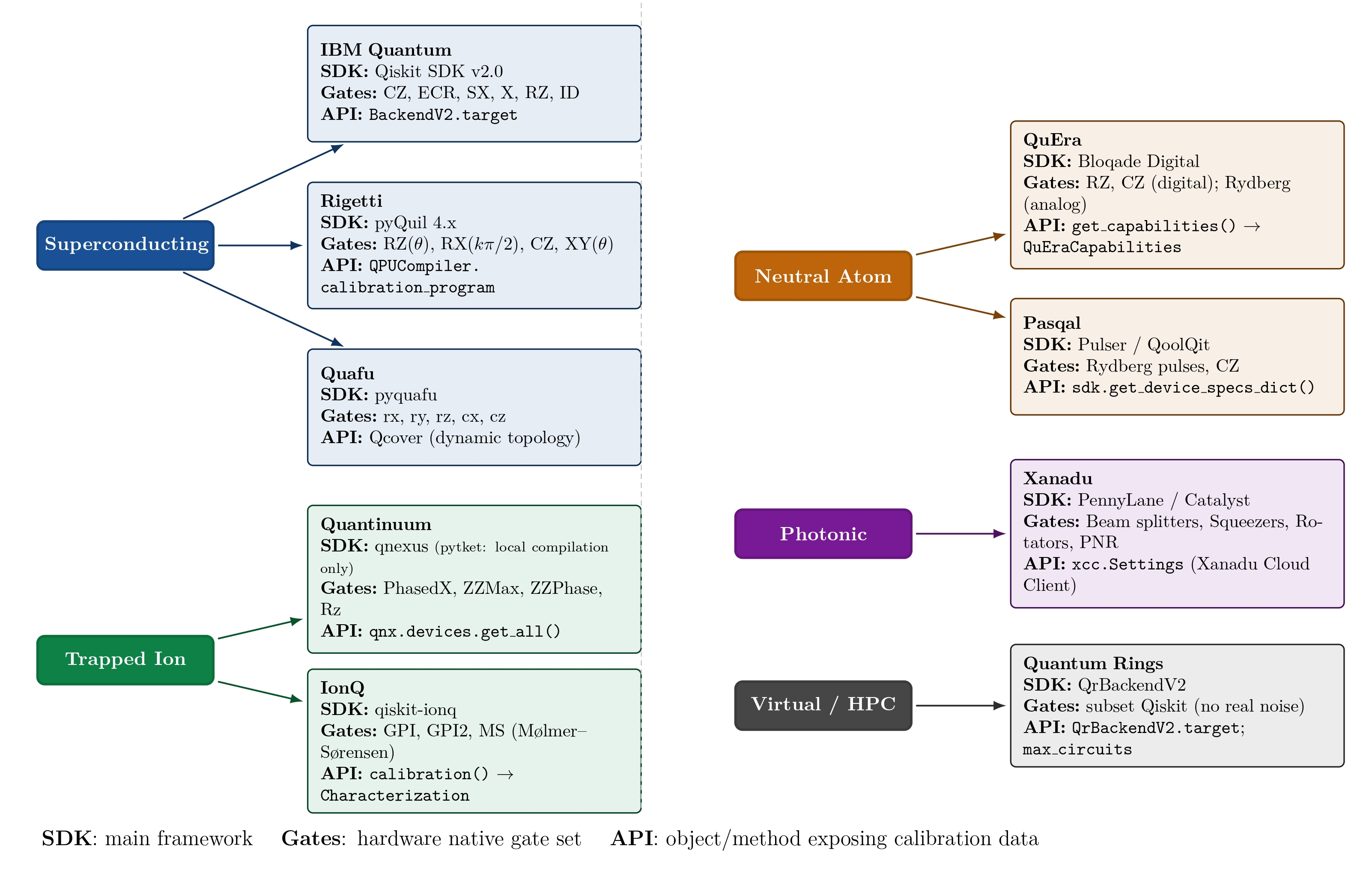
Fig 1: Classification of quantum computing providers by physical architecture.
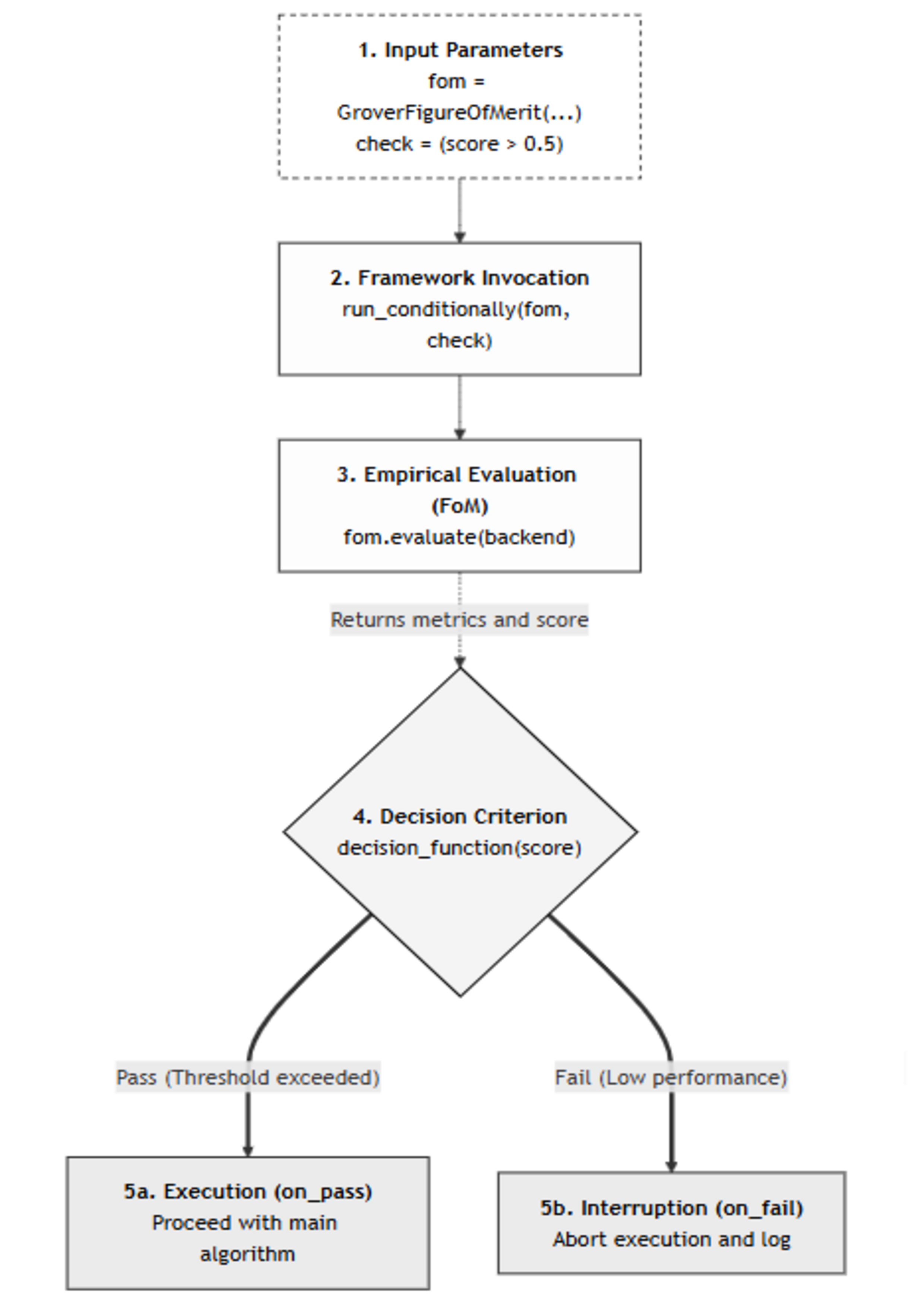
Fig 2: Qonscious conditional execution flow. The FoM result (score) can feed the decision function
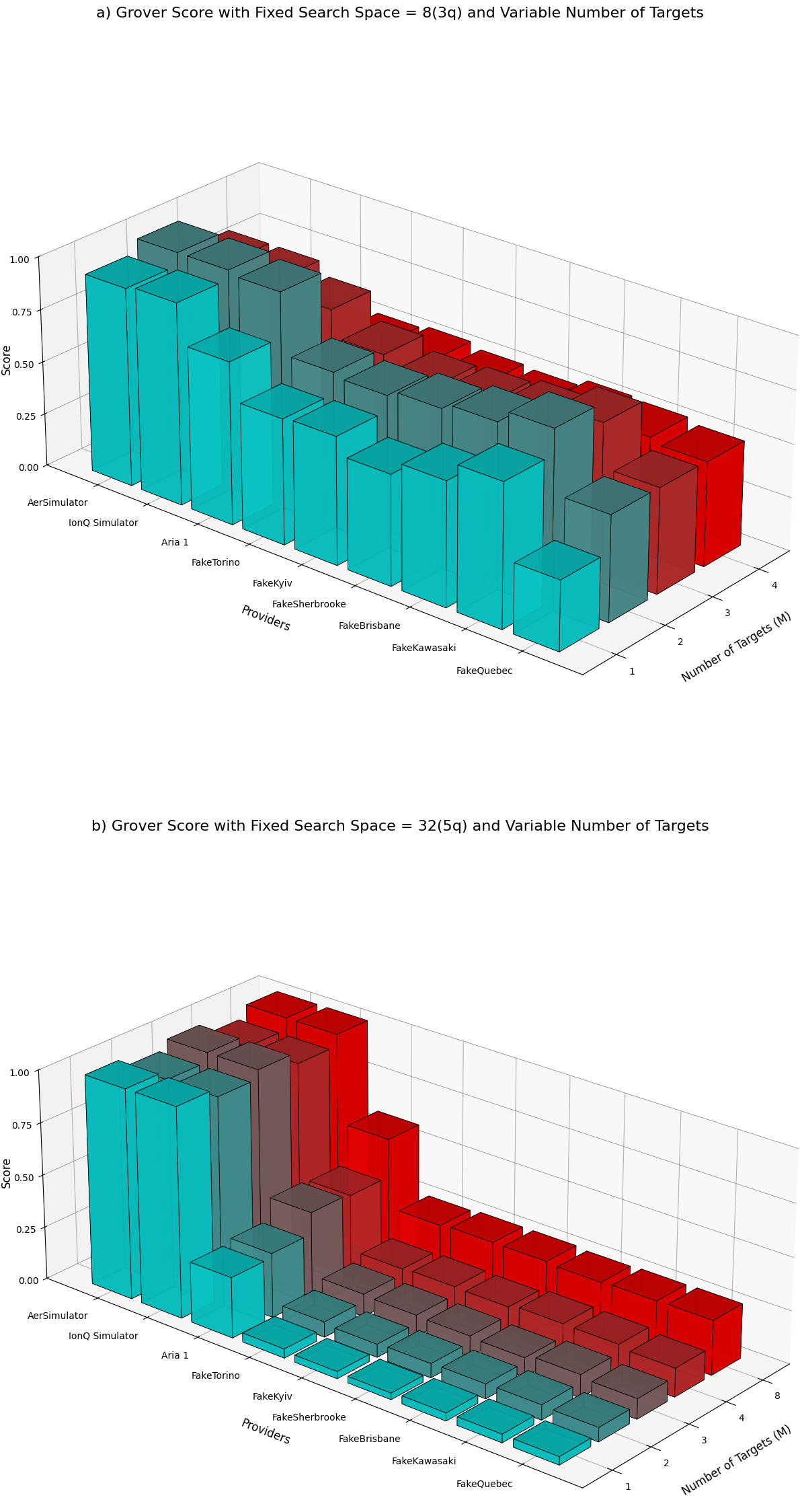
Fig 3: Comparative benchmarking of the Grover Score with a variable number of targets. a) For
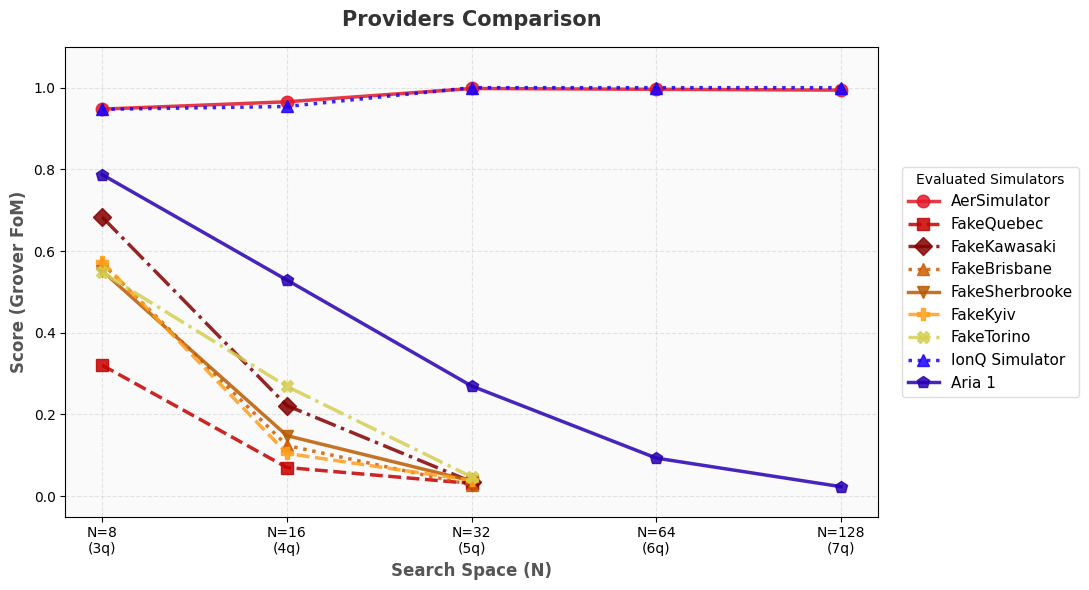
Fig 4: Score comparison across different backends
Limitations
- Validation limited to noise models derived from hardware rather than measurements on physical quantum processors, missing dynamic effects like crosstalk and thermal fluctuations.
- Focus on Grover’s algorithm as a single stress test restricts insight into performance variability for other algorithm classes with different gate and entanglement patterns.
- Transpilation overhead depends on provider-specific compilers; current method relies on default decompositions that may not be optimal or consistent across backends.
- Shot count fixed at 2000 may limit statistical resolution at larger qubit counts or smaller success probabilities, though adequately chosen for experiments conducted.
- Score weighting parameters (λ, μ) are heuristically chosen and could be further optimized or adapted per application context or hardware characteristics.
- Dynamic temporal variability of hardware noise not fully captured by static noise models; metric does not yet incorporate in-situ calibration data variability.
Open questions / follow-ons
- How well do GroverFigureOfMerit scores correlate with actual performance on physical quantum processors, including dynamic noise phenomena not captured by current models?
- Can an intermediate representation or agnostic transpilation layer be developed to reduce topological overhead while preserving backend-agnosticism, improving FoM scores?
- Does the agnostic FoM approach generalize effectively to other quantum algorithms with different circuit structures, such as variational circuits (VQE, QAOA) or QFT-based routines?
- How can FoM scores be integrated into real-time quantum resource management and scheduling frameworks to optimize cost and performance in cloud quantum computing?
Why it matters for bot defense
For bot-defense and CAPTCHA practitioners exploring quantum-resistant schemes or quantum-assisted attack vectors, this work provides a concrete and practical methodology to benchmark the dynamic, real-world performance limitations of current quantum backends in a unified manner—important for understanding the feasibility and timelines of quantum algorithm deployment. The GroverFigureOfMerit metric captures key hardware constraints such as noisy gate execution, topology-induced transpilation overhead, and temporal instability, allowing security engineers to evaluate whether a given noisy quantum processor could realistically run specific oracle-based or search algorithms that might threaten cryptographic assumptions underlying CAPTCHA.
Moreover, the agnostic, algorithm-centric benchmarking approach detailed here highlights the crucial importance of algorithm-level stress tests rather than relying on static low-level quantum device parameters. CAPTCHAs or bot defenses that consider post-quantum assumptions can benefit from the insight that even well-calibrated qubit fidelities may mask poor algorithmic performance because of transpilation or topology-induced overheads. This work encourages security practitioners to adopt metric-driven quantum backend selection and validation strategies when assessing quantum threat models relevant to automated bot solving or quantum-assisted CAPTCHA-breaking scenarios.
Cite
@article{arxiv2607_08636,
  title={ GroverFigureOfMerit: An Agnostic Figure of Merit for Quantum Backend Characterization in the NISQ Era },
  author={ Tiago Restucha and Marcos Guillermo Lammers and Alejandro Fernández },
  journal={arXiv preprint arXiv:2607.08636},
  year={ 2026 },
  url={https://arxiv.org/abs/2607.08636}
}