
BiSCo-LLM: Lookup-Free Binary Spherical Coding for Extreme Low-Bit Large Language Model Compression
Source: arXiv:2607.08643 · Published 2026-07-09 · By Yuantian Shao, Peisong Wang, Zhilei Liu, Chuangyi Li, Yuanteng Chen, Pengcheng Xie et al.
TL;DR
This paper addresses the challenge of compressing large language model (LLM) weights to extremely low bit rates—around 2 bits per weight—without relying on explicit vector quantization codebooks. Prior low-bit compression approaches either use scalar/group-wise quantization, which lacks representational capacity at such low bit budgets, or vector quantization (VQ) with codebooks and indices that add storage overhead and complexity. The authors propose BiSCo-LLM, a lookup-free binary spherical coding framework that encodes local weight chunks as binary codes on a unit hypersphere, enabling bit-packed sign streams rather than explicit codebook indices. This base codec is supplemented with a residual coding stage that captures reconstruction errors, and category-wise recovery distillation is applied to better align compressed weight reconstruction with model behavior. Sensitive weight channels are protected via a small 8-bit auxiliary path counted separately in storage. Their evaluation on the Qwen3-8B model demonstrates that BiSCo-LLM can achieve a WikiText-2 perplexity of 10.18 (versus 9.73 in FP16/BF16) and downstream task accuracy within 2 percentage points across seven tasks, under a realistic compression accounting that includes codes, decoders, metadata, and compensation modules. This work shows that codebook-free, neural decoder–based binary spherical coding can preserve LLM efficacy at extreme storage compression rates, providing a new direction beyond classical scalar quantization or explicit vector quantization with lookups.
Key findings
- BiSCo-LLM achieves a WikiText-2 perplexity of 10.18 on Qwen3-8B compared to 9.73 for the original FP16/BF16 model.
- Average downstream accuracy is 68.05 on a seven-task evaluation set versus 69.92 for the uncompressed FP16/BF16 baseline.
- The bit-packed binary spherical codecs plus residual BSQ stage effectively compress weights to around 2 bits per weight under explicit storage budgeting, including decoders and auxiliary components.
- A two-stage residual coding approach leads to a practical rate–distortion tradeoff better than simply increasing single-stage code length, enabling more efficient use of code capacity.
- Category-wise codec training and recovery distillation reduce the mismatch between local weight reconstruction and assembled model behavior compared to naive layer-wise reconstruction.
- Sensitive channels benefit from an 8-bit protected auxiliary path, which improves stability and recovery and is reported separately to fairly account for storage overhead.
- LoRA adapters as optional low-rank compensation modules further improve downstream accuracy without dominating the storage budget.
- Storage accounting explicitly counts BSQ codes, neural decoder parameters, protected-channel payloads, LoRA adapters, and metadata to present a fair comparison.
Threat model
The adversary model is not explicitly adversarial or malicious. Instead, the focus is on preserving LLM model functionality and accuracy under extreme weight compression within strict storage and deployment constraints. There are no assumptions about attacks or adversarial manipulations—only that compression should minimize accuracy degradation without extra codebook storage or lookups.
Methodology — deep read
The authors start by defining a model compression problem targeting extreme low-bit weight representations, specifically around 2 bits per weight, where existing scalar or group quantization methods fall short in representational capacity. The threat model is not adversarial but focuses on preserving model accuracy and performance under strict storage constraints during deployment.
Data comes from pretrained large language models, specifically Qwen3-8B, a publicly reported 8-billion parameter model. Weight tensors from linear modules in Transformer blocks are partitioned into fixed-size d-dimensional chunks (e.g., d=32). Each chunk is encoded into a fixed-length binary code of length b bits (e.g., b=32) that represents the chunk as a point on a unit hypersphere. Chunks and their reconstructions form the training data for the codec.
The key technical component is the Binary Spherical Quantization (BSQ) codec: chunk weight vectors are normalized onto a unit hypersphere, then binarized into +1/-1 sign vectors representing directions (rather than magnitudes) to remove explicit codebooks. A compact neural decoder Dₜₕₑₜₐ maps binary codes back to reconstructed weight chunks. This decoder is trained per Transformer module category, such as per linear projection type, so that distinct weight types get specialized decoders.
Because a single-stage BSQ codec cannot efficiently use the full code space (many possible codewords are unused), a secondary residual BSQ codec is trained to encode the reconstruction error left by the base codec. This two-stage residual coding realizes a practical rate-distortion curve where additional code bits are assigned to residual structure rather than enlarging the original code length.
After replacing all weights in one module category with compressed reconstructions, a recovery distillation step is performed. The compressed category is active in the running model, and distillation fine-tunes the model outputs to reduce mismatch between reconstructed weights and original model behavior, capturing cross-layer interactions without expensive end-to-end retraining.
To handle sensitivity imbalance and outliers, a small fraction of channels identified from calibration activations are stored using an auxiliary 8-bit quantization path (protected channels). This path is accounted separately in the storage budget and improves model stability.
Low-rank adaptation (LoRA) modules are optionally trained as compensation for compression error. These adapters are small trainable modules added post-compression, improving accuracy with a modest parameter increase.
Training uses mean squared error loss for base and residual BSQ codecs on weight chunks, combined with distillation losses after category replacement. The neural decoders are compact feedforward networks specific to each module category. Calibration data is used to identify sensitive channels and optimize recovery distillation.
Evaluation protocols include perplexity on WikiText-2, downstream accuracy on a seven-task benchmark suite for Qwen3-8B, and detailed storage accounting that sums bit-packed codes, decoder weights, 8-bit protected payloads, LoRA adapters, and metadata. Ablation studies verify residual coding and category-wise recovery.
The method is reproducible in principle but relies on proprietary or large datasets (Qwen3-8B weights). Code and pretrained decoder weights are not explicitly stated as released. The paper provides detailed pipeline and component descriptions sufficient for informed reproduction attempts.
Example end-to-end: For one Transformer module category (e.g., query projection), weights are chunked into vectors of dimension d=32. Base BSQ codec maps each chunk onto the unit sphere, binarizes to 32 bits, and decodes through the category-specific neural decoder, reconstructing approximate weights. The residual difference is then encoded by a second residual BSQ codec, also binarized and decoded to refine reconstruction. The reconstructed weights replace the original weights for the entire category in the model. Recovery distillation is run with this compressed category active, tuning to improve model output alignment. Finally, an 8-bit protected path is applied to a subset of sensitive channels identified by calibration statistics, further stabilizing the model behavior.
Technical innovations
- Introduction of a codebook-free binary spherical quantization (BSQ) codec for LLM weight compression that maps weight chunks onto a unit hypersphere and binarizes direction information without explicit codebooks or lookup indices.
- A two-stage residual BSQ framework that assigns extra bits to residual reconstruction errors rather than increasing single-stage code length, improving rate-distortion efficiency under tight storage budgets.
- Category-wise codec training and recovery distillation that optimize compression and distillation per Transformer module category, aligning local weight reconstruction with assembled model behavior better than layer-wise approaches.
- Use of an auxiliary 8-bit protected-channel path selectively applied to sensitive channels identified via calibration statistics to stabilize compression-induced errors while counting its storage overhead explicitly.
- Integration of LoRA low-rank adapters as optional compensation modules distinctly accounted apart from core binary spherical codes to improve accuracy without conflating compression size estimations.
Datasets
- Qwen3-8B pretrained model weights — 8 billion parameters — proprietary/publicly released model weights used for compression and evaluation
- WikiText-2 — standard language modeling benchmark — used for perplexity evaluation
- Seven downstream tasks evaluation set — unspecified tasks used to benchmark Qwen3-8B performance after compression
Baselines vs proposed
- FP16/BF16 original model: WikiText-2 perplexity = 9.73 vs BiSCo-LLM: 10.18
- FP16/BF16 original model: average downstream accuracy = 69.92 vs BiSCo-LLM: 68.05
- Single-stage BSQ codec: higher reconstruction error vs Two-stage residual BSQ: improved rate-distortion with better use of extra bits (quantitative delta not fully specified)
- Without 8-bit protected channels: measurable performance drop vs With protected channels: stability and recovery gains (specific numbers not given)
Figures from the paper
Figures are reproduced from the source paper for academic discussion. Original copyright: the paper authors. See arXiv:2607.08643.
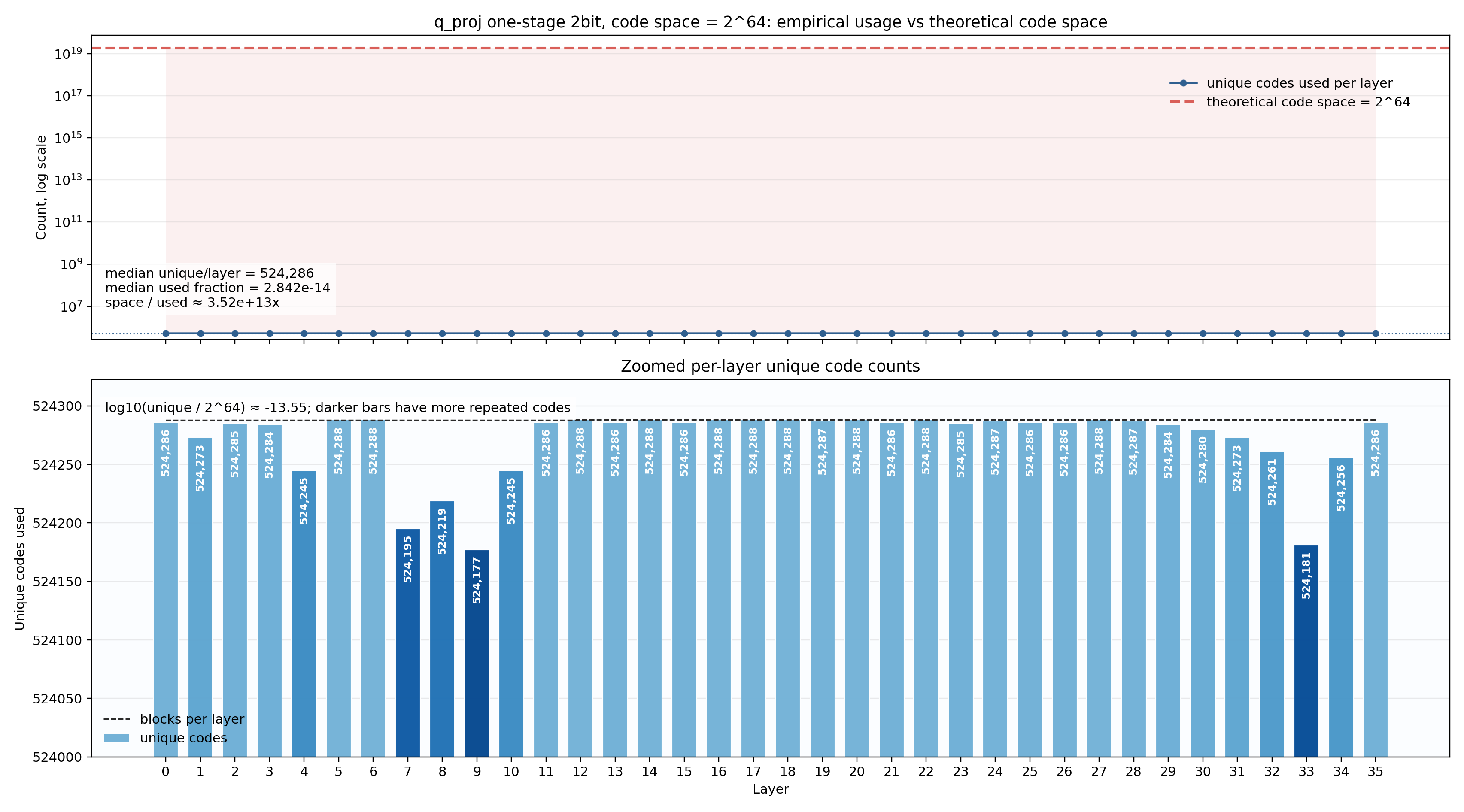
Fig 1: Empirical utilization of the implicit BSQ code space on Qwen3-8B
Limitations
- No adversarial robustness evaluation or threat model involving malicious tampering; focus is purely on compression accuracy and storage constraints.
- Experimental evaluation is limited to one 8B-parameter LLM (Qwen3-8B) and seven unspecified downstream tasks, which may limit generality to larger or different architectures.
- Code and pretrained neural decoder parameters are not explicitly released, limiting immediate reproducibility and third-party validation.
- Effectiveness of the method under substantial distribution shifts or domain adaptation scenarios is untested.
- LoRA compensation modules add model complexity and parameters, raising questions about trade-offs between compression ratio and parameter count.
- Reliance on calibration statistics and sensitive channel identification may introduce complexity and overhead in practical deployment pipelines.
Open questions / follow-ons
- How well does the BiSCo-LLM approach scale beyond 8B-parameter models to trillion-parameter LLMs with different architectural patterns?
- Can the binary spherical coding framework be adapted to quantize activations or embedding layers effectively, rather than just weights?
- What are the practical latency and throughput implications of using neural decoders for weight reconstruction during inference compared to explicit vector quantization systems?
- Would integrating quantization-aware training (QAT) or end-to-end fine-tuning improve rate-distortion trade-offs beyond the current post-training distillation approach?
Why it matters for bot defense
Though not directly targeting bot defense or CAPTCHAs, BiSCo-LLM's advances in efficient extreme low-bit compression of large neural models provide useful insights for bot-defense engineers interested in deploying large language models under strict memory and bandwidth constraints. The paper demonstrates a storage-aware compression pipeline that minimizes reconstruction error without explicit codebooks or latency-expensive lookups, potentially informing strategies for compact model deployment in latency-sensitive or resource-constrained environments (including edge or on-device deployments that might serve CAPTCHA generation or verification tasks).
The category-wise recovery distillation and outlier channel protection principles could be applied to improve robustness in models used for security-sensitive inference tasks. Also, the explicit accounting for all components of the compressed model size (codes, decoders, metadata, compensation) demonstrates a careful systems-level perspective that practitioners in bot detection or CAPTCHA generation should consider when compressing complex models for real-world deployment.
Cite
@article{arxiv2607_08643,
  title={ BiSCo-LLM: Lookup-Free Binary Spherical Coding for Extreme Low-Bit Large Language Model Compression },
  author={ Yuantian Shao and Peisong Wang and Zhilei Liu and Chuangyi Li and Yuanteng Chen and Pengcheng Xie and Yiwu Yao and Zhihui Wei and Jian Cheng },
  journal={arXiv preprint arXiv:2607.08643},
  year={ 2026 },
  url={https://arxiv.org/abs/2607.08643}
}