
zk-ScalHard: Scalable and Hardware-Rooted Privacy-Preserving Authentication for Secure OTA Updates in Zonal SDVs
Source: arXiv:2607.07371 · Published 2026-07-08 · By Shrikant Tangade, Bansi Pambhar, Valeria Loscri, Mauro Conti
TL;DR
This paper addresses the critical security and scalability challenges faced by next-generation Software-Defined Vehicles (SDVs) deploying Zonal-oriented Architectures (ZoA) with 100+ Electronic Control Units (ECUs) requiring frequent Over-the-Air (OTA) software updates. Existing industry standards such as the Uptane framework rely on Public-Key Infrastructure (PKI) that leads to linear scaling overhead (O(n)) in communication bandwidth and verification latency as ECU count grows, creating bottlenecks and risking data privacy due to centralized trust and persistent secrets. To overcome these limitations, the authors propose zk-ScalHard, a novel hierarchical, decentralized, and hardware-rooted authentication protocol that leverages silicon Physical Unclonable Functions (PUFs) combined with zero-knowledge proof (ZKP) circuits to achieve privacy-preserving, scalable vehicle-to-cloud authentication.
The key novelty lies in the multi-tier architecture implementing (1) Zonal Identity and Integrity (ZIDI) ZKP circuits with in-situ multi-party computation (MPC) to eliminate centralized single points of failure, and (2) High-Performance Computing Aggregation (HPCA) ZKP circuits enabling recursive proof aggregation into a single constant-size proof. This provides asymptotic O(1) communication and verification complexity regardless of ECU density. Evaluation against Uptane on a 100-ECU Zonal SDV shows zk-ScalHard reduces authentication bandwidth by 99.2% (98.6KB to 809B) and verification latency by 7.3x (15.47s to 2.1s), while also achieving 99.9% reduction in temporal physical key attack surface through ephemeral PUF-based secrets. The solution realizes secure, GDPR-compliant OTA update authentication at scale, addressing both cybersecurity and privacy regulations for future zonal SDVs.
Key findings
- zk-ScalHard achieves constant O(1) communication and verification complexity versus linear O(n) in Uptane for 100 ECUs.
- Authentication bandwidth reduces from 98.6KB (Uptane) to 809B, a 99.2% savings.
- Verification latency at cloud reduces from 15.47s to 2.1s, a 7.3x speedup.
- Temporal attack surface for key extraction decreases by 99.9% due to ephemeral PUF secrets resident for only 4.2 seconds.
- ZIDI circuit enables in-situ multi-party computation at zonal control units (ZCUs) without centralized key setup, removing systemic single points of failure.
- HPCA circuit performs recursive aggregation of 4 ZIDI proofs into one 805-byte vehicle-level proof.
- PUF-derived secrets serve as dynamic witnesses instead of static keys, ensuring vehicle data sovereignty and GDPR compliance.
- Zonal SDV trusted setup moved from cloud to vehicle’s hardware nodes, increasing resilience to global parameter compromise.
Threat model
The adversary can exercise vertical attacks by gaining temporary physical access to ECUs and ZCUs to perform fault injection and side-channel analysis on persistent memory in an attempt to extract cryptographic keys. At the infrastructure level, the adversary can compromise the OTA cloud server or act as an insider seeking to recover the trusted setup parameters (toxic waste) to forge proofs. Horizontally, the attacker can escalate privileges on the vehicle HPC, intercept IV and V2I communication channels, perform man-in-the-middle and replay attacks, and attempt to impersonate ECUs or ZCUs using intercepted authentication proofs. However, the adversary is constrained by the ephemeral nature of the silicon PUF based secrets and the cryptographic safeguards of zero-knowledge proofs, preventing permanent secret extraction or proof forgery absent breaking underlying cryptographic assumptions.
Methodology — deep read
Threat Model & Assumptions: The adversary can physically access vehicle ECUs/ZCUs temporarily to attempt side-channel or fault attacks on persistent key storage. The attacker can compromise the OTA cloud server or act as a malicious insider to obtain trusted setup 'toxic waste.' Internally, attackers may gain root on the vehicle HPC or intercept/manipulate in-vehicle (IV) and vehicle-to-infrastructure (V2I) communications using standard Dolev-Yao capabilities such as MITM and replay attacks. The adversary is assumed unable to break zero-knowledge proofs or permanently extract silicon PUF secrets from volatile memory due to their ephemeral nature.
Data: The system is modeled on a Zonal SDV with 100+ ECUs grouped into 4 physical zones managed by Zonal Control Units (ZCUs) communicating via CAN-FD, LIN, and Automotive Ethernet. Each ECU has a unique silicon PUF generating noisy entropy used as physical secrets. The authors benchmark against Uptane reference implementation using synthesized ECU version metadata. Details on dataset size or splits are not applicable but the model scales empirically with 100 ECUs.
Architecture & Algorithm: The architecture is a four-layer hierarchical 'Trust Pyramid' with Layer-0 as hardware root of trust (silicon PUFs at ECUs), Layer-1 as zonal integrity (ZIDI ZKP circuit with local MPC to produce zonal proving and verification keys privately), Layer-2 as central aggregation (HPCA ZKP circuit at HPC to recursively aggregate zonal proofs), and Layer-3 as global governance (OTA cloud verifies a single constant-size aggregated proof). Two novel zero-knowledge proof circuits are designed: (a) ZIDI circuit implemented in Circom 2.1 for MPC-based decentralized key generation and zonal authentications with Groth16 zk-SNARKs, and (b) HPCA circuit enabling recursive aggregation on Plonky3/Fri-based transparent, post-quantum proofs for scalable single proof vehicle-level attestation.
PUF responses are used as physical witnesses injected into ZKP computations, generated on-demand and resident only transiently in volatile memory (~4.2 seconds) to reduce attack surface. The ZCU verifies ECU MACs locally and generates succinct ZIDI proofs (809 bytes). HPC aggregates 4 zonal proofs into single 805-byte HPCA proof. The OTA cloud validates final proof using pre-distributed verification keys.
Training Regime & Implementation: The paper does not involve machine learning training but implements cryptographic circuits using Circom 2.1. The trusted setup phase occurs offline factory enrollment generating proving and verification keys per zone in secure multi-party computation MPC ceremony that consumes PUF entropy. Runtime authentication reuses these keys with ephemeral PUF witnesses. Benchmarking performed on simulated workloads comparing proof sizes, verification latency, and communication overhead.
Evaluation Protocol: Metrics include communication bandwidth (manifest size), cloud verification latency (seconds), temporal attack surface window duration (seconds), and proof size (bytes). Baseline Uptane implementations are used for comparison. Ablation includes measuring temporal attack surface reduction and communication complexity scaling with ECU count. Verification was done on standard hardware, unspecified in detail. Cross-validation or distribution shifts are not relevant.
Reproducibility: Code is publicly released on GitHub. Details on frozen weights or datasets do not apply. Some cryptographic parameters and simulations are described but full hardware prototype details are not included. Circuit source code is available for independent verification.
Technical innovations
- A hierarchical multi-tier trust-promotion model for Zonal SDVs combining hardware-rooted silicon PUFs with zero-knowledge proofs to achieve decentralized, scalable authentication.
- The Zonal Identity and Integrity (ZIDI) ZKP circuit implementing in-situ multi-party computation (MPC) to generate local proving and verification keys, eliminating centralized trusted setup risks.
- A High-Performance Computing Aggregation (HPCA) ZKP circuit enabling recursive aggregation of zonal proofs into a single constant-size proof, achieving asymptotic O(1) scalability in communication and verification.
- Integration of silicon PUFs as ephemeral dynamic witnesses for authentication to minimize temporal attack surface and ensure 100% vehicle data sovereignty during OTA updates.
Baselines vs proposed
- Uptane: Vehicle Version Manifest bandwidth = 98.6KB vs zk-ScalHard: 809B (~99.2% reduction)
- Uptane: Cloud-side verification latency = 15.47s vs zk-ScalHard: 2.1s (7.3x speedup)
- Uptane: Temporal key exposure time (persistent) vs zk-ScalHard: 4.2s ephemeral key resident window (99.9% reduction)
Figures from the paper
Figures are reproduced from the source paper for academic discussion. Original copyright: the paper authors. See arXiv:2607.07371.
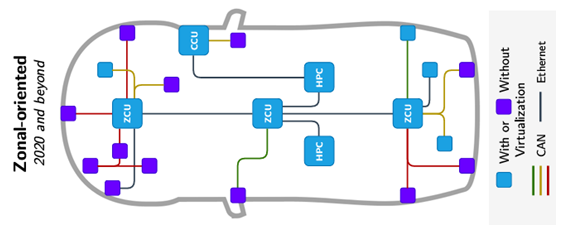
Fig 1: SDV’s Zonal-oriented Architecture (ZoA)
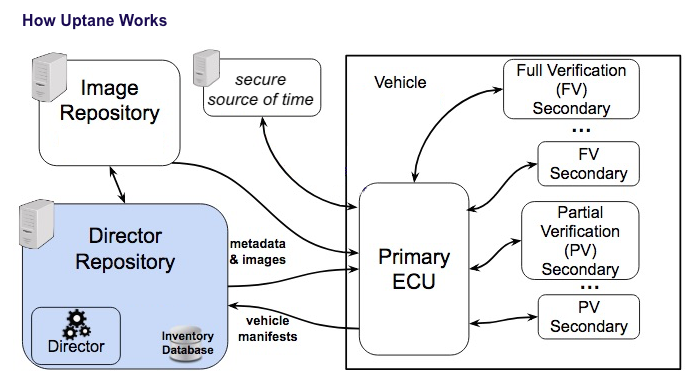
Fig 2: Uptane Secure OTA Update Framework Design (Adapted from

Fig 6: The zk-ScalHard Hierarchical Trust Pyramid
Limitations
- The solution relies on silicon PUF stability and availability; manufacturing variances or aging effects on PUFs are not extensively analyzed.
- Evaluation appears to be simulation-based; no large-scale physical hardware prototype testing reported.
- The trusted setup MPC ceremony requires secure offline factory enrollment, which may be operationally complex to deploy.
- The system’s resilience to advanced adversarial models exploiting side-channel leakage during the brief PUF secret residence is not deeply explored.
- Verification is focused on latency and bandwidth; energy consumption and real-time impact on ECUs or HPC are not reported.
- Generalization beyond the 100 ECU, 4-zone architecture, e.g., for different vehicle scales or architectures, remains to be validated.
Open questions / follow-ons
- How robust is the silicon PUF-based authentication under real-world conditions including device aging, temperature/humidity variations, and manufacturing variabilities?
- What are the practical challenges and overheads of deploying the decentralized MPC trust ceremony at OEM factory scale?
- Can the recursive ZKP aggregation approach be adapted to other automotive use cases beyond OTA updates, such as runtime intrusion detection or secure diagnostics?
- How does the system perform under active network-level attacks such as sophisticated relay or fault injection attacks during the ephemeral proof generation window?
Why it matters for bot defense
This paper’s innovations in scalable, privacy-preserving authentication via hierarchical zero-knowledge proofs and hardware-bound physical unclonable functions offer important lessons for bot-defense and CAPTCHA systems seeking to maintain strong verification guarantees at scale without revealing sensitive identity information. The use of recursive proof aggregation to achieve constant complexity in verification and communication is directly relevant to reducing bot detection latency and network overhead in high-volume applications. Moreover, the concept of ephemeral, hardware-rooted secrets aligns with emerging trends in ephemeral key generation and challenge-response mechanisms in CAPTCHA designs, minimizing attack surfaces associated with long-lived credentials. Integrating multi-party decentralized trust initialization to eliminate centralized single points of failure also suggests architectures for robust, distributed bot defense frameworks that resist server compromises. Finally, the GDPR-compliant data sovereignty demonstrated here could inform CAPTCHAs that must prove user validity without exposing personal data, enhancing privacy-centric bot detection.
Cite
@article{arxiv2607_07371,
  title={ zk-ScalHard: Scalable and Hardware-Rooted Privacy-Preserving Authentication for Secure OTA Updates in Zonal SDVs },
  author={ Shrikant Tangade and Bansi Pambhar and Valeria Loscri and Mauro Conti },
  journal={arXiv preprint arXiv:2607.07371},
  year={ 2026 },
  url={https://arxiv.org/abs/2607.07371}
}