
QCNN with Rough Path Signature Kernels
Source: arXiv:2607.07634 · Published 2026-07-08 · By Leonardo Nogueira Falabella, Vasily Sazonov
TL;DR
This work addresses the computational challenges in time series classification posed by time reparameterization invariance—an issue that complicates extracting meaningful temporal features. The authors propose a hybrid quantum-classical architecture that integrates rough path theory's signature kernels—mathematically robust, time-invariant representations—within quantum neural networks. Specifically, they embed the signature kernel computation as a variational quantum linear solver (VQLS) over a discretized PDE representation of the kernel, feeding the resulting features into a Quantum Convolutional Neural Network (QCNN) for classification. The approach is evaluated on a binary classification task distinguishing handwritten digits 0 and 1 from the MNIST stroke sequence dataset.
The experiments reveal practical scalability bottlenecks in the VQLS component on near-term quantum devices, arising from rapidly growing matrix condition numbers and large system sizes, limiting VQLS to heavily compressed time series sequences. To circumvent this, classical numerical solvers are used for kernel evaluations in downstream QCNN experiments. Empirical results indicate that incorporating signature kernels as quantum features improves classification accuracy for several QCNN architectures, particularly when fusing classical image data with signature kernel scalars encoded on auxiliary qubits. The study provides a concrete analysis of the benefits and limitations of quantum-enhanced learning for time series and outlines practical constraints for current quantum hardware.
Key findings
- Signature kernels, invariant under time reparameterization, can be computed via solving a second-order hyperbolic PDE discretized into a linear system suitable for quantum linear solvers.
- The Variational Quantum Linear Solver (VQLS) algorithm applied to the kernel PDE linear system exhibits rapid performance degradation as time series length increases beyond 4-6 time steps, due to increasing matrix condition number and non-convex optimization landscapes.
- Scaling VQLS to MNIST stroke sequences (~20-50 time steps) requires over 10 fully connected qubits and results in high training cost and low state overlap fidelity as measured by trace distance (Equation 24), rendering direct quantum kernel computation infeasible for current devices.
- Downsampling time series to 15 points reduces kernel matrix size and enables efficient amplitude embedding of kernel matrices into 8-qubit QCNN registers for classification.
- Three QCNN input modalities were compared: baseline raw image encoding, full signature kernel matrix substitution, and a fusion incorporating raw images plus a scalar signature kernel feature on an auxiliary qubit.
- The auxiliary qubit fusion model consistently outperforms both pure kernel substitution and baseline models in binary digit classification accuracy on MNIST stroke datasets.
- No strong correlation between the number of QCNN tunable parameters and classification accuracy was observed; improvement depends on QCNN architecture choice and input modality.
- QCNN circuit depth scales logarithmically as O(log n) with number of qubits, enabling parameter-efficient quantum classifiers.
Threat model
N/A — the paper focuses on quantum machine learning algorithm development for time series classification rather than security against adversarial attacks.
Methodology — deep read
Threat Model & Assumptions: The adversary is not explicitly defined as this is an ML methodological contribution focused on time series classification via quantum machine learning. The threat model emphasizes computational complexity and hardware noise constraints inherent to near-term quantum devices. The work assumes access to noiseless quantum simulators for algorithmic evaluation.
Data: The dataset is a binary subset of MNIST containing digit 0 and 1 samples from the stroke sequence variant converting images into time-ordered pen trajectories. There are 12,665 training and 2,115 test samples with class balance provided. Trajectories are downsampled to 15 time points (shape 15×3 including x, y, pen state). Data is normalized and split into approx 85.7% training and 14.3% testing sets.
Architecture / Algorithm: The pipeline integrates a signature kernel computation layer followed by QCNN classifiers. Signature kernels embed time series as inner products of infinite-dimensional rough path signatures, computed via solving a PDE reformulated as a linear system Ax=b. This linear system is attempted to be solved on quantum devices with Variational Quantum Linear Solver (VQLS)—a parameterized quantum circuit ansatz optimized via classical constrained optimization (COBYLA) with cost functions designed to mitigate barren plateaus.
QCNN architectures consist of hierarchical layers alternating convolutional two-qubit unitaries (various ansatzes studied, e.g., Tree Tensor Network, U5–U15, USO(4), USU(4)) with translational invariance and pooling layers that reduce qubit count analogous to classical CNN pooling. Quantum data encoding uses amplitude embedding for kernel matrices and angle encoding for scalar kernel features on auxiliary qubit(s).
Two main QCNN input paradigms are evaluated: (1) pure kernel substitution where the full kernel matrix replaces the raw image, and (2) auxiliary qubit fusion where raw images are encoded into 8 qubits and a scalar kernel value into a 9th qubit entangled within the QCNN.
Training Regime: Training uses hybrid quantum-classical optimization with classical optimizers (e.g., COBYLA) targeting binary cross-entropy loss via measured expectation values of Pauli-Z operators on the final qubit. Optimization is performed on noiseless statevector simulators. Number of layers in VQLS ansatz is 4, and QCNN follows parameter sharing architectures with O(log n) parameters and circuit depth.
Evaluation Protocol: Metrics focus on classification accuracy on the 0-vs-1 MNIST stroke test set. VQLS scaling evaluated via convergence of cost functions and overlap fidelity between true and approximated quantum states as path length increases. Multiple QCNN ansatzes and input modalities are compared. Ablations include raw image baseline, pure kernel input, and fusion architectures. No cross-validation reported. Statistical significance not explicitly given.
Reproducibility: Code is implemented with Qiskit for quantum circuits and PennyLane for QCNN layers. High-performance noiseless statevector simulators used. Source code is available upon reasonable request but not publicly released. MNIST stroke dataset preprocessing and downsampling methods are clearly described.
Concrete example: For a sample MNIST stroke sequence downsampled to 15 points, its signature kernel matrix is computed classically, loaded via amplitude encoding into an 8-qubit register, and processed through QCNN layers. The final qubit measurement yields classification prediction optimized by minimizing binary cross-entropy over training epochs using COBYLA optimizer.
Technical innovations
- Formulation of the rough path signature kernel evaluation as a linear system derived from a PDE that can be solved via variational quantum linear solvers (VQLS).
- Integration of signature kernel layers as quantum feature maps within a Quantum Convolutional Neural Network architecture for time series classification.
- Introduction of a hybrid multimodal QCNN input architecture fusing classical image data and scalar quantum-encoded signature kernels on auxiliary qubits.
- Detailed analysis and benchmarking of VQLS scalability limitations on near-term quantum hardware for signature kernel PDE systems, emphasizing impacts of matrix condition number and sequence length.
Datasets
- MNIST stroke sequence subset — 14,780 samples (12,665 train, 2,115 test) — publicly available MNIST stroke data filtered for digits 0 and 1
Baselines vs proposed
- Raw image baseline (Standard): classification accuracy varies by QCNN ansatz; generally lower than signature kernel enhanced models.
- Pure SigKernel substitution (full kernel matrix input): improves accuracy compared to baseline for certain QCNN ansatzes.
- SigKernel auxiliary qubit fusion: consistently outperforms both pure kernel substitution and raw image baseline across multiple ansatzes by a margin shown in Fig. 6 (exact percentages not specified).
Figures from the paper
Figures are reproduced from the source paper for academic discussion. Original copyright: the paper authors. See arXiv:2607.07634.
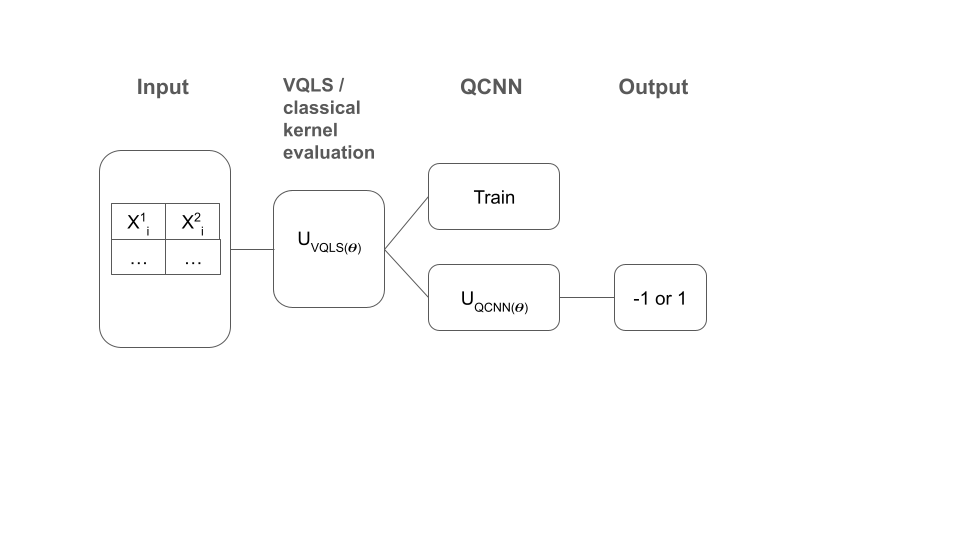
Fig 1: Schematic diagram for the hybrid quantum-classical classification pipeline.
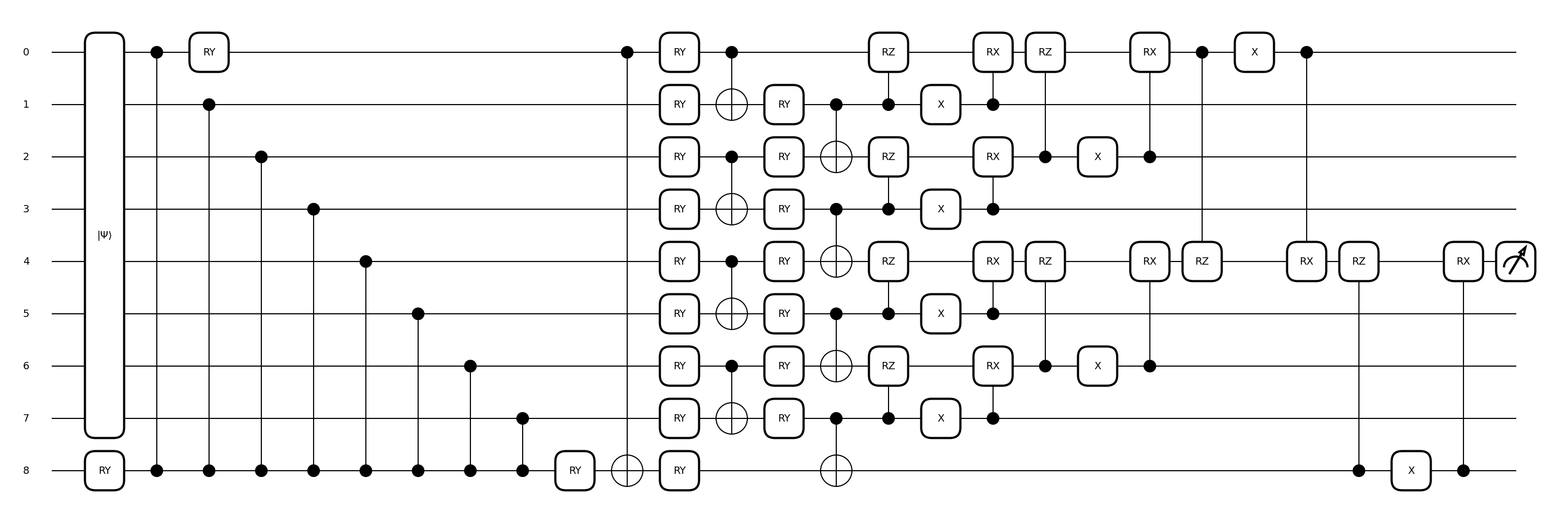
Fig 2: Schematic representation of the QCNN architecture applied to an 8-qubit system. The
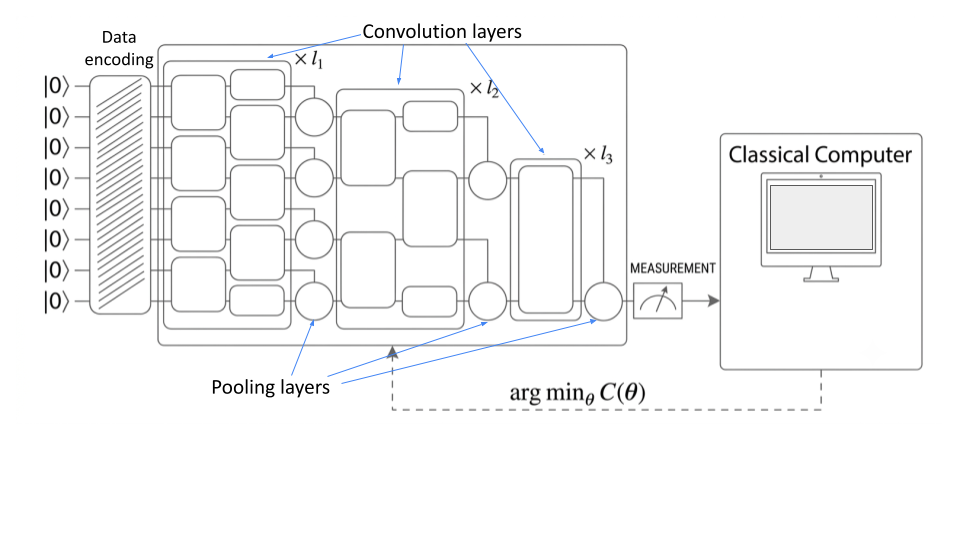
Fig 3: Circuit scheme of the extra qubit kernel architecture, exemplified with RY and CNOT
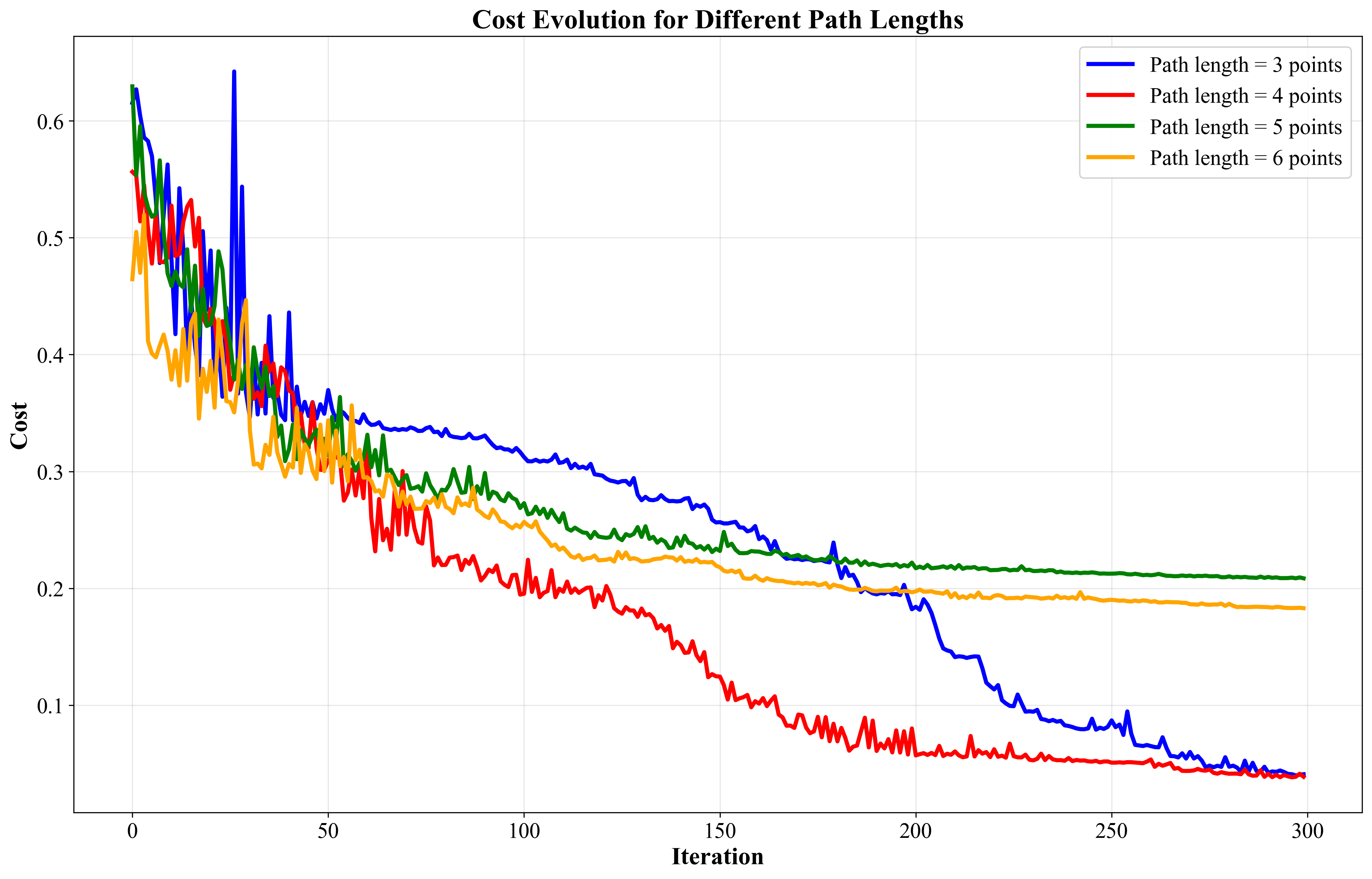
Fig 4: Scalability benchmarks for the VQLS framework across varying path compression levels:
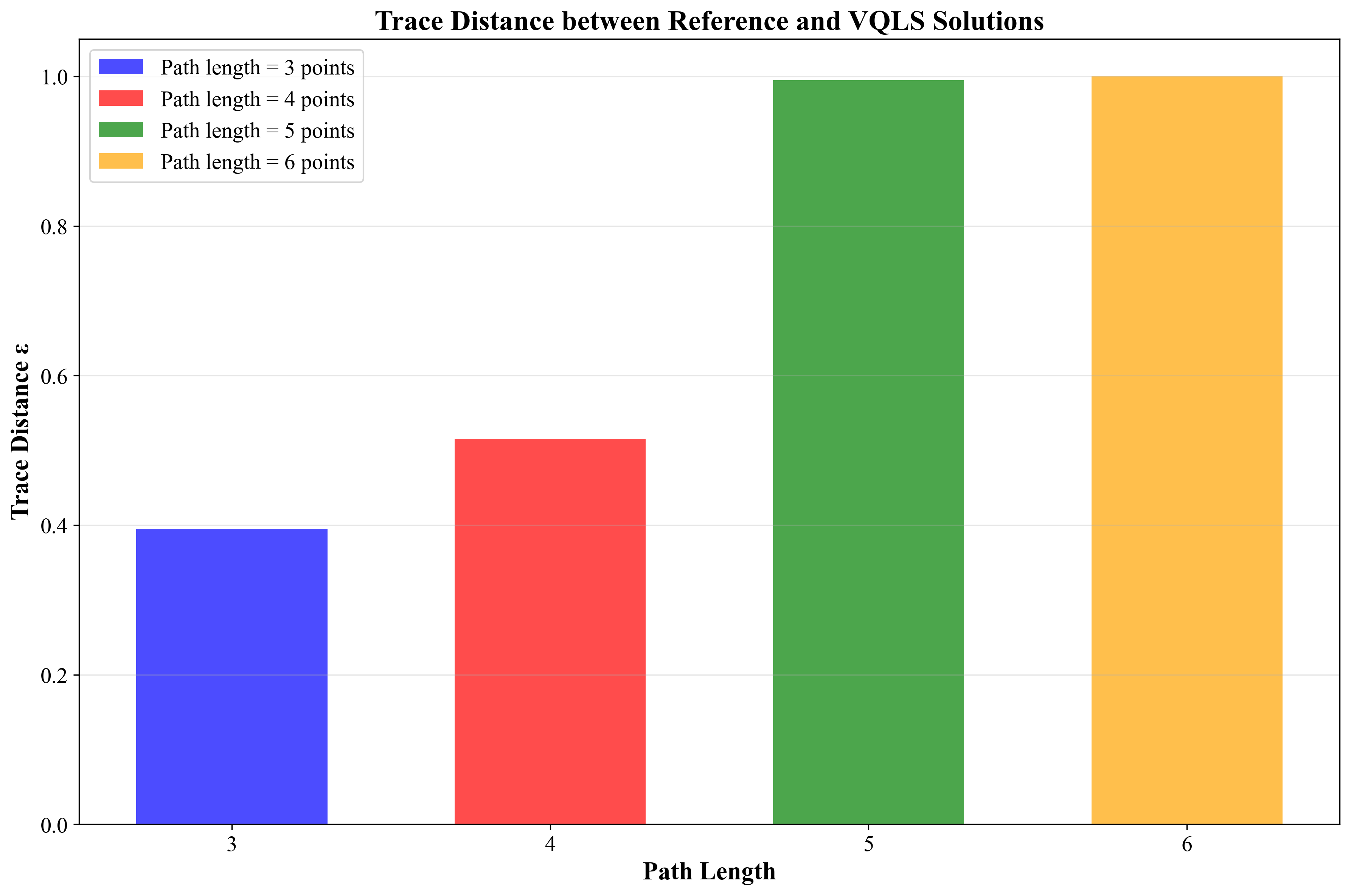
Fig 5: Visual analysis of the MNIST sequence dataset: (a) Characteristic downsampled pen-tip
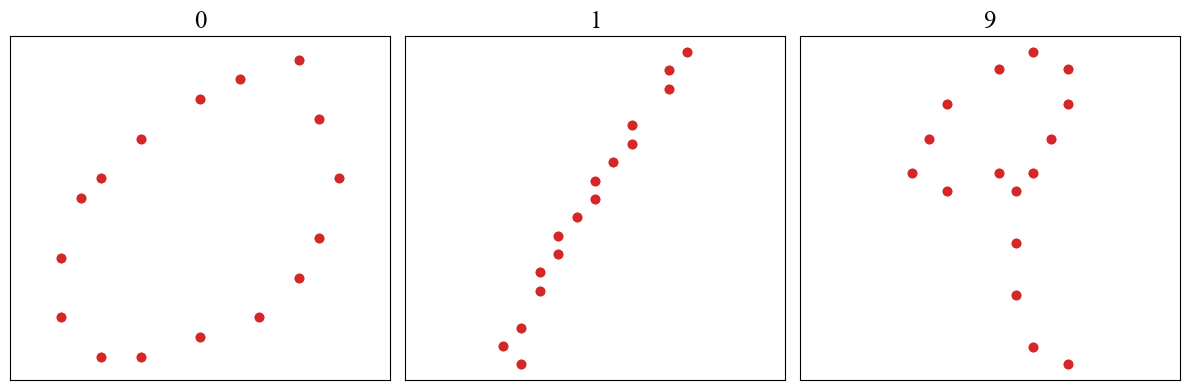
Fig 6: Binary classification accuracy for the 0-vs-1 task benchmarks comparing the baseline
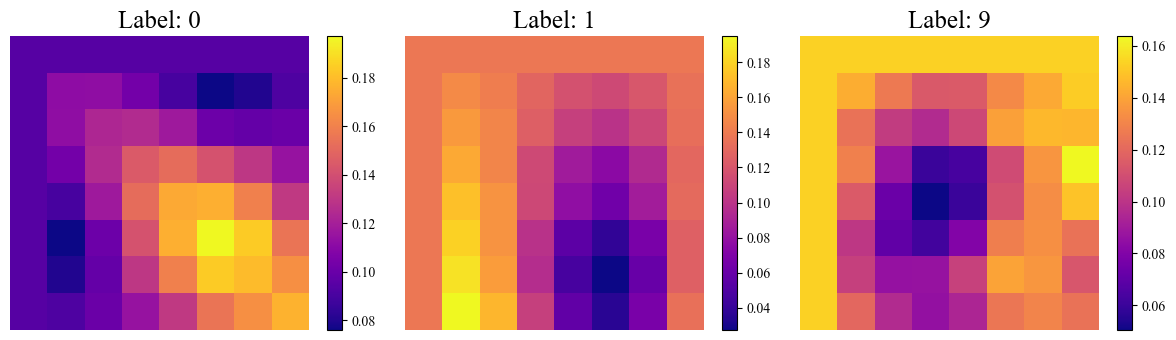
Fig 7 (page 11).
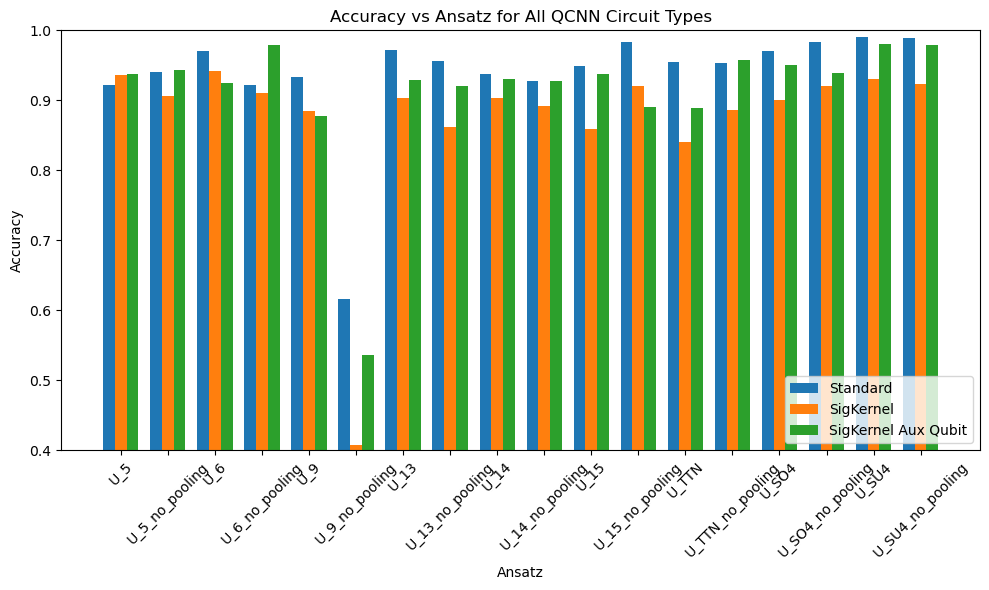
Fig 8 (page 12).
Limitations
- Variational Quantum Linear Solver (VQLS) approach is limited to heavily compressed time series (3-4 time steps) due to rapid increase in problem size and condition number, making it impractical for realistic sequences (~20-50 time steps).
- Heavy downsampling to 15 points reduces fine geometric information in strokes, potentially causing misclassification and limiting ultimate accuracy.
- Empirical evaluations performed only on noiseless statevector simulators; no results on real quantum hardware subject to noise and decoherence.
- Binary classification task on digits 0 vs 1 is a relatively simple proof-of-concept; multi-class or more complex tasks remain unexplored.
- No cross-validation or statistical significance analyses were reported.
- Code and datasets are not publicly released, limiting immediate reproducibility.
Open questions / follow-ons
- How to improve VQLS trainability and scalability for larger time series and more complex kernel PDE systems, potentially via alternative ansatzes such as QAOA-based circuits.
- What is the behavior of these hybrid QCNN architectures on noisy intermediate-scale quantum (NISQ) hardware with realistic noise and finite sampling effects.
- Can multi-class classification be effectively implemented extending beyond the binary 0-vs-1 digit recognition demonstrated.
- How does the signature kernel quantum approach perform on real-world time series datasets with complex temporal distortions and where classical methods struggle.
Why it matters for bot defense
The study presents a novel direction to embed robust, time reparameterization-invariant features of temporal data (via rough path signatures) into quantum neural network architectures, which could influence bot-defense systems analyzing behavioral time series data such as mouse or keystroke dynamics. While current hardware limits practical deployment, the demonstrated fusion of classical and quantum features within QCNNs suggests a path for incorporating richer temporal priors that could improve anomaly detection precision. However, the computational and qubit resource overhead of exact quantum kernel evaluation via VQLS currently restricts applicability. Bot-defense engineers should view this as an early-stage exploration of quantum-enhanced feature extraction rather than an immediately deployable technique. Further advances in scalable quantum solvers and hardware will be required before deployment in latency-constrained CAPTCHA or bot-detection pipelines is feasible.
Cite
@article{arxiv2607_07634,
  title={ QCNN with Rough Path Signature Kernels },
  author={ Leonardo Nogueira Falabella and Vasily Sazonov },
  journal={arXiv preprint arXiv:2607.07634},
  year={ 2026 },
  url={https://arxiv.org/abs/2607.07634}
}