
Ordering and Defect Dynamics in Passive and Active Nematopolars
Source: arXiv:2607.07656 · Published 2026-07-08 · By Fabio Aprile, Massimiliano Semeraro, Giuseppe Gonnella
TL;DR
This paper addresses the complex ordering and defect dynamics in nematopolar systems—materials exhibiting coexisting polar and nematic symmetries that feature both integer and half-integer topological defects. The authors propose and numerically study a novel minimal single-field continuum vector model for dry nematopolar matter that incorporates competing polar and nematic interactions in the free energy and introduces activity via self-advection. By tuning the relative polar-to-nematic alignment strengths, the model captures key phenomenology including depolarization strings connecting half-integer defects, closed depolarization loops, and distinct relaxation mechanisms for defect pairs and loops. Large-scale simulations demonstrate dynamic scaling of characteristic length scales consistent with (t / ln t)^{1/2} growth expected for systems with point-like defects and non-conserved order parameters. Introducing sufficient activity leads to motility-induced charge symmetry breaking—a coexistence of positive integer and negative half-integer defects—and arrested coarsening with saturated length scales. These results unify prior observations in biological and synthetic nematopolar systems within a simple theoretical framework.
Key findings
- At optimal polar-nematic balance (¯k ≈ 0.3), the system spontaneously forms depolarization strings connecting half-integer defects as well as closed depolarization loops separating oppositely polarized domains.
- Oppositely charged half-integer defect pairs connected by strings annihilate with a non-monotonic velocity dependence on ¯k, with annihilation velocity decreasing up to ¯k ~0.3 then slightly increasing (Fig. 2b).
- Like-charged defect pairs connected by strings reach a finite equilibrium separation ℓeq that decreases with increasing ¯k, consistent with minimization of combined interaction and string energies (Fig. 2d).
- Two distinct loop relaxation pathways emerge: curvature-driven shrinking occurs at low ¯k / large ℓnat (nematic-dominated), while continuous polarization rotation and rupture into charged strings occur at large ¯k / small ℓnat (polar-dominated) (Fig. 3).
- Large-scale coarsening from random initial states shows dynamic scaling with characteristic length L(t) growing as (t / ln t)^{1/2}, matching expectations for O(2)/Z_2 order with point defects.
- Strong self-advection Λ leads to motility-induced charge symmetry breaking, with stable coexistence of positive integer and negative half-integer defects and arrested coarsening characterized by saturated length scales.
- Defect density and correlation functions quantitatively characterize ordering dynamics and defect interactions in regimes spanning polar to nematic dominance and passive to active behavior.
Methodology — deep read
The paper begins by defining a minimal continuum free energy functional for a 2D vector polarization field p with competing polar and nematic contributions controlled by parameters kp and kn, and a double-well bulk potential favoring |p|=1. Nematicity arises through a tensor built from p, allowing orientation alignment irrespective of vector direction. The system evolves via a relaxational dynamics equation with a self-advection term scaled by Λ to model activity (Λ=0 passive, Λ>0 active). The molecular field µp driving dynamics splits into bulk, polar elastic, and nematic elastic components derived from the free energy gradients.
Numerical integration uses finite difference schemes on 2D periodic square lattices of size N=512-1024, timestep Δt=10^-2, and lattice spacing ΔN=1 (or 0.5 for loop studies). Simulations run to ~10^6 iterations from random initial disordered states or carefully constructed initial states containing defect pairs or defect loops. The parameter ¯k=kp/kn is varied systematically to explore regimes from polar- to nematic-dominant phases. Other parameters (rotational viscosity Γ, bulk coefficient αp) are fixed to physically relevant values to define natural time and length scales for rescaling observables.
Defect detection uses winding number calculations over lattice plaquettes to locate ±1/2 (half-integer) and ±1 (integer) point defects separately. Two-point correlation functions for polar and nematic order parameters are computed via FFTs and radially averaged to extract characteristic correlation lengths Lp and Ln at fixed correlation thresholds.
Controlled studies of defect dynamics involve initializing pairs of half-integer defects (like- or opposite-charged) connected by strings and monitoring their separation and annihilation velocities as functions of ¯k. Similarly, circular depolarization loops are prepared to investigate relaxation pathways. The observed defect kinetics and loop evolution are quantitatively analyzed against energetic arguments derived from the free energy components. The effects of turning on activity Λ and its impact on defect statistics and coarsening arrest are investigated.
Evaluation involves dynamic scaling analysis of correlation lengths L(t), direct measurement of defect densities and types during coarsening, and comparison with known theoretical scaling laws from O(2) and O(2)/Z2 symmetry-breaking systems. Energetic and morphological features are interpreted to explain defect interaction potentials, string tensions, and the observed dynamical regimes. The authors do not report release of code or datasets explicitly; numerical reproducibility is assured by clear description of parameters and methods.
Technical innovations
- Introduction of a minimal single-field vector model capturing both polar and nematic order through competing free energy terms, enabling study of nematopolar systems without tensorial couplings.
- Implementation of activity via a self-advection term within the relaxational dynamics, bridging passive and active nematopolar behavior.
- Demonstration that depolarization strings and closed loops connecting half-integer defects arise naturally from competing polar-nematic interactions in a single-field framework.
- Discovery of motility-induced charge symmetry breaking in active regimes, featuring coexistence of positive integer and negative half-integer defects and arrested coarsening.
Baselines vs proposed
- Dynamic scaling L(t) from this nematopolar model: L(t) ∼ (t / ln t)^{1/2}, consistent with known growth laws for O(2)/Z2 point defect systems.
- Annihilation velocity of opposite-charged defect pairs: non-monotonic in ¯k (Fig. 2b), with v decreasing from ~0.015 to ~0.008 (in simulation units) around ¯k=0.3, then increasing slightly.
- Equilibrium separation ℓeq between like-charged defect pairs decreases from ~130 units at ¯k=0.05 to ~100 units at ¯k=0.7 (Fig. 2d).
Figures from the paper
Figures are reproduced from the source paper for academic discussion. Original copyright: the paper authors. See arXiv:2607.07656.
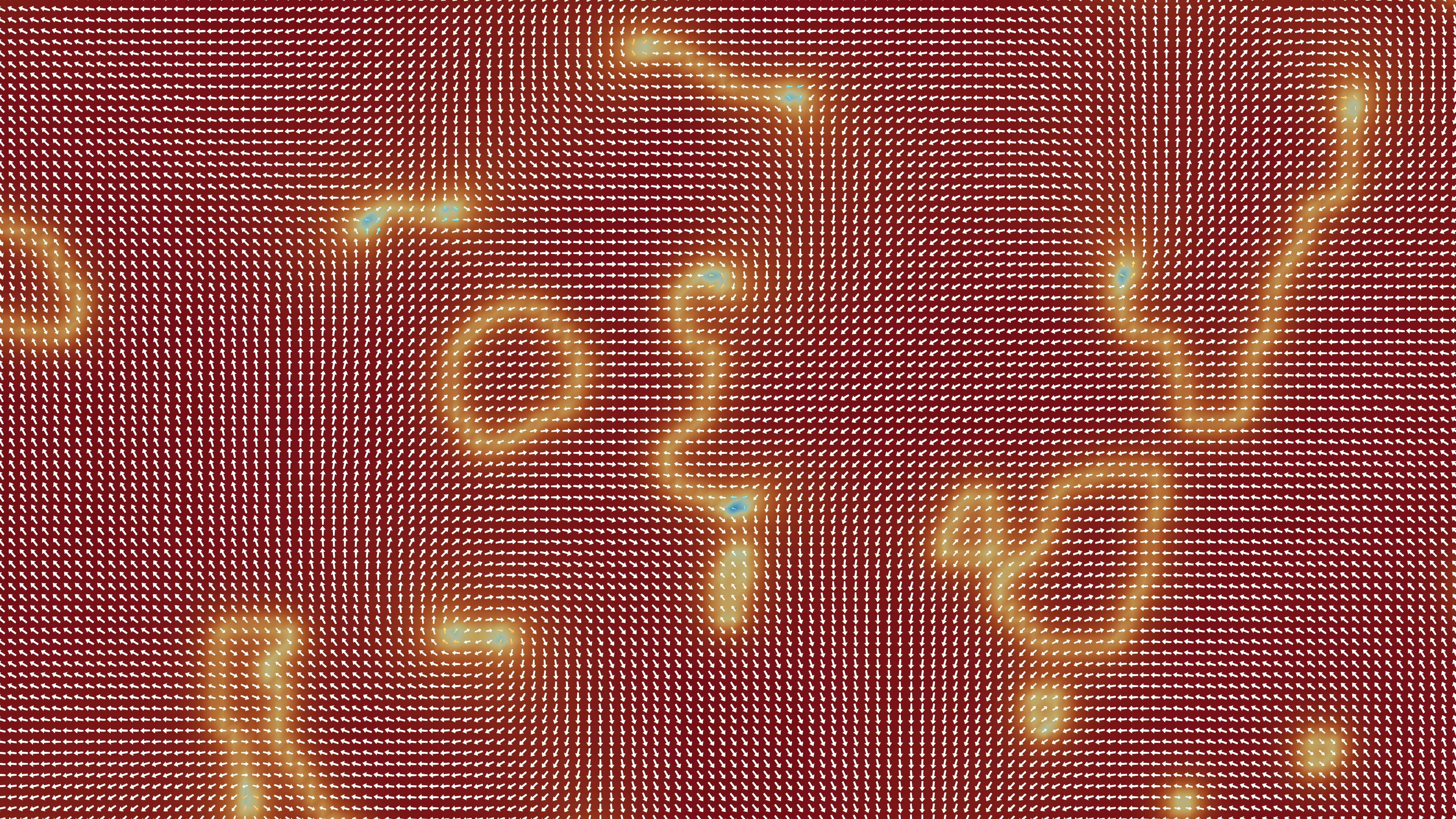
Fig 1: A typical nematopolar configuration with string and loop structures.
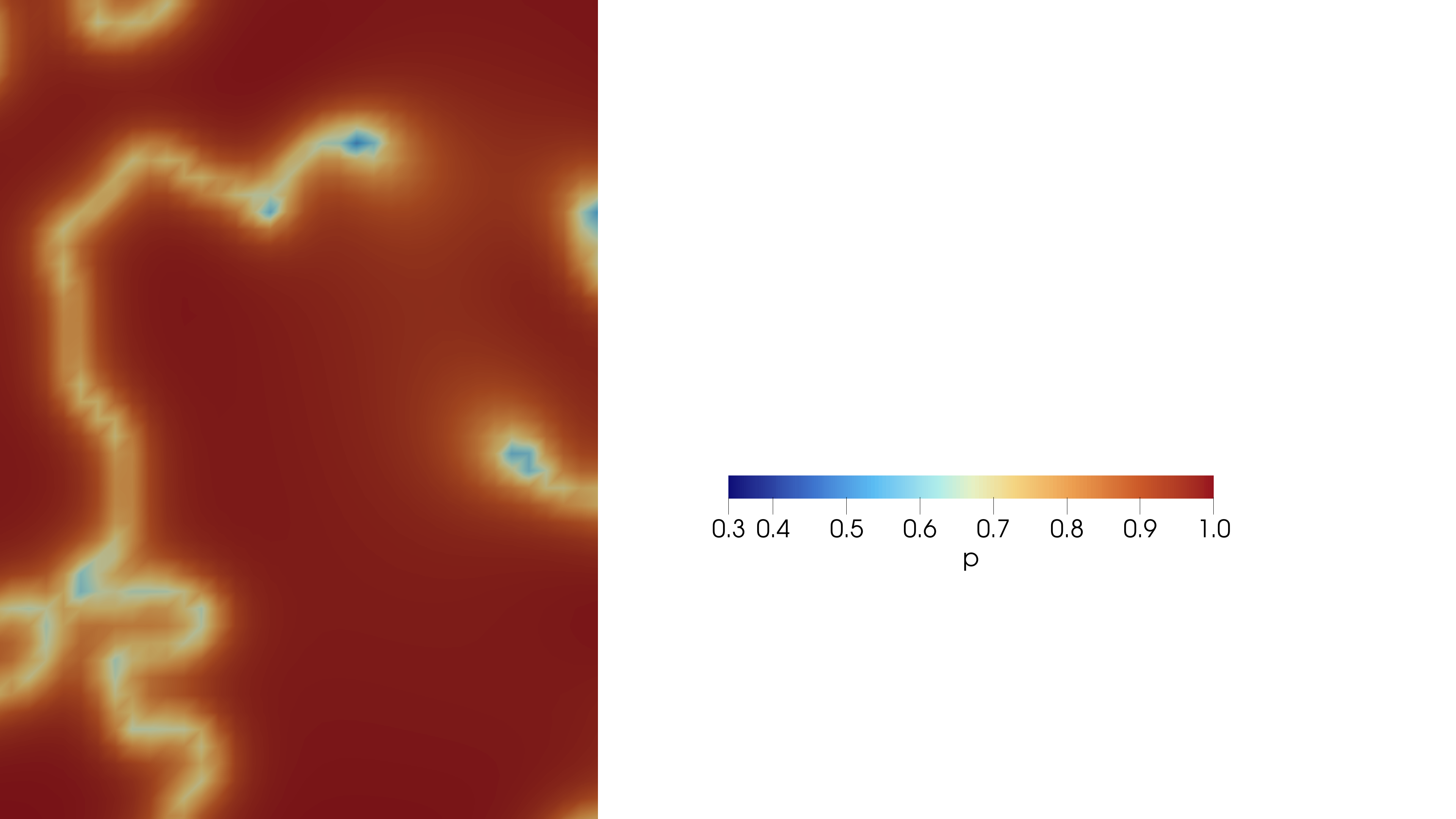
Fig 2: Pairs of half-integer defects in controlled settings.
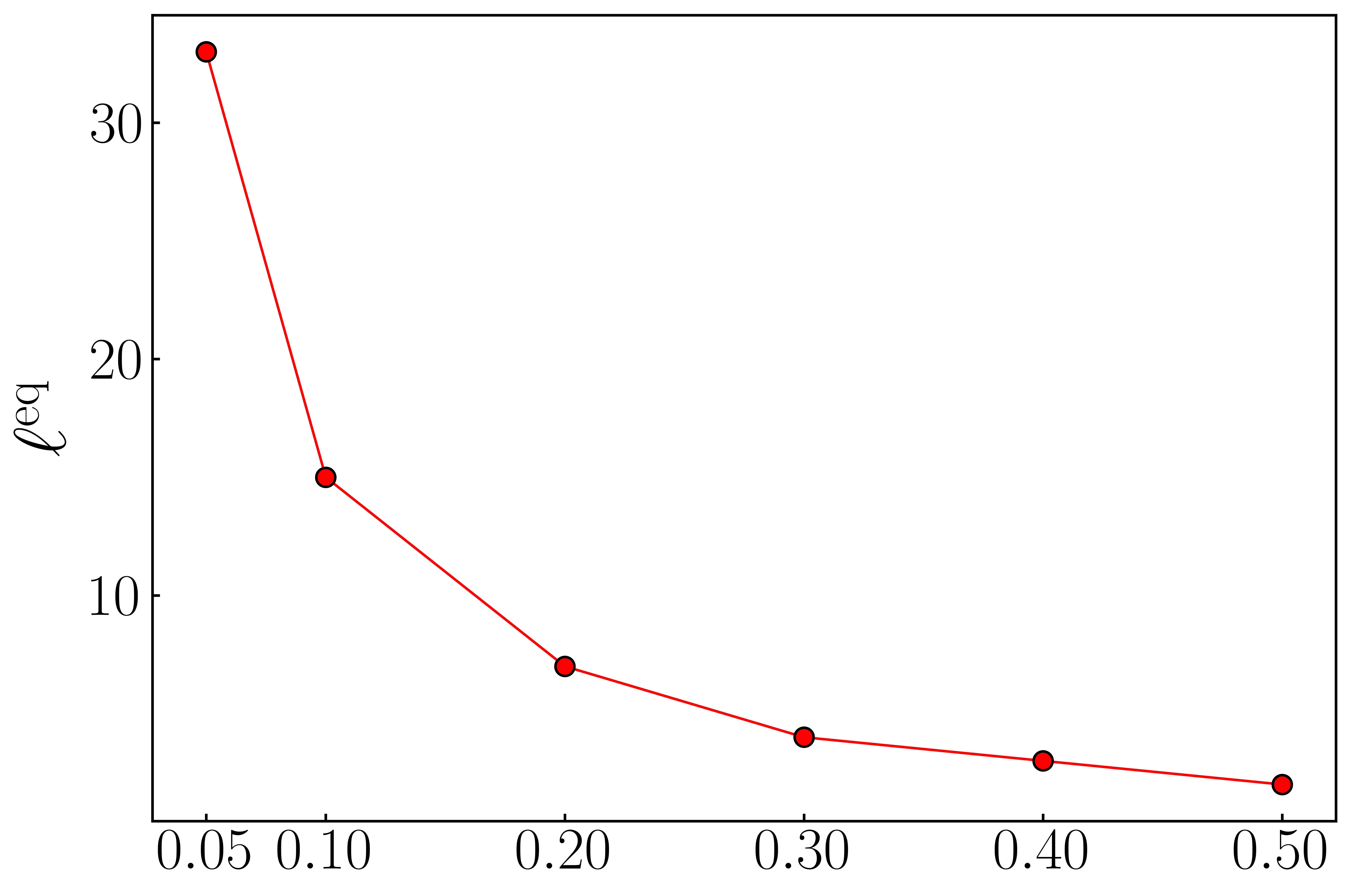
Fig 3: Loop phenomenology: shrinking, rotational relaxation and rupture. (a) to (c) Evolution of a depolarization loop at
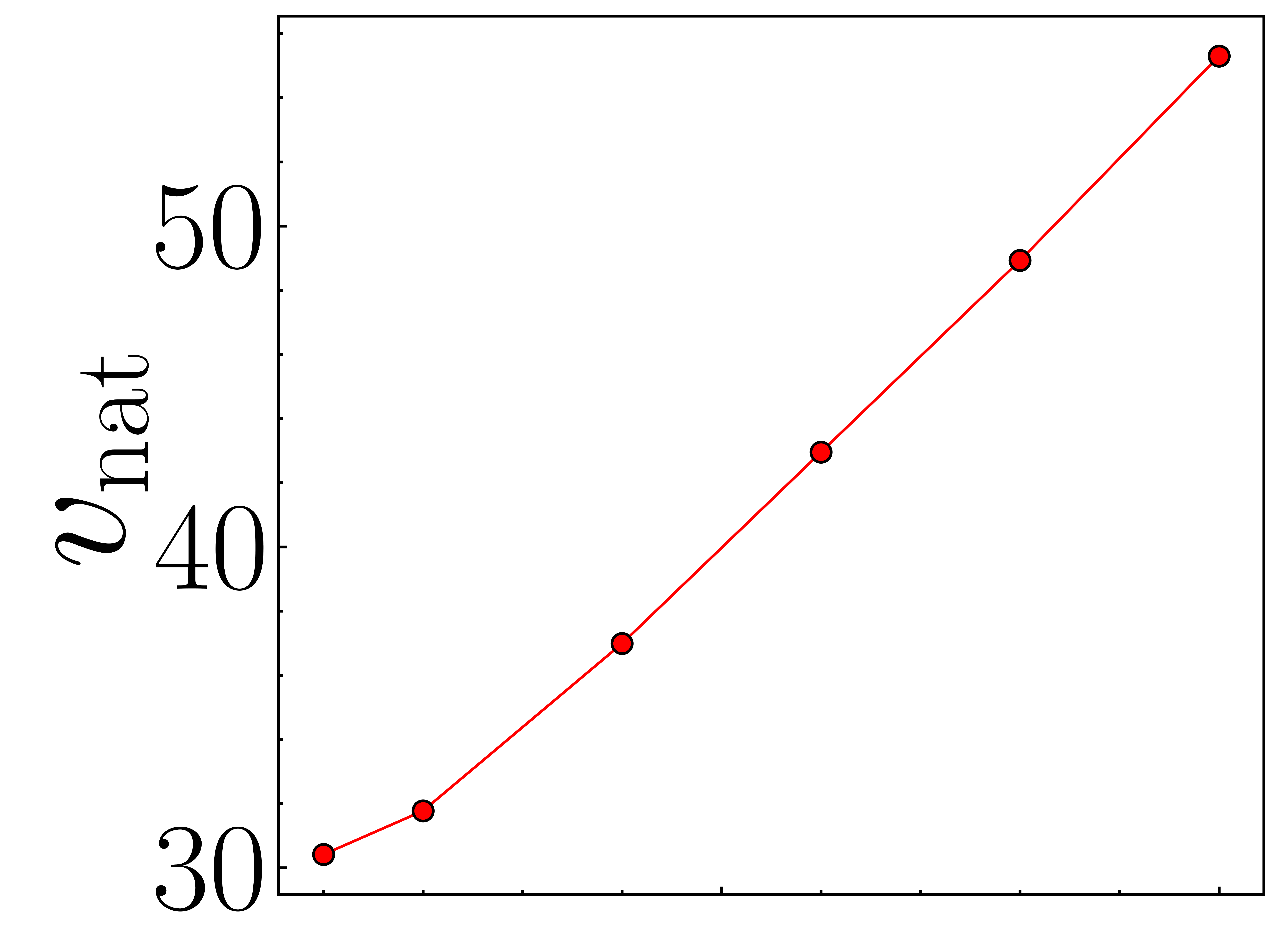
Fig 4 (page 6).
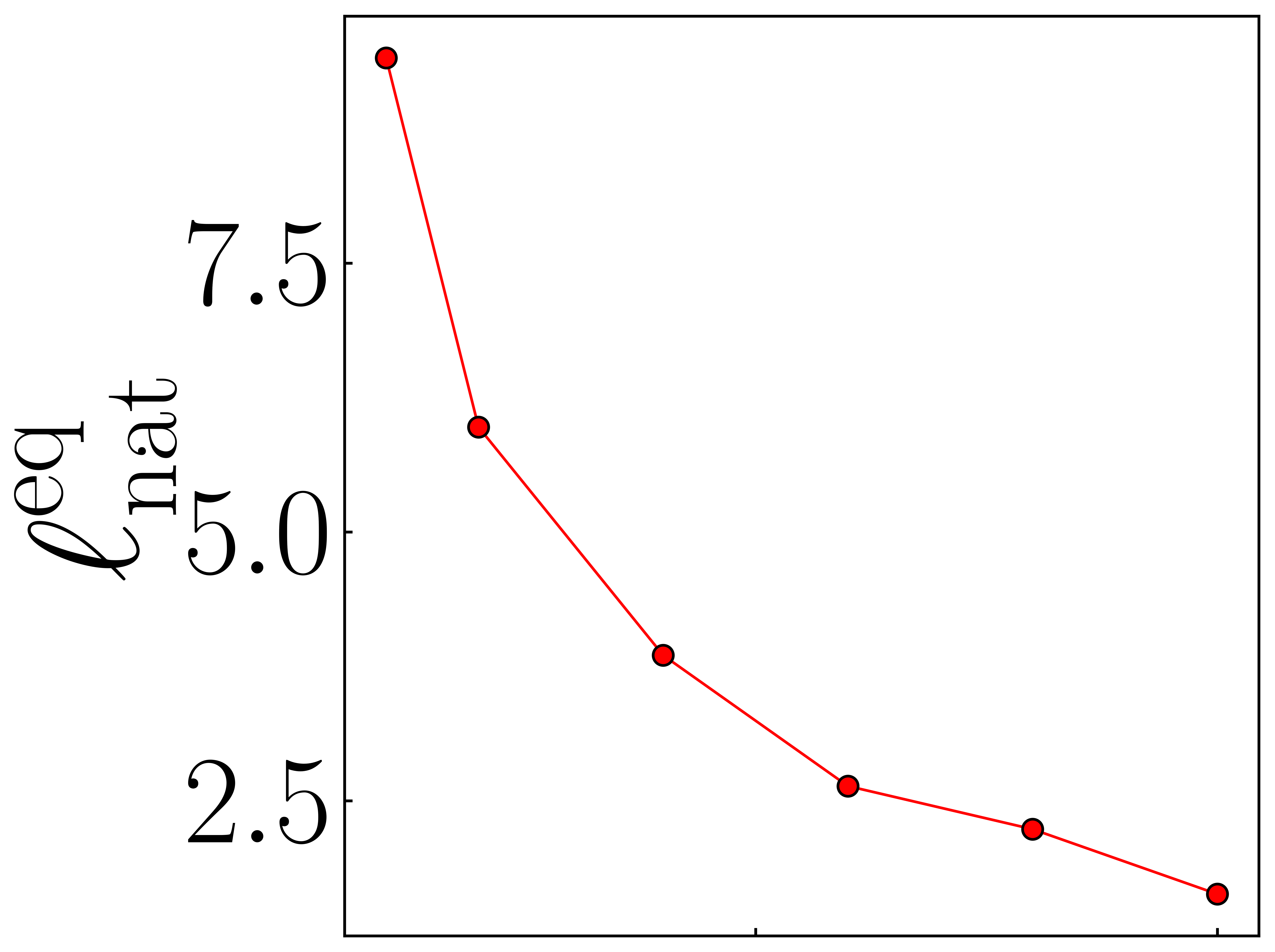
Fig 5 (page 6).
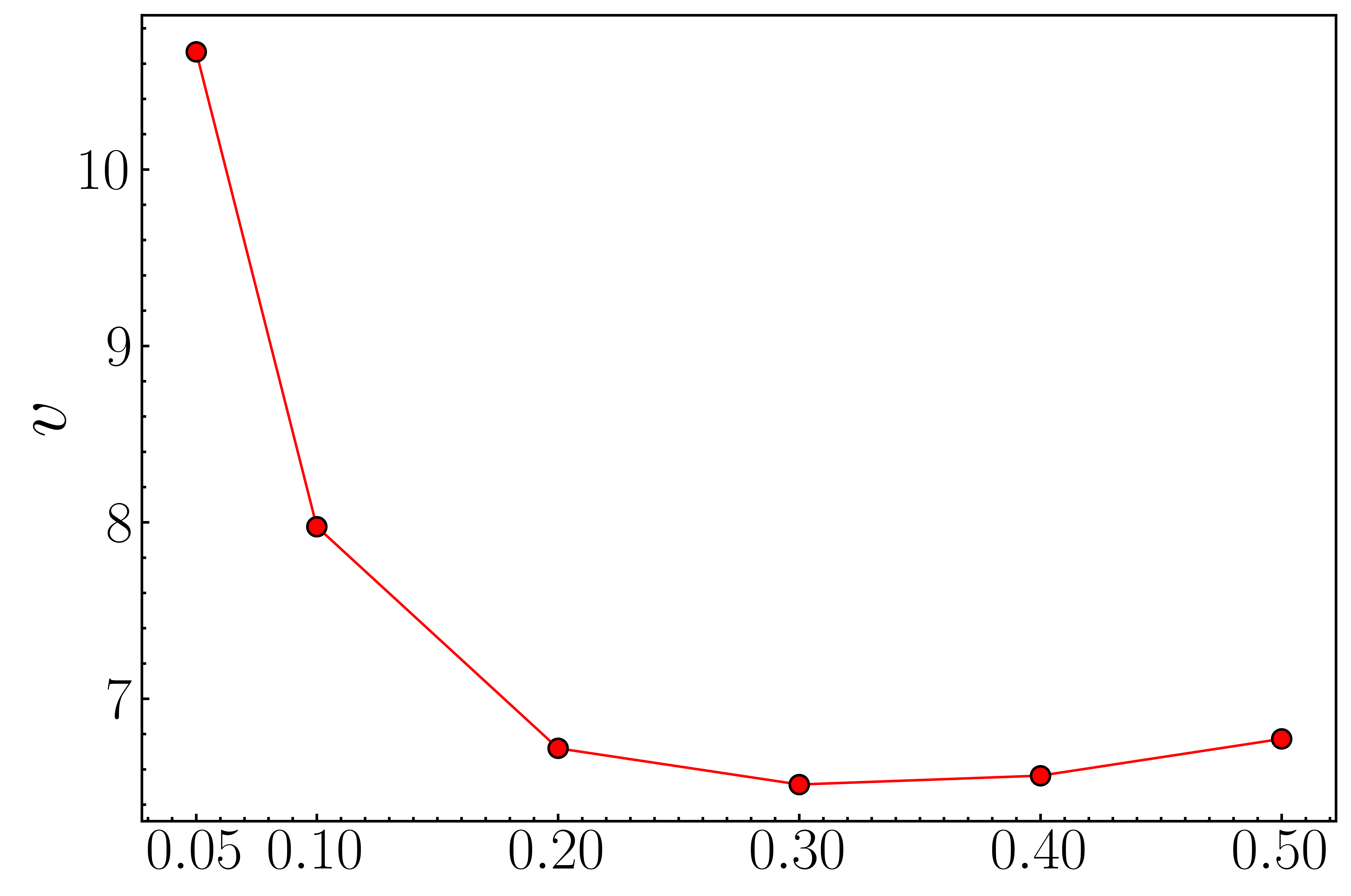
Fig 6 (page 6).
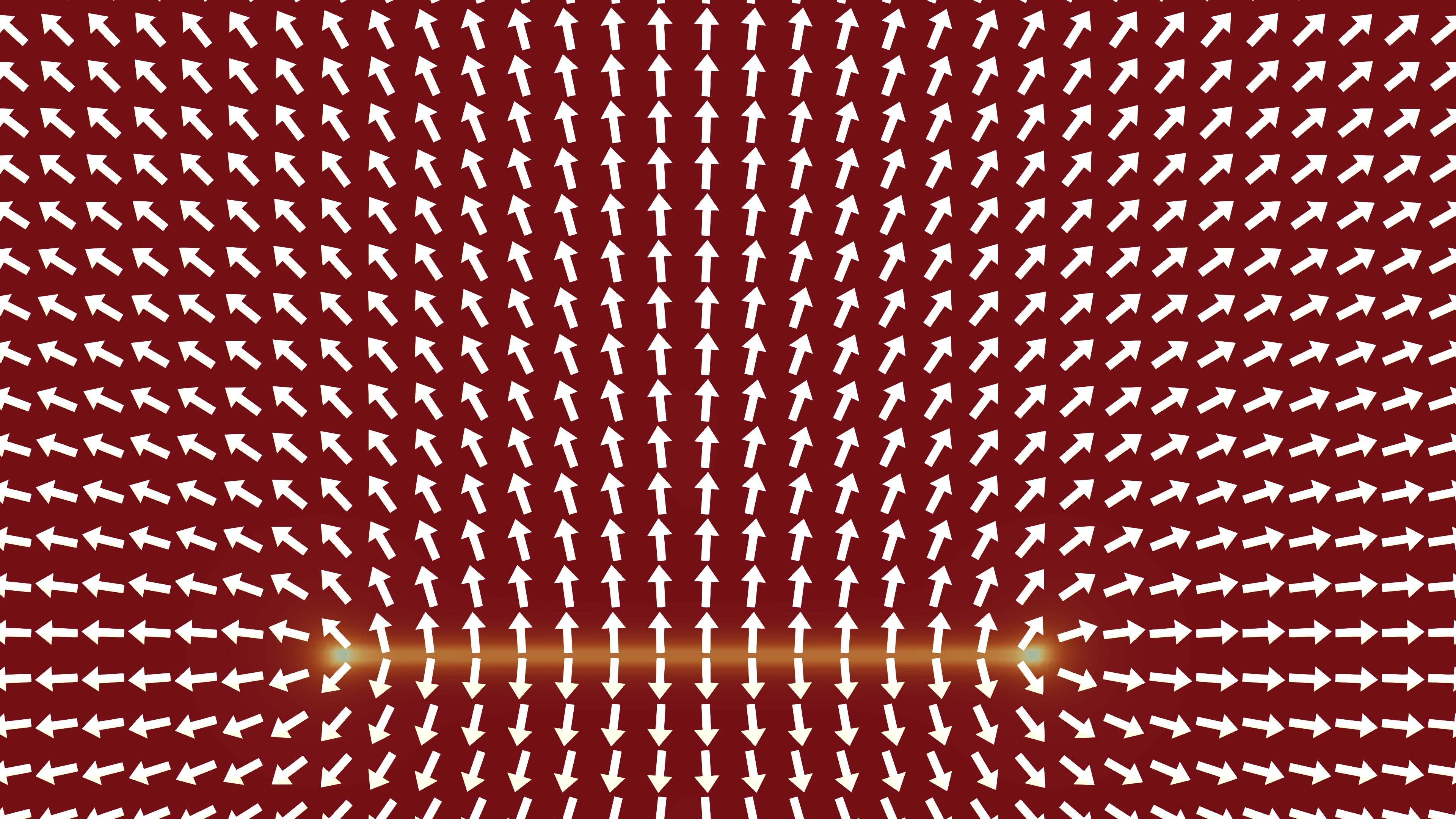
Fig 7 (page 6).
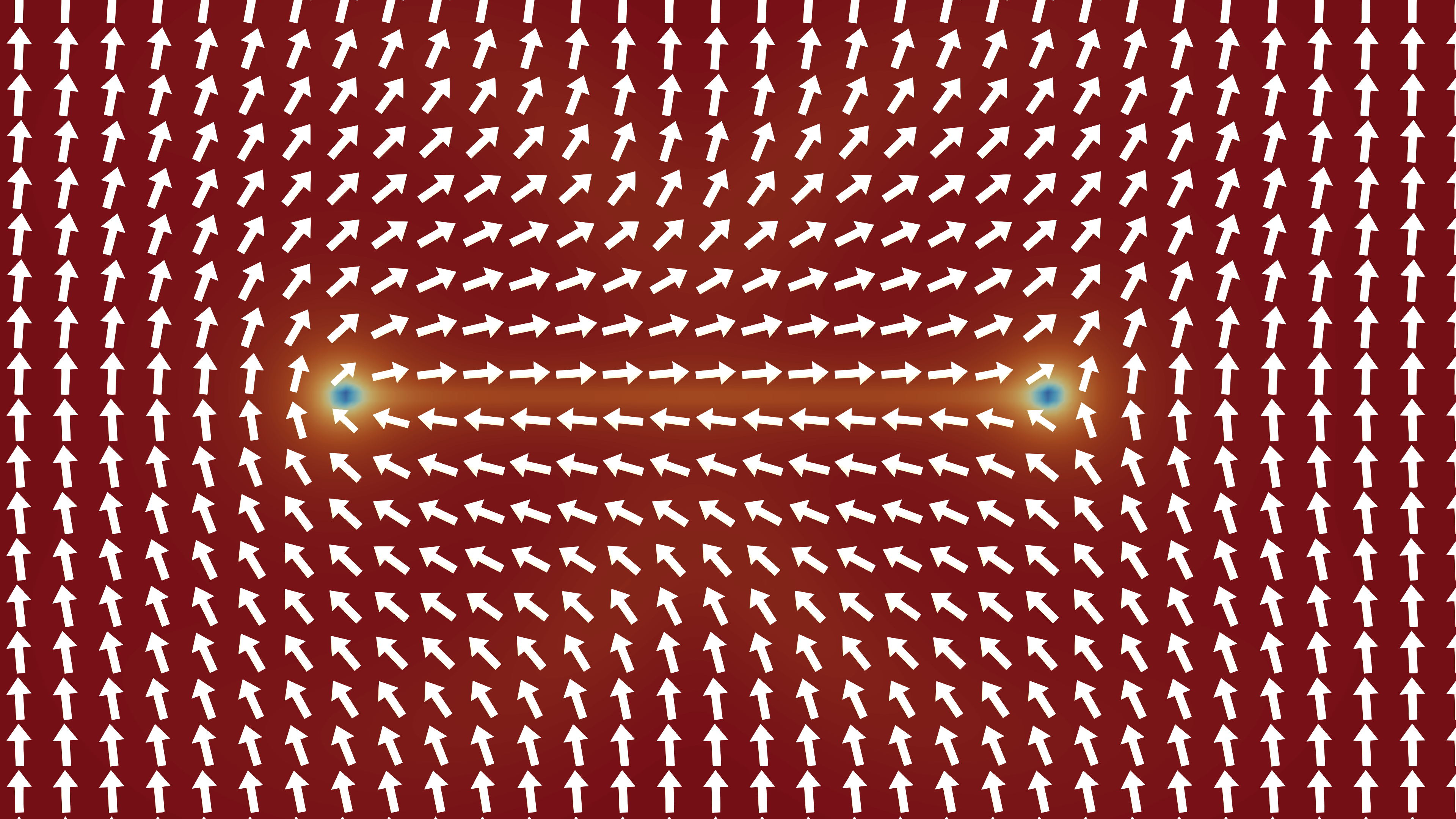
Fig 8 (page 6).
Limitations
- Model is two-dimensional and dry (no hydrodynamics or wet active effects included), limiting applicability to thin films or dry active matter.
- The single-field description abstracts away microscopic multi-component nature of many experimental nematopolar systems.
- No explicit validation against experimental datasets; conclusions are purely numerical and theoretical.
- Parameter sweeps focus mainly on varying relative elastic constants and activity; other physical parameters and noise effects left unexplored.
- Numerical studies rely on finite lattice sizes which may limit observation of very long-time asymptotic behaviors or rare defect events.
- No explicit adversarial or robustness evaluations as relevant to security or bot-detection domains.
Open questions / follow-ons
- How do hydrodynamic couplings and fluid flow affect defect dynamics and coarsening in nematopolar active systems beyond the dry approximation?
- What microscopic particle models correspond exactly to the continuum single-field nematopolar description presented here?
- Can the identified motility-induced charge symmetry breaking phenomena be observed experimentally in biological or synthetic active nematopolar materials?
- How do thermal fluctuations and noise influence loop rupture dynamics and defect-string interactions in both passive and active regimes?
Why it matters for bot defense
While this paper does not directly address bot defense or CAPTCHA systems, the detailed study of competing order parameters and defect dynamics in active media could inspire new classes of behavioral or physical challenge-response mechanisms. Specifically, the complex spatiotemporal defect patterns—half-integer and integer charges connected by strings and loops—could motivate novel signal signatures or biomimetic challenges where automated scripts must identify or interact with evolving topological patterns, potentially increasing robustness against automated attacks. Additionally, the characterization of arrested coarsening and dynamic scaling laws provides a framework to model persistent, structured temporal patterns that are difficult to spoof. However, applying these physical phenomena directly would require significant adaptation given the abstract nature of this research.
Cite
@article{arxiv2607_07656,
  title={ Ordering and Defect Dynamics in Passive and Active Nematopolars },
  author={ Fabio Aprile and Massimiliano Semeraro and Giuseppe Gonnella },
  journal={arXiv preprint arXiv:2607.07656},
  year={ 2026 },
  url={https://arxiv.org/abs/2607.07656}
}