
Koopman Spectral Analysis of Lithium-Ion Battery Dynamics: State of Charge as a Marginally Stable Observable
Source: arXiv:2607.07594 · Published 2026-07-08 · By Bakhtiar Nafis, Khalid Mahmud Labib, Saad Waheed, Shabbir Ahmed
TL;DR
This paper addresses the longstanding challenge of accurately estimating the state of charge (SOC) in lithium-ion batteries, which is difficult due to nonlinear, time-varying electrochemical dynamics influenced by operating conditions and aging. Conventional methods like equivalent circuit models (ECM) combined with extended Kalman filters (EKF) require repeated parameter identification and suffer from modeling uncertainties, while pure data-driven models lack physical interpretability. The authors propose a novel data-driven framework leveraging Koopman operator theory, specifically Dynamic Mode Decomposition with Control (DMDc) combined with Hankel time-delay embedding, to identify a linear lifted representation of the nonlinear battery dynamics directly from measured terminal voltage and current data obtained from Hybrid Pulse Power Characterization (HPPC) tests. This approach does not require explicit identification of ECM parameters.
Spectral decomposition of the learned DMDc operator reveals intrinsic battery dynamic modes as Koopman eigenvalues and eigenvectors. The SOC emerges as the slowest, marginally stable mode with an eigenvalue closest to the unit circle, consistent with SOC's integrator-like behavior derived from charge conservation physics. The corresponding modal coordinate is used as a physically interpretable SOC-sensitive observable. Validation using experimental HPPC data shows that the proposed Koopman-DMDc method reconstructs terminal voltage with an RMSE of 0.0131 V and estimates SOC with an RMSE of 0.0043%, outperforming traditional Coulomb counting and an EKF benchmark based on a 2RC equivalent circuit model. This demonstrates that Koopman spectral analysis can provide an accurate, interpretable, and computationally efficient pathway for data-driven SOC estimation, avoiding explicit physical modeling and parameter tuning.
Key findings
- The proposed DMDc-based method reconstructs terminal voltage with a root-mean-square error (RMSE) of 0.0131 V compared to 0.0439 V RMSE for the extended Kalman filter (EKF) benchmark.
- SOC estimation RMSE using the DMDc framework is 0.0043%, outperforming Coulomb counting RMSE of 0.0047% and EKF RMSE of 0.0078%.
- The Koopman eigenvalue associated with SOC dynamics is identified as λ_SOC = 1.000001, lying closest to the unit circle, reflecting marginal stability and integrator-type behavior consistent with charge conservation.
- Equivalent circuit model (2RC ECM) parameters exhibit significant variation across SOC regions, undermining EKF performance and requiring frequent recalibration, which the DMDc framework avoids.
- Hankel time-delay embedding dimension of 2000 was used to lift voltage signals into a high-dimensional observable space, enabling accurate linear approximation of nonlinear battery dynamics via DMDc.
- The DMDc approach successfully captures both fast transient voltage pulses and slow quasi-static relaxation dynamics within a unified framework from measured current and voltage data.
- DMDc model trained on approximately 75% of the experimental HPPC data generalizes well, maintaining bounded voltage prediction errors during held-out test portions including high-rate current pulses.
- The SOC modal coordinate extracted from Koopman modes requires min-max normalization to map into physically meaningful SOC units but provides a direct and physically interpretable estimator.
Methodology — deep read
Threat Model & Assumptions: The adversary perspective is not the focus here as this is a system modeling and state estimation study rather than a security paper. The model assumes access only to external measurements: terminal voltage and current during HPPC testing. The SOC cannot be directly measured, so it is inferred from these signals. The nonlinear battery dynamics, parameter variations due to temperature and aging are acknowledged but not attacked.
Data: The experimental dataset comes from Hybrid Pulse Power Characterization (HPPC) tests on lithium-ion cells providing voltage and current time series. The dataset includes both charging and discharging pulses with relaxation intervals across the full state-of-charge operating range. Approx. 75% of the data is used for training and 25% for validation to assess generalization. No explicit data augmentation or preprocessing besides Hankel time-delay embedding is reported.
Architecture/Algorithm: The method constructs a Hankel matrix by time-delay embedding measured voltage signals with an embedding dimension of 2000 to lift observables into a high-dimensional space (observable space). Dynamic Mode Decomposition with Control (DMDc) is then applied to input-output snapshots of the voltage states and current inputs to identify a linear state-space model x_{k+1} = A x_k + B u_k, where A models the autonomous lifted system dynamics, and B encodes how current inputs affect the state.
The Koopman operator framework underpins this setup by representing nonlinear battery dynamics as a linear operator on observable functions. Spectral decomposition of matrix A yields eigenvalues and eigenvectors (modes), representing distinct dynamic components.
Training Regime: The best-fit operators are solved via least squares using Moore-Penrose pseudoinverse with truncated singular value decomposition for numerical stability. Hyperparameters such as embedding dimension and data splits are fixed as stated. No explicit mention of epochs or iterative training since the method is not iterative learning but a regression-based operator identification.
Evaluation Protocol: Root-mean-square error (RMSE) and mean absolute error (MAE) metrics are computed to evaluate voltage reconstruction and SOC estimation accuracy against held-out test data. The proposed DMDc method is benchmarked against Coulomb counting and a 2RC ECM-based EKF algorithm with carefully identified parameters. Voltage prediction errors are analyzed pointwise over the entire HPPC test cycle to assess transient and steady-state performance.
Reproducibility: While the paper details the methodology with equations and parameters, no explicit code release or dataset sharing is mentioned. The experimental HPPC data appears proprietary or from standard benchmarks. The methodology is based on published mathematical methods (DMDc, Hankel embedding) with prior work cited.
Concrete Example: Terminal voltage time series from HPPC test are embedded using Hankel embedding to form a high-dimensional state space. DMDc regression identifies A and B matrices from these voltage and current snapshots. Eigen-decomposition of A yields Koopman eigenvalues and modes. The mode with eigenvalue nearest 1 is identified as the SOC mode. Projecting the Hankel voltage matrix onto these modes recovers modal coordinates, with the SOC modal coordinate undergoing min-max normalization to produce SOC estimates. These estimates closely track reference SOC computed from discharge capacity measurements and outperform EKF and Coulomb counting.
Technical innovations
- Application of Dynamic Mode Decomposition with Control (DMDc) combined with Hankel time-delay embedding to learn a lifted linear state-space model of lithium-ion battery dynamics directly from input-output data without explicit physical model parameterization.
- Identification of the state-of-charge (SOC) as the Koopman eigenmode whose eigenvalue lies closest to the unit circle, reflecting the marginally stable, integrator-type nature of charge conservation dynamics.
- Demonstration that the Koopman spectral decomposition naturally separates fast transient and slow quasi-static battery dynamics without requiring parameter tuning inherent in equivalent circuit models or extended Kalman filters.
- Use of the modal coordinate associated with the SOC Koopman eigenvalue as a physically interpretable SOC-sensitive observable that enables accurate data-driven SOC estimation.
Datasets
- Hybrid Pulse Power Characterization (HPPC) test data — size not explicitly stated — experimental lithium-ion cell measurements
Baselines vs proposed
- Voltage Reconstruction RMSE: EKF (2RC ECM) = 0.0439 V vs proposed DMDc = 0.0131 V
- SOC Estimation RMSE: Coulomb counting = 0.0047% vs EKF = 0.0078% vs proposed DMDc = 0.0043%
Figures from the paper
Figures are reproduced from the source paper for academic discussion. Original copyright: the paper authors. See arXiv:2607.07594.
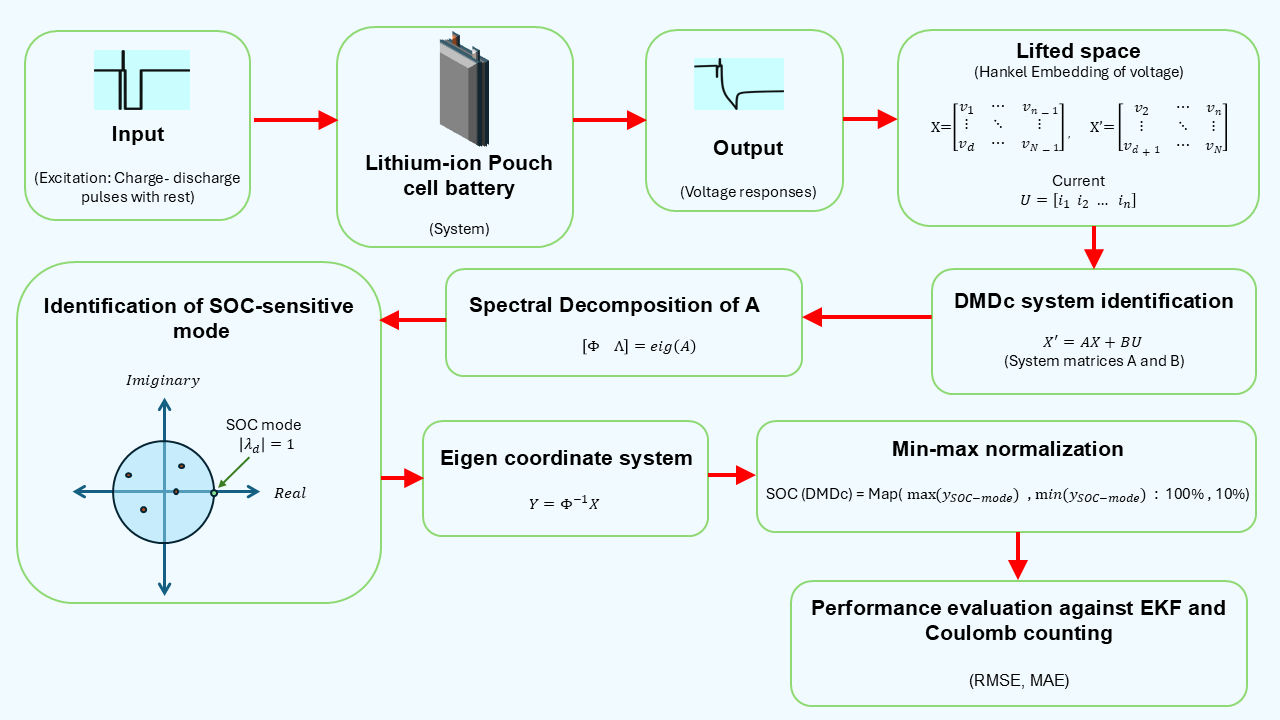
Fig 1: Workflow of the proposed DMDc-based SOC estimation framework.
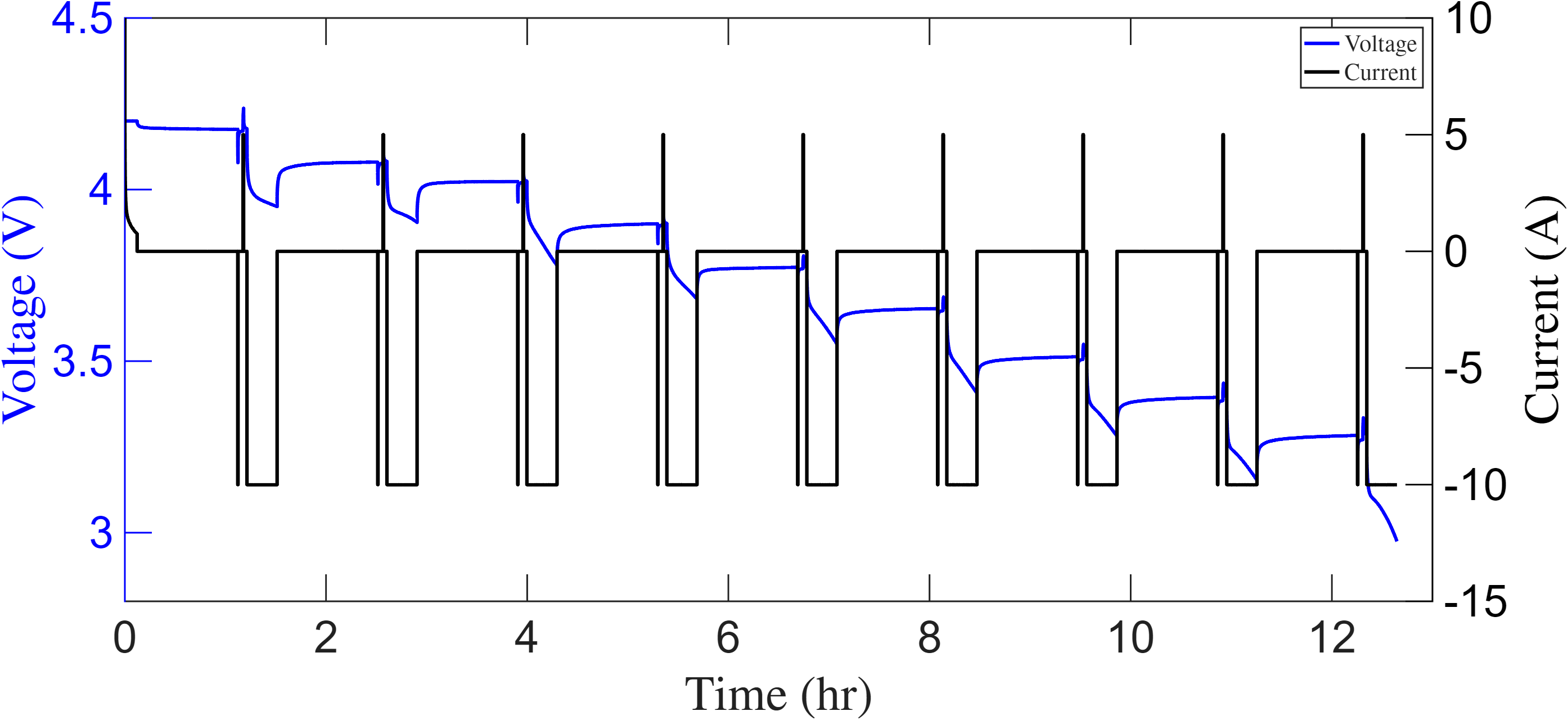
Fig 2: DMDc-based terminal voltage prediction evaluated on the full HPPC test cycle. (A) Hy-
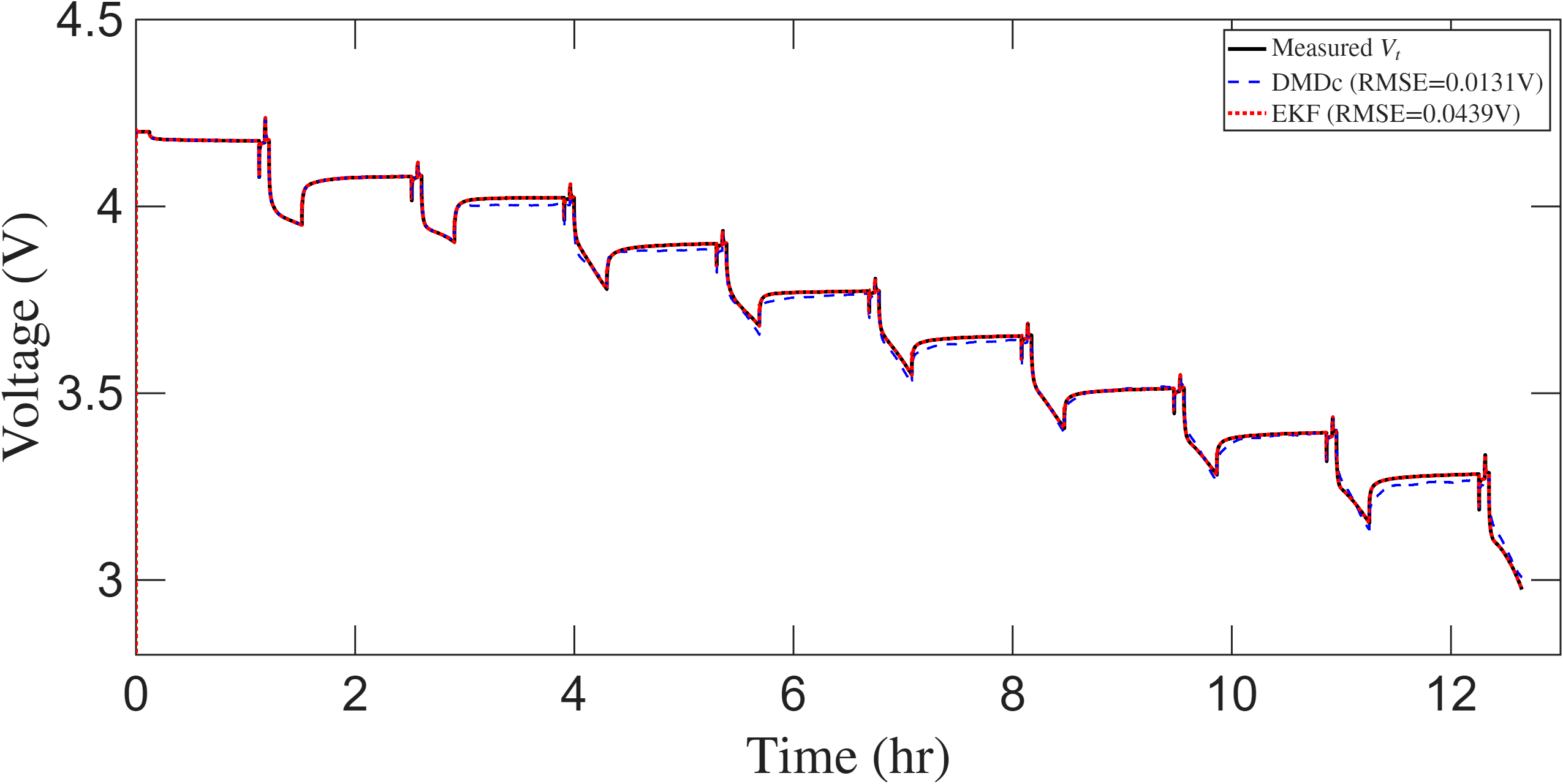
Fig 3: Koopman-theoretic analysis of Li-ion battery dynamics via DMDc. (A) Eigenvalues of
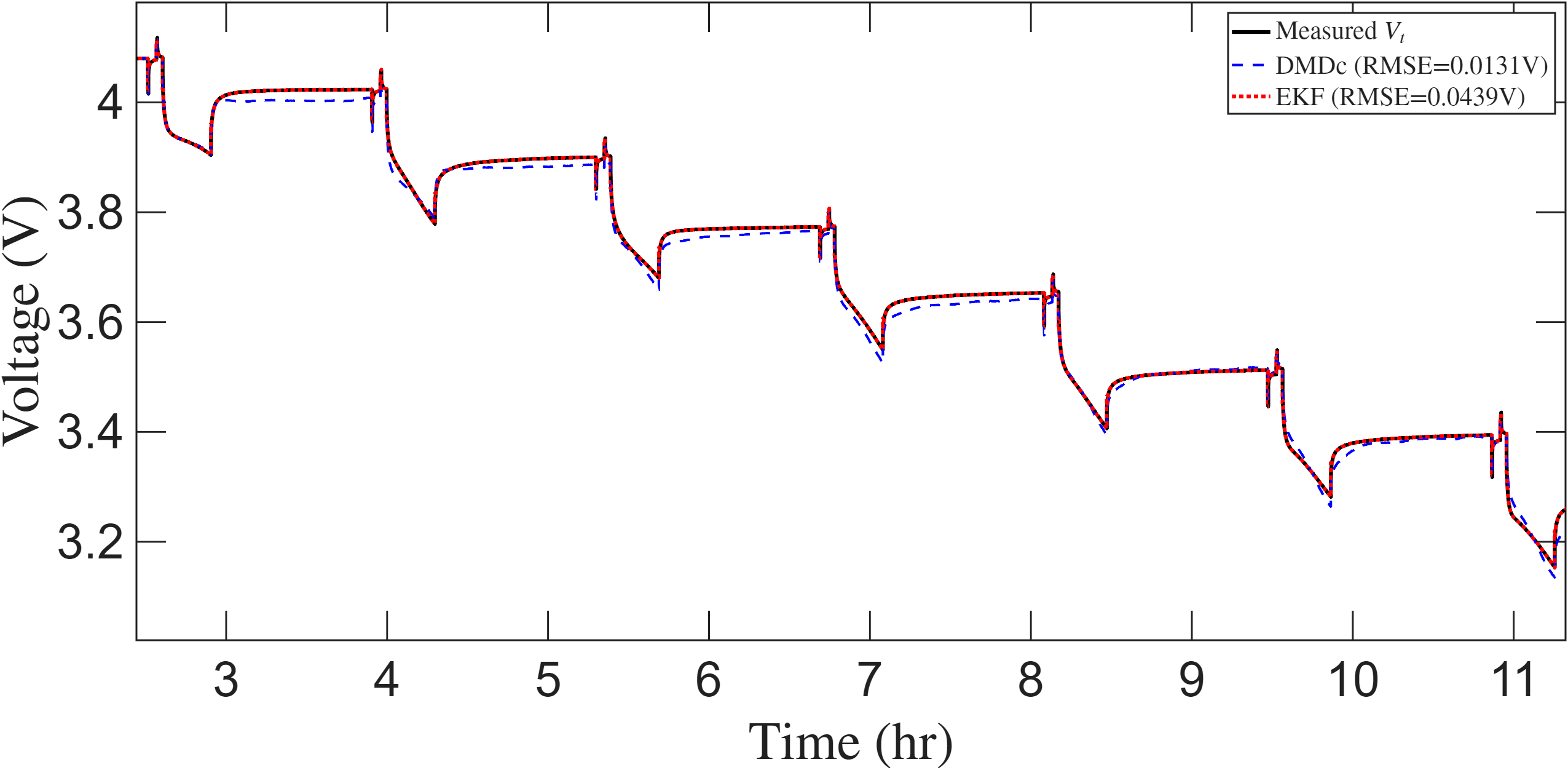
Fig 4 (page 8).
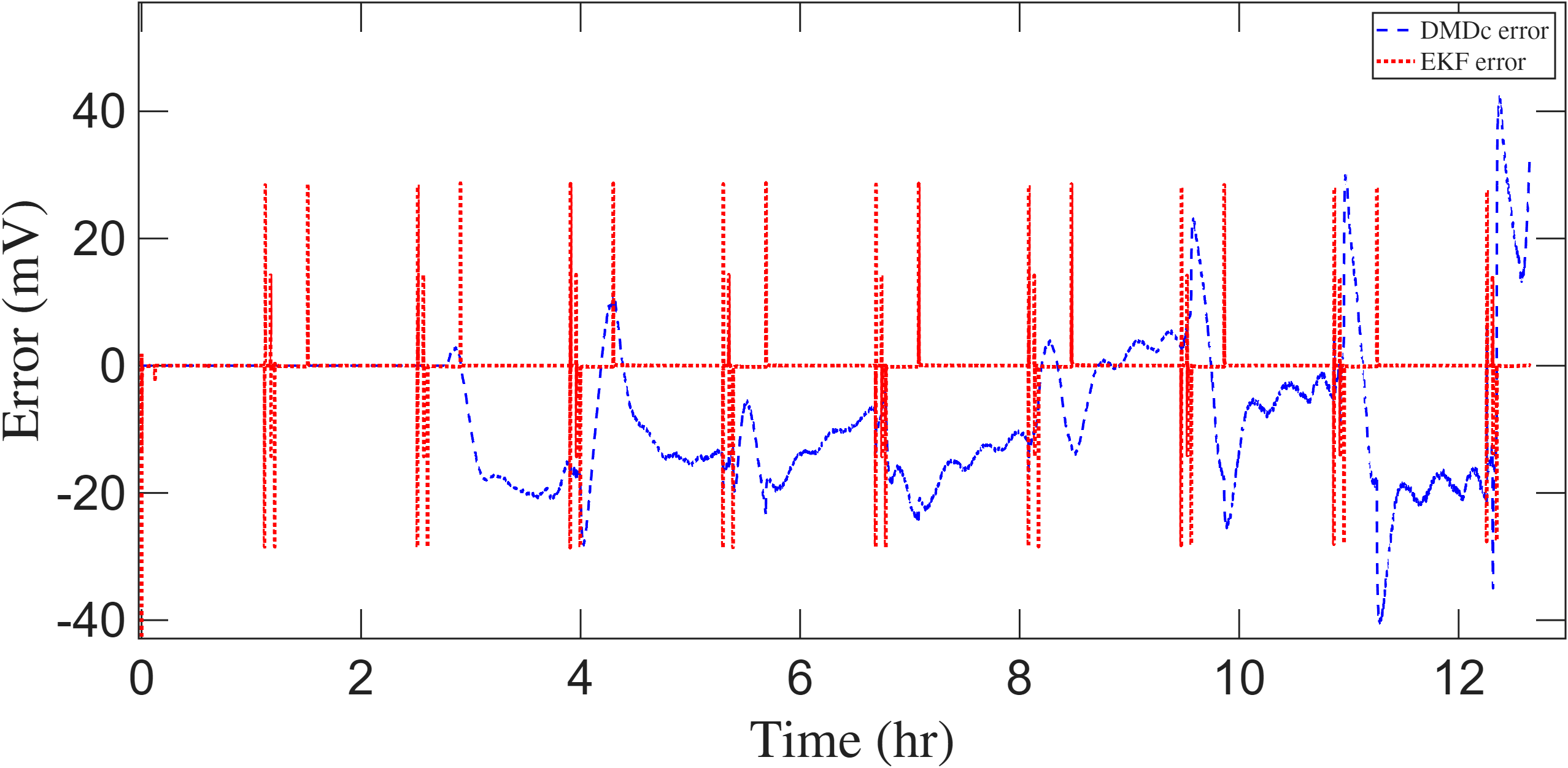
Fig 5 (page 8).
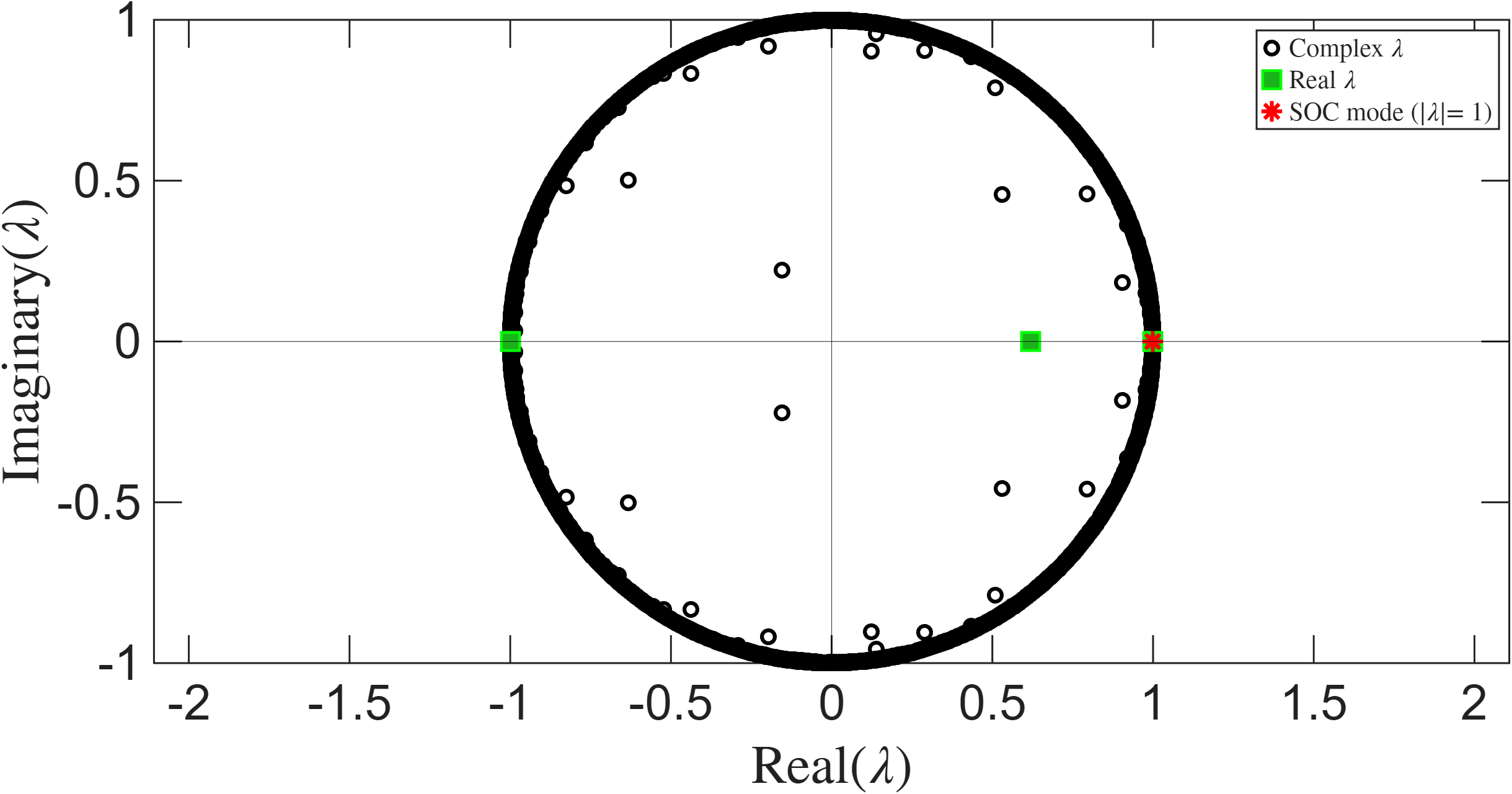
Fig 6 (page 9).
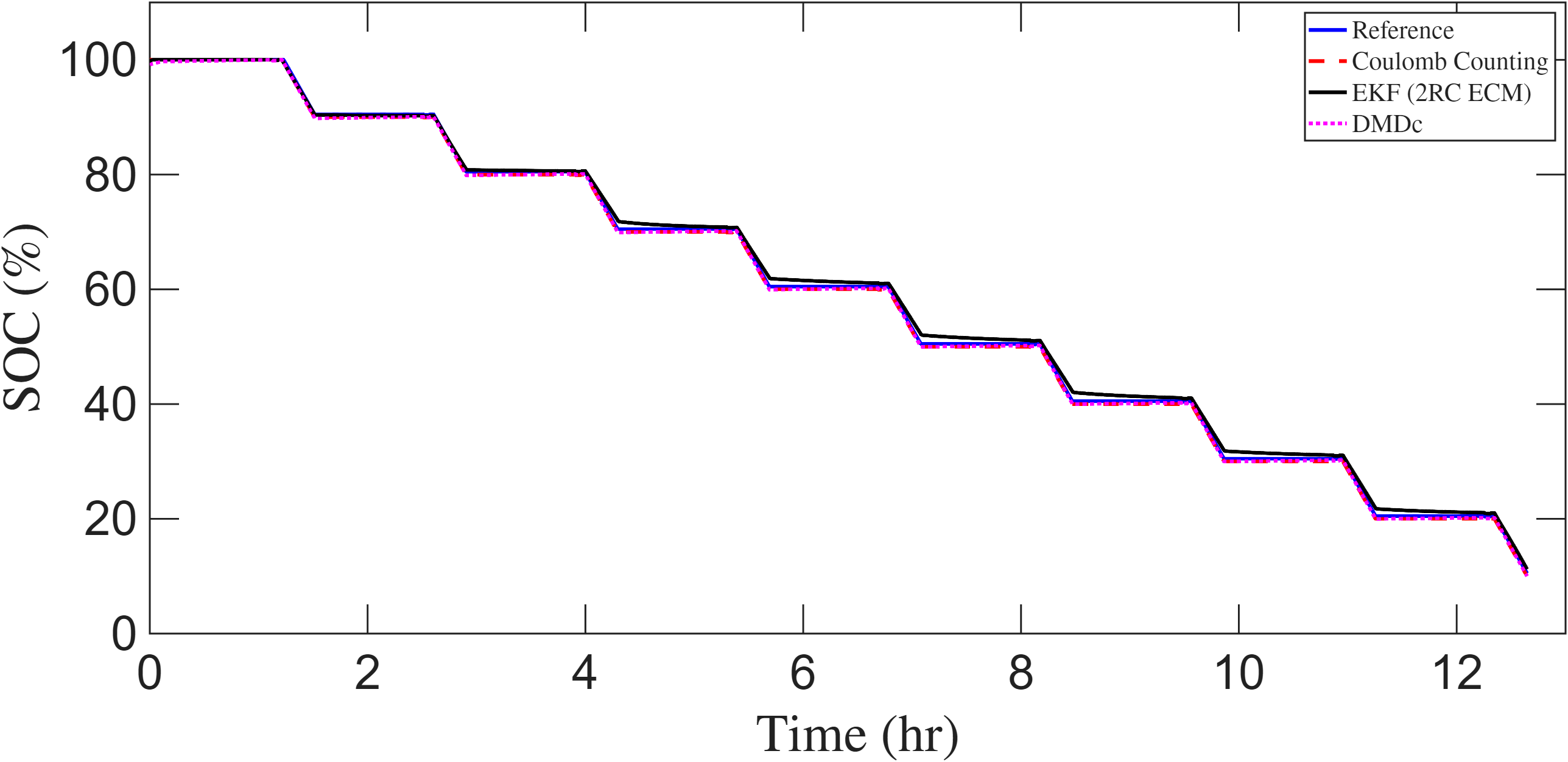
Fig 7 (page 9).
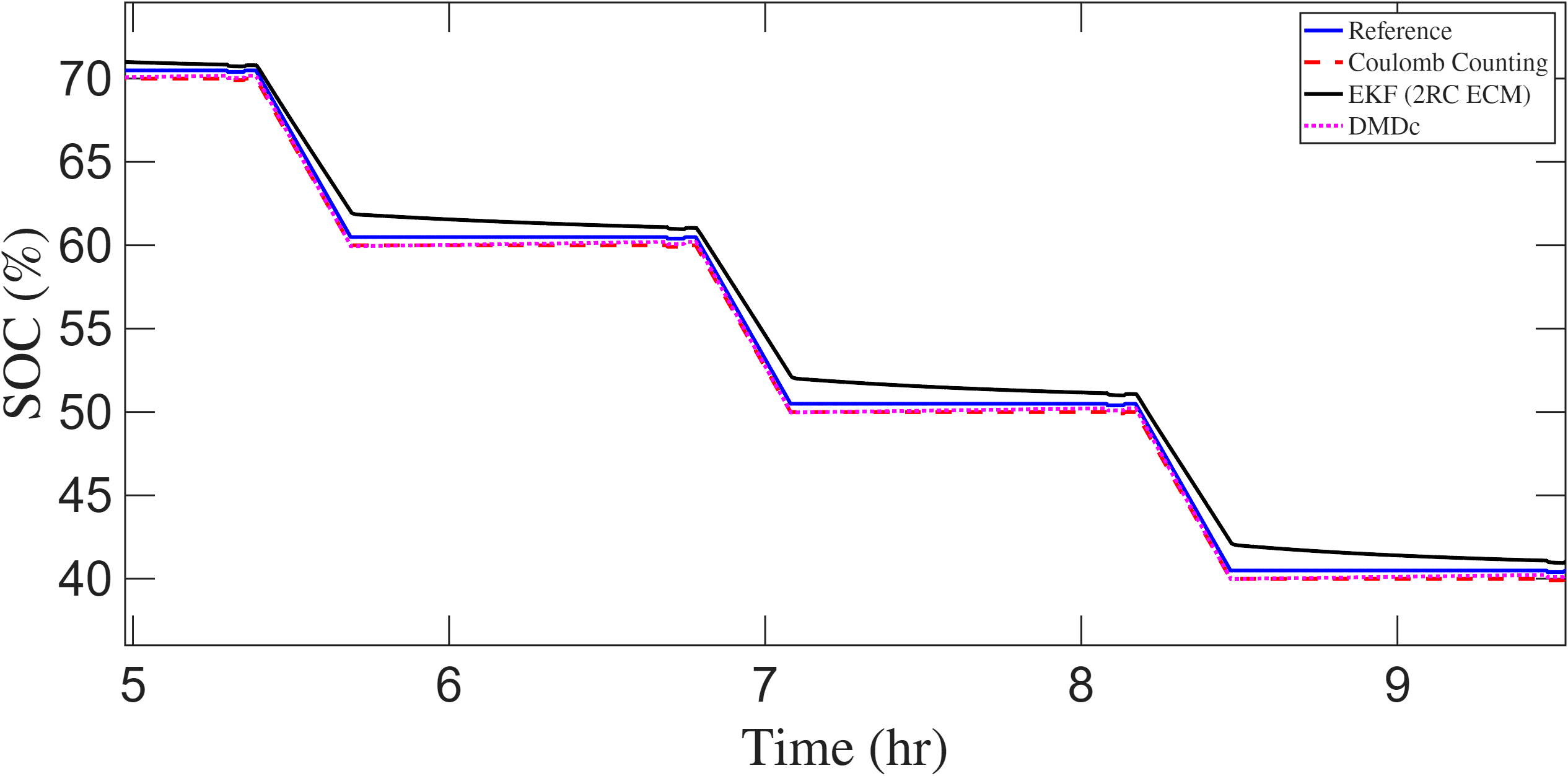
Fig 8 (page 9).
Limitations
- The SOC-sensitive modal coordinate requires post hoc min-max normalization to produce SOC estimates in physical units, lacking a direct calibrated mapping.
- The Koopman-DMDc approach assumes a globally linear approximation in the lifted observable space, which may be insufficient to capture strong nonlinearities due to temperature, hysteresis, aging, or current rate variations.
- Battery aging and parameter drift can alter Koopman spectral structure, requiring model updates or retraining; the robustness to aging is not evaluated here.
- Mode mixing may occur where multiple electrochemical processes coexist within a single Koopman mode, limiting one-to-one correspondence between modes and physical states.
- No explicit assessment under out-of-distribution operating conditions, severe degradation states, or varying temperature environments was performed.
- Lack of released code or public datasets limits immediate reproducibility.
Open questions / follow-ons
- How to develop a rigorous quantitative mapping from Koopman modal coordinates to SOC values in physical units without relying on ad hoc normalization?
- Can nonlinear observable lifting strategies or adaptive Koopman representations improve robustness to strong battery nonlinearities, temperature variation, and aging-induced parameter drift?
- How does the Koopman spectral decomposition evolve with battery aging, and can long-term eigenvalue changes be exploited for state-of-health (SOH) estimation or degradation diagnostics?
- What are the practical challenges and solutions for real-time embedded implementation of Koopman-DMDc based SOC estimation in commercial battery management systems?
Why it matters for bot defense
From a bot-defense or CAPTCHA engineering perspective, this work is primarily relevant as an example of using Koopman operator theory and data-driven spectral decomposition to extract interpretable latent states from complex nonlinear dynamical systems solely from input-output data. The methodology illustrates how time-delay embeddings combined with operator-theoretic frameworks can identify physically meaningful modes underlying complicated dynamics, even when explicit mechanistic parameter identification is difficult or unreliable.
Practitioners designing bot-detection or CAPTCHA defenses may draw parallels wherein complex adversarial behavior over time could be abstracted into latent modes using similar spectral methods, separating marginally stable (persistent) from quickly decaying or oscillatory behaviors. The careful identification of marginally stable modes analogous to the integrator-type SOC mode might inspire algorithms to isolate bot-like behavior patterns that remain consistent over long intervals. Additionally, the general notion of combining Hankel embeddings with controlled dynamic mode decomposition to robustly learn system representations from noisy, nonlinear input-output data has potential cross-domain applicability in behavioral biometrics or traffic analysis defense techniques.
Cite
@article{arxiv2607_07594,
  title={ Koopman Spectral Analysis of Lithium-Ion Battery Dynamics: State of Charge as a Marginally Stable Observable },
  author={ Bakhtiar Nafis and Khalid Mahmud Labib and Saad Waheed and Shabbir Ahmed },
  journal={arXiv preprint arXiv:2607.07594},
  year={ 2026 },
  url={https://arxiv.org/abs/2607.07594}
}