
Coherent Signal Detection with Pruning -- I. Finding Short-Period Binary Pulsars in Circular Orbits
Source: arXiv:2607.07700 · Published 2026-07-08 · By Pravir Kumar, Barak Zackay
TL;DR
This paper addresses the computational challenge of detecting short-period binary pulsars in circular orbits via fully coherent phase models. Rapid orbital motion modulates the pulsar’s spin frequency, requiring dense searches over high-dimensional orbital parameter spaces that quickly become computationally prohibitive with traditional brute-force or low-order polynomial approaches such as constant-acceleration or jerk searches. The authors propose a novel hierarchical Extreme Pruning (EP) framework that progressively eliminates unlikely parameter regions during successive coherent integration stages. This statistically principled pruning leverages the monotonic growth of coherent signal strength and the divergent statistical behavior under noise and signal hypotheses to exponentially reduce the number of templates evaluated. The approach enables fully coherent integration over entire or multiple orbital periods for the first time with feasible computational cost. Validation on simulated data shows greater than 90% detection probability near the sensitivity threshold and up to 10 orders of magnitude computational cost reduction compared to unpruned baselines. Compared to traditional acceleration searches, EP achieves a 3- to 5-fold sensitivity improvement, enabling discovery of weak and relativistic binary pulsars previously inaccessible.
Key findings
- The EP algorithm achieves >90% detection probability at the sensitivity threshold and near-unity recovery for stronger signals (Fig. 9, 10).
- Computational complexity is reduced by up to 10 orders of magnitude relative to an unpruned hierarchical baseline search (Fig. 11).
- Compared to standard acceleration and jerk searches, EP delivers a 3 to 5-fold increase in search sensitivity for pulsars in circular binaries with Tobs ~ Porb.
- The pruning thresholds can be optimized using Viterbi algorithms to balance detection performance and computational cost.
- Fully coherent search over entire orbital periods and beyond is achievable for the first time without prohibitive costs.
- Grid design based on orthogonalized Chebyshev polynomial metrics reduces template counts dramatically compared to naive grids (Eq. 25 vs Eq. 22).
- Fourier domain folding with weighted profiles and optimal detection statistics improves sensitivity for variable noise and narrow duty cycle pulses.
- A circular-orbit polynomial phase model including velocity, acceleration, jerk, snap, and crackle terms accurately approximates the Doppler-modulated pulsar phase for Tobs ≲ a few hours.
Threat model
The adversary is the high-dimensional search parameter space combined with Gaussian noise that obscures weak pulsar signals. The method assumes no prior knowledge of orbital parameters except that orbits are circular and sky locations are constrained by telescope beam. The pruning algorithm cannot recover signals if their instantaneous S/N remains below pruning thresholds, and it does not defend against adversarially corrupted data or systematic RFI. It operates under the assumption that noise is stationary or at least well-modeled statistically. The main capability of the adversary is to hide signals under noise fluctuations and exponentially increase computational cost, which EP seeks to mitigate.
Methodology — deep read
Threat model and assumptions: The adversary here is the noise environment and the high-dimensional parameter space of possible orbital and spin frequency evolution that must be searched exhaustively to detect pulsar signals buried in Gaussian noise. The work assumes circular orbits with negligible eccentricity, known sky position within beam uncertainty, frequency-averaged and de-dispersed input data, and non-relativistic Doppler modulation. Post-Keplerian effects and spin-down are neglected for the observation durations considered (≲ few hours). The method targets blind periodicity searches over 3 to 6 phase derivatives.
Data: Simulated time series data mimicking pulsar signals modulated by circular binary orbits are used for validation. The signals are injected into Gaussian noise with realistic timing and noise properties. The observation durations (Tobs) are comparable to orbital periods (Porb) ranging from ~10 min to hours. No real telescope data are used in this initial methodological validation (deferred to Paper II).
Architecture and algorithm: The core contribution is the Extreme Pruning (EP) method, which organizes the parameter-space search as a hierarchical tree where each layer corresponds to an increasing coherent integration time segment. At each stage, candidates are evaluated using a coherent detection statistic extracted via time-domain or Fourier-domain folding based on a polynomial phase model defined by frequency derivatives up to 5th order (velocity, acceleration, jerk, snap, crackle). The pruning thresholds for these intermediate segments are set such that candidates unlikely to reach the final detection S/N threshold in the full observation are discarded early, avoiding the need to evaluate their descendant subtrees. The detection statistics used include both a suboptimal normalized folding statistic and a more statistically optimal maximum-likelihood statistic using inverse variance weighting to handle non-stationary noise.
The polynomial phase model is parameterized by frequency derivatives evaluated at the observation mid-point, with the dimensional parameter space orthogonalized using Chebyshev polynomials to optimize grid spacing and reduce the number of templates.
Training regime: There is no machine learning training; rather, the method relies on analytic statistical modeling of noise and signal detection statistic distributions under Hypotheses H0 (noise) and H1 (signal), and threshold optimization via Viterbi dynamic programming, seeded by heuristic thresholds. Computation is benchmarked on standard CPUs across varying search parameters, and pruning threshold schedules are optimized for cost versus detection probability tradeoffs.
Evaluation protocol: Detection probability (Pd) and false dismissal rates (Type II error) are evaluated using injection-recovery experiments on simulated data spanning various S/N levels. Computational cost is measured in terms of number of templates evaluated and wall-clock runtime. Baselines include unpruned hierarchical searches and conventional acceleration/jerk-based methods (PRESTO FDAS/FJAS). Ablations explore impact of pruning threshold schemes and grid orthogonalization. No cross-validation is needed as this is an algorithmic method. No real data or distribution shifts are tested yet.
Reproducibility: Code implementation details are provided, but no public code or weights are released at this time. The simulated datasets are described but not publicly hosted. Future Paper II promises full pipeline evaluation on real telescope data.
Example end-to-end: For an 18-minute observation divided into 128 segments, candidates are initially folded over short subsegments; those below pruning S/N thresholds (e.g. 3,5,7 at escalating integration lengths) are discarded early, cutting a significant fraction of template tree branches. Surviving candidates are extended to longer coherent integrations, recursively applying thresholds until final detection statistics above S/N=10 are reached for retained candidates. This process results in a final candidate set that recovers injected pulsars with >90% probability while spending orders of magnitude less CPU than brute-force full coherent searches.
Technical innovations
- Introduction of Extreme Pruning (EP), a hierarchical multi-stage template elimination algorithm reducing pulsar search complexity exponentially with integration time.
- Application of Viterbi dynamic programming to optimize pruning thresholds balancing Type I/II errors across hierarchical coherent search stages.
- Use of Chebyshev polynomial orthogonalization to define optimally spaced grids in high-dimensional frequency derivative parameter space, enabling coarser and more efficient template banks.
- Extension of Fourier-domain folding techniques with inverse-variance weighting and statistically optimal detection statistics to improve sensitivity under heteroscedastic noise.
- Adaptation of polynomial phase models including up to 5th derivatives (crackle) for circular binary pulsar orbital modulation, enabling fully coherent searches over entire or multiple orbits.
Datasets
- Simulated circular binary pulsar time series — size varies by experiment — internal generation described in paper
Baselines vs proposed
- Unpruned hierarchical search baseline: computational cost ~10 orders of magnitude higher than EP at similar detection probability.
- Conventional acceleration search (PRESTO FDAS): sensitivity 3 to 5 times lower than EP for Tobs ~ Porb binary pulsars.
- Jerk search: sensitivity drop-off observed beyond 15% of orbital period, limiting integration length compared to EP's full orbit coherence.
- Viterbi-optimized pruning thresholds outperform heuristic thresholds by ~10-20% in detection probability at comparable cost.
Figures from the paper
Figures are reproduced from the source paper for academic discussion. Original copyright: the paper authors. See arXiv:2607.07700.

Fig 8: Comparison of three heuristic threshold schemes for a circular-orbit search (𝑃orb ≥𝑇obs) over an 18-min observation divided into 128 segments

Fig 10: Viterbi-optimized threshold schemes for the same configuration as Figure 8. The Trials-Aware heuristic is used as the initial guess path (orange), and

Fig 11: Comparison of Viterbi-optimized schemes (solid blue tones) with the heuristic schemes of Figure 8 (same panels). Optimized paths are shown for
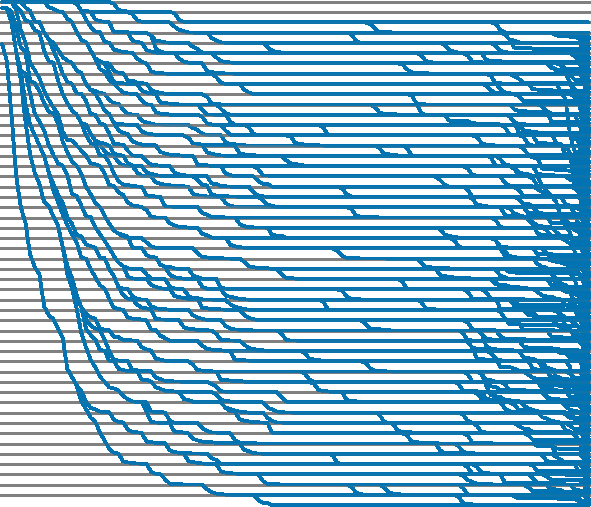
Fig 12: Ensemble pruning cost 𝐿= 𝐶total/𝑃𝑑versus cumulative de-

Fig 13: Schematic of the middle-out integration path for 𝑀= 8 anchored
Limitations
- Current work limited to circular orbits; real binaries with significant eccentricity require extended models not yet implemented.
- Validation performed only on simulated Gaussian noise data; real telescope noise with RFI and instrumental artifacts not addressed here.
- Relativistic post-Keplerian timing effects ignored assuming short observations and low eccentricity, potentially limiting applicability to some binaries.
- No adversarial or worst-case scenario analysis of pruning failure modes or signal loss rates beyond typical distributions.
- Pruning thresholds require tuning and may require recalibration for different survey conditions or hardware.
- Computational benchmarks assume idealized CPU setups; scalability to large telescope data volumes and heterogeneous HPC environments requires further study.
Open questions / follow-ons
- How to extend the EP framework to eccentric binary orbits with higher-dimensional phase models incorporating eccentricity and relativistic effects?
- What is the impact of non-Gaussian noise, radio frequency interference (RFI), and realistic instrument systematics on pruning efficiency and false dismissal rates?
- Can the pruning thresholds and grid construction be adaptively learned or optimized online for dynamic survey conditions?
- How does the hierarchical pruning perform under cross-validation with real pulsar populations and archival survey data, including in blind searches for unknown sources?
Why it matters for bot defense
For bot-defense and CAPTCHA practitioners, this paper exemplifies a hierarchical pruning framework to efficiently search very large parameter spaces for rare, weak coherent signals buried in noise. The EP method’s core principle — early elimination of unlikely candidates based on intermediate partial evidence to drastically reduce downstream computation — parallels strategies in puzzle-solving tasks such as puzzle verification and bot activity detection, where early stage heuristics can lower workload. Similarly, the use of mathematical orthogonalization to reduce correlation and redundancy in search grids might inspire feature-space optimizations in CAPTCHA challenge parameter design. Although the domain is astrophysical signal detection, the underlying statistical and computational efficiencies from pruning and hierarchical search strategies may inspire improved scalable algorithms for high-throughput bot detection or challenge-response inference with costly verification steps.
Cite
@article{arxiv2607_07700,
  title={ Coherent Signal Detection with Pruning -- I. Finding Short-Period Binary Pulsars in Circular Orbits },
  author={ Pravir Kumar and Barak Zackay },
  journal={arXiv preprint arXiv:2607.07700},
  year={ 2026 },
  url={https://arxiv.org/abs/2607.07700}
}