
LogicHunter: Testing LLM Agent Frameworks with an Agentic Oracle
Source: arXiv:2607.06195 · Published 2026-07-07 · By Minghui Long, Yanjie Zhao, Haoyu Wang
TL;DR
The paper addresses a critical gap in the automated testing of large language model (LLM) agent frameworks such as LangChain, LlamaIndex, and CrewAI. These frameworks underpin many production AI systems but remain under-tested due to fundamental challenges in test generation and oracle ambiguity. Unlike traditional software where crashes signal bugs, these pure Python agent frameworks often fail silently or throw ordinary exceptions indistinguishable from API misuse, making automated bug detection extremely difficult. Existing fuzzers generate many invalid inputs due to strict type schemas and complex protocols, while unit test generators produce only trivial cases with weak behavioral specifications.
The authors propose LogicHunter, a unified fuzzing and oracle framework that bridges the generation-oracle gap for agent framework testing. LogicHunter’s test generation synthesizes valid-by-construction yet semantically extreme inputs by combining formal type specifications with realistic usage patterns mined from real repositories. Behavioral probes are embedded in test cases to detect silent semantic failures. To resolve oracle ambiguity, LogicHunter introduces an Agentic Oracle—a ReAct-style agent with dual-layer state and dual-stream memory—that actively queries documentation, inspects source code, and executes runtime states for evidence-driven bug classification. Evaluated on three popular agent frameworks, LogicHunter discovered 40 previously unknown bugs (30 confirmed, 26 fixed) while state-of-the-art approaches found none. The Agentic Oracle achieved 91.17% precision, outperforming best passive methods by 61 percentage points. This work reveals the critical importance of specification-aware input generation combined with active reasoning oracles for testing complex LLM agent frameworks.
Key findings
- LogicHunter discovered 40 previously unknown bugs across three major LLM agent frameworks (LangChain, LlamaIndex, CrewAI).
- 30 bugs were confirmed by developers and 26 have been fixed upstream at time of writing.
- The Agentic Oracle achieved 91.17% precision in bug detection, surpassing the best passive oracle (29.27%) by 61.9 percentage points.
- State-of-the-art baseline testing tools reported zero bugs in the same evaluation.
- Specification-driven generation reduced invalid test inputs caused by Pydantic and protocol violations, enabling high-value test synthesis.
- Behavioural probes embedded into tests enabled detection of silent semantic failures beyond exception trapping.
- The dual-layer state management and dual-stream memory architecture in the Agentic Oracle enabled efficient active retrieval of documentation and runtime inspection.
- Hash-based deduplication and validity filtering removed redundant and invalid tests, focusing verification compute on unique anomalies.
Threat model
The adversary is latent logical bugs or semantic failures within LLM agent frameworks that manifest as ambiguous or silent errors rather than explicit crashes. They cannot produce catastrophic native crashes but cause silent semantic violations or ordinary exceptions indistinguishable from API misuse. The testing system has full access to framework source code, documentation, and runtime environment in a sandbox and relies on active reasoning to distinguish genuine defects from benign misuse.
Methodology — deep read
Threat Model & Assumptions: The adversary is the bug in the LLM agent framework codebase that causes silent semantic failures or ambiguous exceptions. They assume no explicit crash signals or differential oracles are available. The framework code is accessed fully for static analysis, code navigation, and dynamic inspection within a sandbox. External service dependencies are mocked for testing.
Data: They evaluate on three widely used public LLM agent frameworks - LangChain, LlamaIndex, and CrewAI. They mine real-world usage from official and popular repositories to extract API invocation patterns and context construction snippets. Exact corpus sizes are not specified but include top-rated projects and official client codebases. No closed datasets are used; all code is publicly accessible.
Architecture / Algorithm: LogicHunter comprises two main phases. Phase I (Test Generation) uses a Generator Agent that fuses explicit contracts (type hints, Pydantic schemas, docstrings) extracted via static analysis with implicit usage protocols mined via AST parsing of real-world repos. The output is executable seed test scripts plus structured API profiles encoding complexity, documentation context, and logic pseudocode. A Fixer Agent executes and repairs seeds to obtain valid baseline tests, promoted as Golden Seeds. A Mutator Agent applies complexity-aware, contract-respecting multidimensional mutations on Golden Seeds to produce diverse test variants with embedded behavioural probes encoding expectation assertions. Phase II (Test Verification) executes tests in a sandbox and classifies anomalies into runtime exceptions and assertion failures. A hash-based deduplication removes redundant failures based on stack trace or triggering AST node hashes. Validity filtering discards invalid tests where failures do not engage target library logic. The remaining unique failures feed the Agentic Oracle System, a ReAct-inspired LLM agent with Dual-Layer State Management and Dual-Stream Memory that actively retrieves documentation, navigates source code, inspects runtime states, and executes repro scripts to formulate verdicts on bug presence or benign misuse. It classifies defects into a taxonomy of 6 categories.
Training Regime: Not applicable as this is a test generation and oracle framework rather than a model training paper. However, LLM calls in agents are orchestrated with prompt templates (examples provided) and complexity-adaptive budgets.
Evaluation Protocol: The large-scale experiment consists of running LogicHunter and three state-of-the-art baseline fuzzers on the three frameworks. Metrics include number of confirmed discovered bugs, developer fix status, oracle precision (percentage of confirmed bugs among flagged anomalies), and comparison to baseline zero bugs found. Ablations examine oracle precision impact when varying parameters like minimum observation count k_min.
Reproducibility: The authors do not explicitly mention code release or frozen weights for their LLM agents or pruning. The evaluation is performed on public frameworks and mined real-world usage, suggesting reproducibility is feasible but no direct artifacts are linked in the paper.
An end-to-end example: For each API, the Generator Agent extracts explicit contracts and implicit usage from corpus snippets, fuses these to produce seed Python test scripts with executable contexts. The Fixer Agent runs these, repairing failures from Pydantic violations or import errors until a stable Golden Seed is produced. The Mutator Agent then mutates parameters within documented constraints to generate probe-equipped test variants designed to exercise semantic edges. The full test suite executes, failures are identified and deduplicated, then passed to the Agentic Oracle which actively queries docs, source, and runtime state to confirm bugs or flag benign misuse, achieving high precision bug discovery in complex rapidly evolving LLM agent frameworks.
Technical innovations
- Specification-driven test generation combining formal type schemas and mined real-world usage patterns to synthesize semantically extreme, valid-by-construction tests.
- Behavioral probes embedded in generated tests that provide expectation-oriented assertions revealing silent semantic failures beyond crashes.
- An Agentic Oracle based on a ReAct-style LLM agent with dual-layer state management and dual-stream memory for active, evidence-based diagnosis via dynamic documentation retrieval, source code navigation, and runtime inspection.
- A two-stage verification pipeline with hash-based deduplication and validity filtering to reduce noise prior to applying the computationally expensive Agentic Oracle.
- Complexity-adaptive mutation budget allocation to scale testing effort with API complexity, balancing coverage and cost.
Datasets
- LangChain — public open-source framework with over 30,000 GitHub issues — mined usage examples from official and top repos
- LlamaIndex — public open-source framework — mined usage examples from official and top repos
- CrewAI — public open-source framework — mined usage examples from official and top repos
Baselines vs proposed
- State-of-the-art fuzzers (unspecified) on target frameworks: discovered 0 bugs vs LogicHunter: found 40 bugs (30 confirmed, 26 fixed)
- Best passive LLM oracle precision: 29.27% vs Agentic Oracle precision: 91.17%
Figures from the paper
Figures are reproduced from the source paper for academic discussion. Original copyright: the paper authors. See arXiv:2607.06195.

Fig 2: The workflow of LogicHunter. Phase I synthesizes specification-compliant tests with behavioral
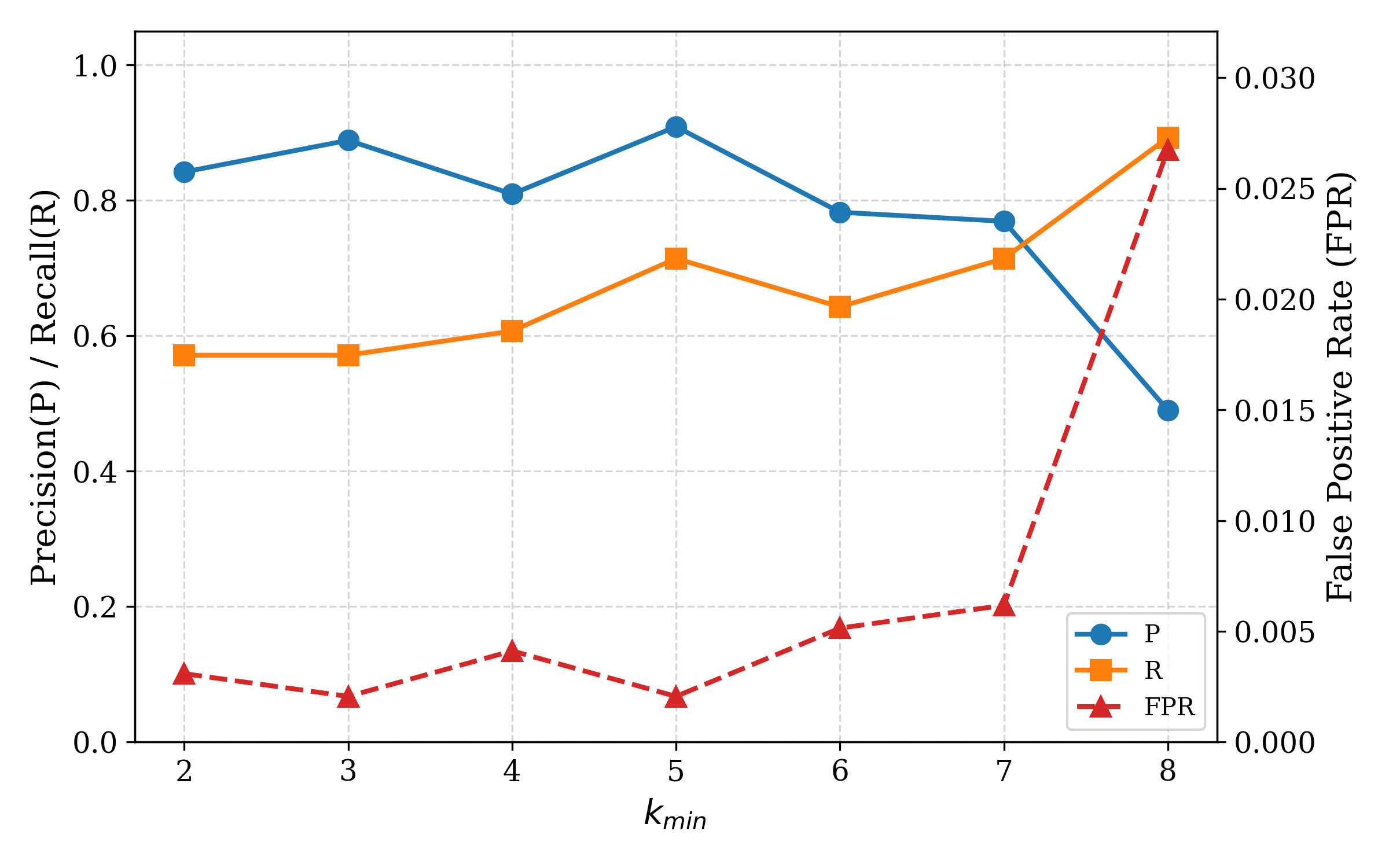
Fig 5: Impact of 𝑘𝑚𝑖𝑛on oracle performance.
Limitations
- No discussion of adversarial robustness or resilience to evasive bugs crafted by sophisticated attackers.
- Evaluation limited to three agent frameworks; generality to other frameworks or domains not shown.
- Rapid API evolution may still cause occasional knowledge obsolescence despite active retrieval mechanisms.
- Computational cost and latency of Agentic Oracle not deeply analyzed, potentially limiting real-time applicability.
- Reproducibility unclear due to lack of released code or frozen model checkpoints.
- Behavioral probes rely on heuristics from documentation; some silent failures could remain undetected.
Open questions / follow-ons
- How can the Agentic Oracle be optimized to reduce computational overhead and scale to continuous integration pipelines?
- Can the specification-driven generation approach be generalized to test other dynamically typed or rapidly evolving software frameworks?
- How to integrate adversarial testing techniques or fuzzers enhanced by LogicHunter’s generation principles to uncover more sophisticated or stealthy bugs?
- What formal guarantees or theoretical analyses can be developed for semantic coverage and bug discovery completeness in specification-aware fuzzing of agent frameworks?
Why it matters for bot defense
LogicHunter’s approach is directly relevant to bot-defense engineers building or integrating LLM-powered agent frameworks or AI orchestration pipelines. Its combination of specification-driven input generation and an active reasoning oracle addresses a critical gap in testing complex, schema-rich, and protocol-dependent Python frameworks where silent semantic failures are common and crashes rare. For CAPTCHA and bot defense systems that increasingly incorporate LLM agents for adaptive challenge generation or dynamic verification workflows, LogicHunter’s methodology offers a blueprint for more rigorous and automated testing that goes beyond syntactic correctness and naive crash detection. The behavioral probes and agentic oracle concepts also highlight how test oracles can leverage external context and runtime introspection to increase bug detection precision, a principle potentially applicable to detecting sophisticated automated bot behaviors or evasion strategies adapting to defensive CAPTCHA logic. However, LogicHunter focuses on framework-level defect detection and does not directly address adversarial bot evasion, so bot-defense engineers should consider it a complementary tool for infrastructure robustness rather than an anti-bot solution itself.
Cite
@article{arxiv2607_06195,
  title={ LogicHunter: Testing LLM Agent Frameworks with an Agentic Oracle },
  author={ Minghui Long and Yanjie Zhao and Haoyu Wang },
  journal={arXiv preprint arXiv:2607.06195},
  year={ 2026 },
  url={https://arxiv.org/abs/2607.06195}
}