
Domain-Driven Design in Practice: A Large-Scale Empirical Characterisation of the Open-Source Ecosystem
Source: arXiv:2607.06471 · Published 2026-07-07 · By Ozan Özkan, Önder Babur, Mark van den Brand
TL;DR
This study addresses the practical adoption landscape of Domain-Driven Design (DDD) by conducting the first large-scale empirical characterization of open-source repositories implementing DDD patterns on GitHub. Prior research on DDD has been mostly theoretical or anecdotal, with nearly 39% lacking rigorous empirical validation. By mining 11,742 candidate repositories using a hybrid approach combining GitHub topic tags and README keyword search, the authors applied a novel semantic validation pipeline leveraging GPT-4o with a triplicate majority-vote strategy to filter down to 2,502 verified DDD repositories. This semantic classification was validated against human expert labels, achieving substantial agreement (Cohen’s kappa = 0.77). The study reveals that DDD adoption sharply accelerated after 2017 and results in notably long-lived projects, with median lifespans exceeding typical GitHub projects by over an order of magnitude, indicating substantial, professional-grade engineering.
Notably, while academic research tends to be Java-centric, this empirical data shows that C# (34%) and TypeScript (18%) dominate practical DDD adoption, not Java (16%). The ecosystem is dominated by Layered and Clean Architecture styles, with CQRS and Event Sourcing patterns recurring in distributed, data-intensive systems. However, about 25% of projects record no explicit business domain context in their documentation, signaling a gap in preserving domain intent as software evolves. The authors call for lightweight architectural traceability standards and provide guidance for practitioners reusing open-source DDD repositories.
Key findings
- Semantic validation pipeline using GPT-4o achieved Cohen’s kappa = 0.77 and F1-score = 92.5% against human labellers on a 50-repo benchmark.
- From 11,742 initial candidates mined by topic+README keywords, 2,502 repositories were semantically verified as genuine DDD implementations.
- DDD adoption accelerated sharply after 2017, marking a turning point from theoretical to practical maturity in open source.
- Median lifespan of verified DDD projects is 340.37 days (mean 660.73 days), over 34x longer than the typical GitHub project median lifespan of 9.9 days.
- C# leads with 34.17% of DDD repos, TypeScript next with 17.71%, and Java only 16%, challenging Java-centric academic focus.
- Layered Architecture and Clean Architecture dominate structural patterns; CQRS and Event Sourcing recur in distributed, data-intensive projects.
- 25.3% of DDD repositories record no explicit business domain context in metadata or documentation.
- Filtering criteria retained projects with >=10 commits, at least one issue or pull request, and implemented in general-purpose programming languages.
Threat model
N/A — this study does not address a security threat model but rather the challenge of label noise and misclassification in mining software repositories. The adversarial challenge is correctly identifying repositories that genuinely implement Domain-Driven Design rather than those that merely mention or superficially reference it. There is no assumed adversary against the software itself.
Methodology — deep read
Threat model and assumptions: The study assumes the adversary as label noise and false positives in repository classification rather than security adversaries. The goal is to accurately identify repositories implementing genuine DDD practices, distinguishing from mislabeled, tutorial, or anemic implementations. There is no adversarial code tampering assumed.
Data collection: The authors mined GitHub repositories through the GraphQL API up to end of 2025, combining topic-based mining (from GitHub repository topics) and README keyword search (keywords derived from seminal DDD literature). The initial candidate set contained 11,742 unique repositories.
Filtering: Inclusion criteria required repositories to be public, not archived or forks, created before 2026, with at least 10 commits, at least one issue or pull request, non-zero lines of code, and implemented in general-purpose languages commonly used in DDD (Java, C#, TypeScript, Python, Go, etc.). Exclusion removed incomplete or non-executable repos dominated by markup/configuration languages.
Semantic validation pipeline: To overcome label noise, the authors developed a novel semantic classification pipeline using the GPT-4o large language model. Each repository's source files were inspected for evidence of core DDD patterns, such as Rich Domain Models and architectural structures, rather than relying solely on metadata. The pipeline involved an agentic multi-step approach, applying three GPT-4o queries per repo and deciding by majority vote. It focused on the seven most prevalent programming languages representing 95.29% of repos.
Validation: The pipeline was benchmarked against an independently hand-labelled ground truth sample of 50 repositories, showing substantial agreement with human experts (Cohen’s kappa = 0.77, F1 score = 92.5%). This validated the approach for large-scale automated semantic verification.
Analysis: The verified dataset of 2,502 repos underwent descriptive statistical analysis over temporal adoption trends, architectural taxonomy (e.g., dominance of Layered, Clean, CQRS, Event Sourcing), programming languages usage, ownership patterns (individual vs organization), business domains, and community activity metrics such as pull request latency and frequency of commits.
Reproducibility: The authors released retrieval code via a public GitHub repository but the dataset likely remains proprietary due to volume. Full retrieval documentation including query noise rates is provided to facilitate reproducibility.
Example end-to-end: Starting with 11,742 repos mined by topic and README keyword searches, the team filtered by activity and language criteria to 4,206 candidate repos. The GPT-4o semantic pipeline was applied to these—three independent queries per repo scanned key source files. Majority vote labels confirmed 2,502 repos as legitimate DDD implementations. This curated dataset then served for detailed quantitative analysis of language distribution, architecture styles, project longevity, and documentation completeness.
Technical innovations
- Introduction of a novel semantic validation pipeline using GPT-4o with a triplicate majority-vote strategy to verify genuine DDD implementation at scale.
- Hybrid mining strategy combining GitHub topics with README keyword searches to maximize recall while balancing precision in repository identification.
- Large-scale empirical characterization of the DDD open-source landscape coupled with semantic code-level inspection rather than relying on metadata alone.
- First use of agentic LLM validation pipeline in Mining Software Repositories applied specifically to architecture paradigms like DDD.
Datasets
- Initial candidate dataset — 11,742 repositories — mined from GitHub using topic and README keyword queries.
- Verified dataset — 2,502 repositories — semantically validated for genuine DDD implementation using GPT-4o.
- Benchmark sample — 50 repositories — manually labelled for evaluation of semantic validation pipeline.
Baselines vs proposed
- Human expert labelling: Cohen’s kappa = 1.0 (ground truth) vs GPT-4o pipeline: kappa = 0.77 on 50-repo benchmark.
- Median project lifespan: typical GitHub projects = 9.9 days vs DDD verified projects = 340.37 days (34x longer).
Figures from the paper
Figures are reproduced from the source paper for academic discussion. Original copyright: the paper authors. See arXiv:2607.06471.
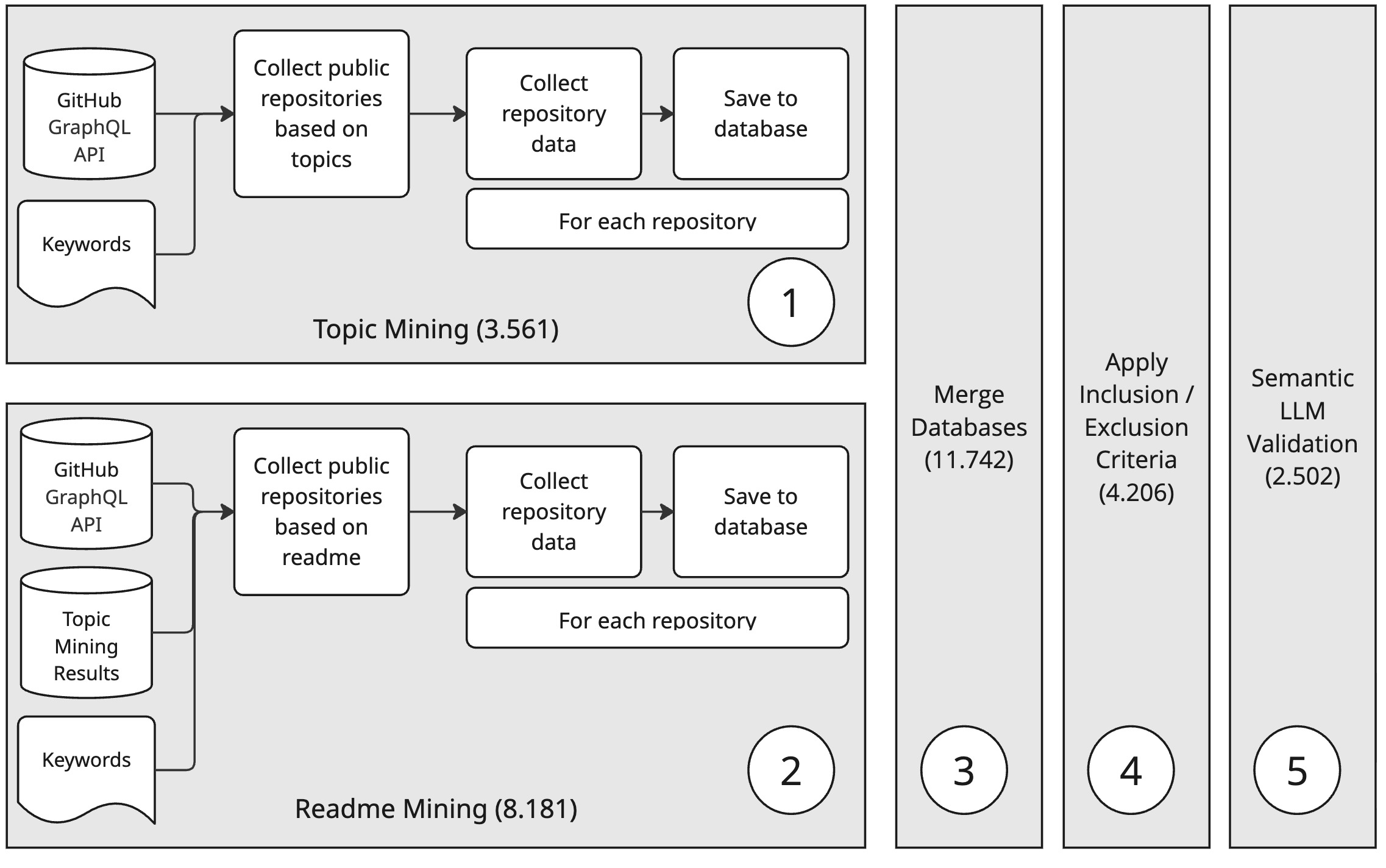
Fig 1: Overview of the data collection and verification pipeline, comprising topic-based
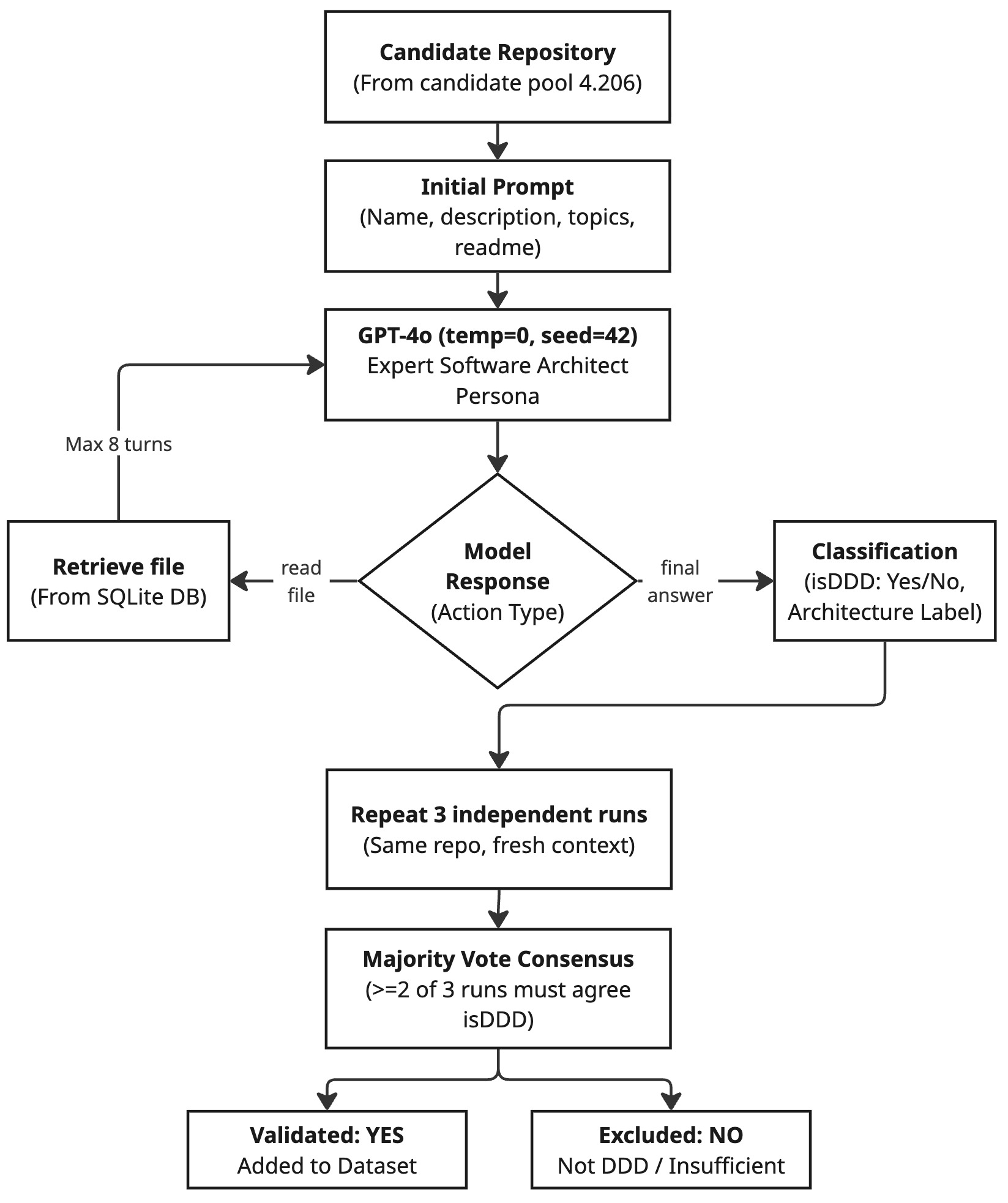
Fig 2: The agentic GPT-4o classification pipeline. Each repository undergoes up to
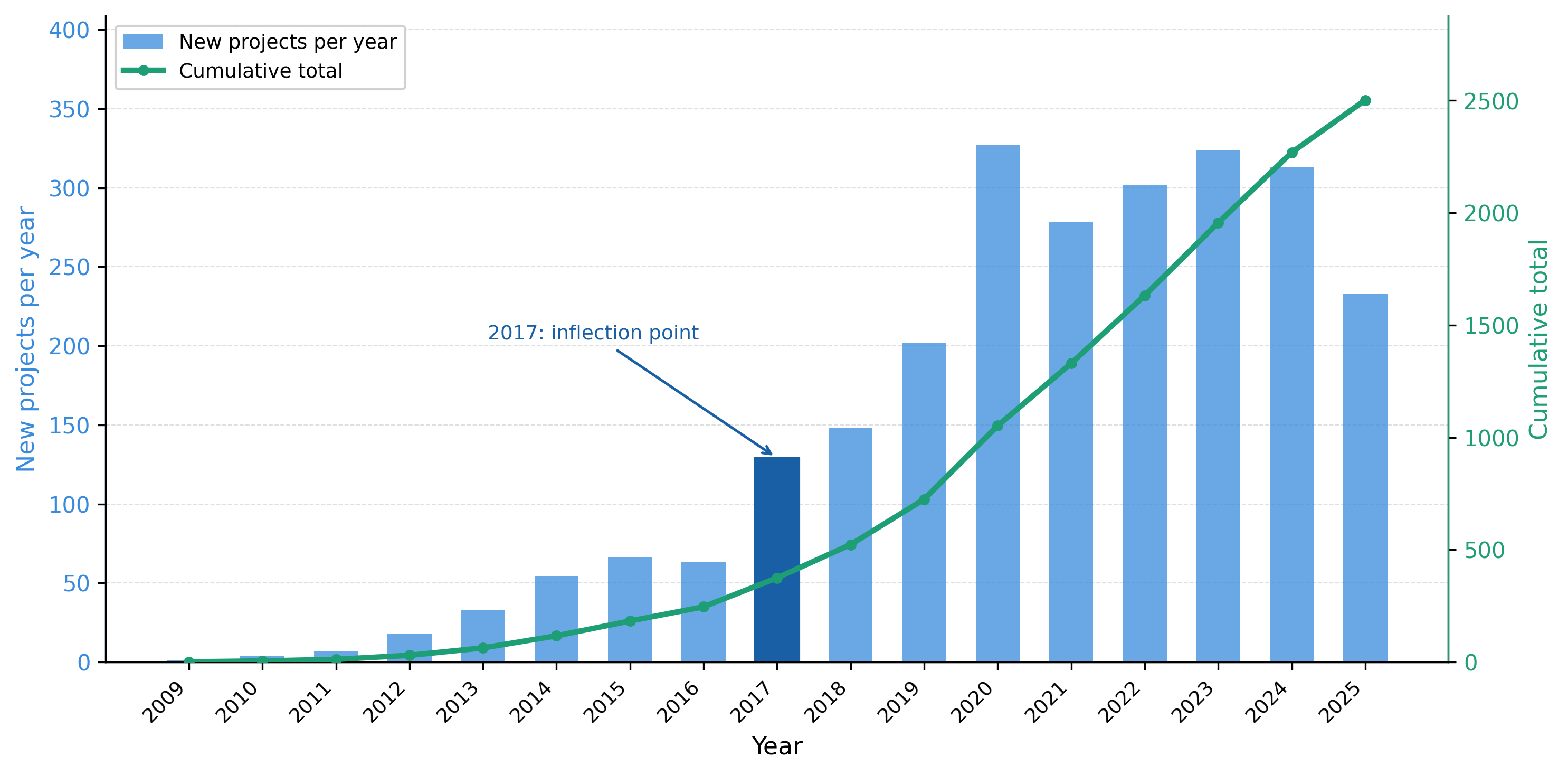
Fig 3: Annual creation of verified DDD repositories on GitHub (bars, left axis) and
Limitations
- Semantic validation relies on GPT-4o LLM, which though validated, may still miss subtle or novel DDD variants.
- Manual benchmark sample is relatively small (50 repos), limiting robustness of agreement assessment.
- GitHub-based mining may miss private repositories or projects on other platforms, limiting ecosystem coverage.
- Exclusion of repos predominantly in non-general-purpose languages or with inadequate metadata may introduce selection bias.
- No direct evaluation of the correctness or quality of the DDD implementations beyond semantic signatures.
- Business domain annotation absence in 25.3% of projects suggests incomplete domain traceability, limiting semantic conclusions.
Open questions / follow-ons
- How can lightweight, standardized architectural traceability practices be designed to better capture explicit business domain context in DDD projects?
- Can future work expand validation with larger, more diverse manually-labelled datasets to improve semantic classifier robustness?
- What are the longitudinal maintenance and evolution patterns of DDD implementations beyond project lifespan, i.e., how well do implementations adhere to DDD principles over time?
- How do private, enterprise, or non-GitHub-hosted projects compare in DDD adoption and architecture patterns?
Why it matters for bot defense
For bot-defense and CAPTCHA engineers, this paper provides a rigorous methodology for semantically validating architectural paradigms at scale using large language models, a technique that can be adapted for detecting adversarial or undesirable software behaviors in large codebases. Understanding how DDD patterns manifest in open source projects also helps in recognizing well-engineered, sustainable system structures — knowledge potentially useful for analyzing software ecosystems underpinning bot activities or automated attack frameworks. The semantic validation pipeline exemplifies a scalable approach to minimize false positives inherent in metadata or keyword-based classification, an important lesson when filtering repositories or code snippets related to security tooling or attack signatures. Finally, the study’s identification of language and architectural distributions assists engineering teams in calibrating detection heuristics according to dominant technologies, critical for platform-specific bot-defense implementations.
Cite
@article{arxiv2607_06471,
  title={ Domain-Driven Design in Practice: A Large-Scale Empirical Characterisation of the Open-Source Ecosystem },
  author={ Ozan Özkan and Önder Babur and Mark van den Brand },
  journal={arXiv preprint arXiv:2607.06471},
  year={ 2026 },
  url={https://arxiv.org/abs/2607.06471}
}