
Designing Computerized Gait Analysis for Pediatric Care: Clinician Perspectives on Sensing, Workflow, and Care Environments
Source: arXiv:2607.06076 · Published 2026-07-07 · By Elizabeth Hong, Andrea Green, Ge Wang, Yiwen Dong
TL;DR
This study investigates the unique challenges and design needs of computerized gait analysis (CGA) specifically in pediatric care, an area underexplored in prior CGA research. The authors conducted qualitative interviews and quantitative surveys with 12 pediatric clinicians (7 medical experts and 5 physicians) and 1 system designer experienced in pediatric CGA. The study reveals critical mismatches between existing CGA sensing technologies—originally designed mostly for adults or controlled lab settings—and the requirements introduced by children’s developmental variability, sensory sensitivities, and variable care environments. Clinicians highlighted difficulties related to wearable sensor comfort, calibration for children’s smaller and variable body proportions, and maintaining child engagement during assessments. They also emphasized the importance of adapting workflows and moving gait data capture beyond specialized labs into more naturalistic settings such as schools and playgrounds.
Clinician participants prioritized sensor accuracy, functionality, ease of use, and patient comfort over cost, accessibility, and scalability. Kinematic gait parameters were viewed as most critical for clinical decision-making across diverse settings. Medical experts rated motion capture systems and force plates as most suitable for gait labs, while wearable and smartphone-based devices were preferred for decentralized environments including local care centers and home monitoring. Qualitative findings underscored that CGA technologies substantially improve the objectivity and standardization of gait assessment, facilitating more evidence-based and impactful interventions. However, success depends heavily on addressing pediatric-specific needs through sensing modality adaptations, flexible clinical workflows, and ecological validity in diverse real-world environments. The study contributes concrete design opportunities for advancing pediatric CGA toward less burdensome, more interpretable, and child-centered measurement systems.
Key findings
- Clinicians rated accuracy (mean=6.18/7), functionality (5.72), ease of use (5.64), and comfort (5.36) as the top technology performance criteria, with affordability (3.91), accessibility (4.36), and scalability (4.09) rated lower.
- Among gait parameters, kinematics was rated highest in clinical importance across lab, local care, and home settings.
- Motion capture systems and force plates were considered most appropriate for gait laboratories; pressure mats and smartphones for local care centers; and wearables (e.g., smartwatches, smartphones) for patient homes.
- Most CGA technologies surveyed reliably measured temporal and spatial gait parameters, but fewer captured joint kinematics accurately, and very few handled kinetics or muscle activation well.
- Clinicians reported that pediatric sensor placement and calibration are complicated by children’s smaller and variable anatomies and sensory sensitivities to wearables.
- Engagement and compliance challenges specific to children require designs that minimize contact and sensory burden, treating contact reduction as a data validity strategy as well as a comfort measure.
- Clinicians stressed the need for gait analysis workflows that incorporate family-mediated pre-visit preparation and that extend sensing beyond controlled lab environments to ecologically valid settings like schools and playgrounds.
- No single technology modality dominated clinician preferences across all contexts, evidencing the importance of flexible, context-sensitive CGA system designs.
Threat model
Not applicable in the traditional security sense; the study assumes clinical stakeholders as adversaries to CGA use in terms of workflow constraints, usability barriers, and pediatric patient engagement challenges rather than malicious actors.
Methodology — deep read
The research employed a mixed-methods approach combining qualitative interviews with quantitative surveys to understand clinician perspectives on pediatric CGA technologies. The threat model is primarily clinical practice constraints rather than adversarial. The data comprised input from 13 participants: 7 medical experts with technical roles in gait analysis, 5 physicians who interpret gait data for treatment, and 1 CGA system designer. Participants were recruited from a university hospital gait lab in 2025, all experienced with computerized gait analysis and pediatric patients.
The study procedure involved one-on-one Zoom sessions lasting about one hour, including an informed consent process. Participants first considered a clinical scenario involving pediatric gait assessment for cerebral palsy. They completed tailored quantitative surveys: medical experts rated 14 CGA technologies on multiple criteria (functionality, accuracy for gait parameters, ease of use, comfort, affordability, availability, scalability) and indicated technology suitability across three clinical settings (gait lab, local care center, home). Physicians evaluated the clinical importance of five gait parameters across these settings.
After surveys, semi-structured interviews elicited richer qualitative data on experiences with CGA, barriers encountered, workflow adaptations, and envisioned design needs. All sessions were recorded, transcribed, and analyzed using thematic coding with >90% inter-rater reliability. Quantitative data were analyzed descriptively, summarizing central tendencies and patterns without inferential statistics due to sample size.
Evaluation included cross-context comparisons of technology suitability and gait parameter importance, identification of clinician needs and workarounds, and thematic extraction of design implications. Example interpretation: clinicians highlighted that traditional marker-based motion capture excelled for kinematics in labs but was impractical for naturalistic settings, motivating the need for wearable or vision-based systems adapted for sensory-sensitive pediatric users. The study emphasized pediatric-specific challenges such as variable body sizes, sensory discomfort, and workflow fragmentation.
The authors did not report releasing datasets or code. The sample size and recruitment from a single gait lab limit generalizability but provide in-depth expert insights. The methodology foregrounds clinical user perspectives to guide human-centered design of pediatric CGA technologies.
Technical innovations
- Identification of pediatric-specific sensing challenges including sensory sensitivities and body proportion variability impacting sensor calibration and placement.
- Proposal to treat reduced sensor contact as a fundamental data validity approach rather than solely a comfort enhancement.
- Integration of family-mediated pre-visit preparation tools to improve engagement and compliance in pediatric gait analysis workflows.
- Design recommendation to expand gait data capture beyond controlled labs into ecologically valid settings such as schools and playgrounds to better reflect authentic child movement.
Baselines vs proposed
- Motion Capture: Majority of medical experts rated it capable of measuring temporal, spatial, kinematics, kinetics parameters; not muscle activation, compared to other methods with fewer capabilities.
- Force Plates: Rated high for ground reaction forces and temporal parameters, but less so for spatial or kinematics.
- Wearable IMUs (Smartphones, Smartwatches): Rated suitable for temporal and spatial gait parameters in home settings, but limited for kinematics or kinetics.
- Single Video Camera: Rated moderately capable for temporal, spatial, and kinematics, across various contexts.
Figures from the paper
Figures are reproduced from the source paper for academic discussion. Original copyright: the paper authors. See arXiv:2607.06076.
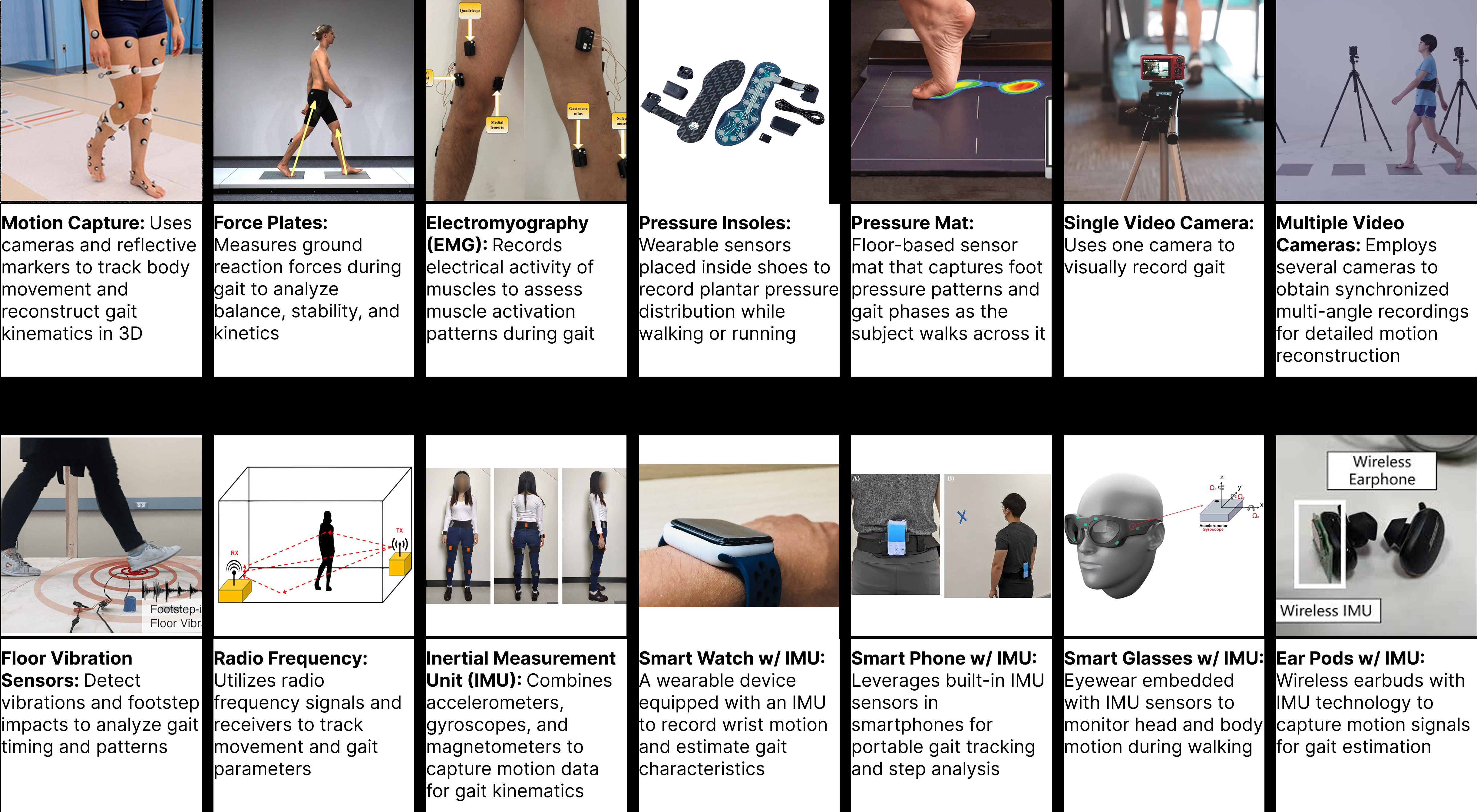
Fig 1: The computerized gait technologies that were presented to participants. Participants evaluated each technology for functionality,
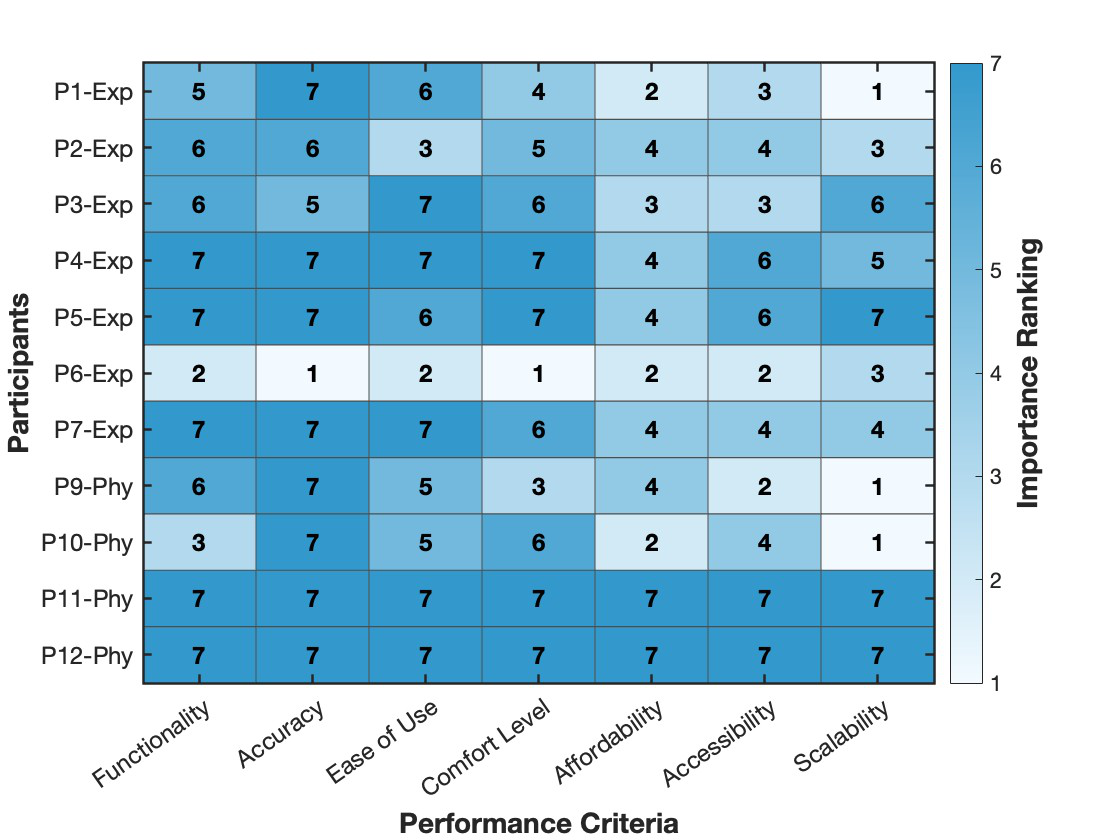
Fig 2: Participant rankings of computerized gait analysis performance criteria and gait parameters. (a) Overall importance of seven
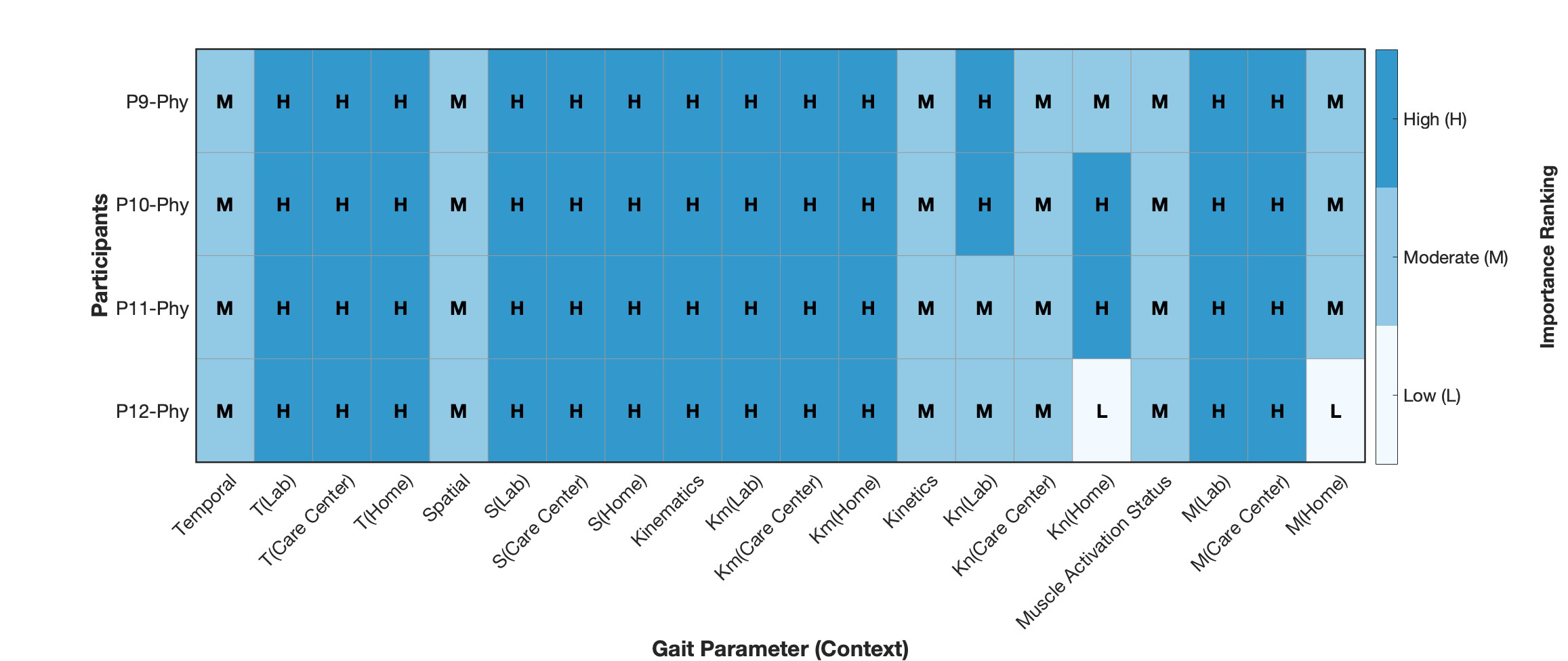
Fig 3: Images of three contexts (gait lab, local care center, and patient home) that were shown to medical expert participants (P1–P7).
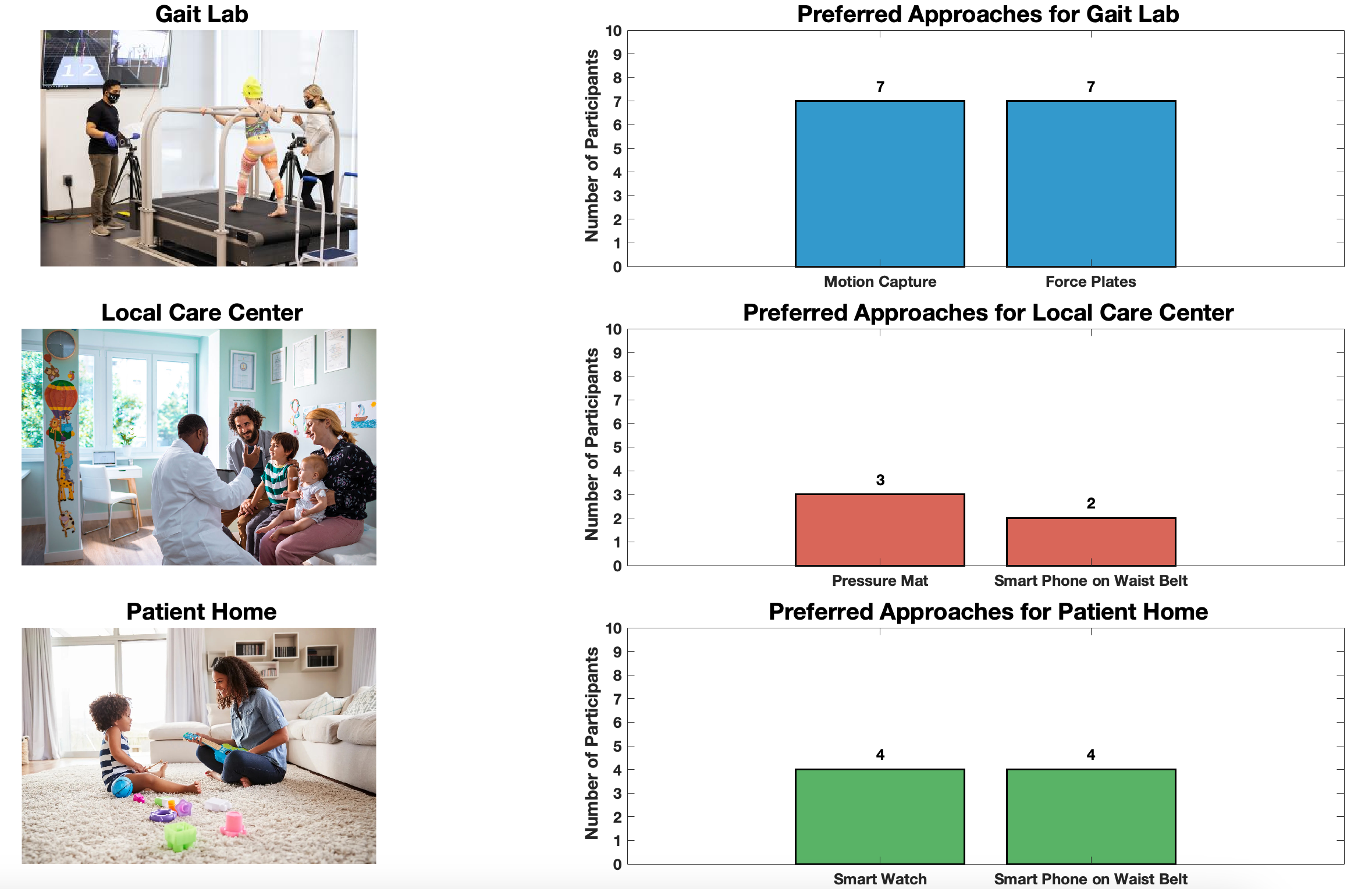
Fig 4 (page 7).
Limitations
- Small sample size of 13 participants from one institution limits generalizability.
- Predominantly qualitative and descriptive analyses without inferential statistical validation.
- No direct empirical testing of sensor accuracy or technical performance, relying on clinician perceptions.
- Study did not include pediatric patients or caregivers directly, focusing solely on clinician and designer perspectives.
- Emerging technologies like radio-frequency sensing remain unfamiliar to many participants, limiting evaluation depth.
- No adversarial or security threat modeling of CGA systems was conducted.
Open questions / follow-ons
- How can sensor calibration algorithms dynamically adapt to children's variable and developing anatomies in real time?
- What design approaches best balance reduced sensor contact with maintaining measurement accuracy in sensory-sensitive pediatric populations?
- How can pediatric gait analysis systems be optimized for deployment and usability in informal, naturalistic environments beyond specialized labs?
- What role can families and caregivers play in co-designing pediatric CGA workflows and technology interfaces?
Why it matters for bot defense
While this paper does not directly address bot defense or CAPTCHA, its rigorous human-centered and domain-expert driven approach to designing sensing systems for variable and challenging populations offers valuable lessons. Bot-defense engineers can draw parallels in how user sensory and interaction diversity affects data collection validity and engagement. The emphasis on flexible configurations, environment-aware sensing, and reducing user burden informs scanning or interaction flows that must accommodate highly heterogeneous users or devices. The study also highlights the integration of multi-stakeholder workflows and the need for capturing authentic usage in naturalistic settings, concepts useful when considering adaptive CAPTCHA deployments that account for real-world user variability. Lastly, the focus on the interpretability of complex sensor data by domain experts resonates with transparency and usability challenges in CAPTCHA design and response analysis.
Cite
@article{arxiv2607_06076,
  title={ Designing Computerized Gait Analysis for Pediatric Care: Clinician Perspectives on Sensing, Workflow, and Care Environments },
  author={ Elizabeth Hong and Andrea Green and Ge Wang and Yiwen Dong },
  journal={arXiv preprint arXiv:2607.06076},
  year={ 2026 },
  url={https://arxiv.org/abs/2607.06076}
}