
Continuous Narrow-Linewidth Superradiance in Waveguide QED
Source: arXiv:2607.06556 · Published 2026-07-07 · By Anna Bychek, Martin Fasser, Ivan Vybornyi, Klemens Hammerer, Susanne F. Yelin, Helmut Ritsch et al.
TL;DR
This paper addresses the challenge of realizing continuous, narrow-linewidth superradiant emission from ensembles of quantum emitters for precision optical frequency references without relying on conventional optical cavities. The authors propose a novel approach using partially incoherently pumped sub-ensembles coupled through a nanophotonic one-dimensional bidirectional waveguide. This setup leverages waveguide-mediated all-to-all dipole-dipole interactions to enable collective, directional superradiant emission with a linewidth close to the bare atomic transition frequency. Selectively pumping only a fraction of the emitters enhances emission characteristics by using the unpumped emitters as a collective frequency-selective resonator, providing effective feedback analogous to an optical cavity. The work demonstrates strong metrological gains via superlinear emission scaling, narrow spectral lines, directional output, and reduced intensity fluctuations quantified by second-order correlations near unity. Extensive numerical analysis reveals how emitter geometry, partial pumping, and waveguide coupling phases can be optimized to maximize brightness and spectral coherence.
Key findings
- Partially pumping half of the emitters in a chain yields substantially narrower emission linewidths and higher directional emission intensity compared to pumping the full ensemble, with spectral peaks near the bare emitter frequency (Fig. 1b, Fig. 2c).
- Optimal residual emitter spacing for maximal coherent exchange versus dissipative coupling is approximately δa ≈ λ0/(2N), corresponding to a quarter-wave phase shift between pumped and unpumped sub-ensembles, minimizing dissipative coupling and enhancing coherent feedback (Eq. 14, Fig. 2b).
- At optimal emitter spacing and pump rate scaling R ∝ N, the emitted photon flux into the waveguide scales quadratically with emitter number, IL ∝ N^2 Γ, while the linewidth decreases below the single-emitter linewidth Γ + Γ′ and the spectral peak moves toward the bare emitter resonance frequency (Fig. 5).
- Photon statistics of the emitted light reach second-order intensity correlation values g^(2)(0) ≈ 1 in the left-propagating output field, indicating near-Poissonian fluctuations consistent with stable superradiant emission rather than fluorescence (Fig. 6).
- The metrological figure of merit combining photon flux, linewidth, and frequency shift, ML, scales approximately quadratically with emitter number for partially pumped ensembles, surpassing the linear scaling of independent emitters (Eq. 19, Fig. 7).
- Directional emission is strongly asymmetric due to partial pumping and propagation phases, with enhanced emission and spectral purity in the left-propagating guided mode, while the right-propagating field is suppressed and frequency shifted (Fig. 3).
- The collective superradiant enhancement and metrological advantage are robust to static positional disorder with standard deviation σa = λ0/4 and inhomogeneous frequency broadening on the order of the emitter linewidth Γ (Fig. 8).
Methodology — deep read
The authors model an ensemble of N identical two-level quantum emitters coupled to a bidirectional single-mode waveguide with a decay rate Γ into the guided mode and free-space losses Γ′. The emitters have transition frequency ω0 and are arranged in a 1D chain with controlled nearest-neighbor spacing a = a0 + δa, where a0 is an integer multiple of the resonance wavelength λ0 and δa controls residual phases. They study a partial pumping scheme where only a subset Np (e.g., half) is incoherently pumped at rate R, while the rest remain unpumped.
The system dynamics are described by a Lindblad quantum master equation incorporating Hamiltonian coherent exchange mediated by waveguide dipole-dipole interactions Jnm = (Γ/2) sin(k|xn-xm|), collective dissipative coupling Γnm = Γ cos(k|xn-xm|), incoherent pumping on pumped emitters, and free-space decay. The bidirectional waveguide supports two output channels with operators ˆEL/R describing left/right propagating fields.
Key figures of merit include steady-state emitted photon intensity IL/R calculated from dipole correlations, the steady-state emission spectrum SL/R(ω) obtained from two-time correlation functions, and the zero-delay second order correlation g^(2)(0) describing photon statistics.
Due to exponential growth of Hilbert space with N, the authors use a second-order cumulant expansion truncation of equations of motion to capture two-body correlations for larger ensembles and a fourth-order cumulant expansion to compute g^(2)(0).
The study explores parameter space including residual emitter spacing δa to optimize coherent vs dissipative coupling ratio ηAB, pumping fractions, total emitter number N (up to ~100), and pumping rates R. The emission intensity, linewidth, spectral peak shifts, directional asymmetry, photon statistics, and a metrological figure of merit ML are numerically computed. Disorder robustness is analyzed via averaging over realizations with random positional displacements and inhomogeneous frequency detunings.
Evaluations are performed at steady state after sufficiently long evolution, comparing partial versus full pumping scenarios and independent emitter baselines. The methodology relies on established Born-Markov and rotating wave approximations with coherent and dissipative coupling rates derived from the Green’s function of a 1D waveguide mode. The mapping to collective jump operators and input-output formalism enables calculation of directional emission properties.
An end-to-end example considers a chain of N=50 emitters with half pumped at scaled rate R=NΓ/16, residual spacing δa=λ0/(2N), and free-space decay Γ′=3Γ, revealing the characteristic superlinear emission intensity scaling, spectral linewidth narrowing below single emitter limit, emission frequency locked near ω0, and g^(2)(0) approaching unity in the preferred emission direction. This confirms the viability of partial pumping and optimized spacing to realize continuous, narrow-linewidth superradiance in waveguide QED.
Technical innovations
- Use of partial incoherent pumping of a sub-ensemble within a waveguide-coupled emitter chain to achieve narrow-linewidth, directional steady-state superradiant emission without a conventional cavity.
- Identification of optimal residual emitter spacing δa ≈ λ0/(2N) that maximizes coherent exchange while suppressing dissipative coupling between pumped and unpumped sub-ensembles, enabling effective collective frequency-selective feedback.
- Introduction of a metrological figure of merit combining emission intensity, linewidth, and frequency shift to quantify active optical frequency reference performance of waveguide-mediated superradiance.
- Application of cumulant expansions (second- and fourth-order) to efficiently model collective emission properties and photon statistics for moderately large multi-emitter waveguide QED systems.
Baselines vs proposed
- Independent incoherently pumped emitters: steady-state intensity scales linearly with N, linewidth power broadened by pumping rate R, and metrological parameter ML scales as ~N for fixed R but degrades at high R.
- Partial pumping with optimized emitter spacing and pump rate scaling R ∝ N: emitted photon flux IL scales quadratically as ∝ N² Γ, linewidth narrows below single-emitter linewidth Γ + Γ′, and metrological parameter ML also scales approximately as N², outperforming independent emitter ensembles by orders of magnitude.
Figures from the paper
Figures are reproduced from the source paper for academic discussion. Original copyright: the paper authors. See arXiv:2607.06556.

Fig 1: Continuous narrow-linewidth collective emis-

Fig 2 (page 1).
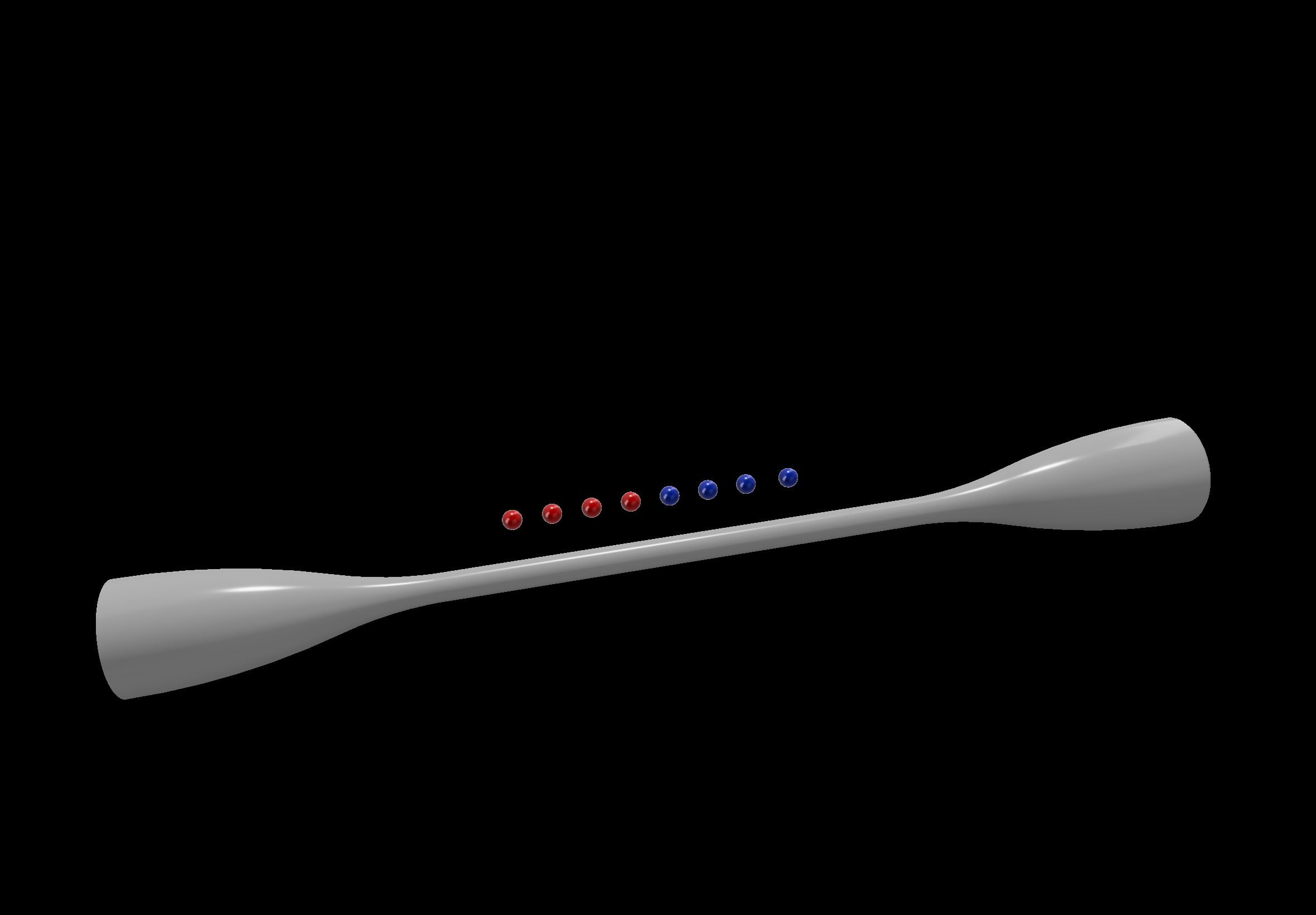
Fig 3 (page 1).

Fig 4 (page 1).

Fig 5 (page 1).
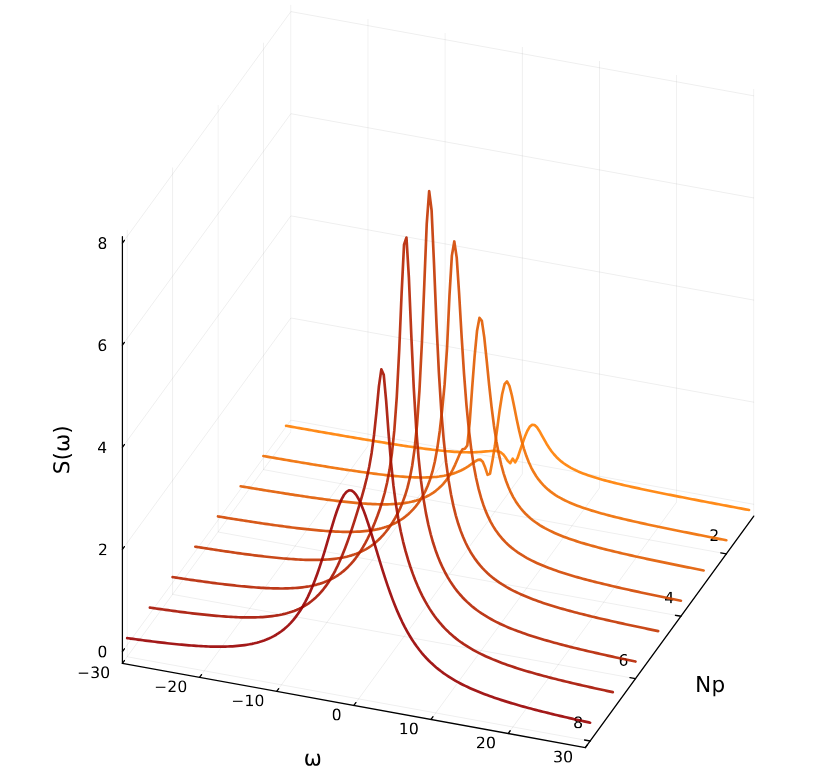
Fig 6 (page 1).
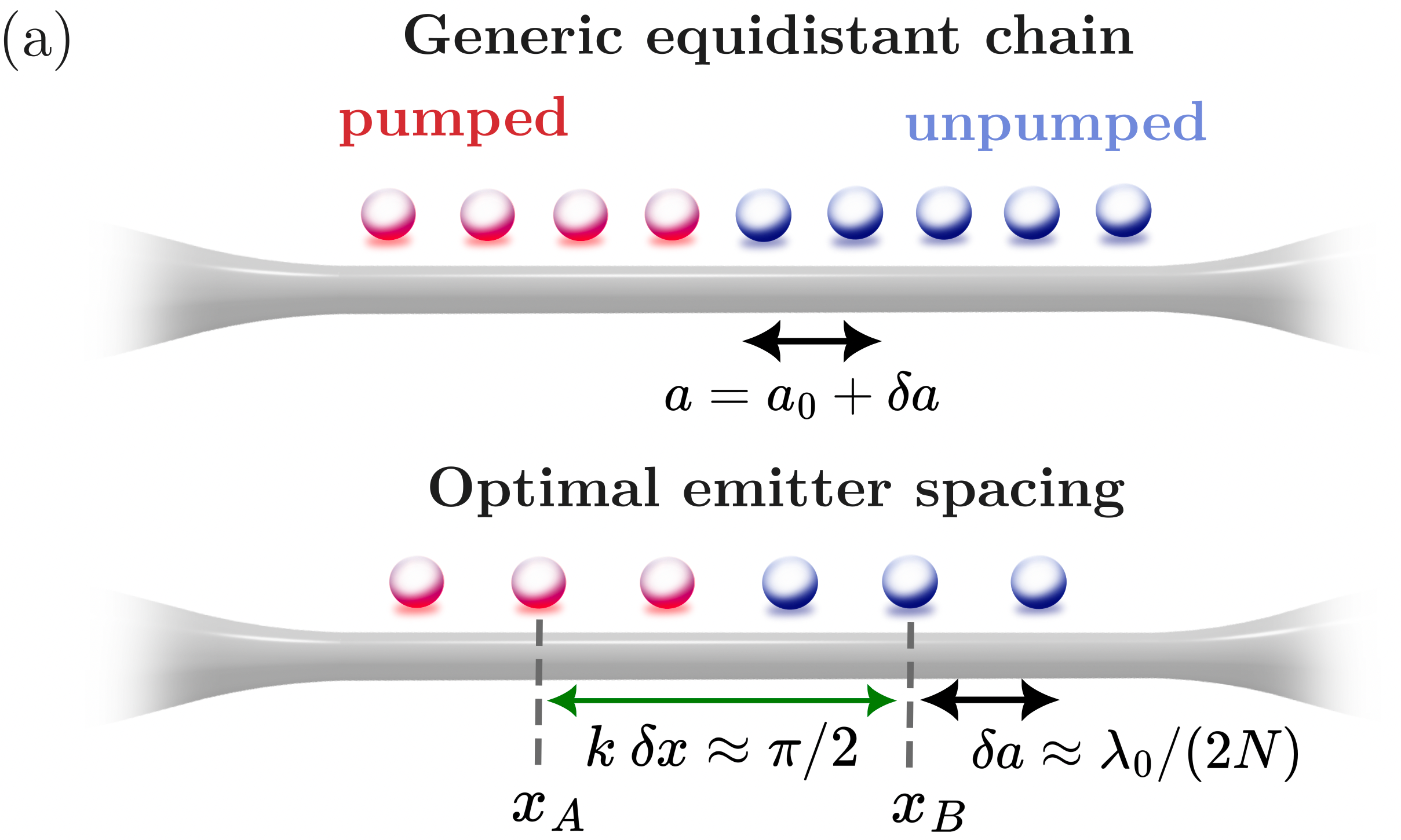
Fig 2: Optimal emitter spacing and emission proper-
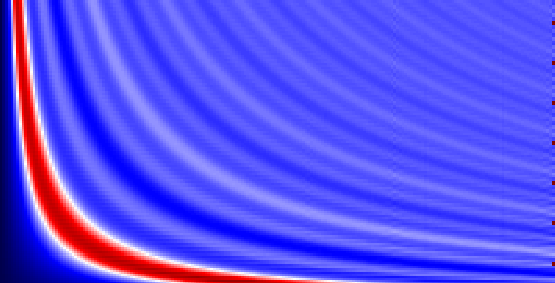
Fig 3: Emission into left- and right-propagating waveg-
Limitations
- Numerical modeling relies on cumulant expansions which may neglect higher-order correlations and could limit accuracy for very large ensembles or strong correlations.
- Analysis primarily considers idealized one-dimensional equidistant emitter chains with controlled spacing; fabrication imperfections in realistic nanophotonic devices may induce additional disorder beyond considered positional and frequency randomness.
- No experimental demonstration yet; robustness tested only through numerical simulations including disorder, but real systems may present dynamical noise sources and technical noise not modeled.
- Model assumes identical two-level emitters and neglects multilevel atomic structure or environmental effects that may impact coherence in realistic implementations.
- Free-space loss Γ′ is treated as a parameter but achieving favorable β factors (channeling dominant decay into waveguide) could be challenging experimentally.
Open questions / follow-ons
- How does the proposed partial pumping scheme perform under time-dependent noise sources and dephasing present in experimental nanophotonic platforms?
- Can the scheme be generalized to more complex emitter geometries or higher-dimensional waveguides with engineered dispersion?
- What are the fundamental limits on photon flux and linewidth reduction in presence of technical imperfections and finite temperature effects?
- Could coherent or feedback control methods further enhance collective emission beyond the incoherent pumping studied here?
Why it matters for bot defense
While primarily a quantum optics and metrology study, the results have indirect relevance to bot-defense engineering through the broader theme of controlling and extracting highly coherent, directional light emission from complex many-body systems with engineered interactions. The concept of achieving stable, narrow-linewidth emission from small ensembles without relying on bulky cavities hints at new possibilities for on-chip photonic hardware that could be employed in advanced sensing or secure authentication setups. Furthermore, the partial pumping and collective feedback mechanism introduces a novel paradigm for managing noise and fluctuations at a quantum statistical level, which could inspire defense mechanisms that use engineered physical-layer signals to differentiate legitimate users from bots. However, direct application to classical CAPTCHA or bot detection would require further interdisciplinary developments bridging quantum photonics with security architectures.
Cite
@article{arxiv2607_06556,
  title={ Continuous Narrow-Linewidth Superradiance in Waveguide QED },
  author={ Anna Bychek and Martin Fasser and Ivan Vybornyi and Klemens Hammerer and Susanne F. Yelin and Helmut Ritsch and Raphael Holzinger },
  journal={arXiv preprint arXiv:2607.06556},
  year={ 2026 },
  url={https://arxiv.org/abs/2607.06556}
}