
FUSE: FK-Steered Multi-Modal Flow Matching for Efficient Simulation-Based Posterior Estimation
Source: arXiv:2607.05252 · Published 2026-07-06 · By Weichen Qin, Yufan Xie, Peihao Wang, Chia-Jui Chou, Minghui Du, Peng Xu et al.
TL;DR
This paper addresses the challenge of efficient and accurate posterior estimation in simulation-based inference (SBI), especially for high-dimensional, multimodal scientific inverse problems such as exoplanet orbital parameter estimation. Existing SBI methods typically fuse parameter and observation inputs in a brute-force manner, ignoring their structural differences, which limits the fidelity of posterior approximations. The authors propose FUSE, a new framework that combines a dual-track Multimodal Diffusion Transformer (MM-DiT) architecture to preserve and interact heterogeneous parameter and observation features, with a novel Feynman-Kac (FK) steered inference method that leverages intermediate likelihood evaluations to guide generative trajectories during sampling.
FUSE significantly improves posterior fidelity on the standard Simulation-Based Inference Benchmark (SBIBM) compared to state-of-the-art baselines, producing posteriors much closer to references obtained by expensive MCMC. FK steering further enhances sample quality by dynamically resampling candidate trajectories based on simulator likelihoods, concentrating computational effort on high-probability regions. In a demanding real-world task of estimating the orbital parameters of exoplanet β Pictoris b, FUSE successfully resolves complex parameter degeneracies where previous amortized approaches struggle, closely matching long-run PTMCMC results but with far less runtime. Overall, FUSE presents a scalable, high-precision SBI framework combining powerful multimodal representation learning with likelihood-guided inference.
Key findings
- FUSE achieves better posterior fidelity than baselines on the SBIBM benchmark, with ℓ-C2ST = 0.59 compared to 0.64 (NPE), 0.66 (FMPE), and 0.63 (Simformer) at 105 simulations (Table 1).
- FUSE reduces statistical discrepancy metrics such as MMD (0.016 vs 0.033-0.046), KL divergence (0.28 vs 0.66-0.94), and Sinkhorn distance (0.077 vs up to 0.228) across 10 benchmark tasks.
- Sample efficiency analysis shows FUSE outperforms other methods in complex SBI problems at high simulation budgets, especially on challenging tasks like SLCP and LV (Fig. 2).
- FK-steered inference further concentrates posterior samples in high-likelihood regions on SLCP, improving mode localization compared to vanilla FUSE and baselines (Fig. 3).
- Applied to β Pictoris b orbital estimation, FUSE resolves parameter degeneracies (e.g. orientation angles i, Ω) that NPE/FMPE fail to constrain, achieving lowest Normalized Sinkhorn divergence across all 8 parameters (Fig. 4a).
- FUSE’s marginalized posteriors closely align with reference PTMCMC samples, recovering sharp peaks and complex parameter correlations in the real-world astrophysics task (Fig. 4b).
- The MM-DiT dual-track architecture preserves heterogeneous parameter and observation structures better than previous MLP or fused transformer baselines.
- FK-steering introduces only modest inference overhead while substantially enhancing posterior fidelity by resampling particles according to simulator-based likelihood scores.
Methodology — deep read
Threat Model & Assumptions: The adversary is not explicitly adversarial; the paper addresses efficient Bayesian posterior estimation from simulation data, assuming access to a simulator that can compute likelihoods p(x|θ) for observed data x and parameters θ. The goal is accurate posterior recovery under limited simulation budgets and complex multimodal posteriors.
Data: The main quantitative evaluation uses the SBIBM benchmark, consisting of 10 SBI tasks with parameter dimensions ranging from 2 to 10 and observation dimensions from 2 to 100. Each task provides 10 fixed observations and 104 reference posterior samples obtained via MCMC for quantitative evaluation. For real-world validation, the β Pictoris b exoplanet dataset involves an 8-dimensional parameter space including Keplerian orbital elements and system properties. Preprocessing for embeddings involves MLP tokenization of scalar parameters and contextual embedding of observations.
Architecture / Algorithm: FUSE adopts a dual-track Multimodal Diffusion Transformer (MM-DiT) architecture inspired by multimodal diffusion transformers. Parameters and observations are separately embedded into token sequences and processed through modality-specific linear projections. Then, a joint self-attention mechanism fuses these while preserving separate contextual features, enabling bidirectional information flow to capture cross-modal correlations for posterior estimation. A lightweight, shared linear readout head with mean pooling decodes the velocity field for flow matching.
Training uses conditional flow matching with a rectified flow objective, minimizing squared error between the learned velocity and the ground-truth conditional transport paths obtained by linear interpolation between data and noise samples. Inputs include noisy interpolated parameter states, observations, and time embeddings with FiLM-style adaptive normalization.
Inference leverages probability flow ODE integration of the learned vector field backward from noise to posterior samples. The key novelty is FK-steered sampling, where multiple particles propagate concurrently with likelihood-based resampling at intermediate discrete time points using potentials derived from simulator log-likelihoods plus prior. This focuses computation on high-likelihood regions without reverting to slow MCMC. Stochasticity is introduced in the reverse-time update post-resampling to maintain particle diversity and reduce sample degeneracy.
Training Regime: Specific training details such as epochs, batch sizes, or hardware are not fully enumerated in the text but the authors reference Appendix B/E for hyperparameters and schedules. Training is performed using amortized generative modeling over simulator-generated datasets and paired (x,θ) samples. The MM-DiT backbone is comparatively high capacity, requiring adequate simulator coverage for stable learning.
Evaluation Protocol: Performance is assessed using seven metrics measuring posterior fidelity and spread: local observation-wise Classifier Two-Sample Test (ℓ-C2ST), Maximum Mean Discrepancy (MMD), Posterior Mean Error (PME), Posterior Variance Ratio (PVR), Median Distance (MEDDIST), Kullback-Leibler divergence, and Sinkhorn distance. Baselines are NPE (Neural Posterior Estimation with Spline Flows), FMPE (flow matching with ResNets), and Simformer (transformer summary-based). Benchmark evaluations report means over 10 SBI tasks and associated observations at simulator budgets from 103 to 105. FK-steering is evaluated separately to isolate architectural gains.
Reproducibility: The authors provide an open-source repository with the code and reproduction instructions at https://github.com/qinwch/FUSE. Exact seeds or frozen weights are not detailed. The SBIBM benchmark and real-world astrophysics dataset are public.
In a concrete example, during FK-steered inference on the SLCP task, B=4 particles are propagated via learned ODE velocity fields with resampling based on simulator likelihoods at multiple intermediate time steps (e.g., t1, t2, etc.). Particles with low likelihood are discarded probabilistically, concentrating sampling on plausible posterior regions. Stochastic noise after resampling restores sample diversity.
This combination enables amortized yet likelihood-guided sampling yielding samples close to costly MCMC results but at orders of magnitude faster times.
Technical innovations
- Dual-track Multimodal Diffusion Transformer (MM-DiT) architecture that maintains separate but interacting embeddings of parameters and observations for improved multimodal posterior modeling.
- Feynman-Kac steered sampling strategy during inference that dynamically resamples multiple generative trajectories using simulator likelihood-derived potentials to bias sampling toward high-probability posterior regions.
- Use of a conditional rectified flow training objective minimizing velocity field regression error on linear interpolation paths for efficient amortized inference.
- Integration of FK steering with stochastic reverse-time sampling to balance exploitation of high-likelihood regions and maintenance of particle diversity, bridging the gap between amortized flows and likelihood-based corrections.
Datasets
- SBIBM Benchmark — 10 tasks, each with 10 fixed observations and 104 reference posterior MCMC samples — public via sbibm framework
- β Pictoris b Exoplanet Dataset — 8-dimensional parameter estimation problem with real observational data — publicly studied in astrophysics literature
Baselines vs proposed
- NPE: ℓ-C2ST = 0.64 vs FUSE without FK-steering: 0.59 (lower is better)
- FMPE: ℓ-C2ST = 0.66 vs FUSE: 0.59
- Simformer: ℓ-C2ST = 0.63 vs FUSE: 0.59
- NPE: MMD = 0.046 vs FUSE: 0.016
- FMPE: MMD = 0.033 vs FUSE: 0.016
- Simformer: MMD = 0.040 vs FUSE: 0.016
- NPE: KL divergence = 0.89 vs FUSE: 0.28
- FMPE: KL = 0.94 vs FUSE: 0.28
- Simformer: KL = 0.66 vs FUSE: 0.28
- FK-steering on SLCP task concentrates posterior samples in high-density regions, improving mode localization compared to no steering (qualitative Fig. 3)
- Sinkhorn divergence on β Pictoris b orbital parameters: FUSE achieves lowest errors compared to NPE and FMPE, effectively capturing complex degeneracies
Figures from the paper
Figures are reproduced from the source paper for academic discussion. Original copyright: the paper authors. See arXiv:2607.05252.

Fig 1: Pipeline of FUSE. (a) FUSE’s Architecture.The architecture employs an independent embedding interface to map heteroge-
Fig 3: FK-steering improves sample quality. We compare
Fig 2: shows the scalability and sample-efficiency be-
Fig 4: Comprehensive evaluation of orbital parameter estimation for β Pictoris b. (a) Quantitative comparison: A heatmap
Fig 5 (page 7).
Fig 6 (page 7).
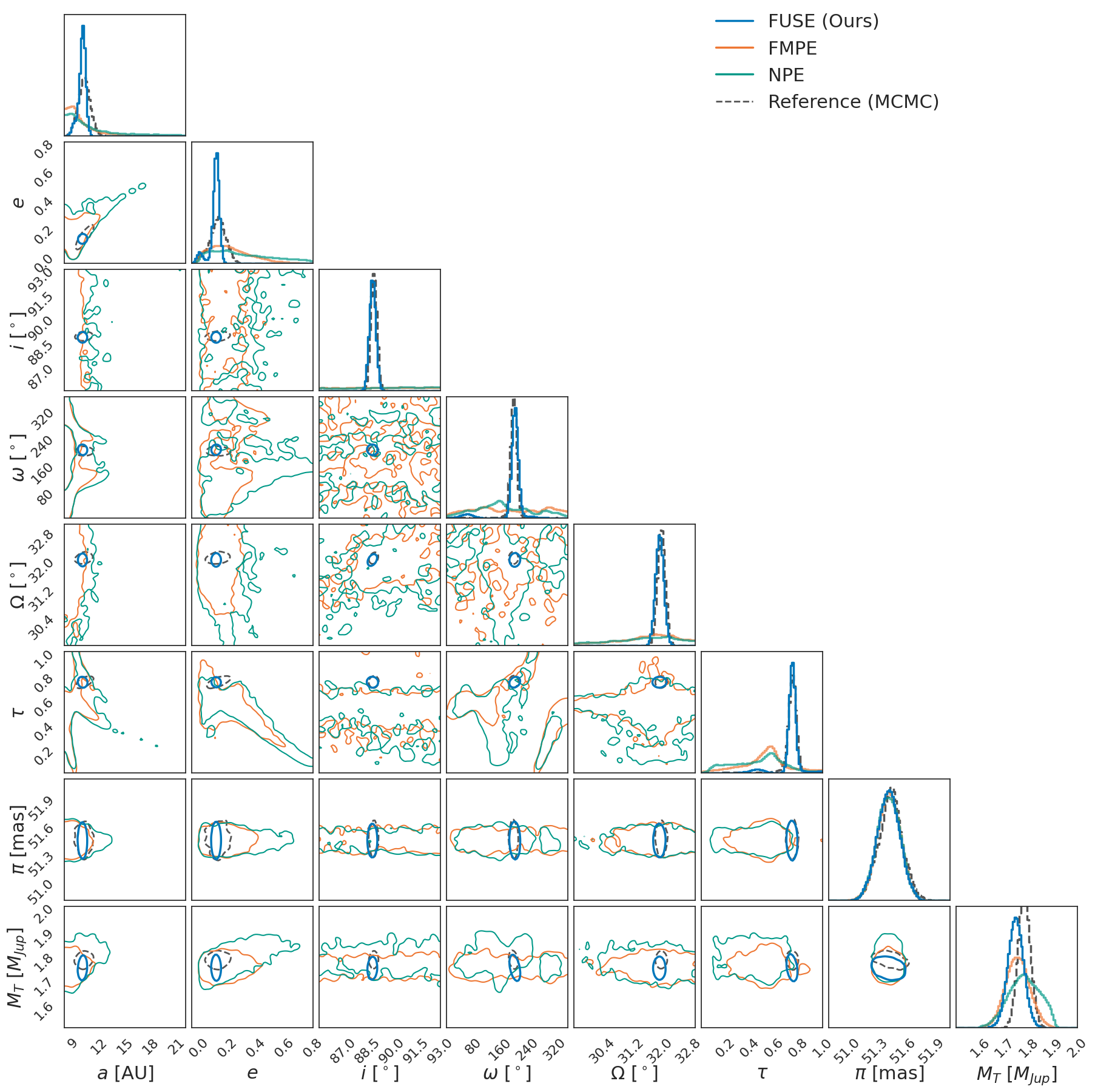
Fig 7 (page 8).
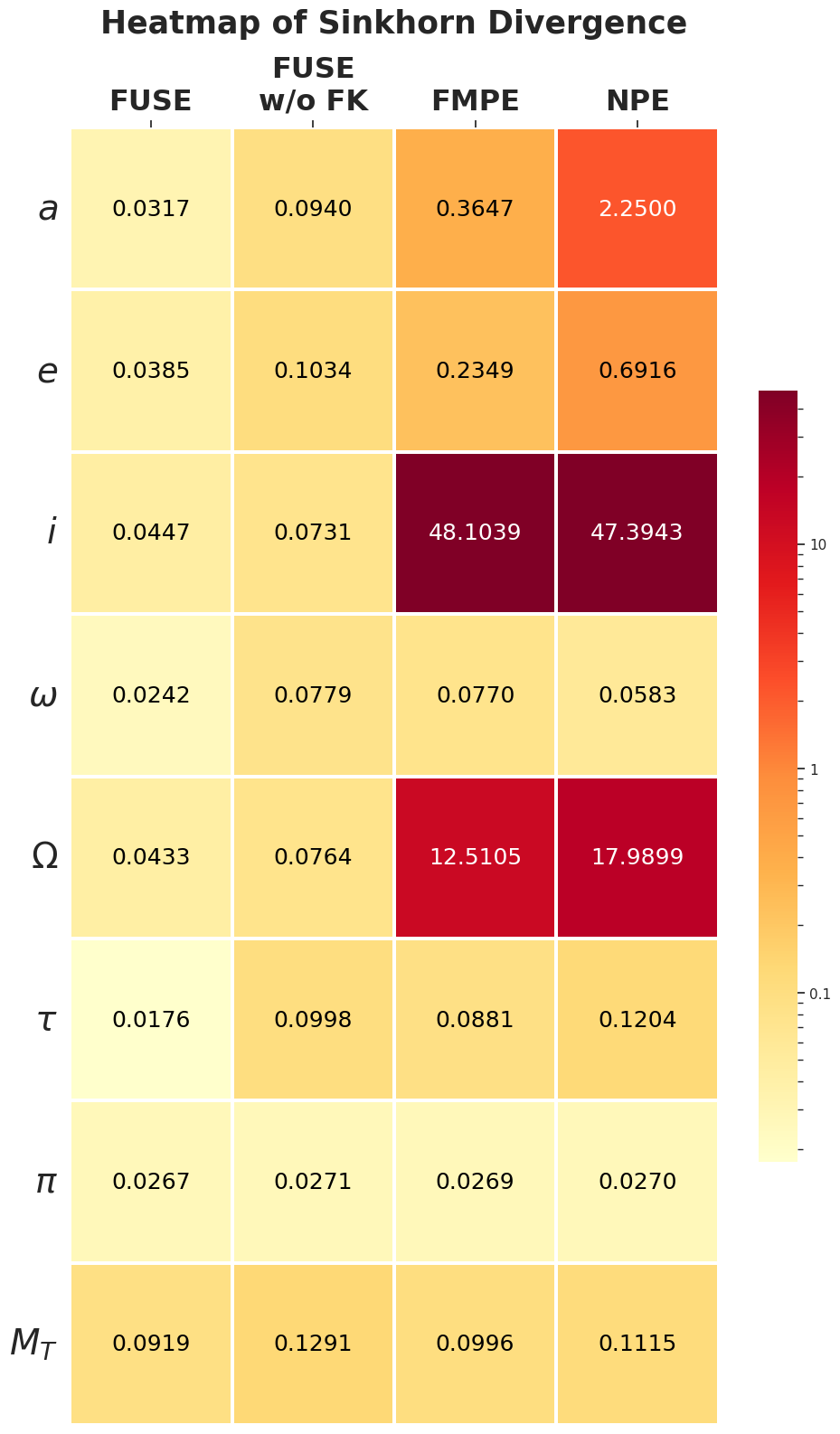
Fig 8 (page 8).
Limitations
- FK-steering, while improving mode concentration, may reduce tail coverage leading to underdispersion as it prioritizes high-likelihood regions.
- High-capacity MM-DiT backbone requires sufficient simulator data and struggles somewhat in very low-budget regimes (below ~103 simulations).
- The FK-steering mechanism is heuristic and not an exact MCMC replacement; particle degeneracy and resampling bias may still affect posterior coverage.
- Details on training stability, hyperparameter sensitivity, and computational cost of FK steering (in wall-clock time) are limited or deferred to appendices.
- Evaluation focuses on parameter estimation benchmarks and a single astrophysics example; generalization to other domains or more complex simulators is not demonstrated.
- The approach relies on availability of simulator likelihoods during inference, which may limit applicability when likelihood evaluation is expensive or unavailable.
Open questions / follow-ons
- Can FK-steered sampling strategies be extended to guarantee better tail coverage while maintaining efficiency?
- How does FUSE scale to significantly higher-dimensional parameter spaces or multimodal observations beyond current benchmarks?
- What are the trade-offs between FK steering computational overhead and accuracy improvements in real-time, large-scale scientific inference?
- Can the dual-track MM-DiT architecture be combined with other generative modeling techniques (e.g., score-based diffusion) to further improve posterior fidelity?
Why it matters for bot defense
While FUSE primarily targets scientific simulation-based inference rather than bot defense or CAPTCHA systems, the core ideas of handling heterogeneous multimodal inputs and likelihood-guided generative sampling can inspire more precise, high-fidelity generative models for challenging distributions. In bot detection, adaptive sample steering that leverages external scoring or likelihood information might improve the robustness or interpretability of generative CAPTCHA breaking or bot fingerprinting models. The dual-track fusion approach also shows promise for combining user behavior (parameters) and sensor data (observations) in a structured manner rather than naive concatenation, which could enhance multimodal signal integration in defense pipelines. However, direct application would require adapting simulation assumptions and likelihood evaluations to adversarial settings, which is not addressed here.
Cite
@article{arxiv2607_05252,
  title={ FUSE: FK-Steered Multi-Modal Flow Matching for Efficient Simulation-Based Posterior Estimation },
  author={ Weichen Qin and Yufan Xie and Peihao Wang and Chia-Jui Chou and Minghui Du and Peng Xu and Ziren Luo and Yi Yang and Jingyi Yu and Bo Liang and Jiakai Zhang },
  journal={arXiv preprint arXiv:2607.05252},
  year={ 2026 },
  url={https://arxiv.org/abs/2607.05252}
}