
Synthetic Contact with AI Reduces Cross-Partisan Animosity
Source: arXiv:2607.02181 · Published 2026-07-02 · By Benjamin Lira, Noah Castelo, Stefano Puntoni, Olivier Toubia
TL;DR
This paper addresses the challenge of rising cross-partisan animosity in the U.S., which is fueled by avoidance of meaningful contact and systematic misperceptions about the opposing political group’s attitudes. The authors propose "synthetic contact"—brief conversations with AI chatbots representing a typical member of the political outgroup—as a scalable alternative to human intergroup contact, which many partisans actively avoid due to aversion and perceived threat. Through five preregistered studies involving 3,960 U.S. partisans, they show that synthetic contact lowers aversion to interaction, corrects misperceptions about the outgroup's views, increases warmth toward the outgroup, and makes real human cross-partisan conversations more likely.
The research finds that partisans are much more willing to talk to an AI bot from the opposing party than a real human counterpart, enduring less aversive trade-offs to avoid the AI conversation. A single 10-minute conversation improves the accuracy of beliefs about the outgroup’s political attitudes and raises feelings of warmth by roughly 4.3 points on a 0-100 thermometer (effect size d=0.37), reversing years of rising animosity. Synthetic contact outperforms social/chatting controls, demonstrating that the effect stems from outgroup-relevant content rather than social interaction alone. Behaviorally, participants who talked to an outgroup bot were six percentage points more likely to opt for a real conversation with an outgroup human than controls. Longitudinal follow-up shows the effect fades mostly within a week, though a small, statistically significant residual remains, concentrated among more extreme partisans. Content analysis reveals that the bots reduced animosity primarily by delivering stereotype-disconfirming information, rather than by increased friendliness or empathy. Overall, the work establishes that AI-mediated synthetic contact offers a scalable, acceptable, and behaviorally consequential intervention to reduce partisan animosity by correcting misperceptions.
Key findings
- Participants matched with a human outgroup partner equated 3 minutes of conversation with 9.65 minutes of aversive mortality reflection, whereas with an AI outgroup partner that aversion was halved to 5.06 minutes (Study 1, d=0.34, p<.001).
- At baseline, Democrats underestimated Republicans' environmental attitudes by more than one standard deviation, enough to flip Republicans from supportive to opposed on average (Study 2).
- A single 10-minute conversation with an outgroup chatbot improved belief accuracy by 0.39 points on a 5-point scale (d=0.46) and raised outgroup warmth by 4.3 points on a 0–100 thermometer (d=0.37, p<.001).
- The three-arm experiment found synthetic contact (outgroup bot) increased outgroup warmth (mean 29.2) significantly more than either an apolitical chatbot control (cats/dogs chat, mean 17.0) or a non-social game control (Space Invaders, mean 17.1) with d=0.58 and d=0.59 respectively (p<.001).
- In the behavioral choice study (N=1069), 67% of participants who talked to an outgroup bot chose a costly real conversation with a human outgroup member versus 61% in the control condition, an odds ratio of 1.33 (p=0.025).
- Longitudinally, the warmth effect was large immediately after chat (d=0.46) but mostly faded within a week with a small residual effect (d=0.05, p=0.16); pooling data showed a small but significant week-later effect (d=0.12, p=0.02) concentrated among high-extremity partisans.
- Content analysis using GPT-5.4-mini rated outgroup bots as delivering significantly more stereotype-disconfirming substance (+2.05 Likert points over controls, p<.001), with smaller and inconsistent differences on empathy or friendliness.
- Belief accuracy gains mediated warmth increases, with perceived informativeness of bots predicting who warmed most (b=1.93, p<.001) while perceived empathy was not a significant predictor.
Threat model
The adversary modeled is primarily the social and psychological barriers—such as partisan animosity, misperception, and affective polarization—that prevent cross-partisan human contact. The AI chatbot intervention is designed to reduce these barriers by providing low-threat, stereotype-disconfirming interactions. There is no consideration of malicious adversaries attempting to manipulate or compromise the chatbot system.
Methodology — deep read
The authors conducted five large preregistered studies with a total of 3,960 U.S. partisans (Democrats and Republicans) to evaluate "synthetic contact"—conversations with AI chatbots representing the political outgroup.
Threat model & assumptions: The adversary here is effectively the social and affective barriers that prevent humans from engaging with outgroup members—partisans avoid cross-partisan contact due to perceived threat and misperceptions. The chatbot intervention addresses this aversion by providing interaction without interpersonal threat. No hostile adversarial attacks on the system or chatbot manipulation by attackers are described.
Data & participants: Samples were drawn from U.S. partisans recruited online, balanced across parties and political extremity. Sample sizes ranged from 500 to over 1,000. Participants were randomly assigned to conditions. Labels consisted of party identity and attitudinal measures (e.g., environmental attitudes via the validated GREEN scale).
Architecture / Algorithm: The synthetic contact bots were implemented using the GPT-4o language model (OpenAI). Bots were prompted specifically to adopt the perspective of a typical outgroup member, using party-conditioned system prompts but no scripted positions. The bots engaged participants in 5- or 10-minute conversations about politically charged topics (environmental policy or immigration). Chat control bots discussed apolitical topics (cats vs dogs) and game controls (Space Invaders) were also included.
Training regime: Not applicable as the study used a pretrained LLM with controlled prompting. No fine-tuning or model training was described.
Evaluation protocol: Measures included incentive-compatible aversion tasks trading off conversation against mortality reflection, belief accuracy and warmth ratings pre/post conversation, active controls to isolate content effects, behavioral choices to engage in real outgroup conversations, and 1-week longitudinal follow-up of warmth. Statistical analyses included logistic regression, mixed effects models, within-person pre-post comparisons, and GPT-based conversation content audits on cognitive and affective dimensions. Effect sizes (Cohen's d, odds ratios) and p-values were reported.
Reproducibility: The paper does not mention releasing code or chatbot prompts publicly but includes detailed prompt descriptions in supplementary material. The data are from non-public online convenience samples.
Concrete example end-to-end: In Study 2, 500 partisans first reported their own and estimated outgroup environmental attitudes, revealing large baseline misperceptions. They then had a 10-minute conversation with a GPT-4o chatbot prompted to represent the opposing party's perspective on environment policy. After the chat, participants re-rated the outgroup’s attitudes and their warmth toward that party. Results showed improved belief accuracy (+0.39 points on a 1-5 scale) and increased warmth (+4.3 points on a 0–100 thermometer), demonstrating correction of misperceptions and affective warming from synthetic contact.
Overall, the methodology combined well-validated measures and preregistered protocols to isolate the cognitive and affective impact of AI-mediated synthetic contact on partisan animosity, leveraging large-scale participant samples and a strong experimental design.
Technical innovations
- Use of AI chatbots prompted to represent a typical political outgroup member to deliver brief synthetic contact for intergroup attitude change.
- An incentive-compatible behavioral aversion paradigm quantifying how partisans trade off mortality reflection time against conversations with human vs AI outgroup partners.
- Combining within-person pre-post design with multi-arm randomized control trials to isolate the effect of outgroup-specific chatbot content versus general social engagement or non-social controls.
- Use of GPT-based content auditing (GPT-5.4-mini) to code conversation transcripts on stereotype-disconfirming cognitive content and affective markers, identifying cognitive information delivery as the principal mechanism of synthetic contact.
Datasets
- U.S. partisans sample from online recruitment — total N=3,960 — internal/non-public
Baselines vs proposed
- Human outgroup partner vs AI chatbot: Equivalent aversion threshold mortality reflection minutes 9.65 vs 5.06 (d=0.34).
- Outgroup bot vs cats/dogs chatbot (apolitical control): Outgroup warmth thermometer 29.2 vs 17.0 (d=0.58, p<.001).
- Outgroup bot vs Space Invaders game: Outgroup warmth thermometer 29.2 vs 17.1 (d=0.59, p<.001).
- Behavioral choice (outgroup bot vs cats/dogs control): Proportion choosing real outgroup conversation 67% vs 61%, OR=1.33 (p=0.025).
Figures from the paper
Figures are reproduced from the source paper for academic discussion. Original copyright: the paper authors. See arXiv:2607.02181.
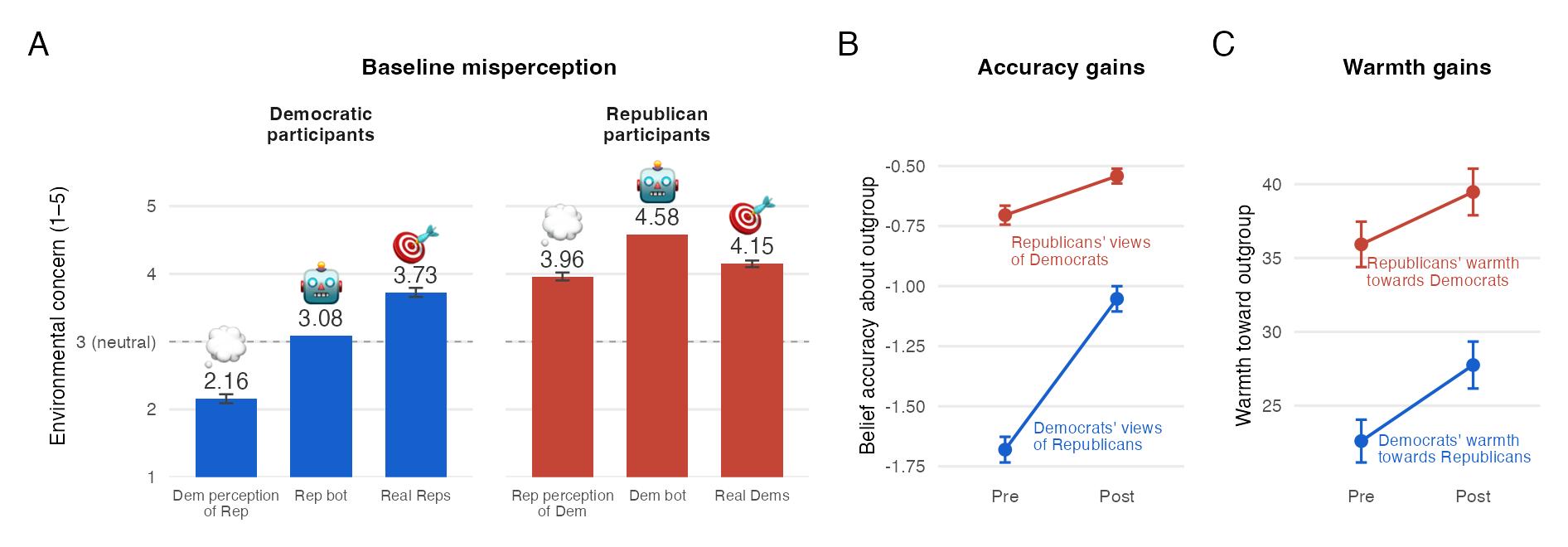
Fig 2: A single ten-minute conversation corrects misperceptions of the outgroup and warms attitudes toward it.
Limitations
- Effect sizes and increased warmth mostly fade within one week, consistent with other brief depolarization interventions, limiting long-term impact from single exposures.
- Measured affective polarization primarily via a single outgroup warmth thermometer, which captures only one dimension of multifaceted polarization.
- Samples drawn online from U.S. partisans and focused on two issue domains (environmental policy and immigration), so generalizability across populations, cultures, and topics is uncertain.
- Bots held somewhat more extreme positions than the average partisan they represented, which might limit the accuracy or neutrality of synthetic contact.
- The study did not explore repeated or longitudinal synthetic contact sessions, which might be needed for durable attitude change.
- Social desirability bias or demand effects cannot be entirely ruled out in self-reported warmth or behavioral measures.
Open questions / follow-ons
- Can repeated or ongoing synthetic contact conversations produce longer-lasting reductions in cross-partisan animosity?
- How does synthetic contact generalize across different cultural contexts, political systems, or issue domains beyond the U.S. environment and immigration topics studied here?
- What are the ethical implications and risks if partisan AI bots inadvertently amplify outgroup stereotypes or convey extremist positions?
- Could hybrid models combining synthetic contact with facilitated human interactions improve affective outcomes beyond cognitive correction?
Why it matters for bot defense
This paper provides a novel application of large language models as social agents capable of lowering barriers to intergroup contact and reducing partisan animosity through stereotype correction. For bot-defense or CAPTCHA practitioners, the results underscore the potential for AI chatbots to influence users’ social attitudes and behaviors beyond standard interaction tasks. Implementing synthetic contact at scale suggests feasible design approaches for deploying AI-driven engagement that reduces avoidance and fosters more constructive social interaction online. The finding that cognitive, information-based routes mediated attitude change, rather than affective friendliness alone, may guide design of bot personas or conversation prompts to optimize social outcomes. Understanding these cognitive-affective mechanisms helps anticipate both the benefits and potential misuse of LLM-based chatbots in politically charged or adversarial contexts. Additionally, the incentive-compatible behavioral measures could inspire robust evaluation frameworks for bot-human social dynamics in platform safety research.
Cite
@article{arxiv2607_02181,
  title={ Synthetic Contact with AI Reduces Cross-Partisan Animosity },
  author={ Benjamin Lira and Noah Castelo and Stefano Puntoni and Olivier Toubia },
  journal={arXiv preprint arXiv:2607.02181},
  year={ 2026 },
  url={https://arxiv.org/abs/2607.02181}
}