
Know Your Source: A Public Knowledge Store for Media Background Checks
Source: arXiv:2607.02383 · Published 2026-07-02 · By Benjamin Nichols, Michael Schlichtkrull, Nedjma Ousidhoum
TL;DR
This paper addresses the problem of unreliable or biased evidence sources impacting the outputs of large language model (LLM)-based retrieval-augmented generation (RAG) systems used for automated fact-checking (AFC). While RAG systems have advanced AFC by grounding claims in retrieved web evidence, existing approaches often assume this evidence is credible, ignoring source trustworthiness issues. To tackle this, recent work introduced media background checks (MBCs), which summarize credibility-relevant attributes of media outlets to support downstream fact verification. However, generating MBCs heavily depends on costly proprietary search APIs, hindering reproducibility and widespread adoption.
The authors introduce MEDIAREF, a large publicly available knowledge store of curated web documents from 200 media sources designed to enable reproducible, low-cost MBC generation without reliance on live search APIs. They describe a systematic, replicable methodology for collecting and updating the data. Evaluations across multiple state-of-the-art open and closed LLMs show that using MEDIAREF for evidence retrieval improves fact recall of MBCs, though overall generation remains challenging, especially for informativeness and verifiability. Human evaluations highlight tradeoffs between clarity, relevance, informativeness, and verifiability in generated MBCs. Models sometimes produce contradictions or omit key facts when updating MBCs iteratively with retrieved evidence. The authors release MEDIAREF to support future research on source-critical reasoning and trustworthy automated fact-checking.
Key findings
- MEDIAREF knowledge store contains 21,921 non-empty scraped documents covering 200 news sources.
- Retrieval-augmented MBC generation improves fact recall scores by ~1–4 percentage points across multiple LLMs compared to zero-shot prompting without IR.
- Best performing model gpt-4o-mini + IR achieves 29.85% fact recall and 8.96% error rate, compared to 28.33% recall and 8.29% error without IR.
- Smaller open-source models (e.g., llama-3.3-70b-instruct) achieve fact recall comparable to state-of-the-art proprietary models.
- Error rates do not necessarily decrease with higher fact recall, highlighting the need to jointly evaluate correctness and error rate.
- Human evaluations show all models produce clear and relevant MBCs, but informativeness and verifiability are harder to achieve, with average scores notably lower.
- 71% of local news outlets in the sample receive low informativeness scores (≤1), indicating very generic or weak MBCs for lesser-known sources.
- Models differ in incorporating retrieved evidence; gpt-5-mini often adds interpretative reasoning about evidence relevance unlike others.
- Iterative updating of MBCs sometimes leads to information loss or contradictions, e.g., 7 MBCs dropped key early background points, and 3 MBCs included conflicting statements.
Threat model
The threat arises from misinformation and bias in publicly accessible evidence sources that retrieval-based fact-checking systems rely on. Adversaries may inject misleading or conflicting content into web documents to manipulate automated media background checks and downstream claim verifications. The system assumes no control over or oracle knowledge of retrieval source reliability, necessitating source-centric scrutiny. The adversary cannot directly alter the internal LLM weights but can influence outputs through poisoned or deceptive evidence content.
Methodology — deep read
Threat model & assumptions: The adversary is not explicitly defined in a traditional sense, but the threat is misleading or biased evidence sources that inject misinformation into retrieval pipelines, leading to distorted downstream automated fact-checking outputs. The system assumes publicly available web data with unknown and potentially conflicting quality.
Data provenance: MEDIAREF is constructed from public web data scraped from search results across 200 media outlets selected from the Media Bias/Fact-Check (MB/FC) dataset, which provides high-quality MBC gold references. Queries targeting aspects like ownership, funding, bias are issued to Google Search API for each outlet. The top 10 results per query are retrieved, merged with URLs cited in gold MBCs, blacklisted sites that copy MB/FC content are removed, and pages scraped using trafilatura. This yields 21,921 non-empty documents in the knowledge store.
Architecture/algorithm: MBC generation is a two-step retrieval-augmented generation process. First, zero-shot LLM prompting generates a preliminary MBC description. Then information retrieval over MEDIAREF using keyword queries and BM25 retrieves the top 30 documents per topic. A DeBERTa-based QA model extracts relevant evidence spans from documents. The LLM iteratively updates the MBC with these evidence snippets, instructed to append and not remove prior points. This iterative refinement aims to enrich and ground the MBC.
Training and parameters: The authors evaluate several existing LLMs (OpenAI GPT-3.5-turbo, GPT-4o-mini, GPT-5-mini, Qwen, Llama 3.3, Mistral 7b, Claude 3.5 Haiku) without additional base model training on the MBC task. All generation uses prompting strategies specified in appendices. Models differ widely in parameter counts and training corpora; no further fine-tuning is reported.
Evaluation protocol: Both automatic metrics (Fact Recall, Error Rate from FActScore, ROUGE-L, METEOR) and human expert annotation on clarity, relevance, informativeness, and verifiability (Likert scales) evaluate quality. Human raters are blinded to model identity and prohibited from searching externally. 108 MBCs (27 per model) are annotated for analysis. Correlation between quality dimensions is assessed to understand interpretability.
Reproducibility: MEDIAREF knowledge store and all code for generating and evaluating MBCs are publicly released. The dataset sampling and retrieval process is fully documented to enable updates. No frozen model weights are provided but prompts and evaluation details are complete for replication.
Example: For a given news outlet 'Rebel News', keyword queries like 'Rebel News ownership' are submitted to Google Search API. Top results are scraped and processed. BM25 retrieves matching documents. QA extracts ownership claims. An LLM generates an initial MBC mentioning ownership and bias from prior knowledge, then iteratively incorporates retrieved evidence snippets to refine the MBC text, which is evaluated against the gold standard using fact-level recall and human ratings.
Technical innovations
- MEDIAREF introduces a publicly available, continuously updatable knowledge store of curated web documents from 200 media outlets facilitating reproducible MBC generation without reliance on proprietary search APIs.
- A protocol combining targeted keyword queries, BM25 retrieval over MEDIAREF, and DeBERTa-based QA extraction provides structured evidence for iterative MBC refinement by LLMs.
- Proposed a methodology to update initial LLM-generated MBCs with retrieved evidence snippets iteratively, preserving prior points to minimize content loss during refinement.
- Designed a human evaluation framework assessing MBC outputs along clarity, relevance, informativeness, and verifiability, extending prior work focused mainly on usefulness.
Datasets
- MEDIAREF — 21,921 documents — Publicly scraped from web via Google Search API and trafilatura scraping
- Media Bias/Fact-Check (MB/FC) dataset — 200 sampled media outlets for test split — Used as gold standard for MBC text references
Baselines vs proposed
- gpt-3.5-turbo without IR: fact recall = 26.86%, error rate = 8.21% vs. with MEDIAREF IR: fact recall = 28.24%, error rate = 8.13%
- gpt-4o-mini without IR: fact recall = 28.33%, error rate = 8.29% vs. with IR: fact recall = 29.85%, error rate = 8.96%
- gpt-5-mini without IR: fact recall = 24.78%, error rate = 4.80% vs. with IR: fact recall = 27.83%, error rate = 5.48%
- llama-3.3-70b-instruct without IR: fact recall = 28.98%, error rate = 9.66% vs. with IR: fact recall = 29.03%, error rate = 9.76%
- mistral-7b-instruct-v0.3 without IR: fact recall = 28.07%, error rate = 10.54% vs. with IR: fact recall = 27.49%, error rate = 10.44%
- qwen-3-32b-instruct without IR: fact recall = 24.91%, error rate = 9.78% vs. with IR: fact recall = 26.22%, error rate = 9.79%
- Claude-3.5-haiku without IR: fact recall = 26.66%, error rate = 7.32% vs. with IR: fact recall = 26.95%, error rate = 7.15%
Figures from the paper
Figures are reproduced from the source paper for academic discussion. Original copyright: the paper authors. See arXiv:2607.02383.

Fig 2: MBC generation method for a given news
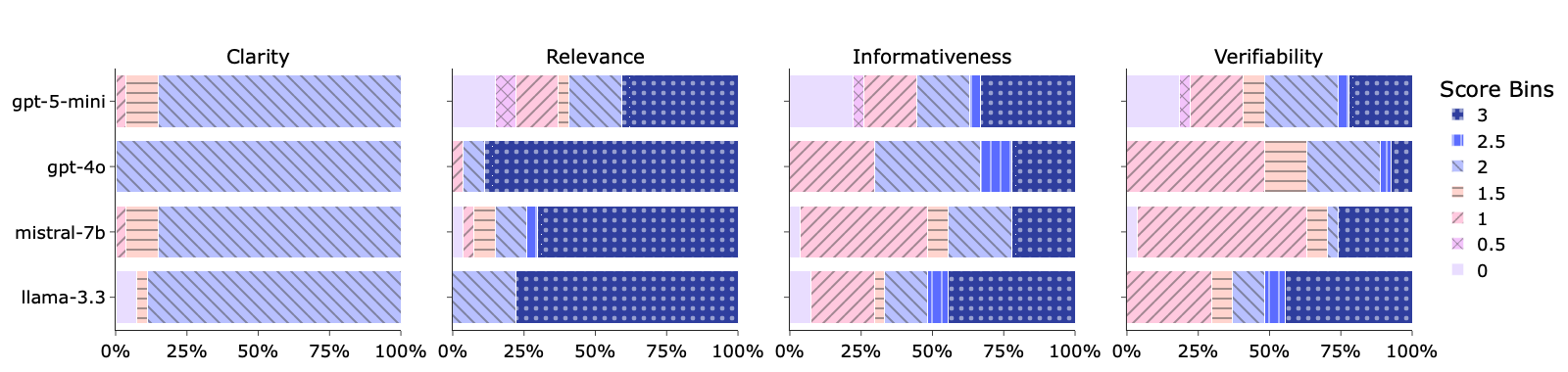
Fig 3: Qualitative analysis results for Clarity, Relevance, Informativeness, and Verifiability. Colours encode
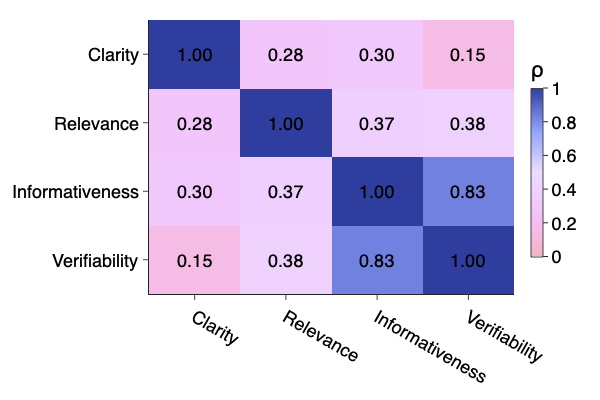
Fig 4: Spearman correlations between MBC clarity,
Limitations
- Reliance on Google Search API rankings for initial retrieval may introduce bias in evidence source selection and affect coverage/diversity in MEDIAREF.
- Blacklists used to remove undesirable sources referencing MB/FC may be incomplete, so some low-quality or biased sources could remain in the knowledge store.
- MEDIAREF only includes freely accessible web pages, missing paywalled, proprietary, or official dataset sources that could provide critical credibility evidence.
- MBC updating by LLMs can cause information loss or contradictions as previous content is preserved rather than revised, potentially confusing users.
- Models struggle to generate informative and verifiable MBC content especially for lesser-known local news outlets due to lack of external independent scrutiny or detailed evidence.
- No formal adversarial robustness or distribution shift evaluations assessing resilience to intentional misinformation or source manipulation have been conducted.
Open questions / follow-ons
- How to integrate more diverse external evidence sources beyond web search, including proprietary or paywalled databases, to enrich MBC coverage and accuracy?
- What methods can improve iterative MBC updating to prevent information loss or contradictions while incorporating new evidence?
- How do different retrieval algorithms and ranking strategies impact the relevance, bias, and comprehensiveness of evidence used for MBC generation?
- Can detection or mitigation techniques be developed to handle adversarial poisoning of retrieval sources that aim to degrade automated source credibility assessments?
Why it matters for bot defense
For bot-defense and CAPTCHA practitioners focusing on automated fact verification pipelines, MEDIAREF provides a valuable resource to ground media source credibility assessments in reproducible, transparent evidence independent of costly live search APIs. Employing curated knowledge stores like MEDIAREF can improve reliability of reasoning about evidence sources, reducing risk from malicious or misleading content influencing LLM outputs. However, results show that even with structured retrieval, current LLMs struggle with informativeness and verifiability aspects of media background checks, especially for less prominent or local outlets. These insights highlight the importance of combining retrieval augmentation with source-critical reasoning and human oversight.
Practitioners designing bot-defense systems that include claim verification or misinformation detection may consider building or integrating similar static, curated evidence repositories to improve consistency and reduce variability inherent in live web retrieval. Understanding the tradeoffs in update methodologies and the challenges in capturing nuanced source characteristics can inform better system design to avoid cascading errors influencing automated trust judgements.
Cite
@article{arxiv2607_02383,
  title={ Know Your Source: A Public Knowledge Store for Media Background Checks },
  author={ Benjamin Nichols and Michael Schlichtkrull and Nedjma Ousidhoum },
  journal={arXiv preprint arXiv:2607.02383},
  year={ 2026 },
  url={https://arxiv.org/abs/2607.02383}
}