
Congestion-Based Slot Pricing in a Railway Auction Game
Source: arXiv:2607.01822 · Published 2026-07-02 · By Bill Roungas, Sebastiaan Meijer
TL;DR
This paper addresses the challenge of allocating discrete, congested railway infrastructure slots among heterogeneous train operators in a deregulated market. The authors propose a multi-agent auction mechanism combining congestion-based pricing—where slot prices rise with aggregate demand—and an asymmetric corrective adjustment that penalizes the largest slot requester while rewarding the smallest. This design aims to counterbalance strategic dominance by large operators while preserving transparency and responsiveness to congestion. To study operator behavior under this mechanism, the authors implement a real-time, web-based multi-agent game simulating repeated auctions with time-constrained decision-making and live feedback. Two structured gameplay sessions with domain experts (railway infrastructure planners) revealed that while the congestion pricing and reward-penalty incentives triggered as designed, large operators persistently pursued aggressive high slot requests despite penalties, indicating that corrective pricing alone is insufficient to neutralize strategic dominance. Post-session debriefs highlighted that participants acted strategically based on assigned roles rather than personal preferences, balancing market-preservation motives and profit maximization.
Key findings
- Congestion-based pricing effectively increased slot acquisition costs as aggregate demand rose, confirming that slot prices responded dynamically to congestion.
- The reward-penalty mechanism applied a 20% penalty to the largest slot requester and a 20% discount to the smallest, activating during gameplay as intended.
- Smaller operators frequently adopted conservative slot requests, benefiting from the discount, while large operators maintained high slot requests despite penalties.
- Large operators sometimes incurred negative profits yet continued aggressive bidding, suggesting strategic motives beyond short-term gain.
- Time-limited decision rounds (7 minutes per round) led to some forfeited rounds, interpreted as decision failures due to cognitive/time pressure.
- Participants reported that decisions were guided by the representative operator role, not personal disposition, validating role-based strategic behavior assumptions.
- The penalty and discount targeted only slot acquisition costs, excluding operational or rolling stock costs.
- Exploratory analysis emphasized descriptive patterns over formal hypothesis testing, with no manipulation of auction parameters across sessions.
Threat model
Strategic train operators competing for scarce railway slots under incomplete information, acting repeatedly with knowledge of aggregate demand and previous competitor bids but without full insight into rivals' valuations or future strategies. Operators differ in size and capacity, some able to dominate through aggressive capacity requests. Operators cannot collude explicitly but may act strategically to preserve market presence or raise rivals' costs. The auctioneer enforces congestion-based pricing and role-based penalties/discounts but cannot fully prevent strategic dominance.
Methodology — deep read
The authors conceptualize railway slot allocation as a repeated auction game with multiple operator-agents of heterogeneous size and capacity competing for discrete train slots on congested infrastructure. The threat model assumes strategic agents with incomplete information, acting repeatedly under time pressure without full knowledge of competitors' private valuations.
The auction mechanism includes a congestion-based base price per slot that rises with total requested slots in each round. A corrective incentive asymmetrically penalizes the operator requesting the most slots (20% price penalty on slot costs) and rewards the one requesting the fewest (20% discount). This design aims to discourage monopolistic bidding by large operators and encourage small operator participation.
Initially, a prototype was developed in Excel for manual testing of the auction logic and financial outcomes. The prototype allowed users to input slot requests and see dynamic cost, revenue, and profit updates, but lacked real-time interaction and synchronization.
The final implementation is a web-based multiplayer game built with HTML, JavaScript, PHP, and MySQL enabling simultaneous, time-limited (7-minute rounds) bidding by human participants controlling predefined operator profiles (small, midsize, large).
Participants observe marginal cost feedback and competitors' previous round slot requests to inform bidding. Cost components include slot acquisition, operational running costs, and rolling stock rental if own capacity is insufficient.
Two structured gameplay sessions were run involving railway domain experts employed by the Swedish infrastructure manager, Trafikverket. All sessions used fixed auction parameters with identical congestion and corrective pricing rules, focusing on exploratory observation rather than hypothesis testing.
Data automatically logged per round included slot requests, costs, revenues, profits, penalty/discount application, and forfeits due to time expiration. Analysts classified bidding behavior as aggressive or conservative compared to operator bid ranges and evaluated decision quality relative to myopic profit-maximizing best responses indicated by marginal cost metrics.
Post-game debriefs gathered qualitative insights into participant reasoning, focusing on role-driven strategic motives such as market presence and raising rivals' costs.
No formal statistical testing, cross-validation, or frozen code/weights apply given the socio-technical, exploratory focus. The system and data collection enable future larger-scale experimental and analytical validation work.
Technical innovations
- Integration of congestion-sensitive slot pricing that dynamically scales slot acquisition costs with aggregate demand in a repeated multi-agent auction setting.
- Introduction of an asymmetric corrective incentive applying a proportional (20%) penalty to the largest slot requester and a discount to the smallest, aiming to mitigate dominant operators' strategic overbidding.
- Implementation of a real-time, web-based interactive multi-agent auction game featuring time-constrained decision-making and live marginal cost and competitor feedback to observe strategic human operator behavior.
- Use of role-assigned human participants representing heterogeneous operator sizes to study strategic behavior under auction pricing with incomplete information in a controlled but realistic environment.
Datasets
- Structured gameplay logs — 2 sessions with 3 operators each (~number of rounds not specified) — collected from web-based auction game with railway domain experts as participants
Baselines vs proposed
- First pricing variation (uniform slot price for all operators): baseline for comparison to second variation with corrective incentives (reward-penalty). No explicit quantitative metrics given for direct baseline comparison.
- Corrective pricing mechanism active during play, with 20% penalty/discount applied, but aggressive bidding by large operators persisted vs. expected deterrence effect of penalty.
Figures from the paper
Figures are reproduced from the source paper for academic discussion. Original copyright: the paper authors. See arXiv:2607.01822.
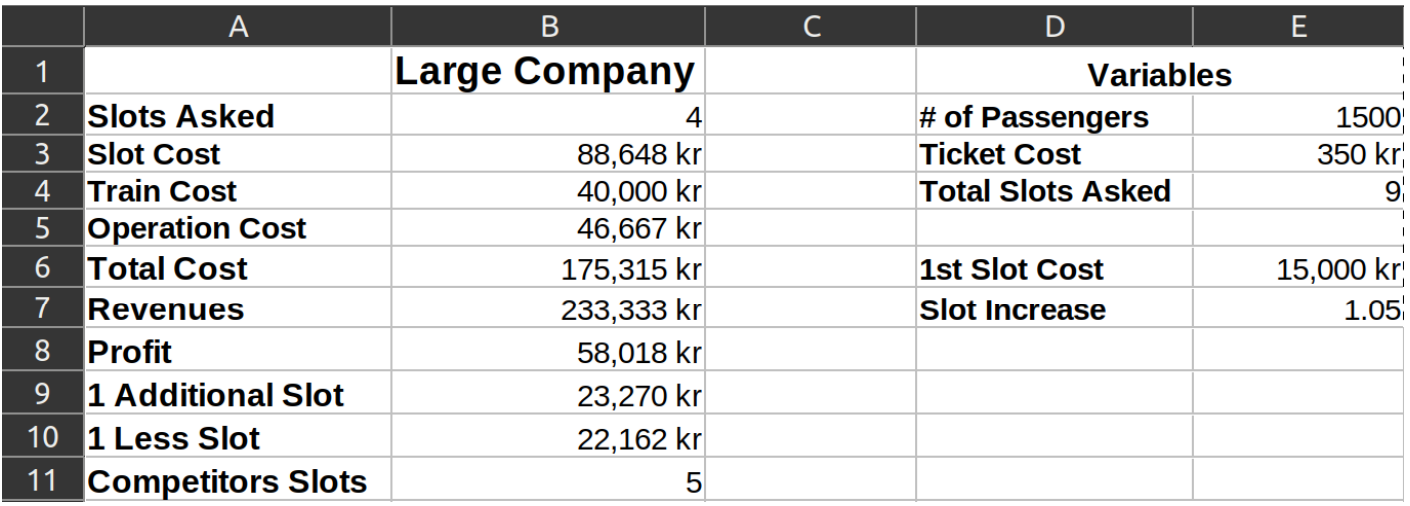
Fig 1: The prototype.
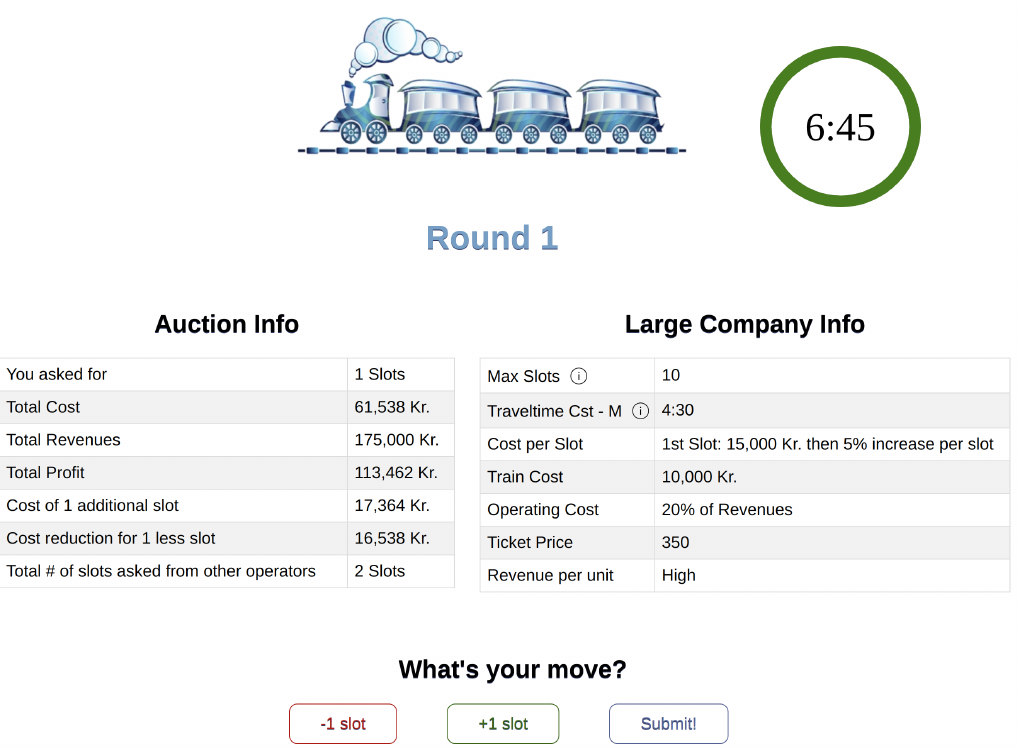
Fig 2: The game interface.
Limitations
- Exploratory/observational study with small sample size (two gameplay sessions, 3 operators per session) limits statistical generalizability.
- No formal hypothesis testing or controlled experiment; auction parameters fixed across sessions without variation to isolate effects.
- Human decision-making under time pressure introduces cognitive/logistical noise unrelated to strategic auction considerations.
- Corrective pricing targets only slot acquisition costs, not operational or rolling stock costs, potentially limiting deterrence impact.
- Absence of non-human (algorithmic) bidders or adversarial testing constrains conclusions about mechanism robustness.
- No testing under distributional shifts or varied market composition beyond fixed small/midsize/large operator configurations.
Open questions / follow-ons
- Can analytical or equilibrium models predict stable outcomes under the proposed congestion-pricing and corrective incentives in multi-operator settings?
- How do different corrective incentive structures, magnitudes, or targeting methods affect strategic dominance and efficiency?
- What role can facilitation or richer behavioral nudges play to better align operator strategies with socially desirable outcomes?
- How do automated or mixed human-algorithmic bidders influence auction dynamics and strategic equilibria under congestion-based slot pricing?
Why it matters for bot defense
From a bot-defense or CAPTCHA perspective, this work highlights the importance of designing pricing and incentive mechanisms that mitigate dominance and encourage fair participation among heterogeneous agents competing over limited shared resources. The combined use of congestion-based pricing plus asymmetric penalties/discounts illustrates a practical approach to balancing efficiency and anti-monopoly objectives. Equally valuable is the multi-agent, real-time interactive experimental platform to observe strategic behavior under adaptive incentives and time pressure. CAPTCHA or bot-defense practitioners might analogously consider how to disincentivize dominant or abusive automated clients while preserving transparency and responsiveness. Additionally, understanding how strategic human or automated agents respond to corrective incentives and feedback can guide mechanism design that better maintains fairness and robustness in adversarial multi-party systems. Importantly, the results underscore that corrective pricing alone may be insufficient, indicating the necessity of layered defenses or facilitation to align incentives effectively.
Cite
@article{arxiv2607_01822,
  title={ Congestion-Based Slot Pricing in a Railway Auction Game },
  author={ Bill Roungas and Sebastiaan Meijer },
  journal={arXiv preprint arXiv:2607.01822},
  year={ 2026 },
  url={https://arxiv.org/abs/2607.01822}
}