
Beyond Skepticism: Evaluating LLMs Pedagogical Intent Reasoning with the Adaptive Pedagogical Vigilance Framework
Source: arXiv:2607.01581 · Published 2026-07-02 · By Minghao Chen, Ruihan Zhou, Jiayi Tang, Zihan Xu, Bowen Huang, Yuxin Liu
TL;DR
This paper addresses the underexplored problem of whether large language models (LLMs) can reason about pedagogical intent in instructional communication, a critical ability for trustworthy AI-assisted education. The authors propose the Adaptive Pedagogical Vigilance (APV) framework, which reconceptualizes vigilance as an adaptive cognitive process for optimizing learning by Bayesian inference about latent teaching motives, encompassing instructional genre, pedagogical stance, and incentives. The core Pedagogical Intent Inference Engine (PIIE) models the teacher as a rational agent selecting instructional content to maximize pedagogical utility, while the student (LLM) inverts this model to update beliefs vigilantly.
APV is rigorously evaluated on a three-level hierarchy: (1) discriminating deliberate teaching from incidental exposure, (2) reasoning about structured pedagogical configurations (stance and incentives), and (3) generalizing to authentic educational discourse. Experiments with state-of-the-art LLMs (GPT-4o, Claude 3.5, Gemini 2.0, and others) demonstrate that APV substantially improves vigilance. It achieves the strongest discrimination between pedagogical and exposure cases, correlates highly with human judgments (r=0.958), and maintains robust performance in naturalistic data where baseline methods degrade. Ablations confirm the necessity of modeling genre, stance, and incentives within a formal Bayesian framework. This work establishes a unified, formal, and empirically validated baseline for measuring and enhancing LLMs' social reasoning about instructional motives.
Key findings
- APV-enabled models show the largest differential in translation confidence shifts between deliberate pedagogy and incidental exposure across cooperative and competitive learning contexts (e.g., APV CoT prompting shift 0.28 vs 0.71 under pedagogy vs exposure).
- APV achieves the highest correlation (r=0.937) between elicited influence scores and a Bayesian pedagogical intent model (Bayesian–LLM), outperforming GPT-4o (r=0.911) and Claude 3.5 (r=0.845).
- Correlation between APV and human judgments on Level 2 tasks is r=0.958, surpassing all baselines, indicating superior human-like vigilance.
- APV exhibits balanced sensitivity to pedagogical stance and incentive structures, achieving correlations > 0.92 on both dimensions, superior to all compared LLMs.
- In realistic pedagogical discourse datasets, APV maintains moderate correlations with rational models (r=0.287–0.345), whereas baseline LLMs drop near zero without steering prompts.
- APV’s predictions of learner translation improvement (∆BLEU) correlate with expert annotations at r=0.41, significantly higher than GPT-4o (r=0.22) and Claude 3.5 (r=0.19).
- Ablation studies show that removal of genre, stance, incentive modeling, or PIIE structure significantly decreases human-alignment correlations (all p<0.01), confirming the necessity of each APV component.
- APV’s performance remains robust across prompting styles (direct vs CoT) and dialog perspectives (first-person vs assistant), unlike other reasoning baselines whose performance degrades under assistant perspective.
Threat model
The adversary is a teacher or instructional source whose pedagogical intent and incentives may be misaligned with the student's learning goals, potentially producing misleading or manipulative instructional content. The LLM (student) is assumed to have no direct access to the teacher's private configuration but observes only the instructional segment. It cannot control or verify the teacher but must reason vigilantly to infer latent teaching configurations and appropriately weigh trust in the instruction to optimize learning belief updates.
Methodology — deep read
The threat model assumes a pedagogical communication setting where a teacher (T) provides instructional segments (I) to a student (S) aiming to learn a translation task. The adversary here would be a teacher whose instructional intent and incentives might be misaligned with the student's learning goals, and the student (LLM) aims to reason vigilantly about the latent pedagogical configuration θ consisting of genre (deliberate teaching vs incidental exposure), pedagogical stance τ (performance vs developmental focus), and reward structures RT (teacher) and RS (student).
The dataset comprises tailored language learning scenarios: controlled synthetic tasks based on prior experimental paradigms (blue/yellow circles adapted to translations), character-based tutoring dialogues with known pedagogy/incentives, and a curated corpus of transcribed real-world instructional segments from online tutorials, feedback videos, and translation forums. For the third level, expert annotations of learning improvements (∆BLEU) and incentives are provided for evaluation.
The core algorithm is the Pedagogical Intent Inference Engine (PIIE), a two-tier Bayesian model where the teacher selects instruction I to maximize a combined utility blending student and teacher rewards weighted by the pedagogical stance τ. The teacher's choice distribution PT(I|w, θ) models rationality via a softmax with rationality parameter βT. The student updates posterior beliefs over the true learning state w by marginalizing over uncertain θ, combining priors with the expected teacher policy likelihood.
APV adapts prompting to explicitly involve this Bayesian formalism, instructing LLMs to infer genre, stance, and incentives from inputs to produce Influence Scores (belief in recommended translation), Perceived Incentive Scores, and Pedagogical Stance estimates (ˆτ). Multiple prompting conditions (direct, Chain-of-Thought) and perspectives (first-person, assistant) are tested.
Training is zero-shot with prompting—no fine-tuning. Experiments run with temperature=1 (exploratory) or temperature=0 (deterministic). Trials per condition range around n=30 or n=1 for real data segments.
Evaluation metrics include proportion shifts in translation confidence, Pearson correlations between LLM output scores and Bayesian model predictions, and correlations with human judgments. Statistical significance is assessed (p<0.01 or p<0.05). Ablations systematically remove APV components from prompts to measure impact.
Reproducibility: The paper does not mention open-source code release or frozen weights. The naturalistic dataset is curated but detailed provenance or public availability is unspecified, limiting direct replication. However, prompting templates and detailed evaluation conditions are described sufficiently to guide reproduction on the same LLM families.
Technical innovations
- Reconceptualization of communicative vigilance as an adaptive Bayesian inference mechanism over latent pedagogical configurations, rather than simple skepticism.
- Formal Pedagogical Intent Inference Engine (PIIE) that models the teacher as a utility-maximizing rational agent selecting instructional content based on a combined student-teacher reward function weighted by pedagogical stance.
- Hierarchical evaluation framework assessing LLMs’ vigilance at discriminating instructional genre, reasoning about fine-grained pedagogical configurations, and generalization to real-world educational discourse.
- Prompt engineering integrating Bayesian pedagogical inference structure explicitly into LLM reasoning to substantially improve alignment with rational and human pedagogical judgments.
Datasets
- Level 1 Controlled Translation Vignettes — ~30 trials per condition — synthetic adaptation of psychology tasks
- Level 2 Tutor Character Scenarios — multiple tutor profiles with known incentive and stance parameters — synthetic structured dialogues
- Level 3 Authentic Pedagogical Discourse Dataset — transcriptions from online language tutorials, teacher feedback videos, translation forums — curated, size unspecified, expert annotations on ∆BLEU on subset
Baselines vs proposed
- GPT-4o (CoT): pupil confidence shift under pedagogy = 0.42 vs APV (CoT) = 0.38; under exposure GPT-4o = 0.65 vs APV = 0.71
- GPT-4o Bayesian alignment r = 0.911 vs APV r = 0.937
- GPT-4o human alignment r = 0.943 vs APV r = 0.958
- Claude 3.5 Bayesian alignment r = 0.845 vs APV r = 0.937
- Claude 3.5 human alignment r = 0.941 vs APV r = 0.958
- Naturalistic setting correlation with Bayesian rational model, GPT-4o (default prompt) r = 0.024 vs APV r = 0.301
- Learner improvement prediction correlation with expert annotation, GPT-4o best steering r = 0.22 vs APV default r = 0.41
Figures from the paper
Figures are reproduced from the source paper for academic discussion. Original copyright: the paper authors. See arXiv:2607.01581.
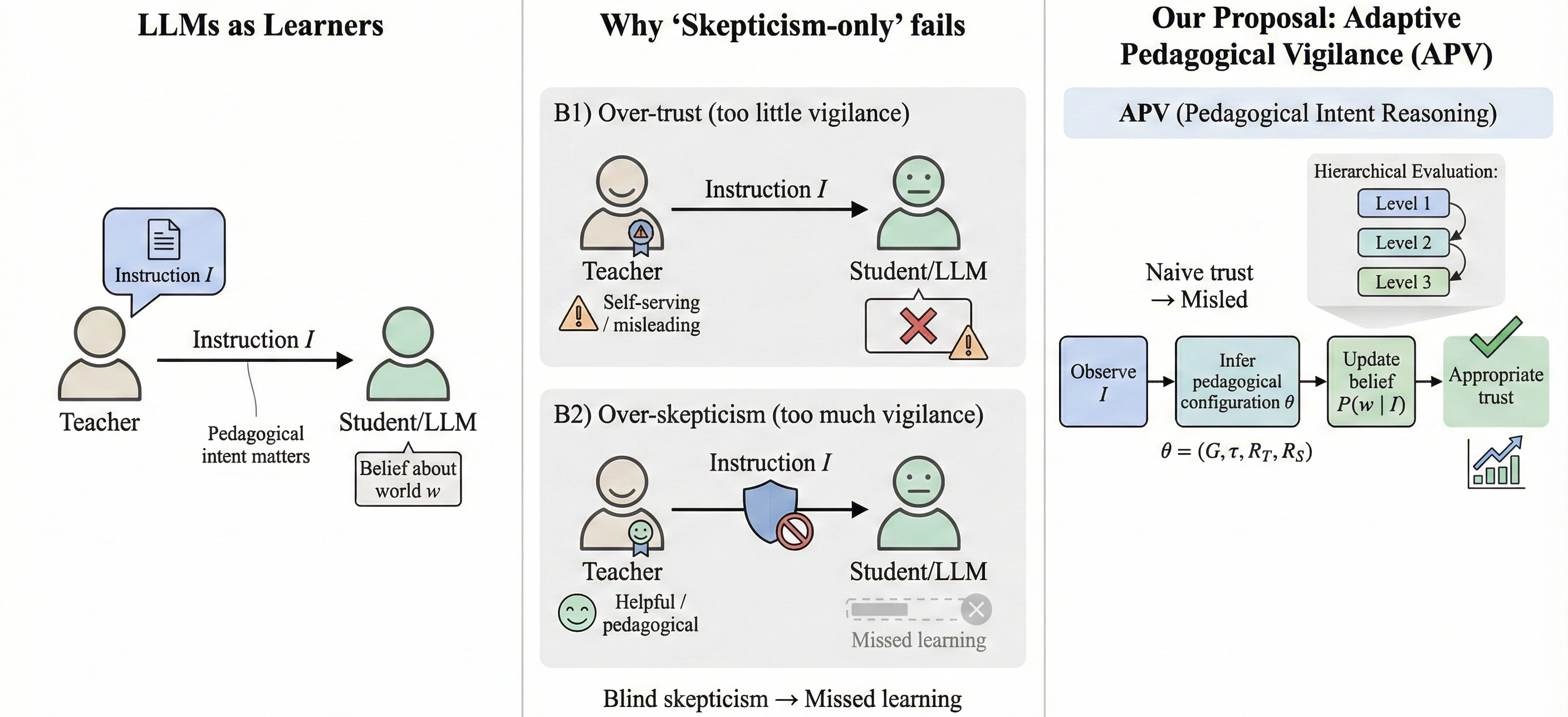
Fig 1: Motivation: Pedagogical intent can warrant neither naive trust nor blanket skepticism; APV
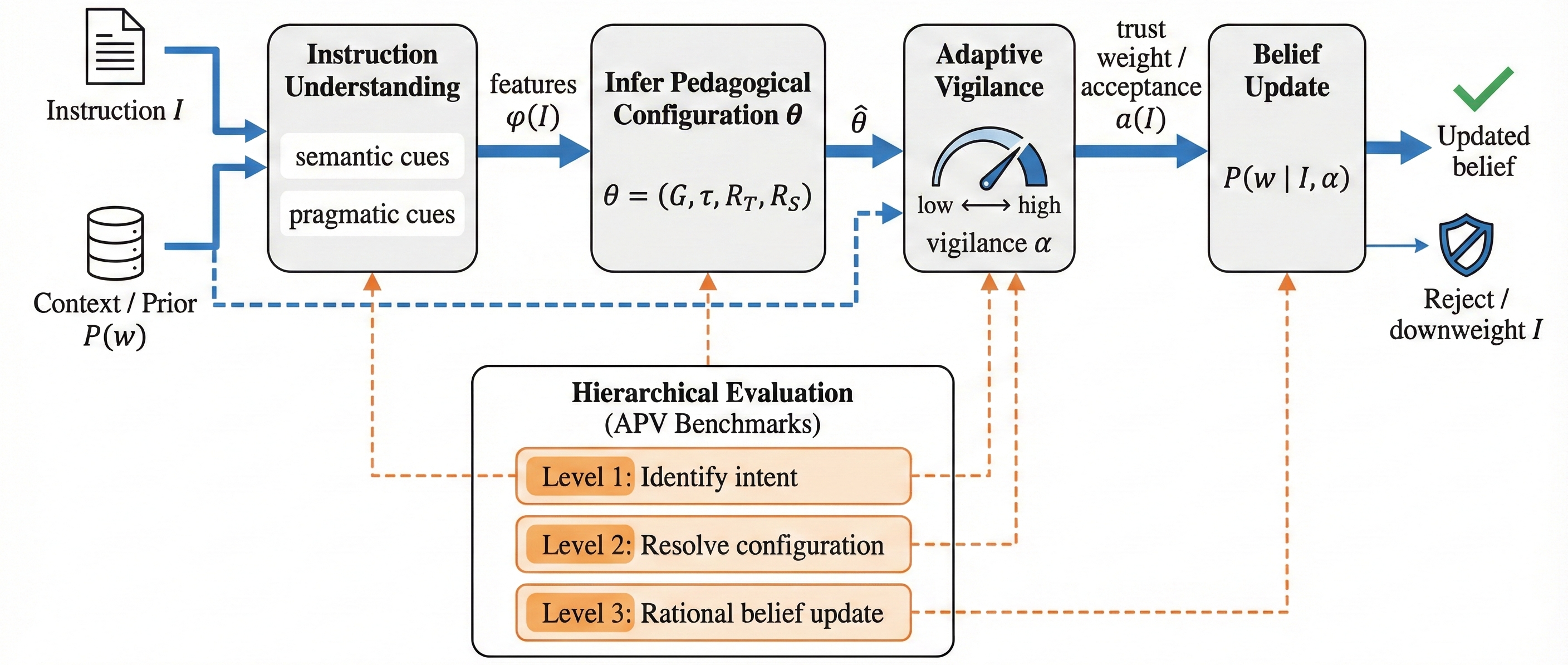
Fig 2: Overview of the APV framework: infer the pedagogical configuration from an instruction
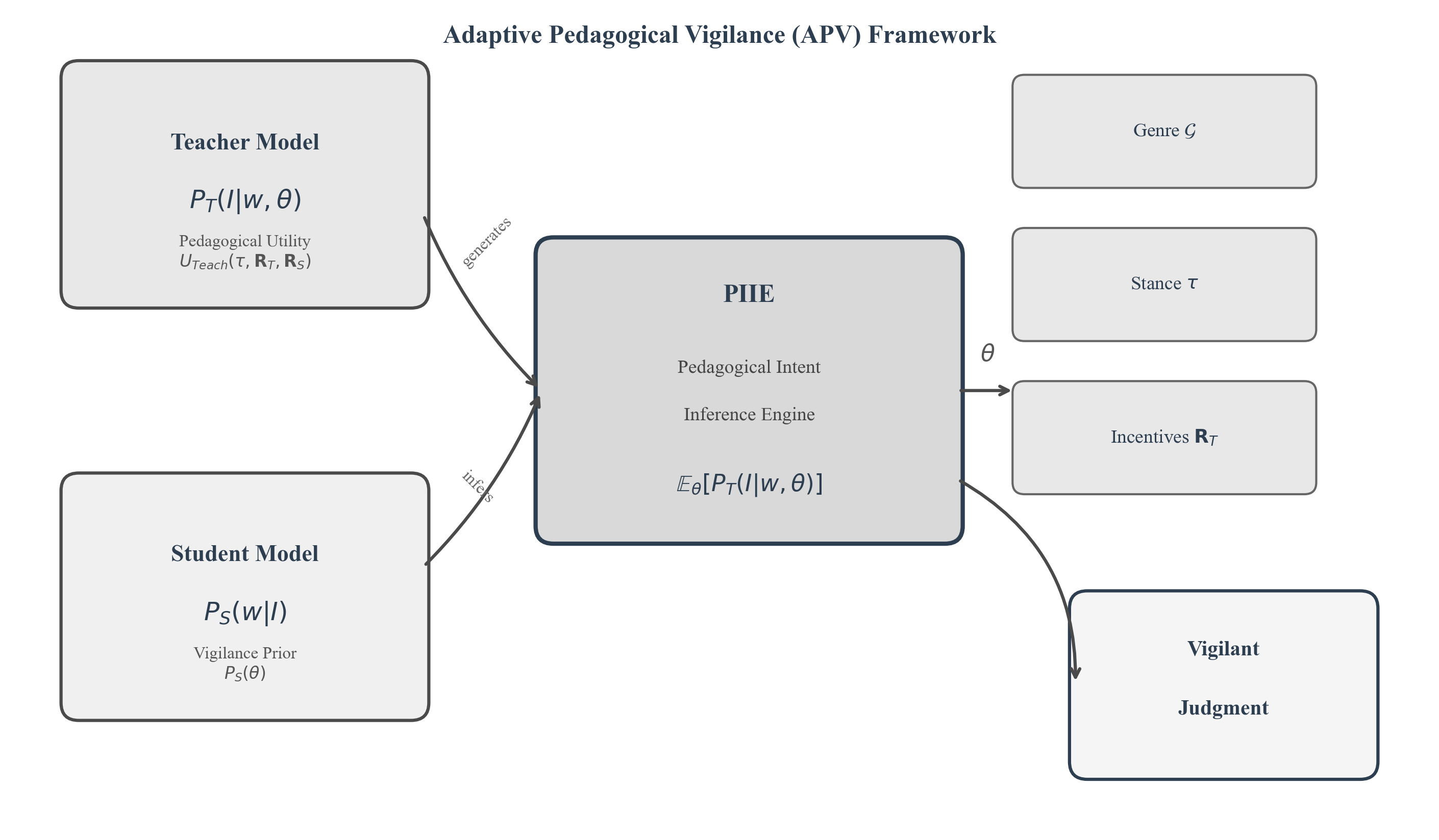
Fig 3: Overview of the Adaptive Pedagogical Vigilance (APV) framework. The Teacher Model
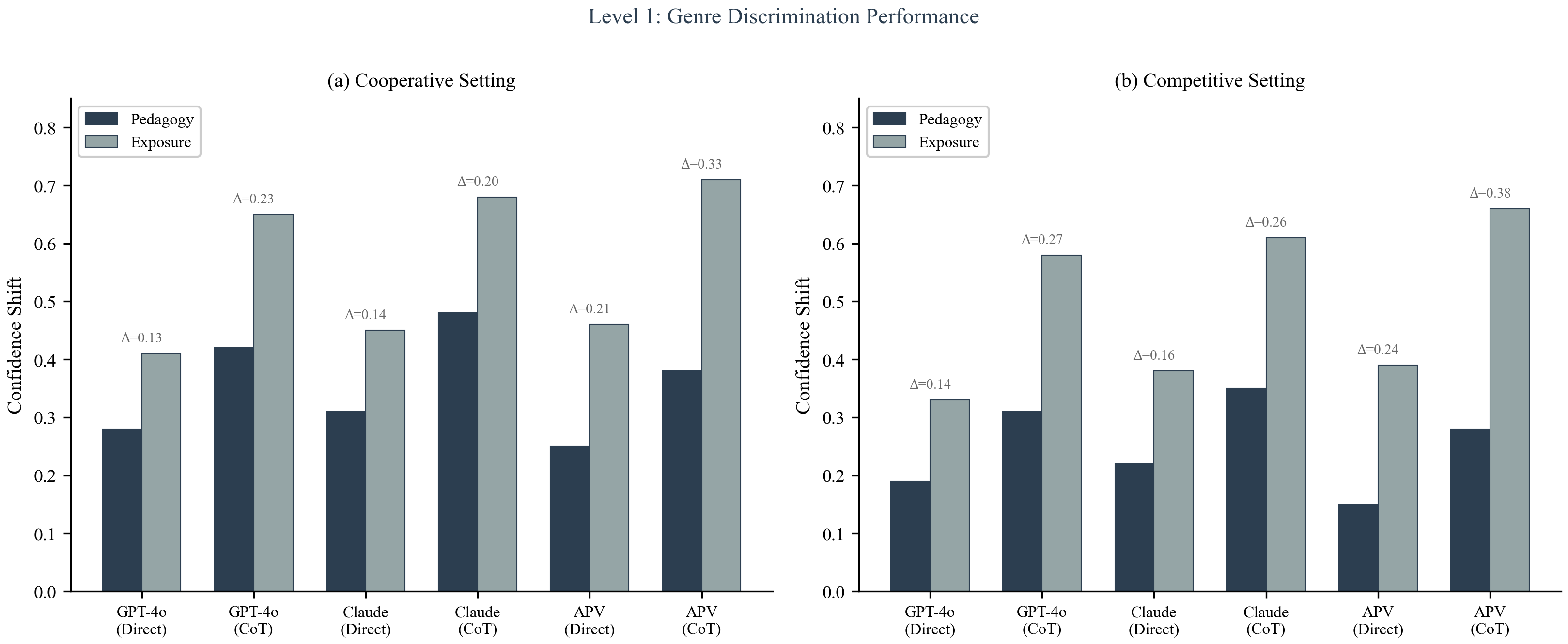
Fig 4: Genre discrimination performance across models. (a) Cooperative setting and (b) Competi-
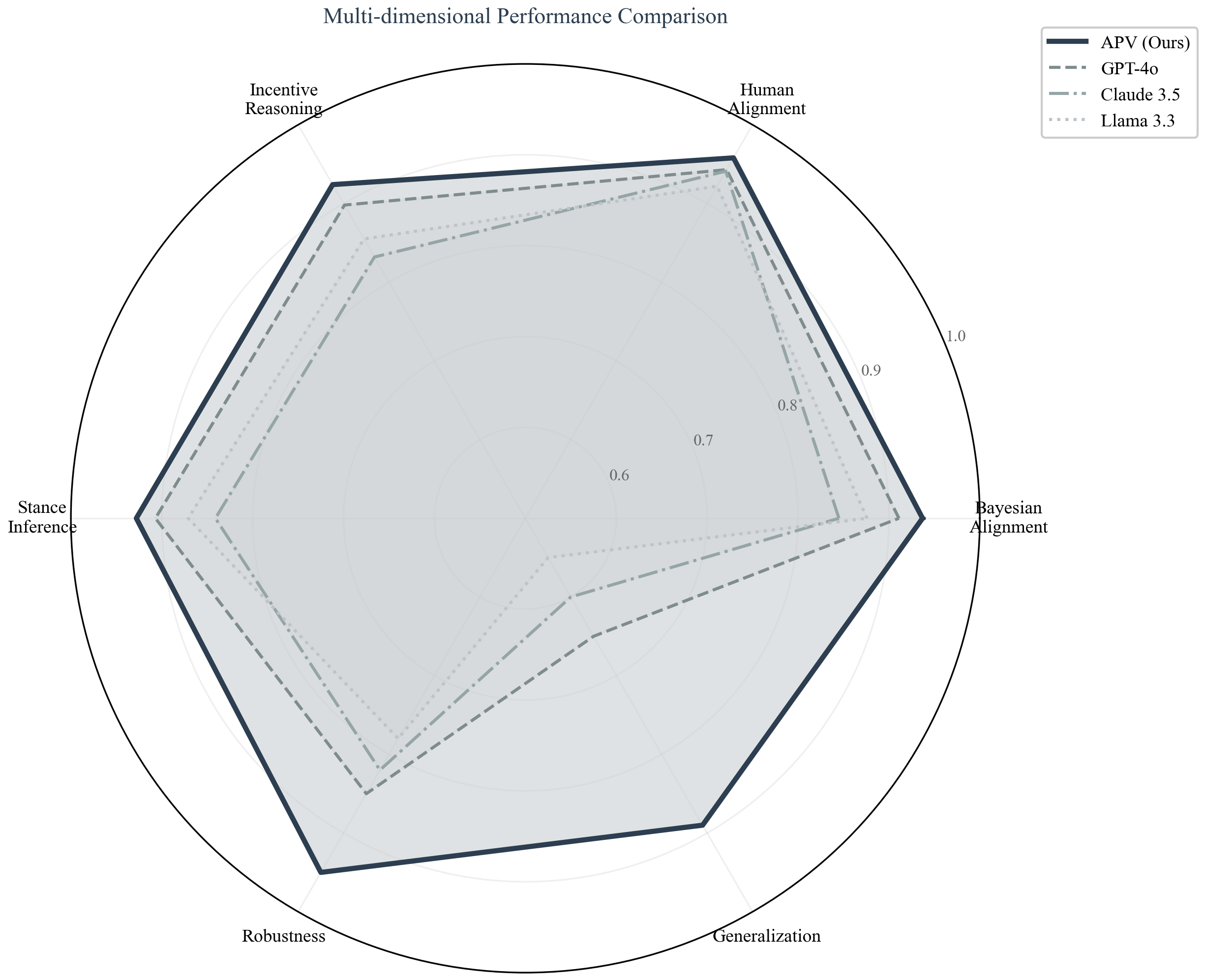
Fig 5: Multi-dimensional performance comparison across models. APV (blue) achieves superior
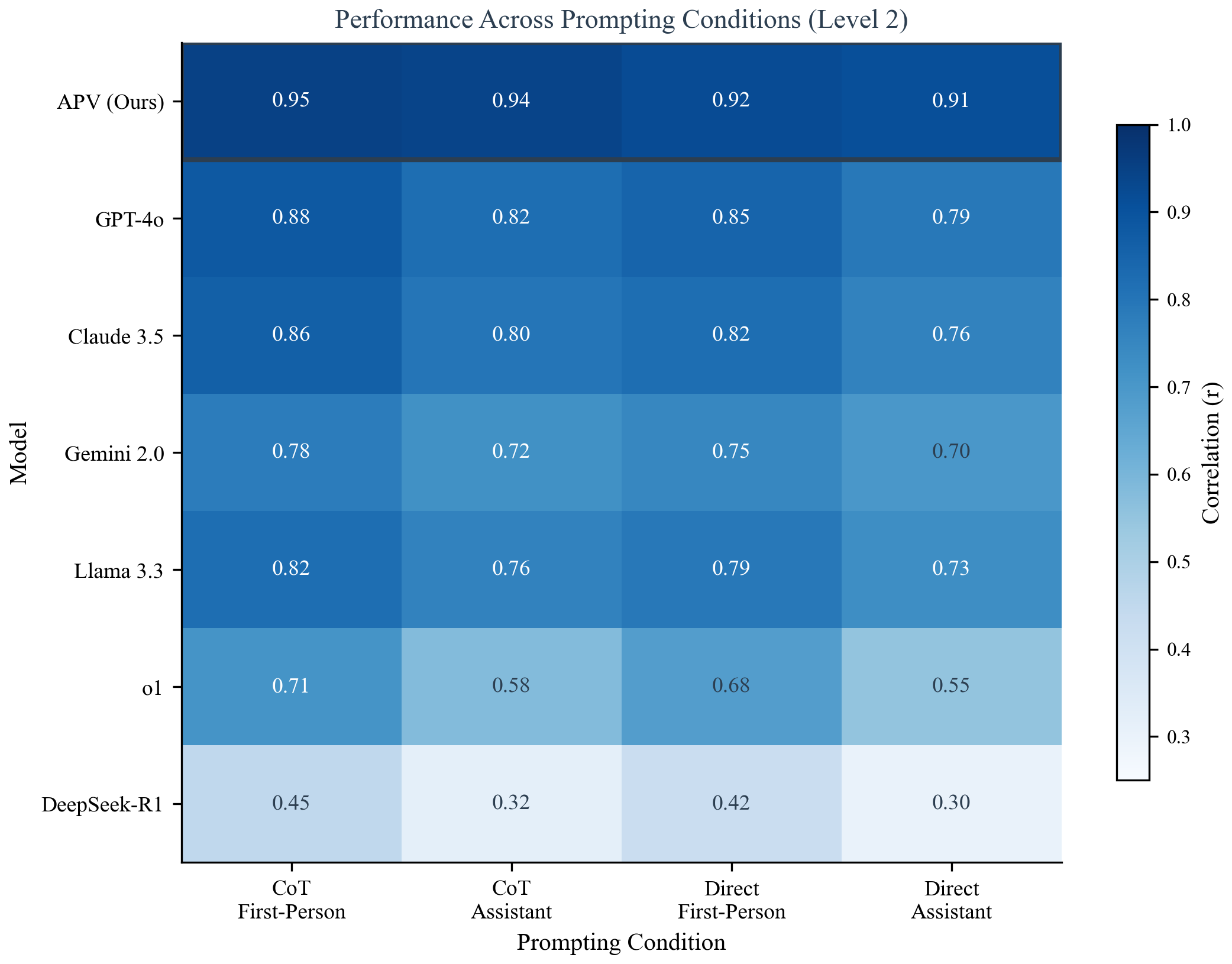
Fig 6: Performance heatmap across prompting conditions for Level 2 evaluation. APV (top
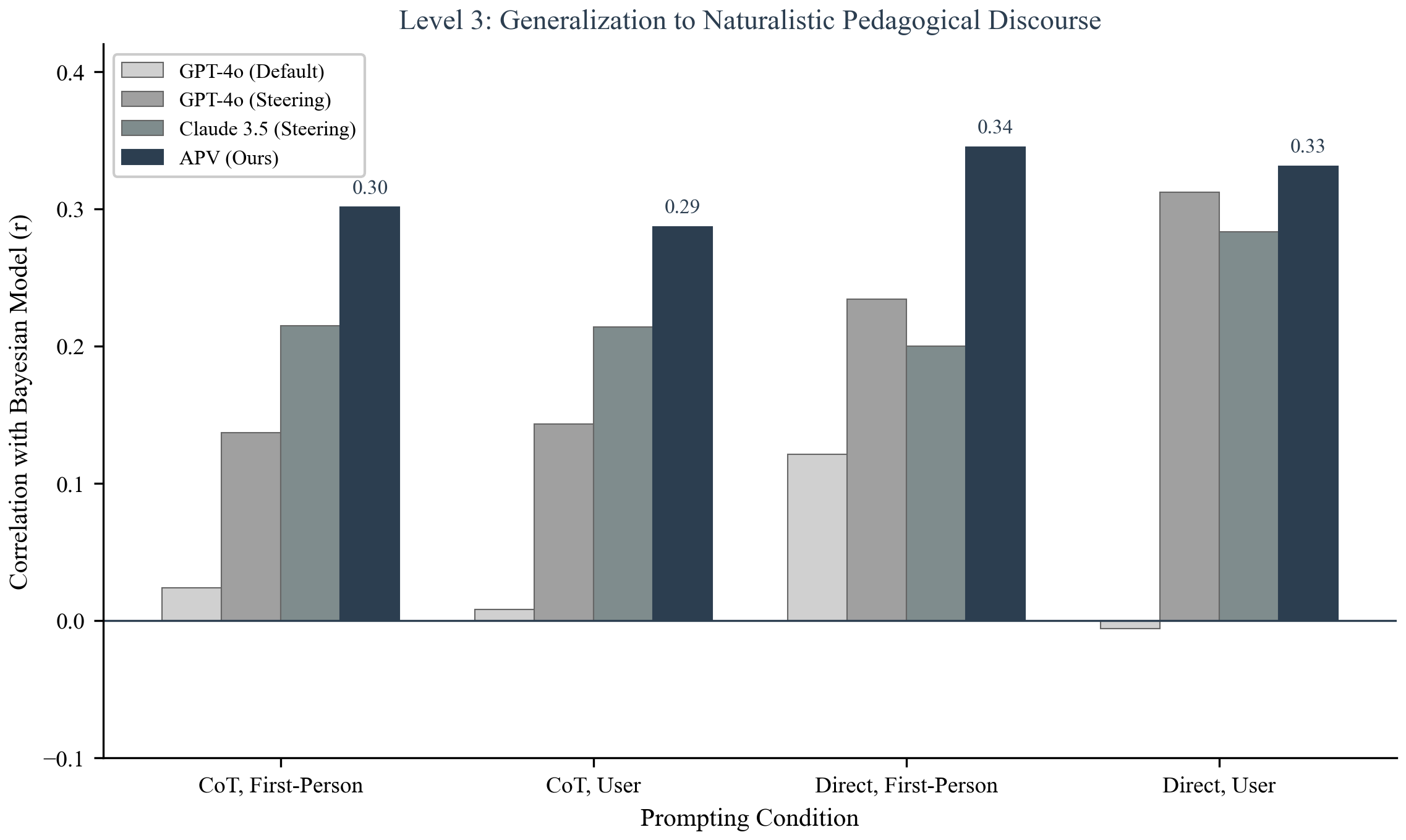
Fig 7: Level 3 generalization to naturalistic pedagogical discourse. APV with default prompting
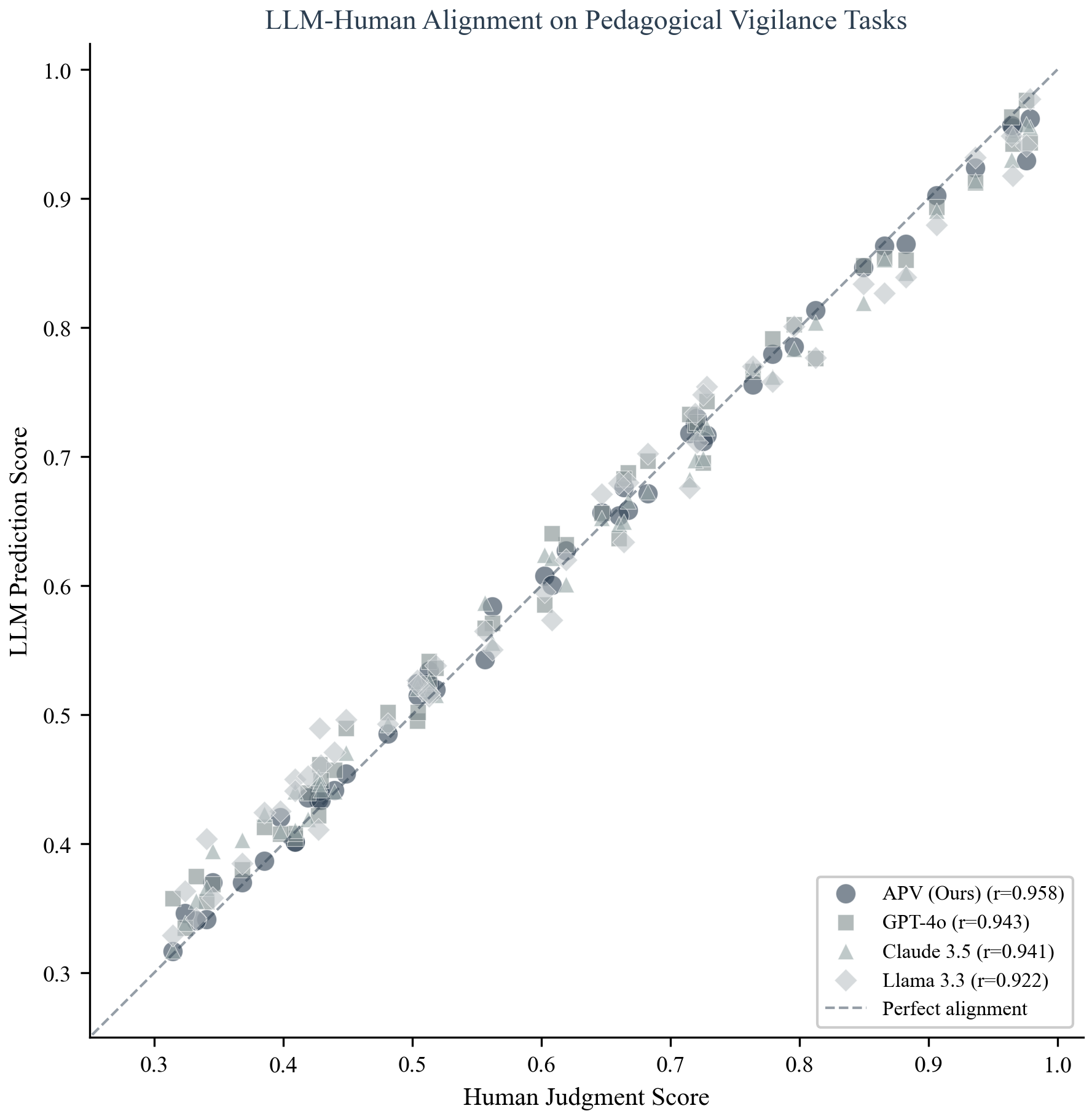
Fig 8: LLM-Human alignment on pedagogical vigilance tasks. Each point represents a test
Limitations
- The naturalistic dataset is curated but its size, coverage, and public availability are not specified, limiting replicability and generalization claims.
- The framework and experiments focus predominantly on translation pedagogy, and applicability beyond this domain remains untested.
- No explicit adversarial evaluation is conducted to test resilience against deceptive or manipulative instructional inputs by hostile teachers.
- Evaluation mostly relies on zero-shot prompting; no fine-tuning or adaptation is explored which might yield stronger vigilance improvements.
- The method requires substantial prior knowledge or modeling of teacher incentives and pedagogical stances, which may be unavailable or improperly specified in other educational contexts.
- Robustness beyond the tested prompting styles, languages, and LLM architectures remains to be validated.
Open questions / follow-ons
- How effectively can the APV framework be extended or adapted to domains beyond translation pedagogy, such as STEM education or persuasive communication?
- Can APV be integrated with fine-tuning or continual learning paradigms to further enhance LLM vigilance rather than relying solely on prompt engineering?
- What defensive mechanisms or robustness guarantees can be developed against adversarial or manipulative pedagogical inputs within the APV formalism?
- How can teacher incentives and stances be estimated or learned dynamically in less structured or data-sparse educational environments?
Why it matters for bot defense
For bot-defense and CAPTCHA practitioners focused on social reasoning and intent inference in LLMs, this work presents a novel, rigorous Bayesian framework for quantifying and improving a model's ability to infer underlying communicative motives within instructional contexts. While not directly about bot detection, the APV framework exemplifies how complex latent intent modeling can enhance trust calibration and reduce naive acceptance of potentially manipulative inputs. The multi-level evaluation hierarchy and formal encoding of incentive structures offer methodological inspiration for designing LLM-based vigilance systems against deceptive or adversarial communication in CAPTCHAs or bot-interaction scenarios.
Additionally, the demonstrated robustness of the APV approach under different prompting techniques and perspectives suggests engineering strategies for more reliable conversational agents that reason about interlocutor motives, an important capability in bot-detection and interaction quality assurance pipelines. Adapting similar intent-inference engines may improve resilience against social engineering by bots or malicious users.
Cite
@article{arxiv2607_01581,
  title={ Beyond Skepticism: Evaluating LLMs Pedagogical Intent Reasoning with the Adaptive Pedagogical Vigilance Framework },
  author={ Minghao Chen and Ruihan Zhou and Jiayi Tang and Zihan Xu and Bowen Huang and Yuxin Liu },
  journal={arXiv preprint arXiv:2607.01581},
  year={ 2026 },
  url={https://arxiv.org/abs/2607.01581}
}