
WST, the Wide-field Spectroscopic Telescope: Mechanical Design and FE Analyses for the High Resolution Spectrograph
Source: arXiv:2607.01132 · Published 2026-07-01 · By Simone D'Auria, Andrea Tozzi, Anna Brucalassi, Matteo Munari, Ciro Del Vecchio, Maria Sofia Randich et al.
TL;DR
The Wide-field Spectroscopic Telescope (WST) is a planned 12-meter-class spectroscopic facility aiming to conduct large-scale surveys with a High-Resolution Multi-Object Spectrograph (MOS-HR) capable of simultaneously observing about 2,000 targets at a resolving power of R=40,000. This paper details the preliminary mechanical design and finite element (FE) analysis of the MOS-HR spectrograph, focusing on developing a modular, compact, and stable opto-mechanical architecture meeting demanding structural and alignment requirements. The design organizes the instrument into four modules, each containing two vertically oriented optical benches with optics mounted on both sides to optimize volume and manufacturability. The authors translate the baseline optical prescription into a 3D mechanical model and conduct initial static, modal, and seismic FE simulations to assess deformation, stress, and dynamic behavior under operational and survival loads. Results indicate the feasibility of the proposed double-skin bench with internal ribs in maintaining alignment tolerances and structural stiffness while enabling a manageable footprint for integration and maintenance. The paper establishes a coherent baseline design and workflow that will support more detailed future optimization and detailed structural assessments.
Key findings
- The MOS-HR instrument targets a resolving power R=40,000 with multiplexing of ~2,000 simultaneous targets via replicated modules.
- Each module integrates two spectrograph units mounted on a vertical optical bench with optics on both sides, yielding a compact footprint (~18 m² per module).
- Finite Element Analysis (FEA) using a double-skin aluminum bench with internal ribs shows maximum static deformations consistent with preliminary alignment tolerance requirements (quantitative deflections not specified).
- Modal analysis finds first eigenfrequencies around 10 Hz, dominated by bending and torsion modes, indicating sufficient dynamic stiffness at this design stage.
- Mechanical loads include optical component masses plus conservative scaling factors for mounts and fixtures, derived from comparable astronomical instruments.
- The central optical path folding mirror with 45° tilt contains a central aperture for the pseudo-slit assembly, minimizing instrument envelope.
- Preliminary shutter and fiber back-illumination system concepts are integrated within the slit assembly to reduce subsystem complexity.
- The modular architecture simplifies manufacturing, transportation, assembly, and future maintenance by enabling independent sub-module handling.
Methodology — deep read
Threat Model & Assumptions: Not a security paper. The design assumes typical astronomical instrument environments with static gravity loading, seismic events, and operational vibrations from the telescope platform. No adversarial conditions are considered.
Data: The primary 'data' are the baseline optical prescription and mass estimates for optical and mechanical components. Optical design specifies a folded reflective collimator, pseudo-slit geometry, fiber packing, and dichroic elements. Masses for optics are nominal values complemented by mechanical interface mass scaling from similar existing instruments.
Architecture / Algorithm: The mechanical architecture consists of four main modules, each containing two spectrograph sub-modules arranged vertically. Each sub-module employs an optical bench constructed from a double-skin aluminum alloy structure with an internal rib network providing stiffness. Optical components are mounted on both sides of the bench to achieve compactness and balanced mass distribution. The central region includes a folding mirror with a 45° tilt and a central aperture for the pseudo-slit fiber assembly. Initial designs for shutter and fiber back-illumination assemblies are conceptualized.
Training Regime: N/A. Design iteration presumably used CAD and FE modeling tools.
Evaluation Protocol: Finite Element Analyses (FEA) were performed with COMSOL Multiphysics v6.4. Static structural simulations evaluated deformation under gravity and load-derived mass distributions, focusing on bending, torsion, and relative skin displacement affecting alignment. Modal analysis computed fundamental frequencies and eigenmodes to estimate dynamic stiffness and susceptibility to telescope-induced vibrations. Boundary conditions included fixed constraints at module base representing telescope platform interfaces. Load cases combined nominal optical mass and mechanical scaling factors, applied as distributed loads on bench skins. The evaluation considered operational and survival load scenarios (including seismic). Results serve as a preliminary feasibility assessment rather than detailed tolerance verification.
Reproducibility: No indication of public code or detailed CAD models released. Methodology based on standard optical prescriptions and FE modeling with commercial software and conservative assumptions.
Technical innovations
- Modular spectrograph architecture with each module integrating two high-resolution optical channels on a vertical double-sided optical bench, balancing compactness, manufacturability, and structural performance.
- Use of a double-skin aluminum optical bench with internal rib structure to achieve high bending and torsional stiffness while minimizing mass and preserving access to optical and mechanical interfaces.
- Inclusion of a folded optical path with a tilted mirror containing a central aperture to accommodate an elongated cylindrical pseudo-slit fiber assembly within a compact volume.
- Conceptual integration of multifunctional slit assembly components combining a shutter mechanism with a fiber back-illumination system to streamline calibration and alignment tasks.
Figures from the paper
Figures are reproduced from the source paper for academic discussion. Original copyright: the paper authors. See arXiv:2607.01132.
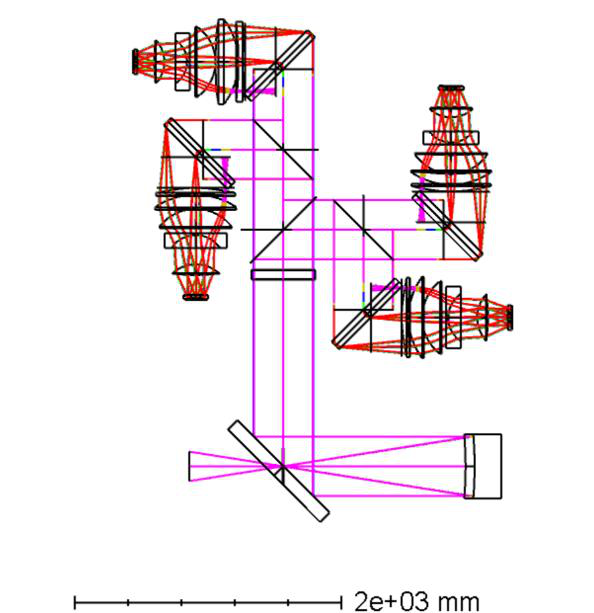
Fig 1: Optical Design of the MOS-HR
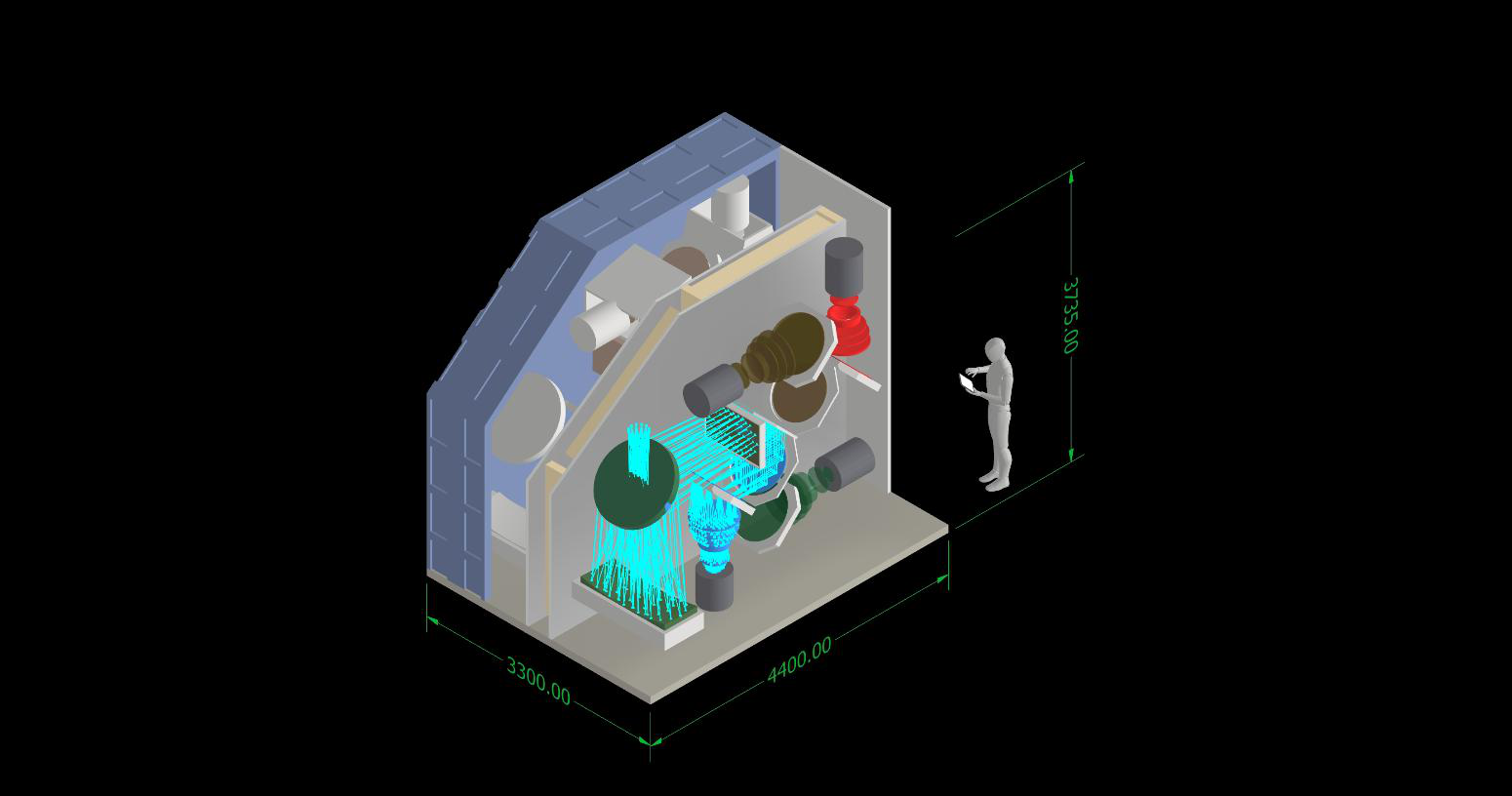
Fig 2: Preliminary design of the MOS-HR double module
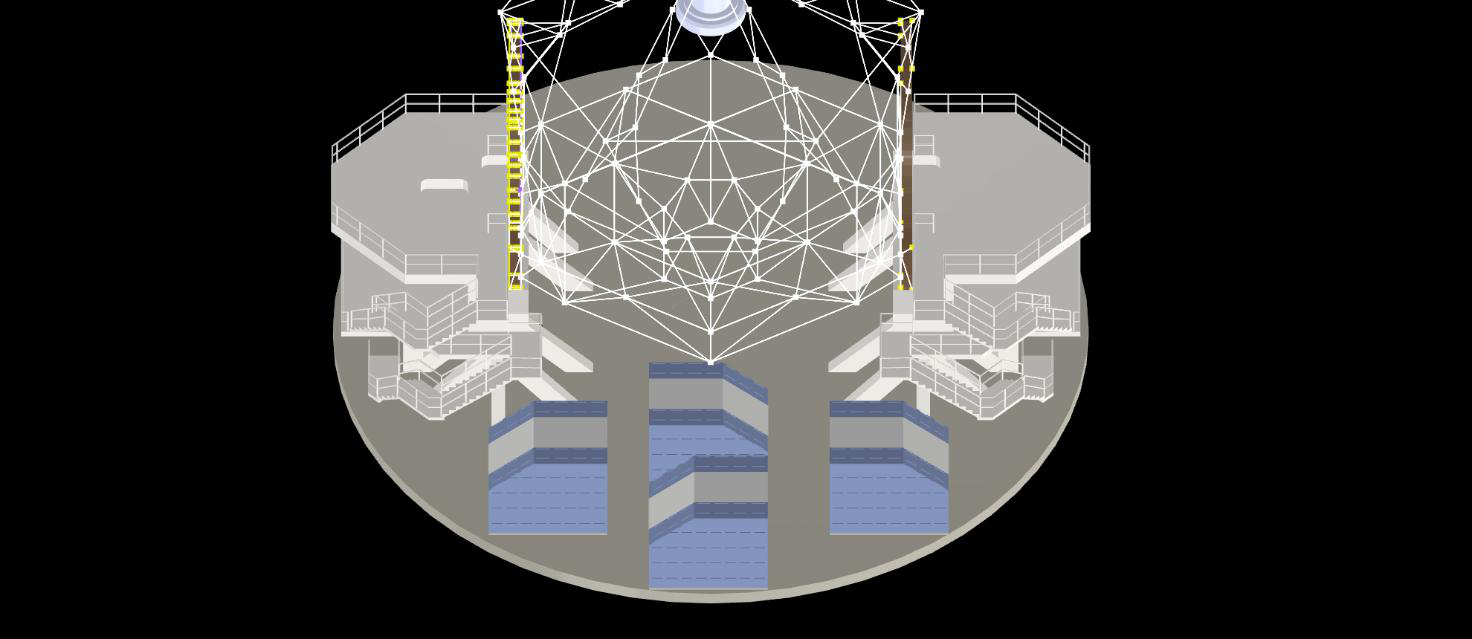
Fig 3: Possible MOS-HR layout of 4 double modules on the rotating platform of the WST
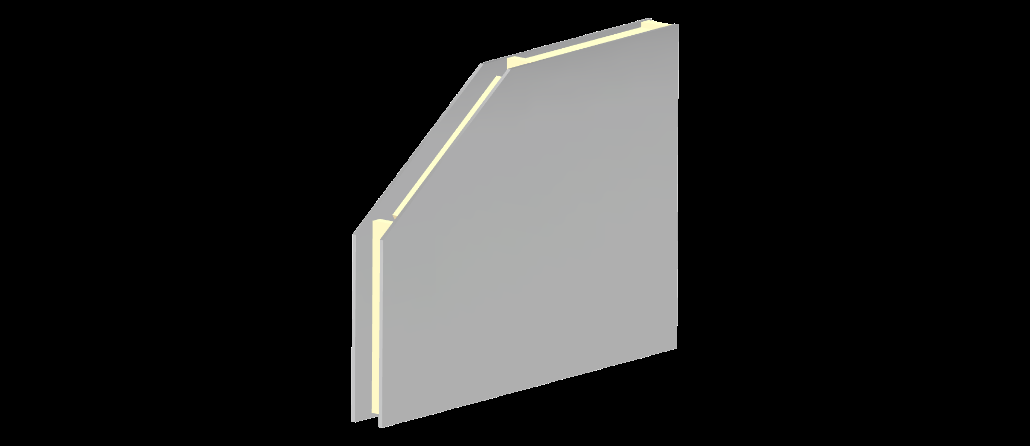
Fig 4: Vertical bench made of two skins with internal ribs
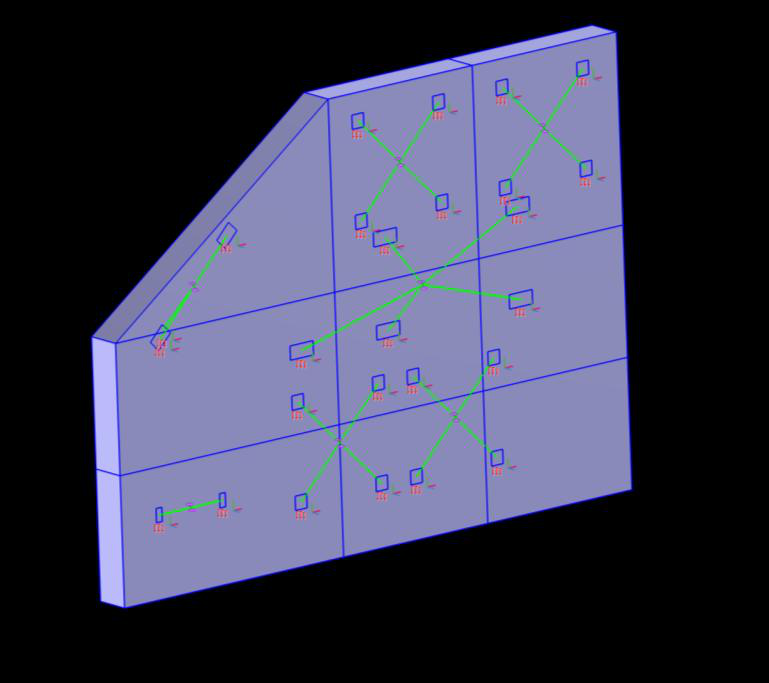
Fig 5: Vertical optical bench FEA geometry and setup: shell elements for both skin and internal ribs elements. Green: mass
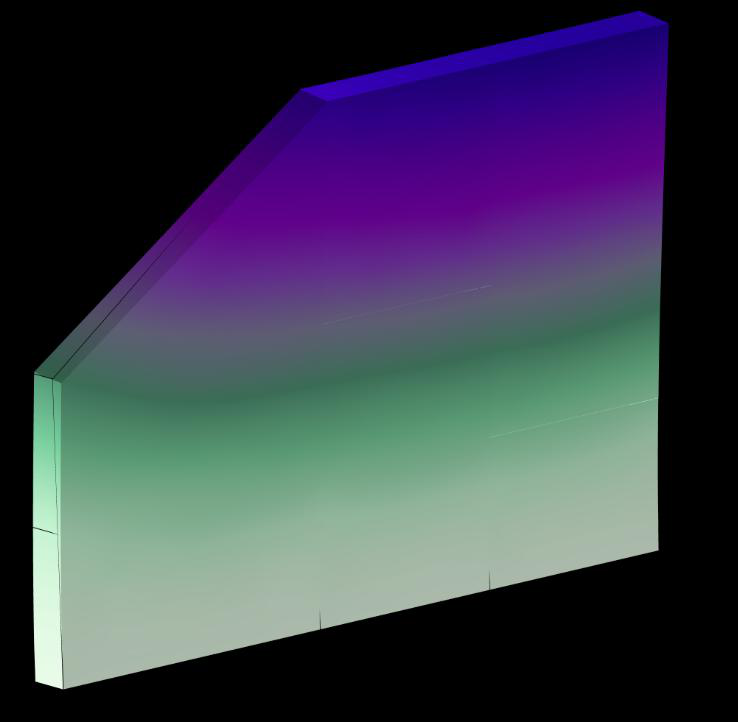
Fig 6: First eigenfrequency modal shape of the optical bench at around 10 Hz. BC: fixed at the bottom, masses and
Limitations
- FE model uses simplified geometry and mass distribution; real interface stiffness and mass might vary, affecting deformation and modal results.
- Thermal and thermo-mechanical effects are not yet incorporated; these will impact alignment and stability in real operating conditions.
- Boundary conditions rely on fixed constraints at the bench base, simplifying the complex interactions with the telescope structure and mounting.
- No experimental validation or physical prototyping reported; analyses remain preliminary and computational.
- Only preliminary shutter and fiber back-illumination designs are presented, lacking detailed design or integration testing.
- No consideration of long-term effects such as material creep, fatigue, or dynamic environmental disturbances beyond seismic and gravity loads.
Open questions / follow-ons
- How will thermal gradients and variations affect structural stability and optical alignment during telescope operations?
- What refinements of the mechanical interfaces between optics and bench are needed to capture real mass and stiffness distribution accurately?
- How will the dynamic response change with realistic telescope platform vibrations and environmental disturbances beyond simplified modal analysis?
- What are the trade-offs in modularity versus complexity for maintenance and assembly at full instrument scale with ~2,000 fibers multiplexed?
Why it matters for bot defense
While this paper is focused on mechanical and opto-mechanical design for a large astronomical spectrograph rather than bot detection or CAPTCHA systems, it has indirect relevance for bot-defense engineering in illustrating rigorous workflow for translating functional design requirements into stable and manufacturable architectures. The approach of modularization to manage complexity, using simulations to predict behavior under environmental stresses, and integrating multiple functionalities into single modules can inspire analogous strategies in complex system design under constraints. Understanding the structural stability and deformation characteristics of critical components could inform design approaches in hardware security modules or physical challenge-response systems with precise alignment requirements. However, direct applicability to CAPTCHA or bot-detection algorithms is minimal.
Cite
@article{arxiv2607_01132,
  title={ WST, the Wide-field Spectroscopic Telescope: Mechanical Design and FE Analyses for the High Resolution Spectrograph },
  author={ Simone D'Auria and Andrea Tozzi and Anna Brucalassi and Matteo Munari and Ciro Del Vecchio and Maria Sofia Randich and Roland Bacon and David Lee },
  journal={arXiv preprint arXiv:2607.01132},
  year={ 2026 },
  url={https://arxiv.org/abs/2607.01132}
}