
Computationally Efficient Near-Optimal Control for Current Ripple Reduction and Optimization of Three-Phase Motors via LMIs
Source: arXiv:2607.01215 · Published 2026-07-01 · By Huu-Thinh Do, Trung B. Tran, Jing Sun, Ilya Kolmanovsky
TL;DR
This paper addresses the computational challenge of optimal control in three-phase permanent-magnet synchronous motors (PMSMs) driven by voltage-source inverters with discrete switching actions. Traditional approaches relying on mixed-integer optimization or value iteration methods suffer from either combinatorial complexity or high offline computational cost. The authors propose a method based on linear matrix inequalities (LMIs) to approximate the infinite-horizon value function with a quadratic parameterization. By iterating Bellman inequalities, they formulate a convex program that can be solved efficiently offline to generate a near-optimal value function approximation. This function is then used as a terminal cost in a horizon-one model predictive control (MPC) law executed online. Simulation on representative PMSM models with varying inverter voltage levels shows the approach achieves a favorable trade-off between current ripple reduction (measured via THD) and switching effort, with performance comparable to finite-control-set MPC (FCS-MPC), but with two to three orders of magnitude reduction in online computational cost. The method also offers formal guarantees on closed-loop stability and invariant sets.
Key findings
- The LMI-based value function approximation computes offline in ~4 seconds for two-level inverter vs 55 minutes for value iteration, and ~30 seconds for five-level inverter.
- Online MPC using the approximate value function executes in 90 µs in MATLAB compared to 13.4 ms for FCS-MPC and 5.5 µs for PI-SVM.
- Total harmonic distortion (THD) decreases from 2.93% (2-level inverter) to 0.76% (5-level inverter), and switching count (Sc) ranges from 85 to 105 across levels with sampling frequency 50 kHz.
- The invariant set parameter δ = 1122.75 for Nlevel = 2 guarantees practical stability and bounds the infinite horizon average cost (ripple amplitude).
- Approximation quality depends on the choice of the objective region in quadratic function fitting; targeting an ε=100 A neighborhood yields closest approximation to value iteration results, though still conservative due to quadratic basis limitations.
- The method enables a variable switching frequency strategy improving energy efficiency compared to fixed switching in PI-SVM modulation.
- The switching law defines piecewise quadratic regions solved via LMIs incorporating rotational angle θre dynamics efficiently without angle-dependent parameters in the value function.
- The proposed controller achieves comparable closed-loop performance in current ripple and switching effort with FCS-MPC but requires 150× lower online computational time.
Threat model
n/a — This paper addresses a control optimization problem without a security adversary context. The main challenge is computational tractability and performance trade-offs rather than malicious actors.
Methodology — deep read
Threat Model & Assumptions: The adversary is not a malicious agent but rather the computational challenge inherent in controlling PMSMs with nonlinear dynamics and discrete finite control sets. The control input (inverter voltage levels) is limited and switching frequency constrained. The model assumes known motor parameters and uses a nominal plant model without uncertainties or disturbances.
Data: The system is modeled analytically based on PMSM dynamics in dq coordinates, discrete-time with Euler discretization, including rotor electrical angle as a time-dependent variable. Parameters stem from finite element analysis of a representative motor aimed at EV applications (e.g. Ld=0.46mH, Lq=1.4mH, R=0.032Ω, Λ_PM=0.1539Wb). The datasets are synthetic, generated from simulation of the motor plus inverter system over a current domain (±300A) with quantized switching inputs.
Architecture / Algorithm: The core algorithm uses a quadratic parameterization of the value function approximation: V_hat(ξ) = ξ^T P ξ + 2 q^T ξ + r, independent of rotor angle θre to reduce complexity. The Bellman inequality V_hat ≤ T V_hat (with T the Bellman operator) is relaxed via iterated Bellman inequalities to reduce conservativeness. Conditions are enforced for all states and inputs using linear matrix inequalities (LMIs) derived from S-procedure arguments bounding nonlinearities and quantized inputs. An optimization problem maximizes a spatial average cost (trace(P)) subject to these LMIs and positivity constraints, solved via convex SDP solvers (MOSEK through YALMIP).
Training Regime: The number of Bellman inequality iterations M=100 is chosen to trade off accuracy and computational cost. The discount factor γ=0.975 models the infinite horizon cost with exponential decay. The LMI program is solved offline on CPU with 16 GB RAM. The controller is then implemented online as a horizon-one MPC using the precomputed V_hat as a tail cost, minimizing one-step cost plus predicted value function over finite control set U.
Evaluation Protocol: Metrics include total harmonic distortion (THD) measuring current ripple, switch count indicating switching effort, and computation time both offline and online. Baselines include indirect PI with space vector modulation (SVM) and finite-control-set MPC with horizon Np=3. Stability and positive invariance are verified via numerical maximization of successor state values over the invariant set. Approximation quality is assessed by comparing V_hat to ground-truth value iteration results on gridded state space. Simulations are carried out at 50 kHz sampling frequency with inverter levels Nlevel ∈ [2,5].
Reproducibility: The code is implemented in MATLAB 2025b with explicit mention of MOSEK and YALMIP. The motor parameters and problem setup are detailed for replication. However, no public release of code or datasets is mentioned, and value iteration baseline uses closed-form grids tailored to the system.
Example end-to-end: For a 2-level inverter, offline LMI optimization computes V_hat in 4.4 seconds. At runtime, the controller evaluates the quadratic function over 8 discrete input voltages to select the minimizing u in ~90 µs. This yields a switching strategy controlling current ripple to 2.93% THD, with 85 switching events in a 50kHz sampling simulation, maintaining operation inside a positively invariant set with radius δ=1122.75, thus guaranteeing stable bounded error behavior.
Technical innovations
- Use of iterated Bellman inequalities parameterized by quadratic forms to approximate infinite-horizon value functions for switched PMSM control, extending Wang et al. (2015) framework.
- Derivation of LMI conditions incorporating the inverter's finite voltage set and rotor angle dynamics to convexify the approximate dynamic programming problem, enabling tractable offline synthesis.
- Integration of the approximated value function as a tail cost in a horizon-one MPC controller for online efficiency while maintaining near-optimal performance.
- Formal stability certification via invariant set analysis of the piecewise quadratic value function under the switching control law.
Baselines vs proposed
- Value Iteration baseline: offline computation time = ~3300s (55 minutes) vs proposed LMI method = 4.4s (Nlevel=2).
- PI-SVM baseline: online computation time = 5.5 µs, THD = ~6-7% (implied worse than proposed); proposed LMI-ADP online time = 90 µs with THD down to 2.93%.
- FCS-MPC baseline: online time = 13.4 ms vs proposed LMI-ADP = 90 µs; comparable THD and switch count (e.g. 85-105 switches).
Figures from the paper
Figures are reproduced from the source paper for academic discussion. Original copyright: the paper authors. See arXiv:2607.01215.
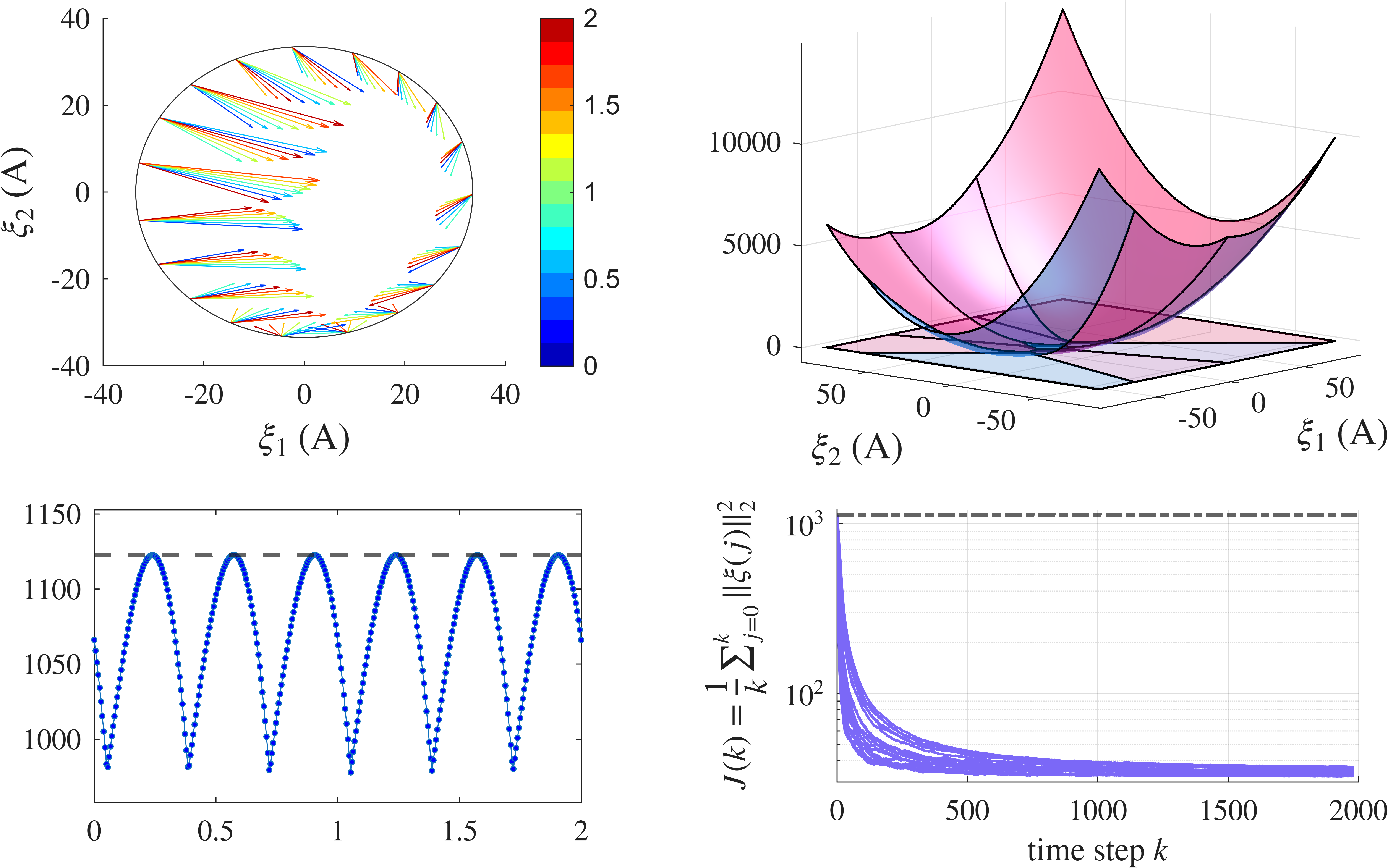
Fig 2: Horizon-one MPC with the approximate value function for
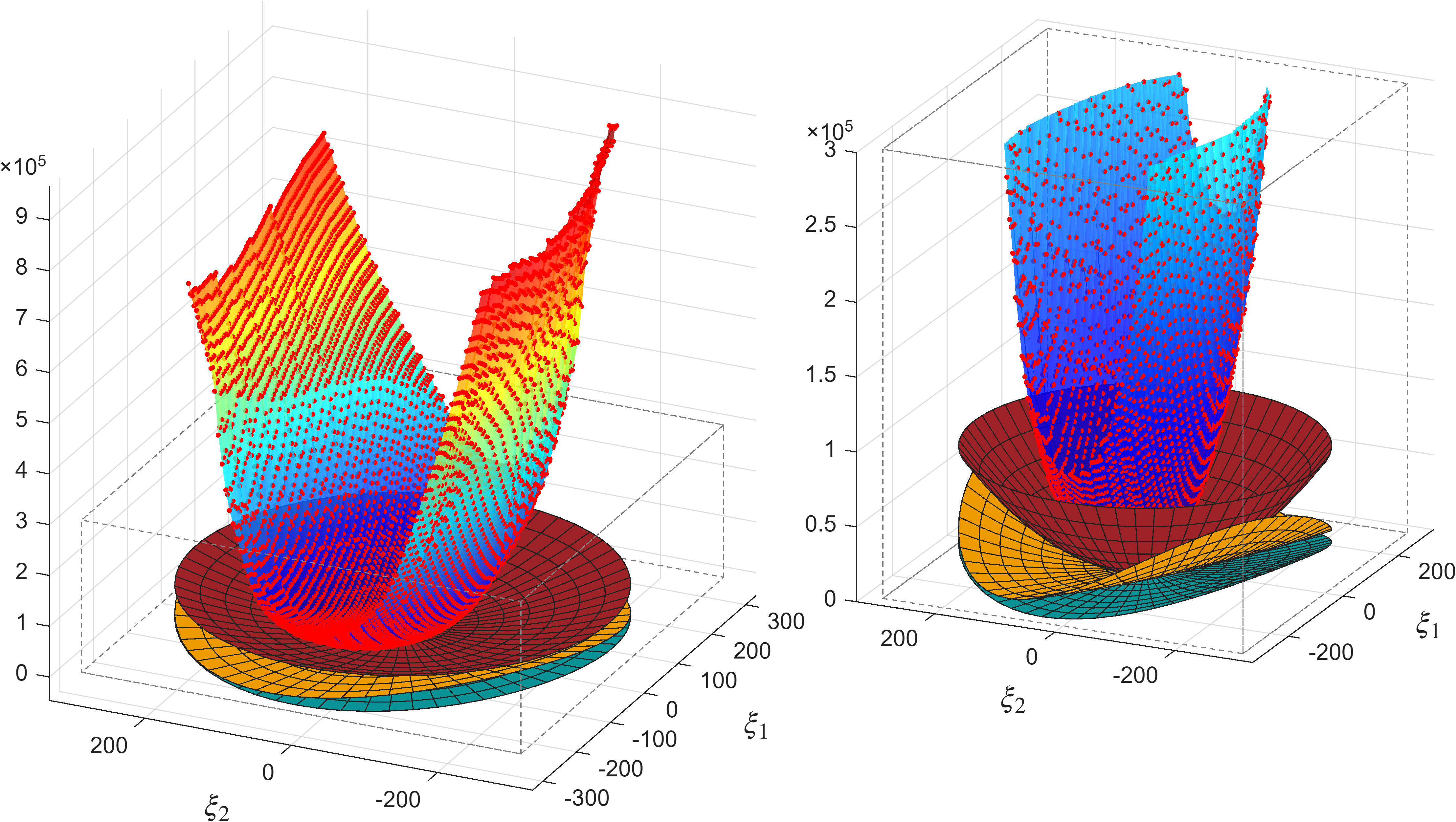
Fig 5: The approximation function ˆ
Limitations
- Value function approximation uses only quadratic basis, limiting expressiveness and resulting in a conservative under-approximation compared to value iteration.
- Method assumes perfectly known nominal motor model; robustness to parameter variations and model uncertainties is not analyzed.
- No real-world experimental validation; results are from simulation only.
- The S-procedure and relaxation to LMIs introduce conservativeness and exclude some feasible solutions.
- Stability guarantees pertain to practical stability within invariant sets, not asymptotic stability.
- Controller evaluation was in MATLAB on CPU — embedded real-time implementation details remain unaddressed.
Open questions / follow-ons
- Can richer function approximators such as higher-degree polynomials or piecewise quadratic functions reduce conservativeness and improve value approximation?
- How robust is the proposed controller to parameter uncertainty, measurement noise, and unmodeled dynamics?
- Can the LMI-ADP approach be extended to handle constraints and nonlinearities beyond the nominal PMSM model effectively?
- What are the practical implementation considerations and real-time performance on embedded hardware for electric vehicle applications?
Why it matters for bot defense
While this paper focuses on control of electromechanical systems rather than security or CAPTCHA, the core contribution of efficiently approximating infinite-horizon value functions via LMIs with guaranteed stability and low online computation is broadly relevant. Bot-defense systems that rely on real-time control or decision policies with discrete actions facing combinatorial complexity could potentially adapt similar approximate dynamic programming techniques to balance performance and computational overhead. The offline-online decoupling via convex program synthesis of value functions and horizon-one optimization may inspire control architectures for bot challenge policies or adaptive CAPTCHA pacing that need to respond quickly with low latency. However, direct application requires translating motor control dynamics to behavior modeling in security contexts.
Cite
@article{arxiv2607_01215,
  title={ Computationally Efficient Near-Optimal Control for Current Ripple Reduction and Optimization of Three-Phase Motors via LMIs },
  author={ Huu-Thinh Do and Trung B. Tran and Jing Sun and Ilya Kolmanovsky },
  journal={arXiv preprint arXiv:2607.01215},
  year={ 2026 },
  url={https://arxiv.org/abs/2607.01215}
}