
A field experiment of social influence and behavioral contagion with bots on Reddit
Source: arXiv:2607.00854 · Published 2026-07-01 · By Hiroki Oda, Kinga Makovi, Taha Yasseri, Milena Tsvetkova
TL;DR
This study addresses the question of how online users on Reddit respond to positive behavioral stimuli—specifically symbolic awards—delivered by apparent human users versus bots, each providing one of four rationales: logical, emotional, moral, or random (lottery). The authors conducted a large, preregistered field experiment involving 2,442 Reddit posts and comments from relatively inexperienced users across 12 non-controversial subreddits. They measured recipients' subsequent activity, content characteristics, and indirect social contagion effects on other users. The core finding is a largely null effect: symbolic awards did not increase user posting volume or impact. Unexpectedly, awards from bots using a random-lottery rationale decreased subsequent user activity and positive sentiment. However, awards—especially from humans with substantive praise—did promote direct private communication from recipients. This points to some resilience of users to simple behavior manipulation by algorithms and bots, while human-to-human influences based on moral praise showed modest positive impact on downstream engagement from other users. The findings caution against overestimating the power of simple bot interventions on user-generated content quantity or quality.
Key findings
- Awards from bots with a random-lottery rationale reduced recipient contributions in number (U=32802.5, p=0.027) and combined text length (U=32077.5, p=0.009) compared to control users.
- Recipients were significantly more likely to send private thank-you messages to human accounts than to bot accounts (Fig 1A), especially when awards included logical or moral praise versus random rationale.
- Awards from human accounts with a moral rationale increased the votes garnered by recipients’ subsequent posts compared to control and human awards with logic or random rationales (U=40029.5, p=0.048; Fig 3A).
- No significant increase in posting volume, length, or positive content tone was observed after receiving awards from most conditions other than the above.
- Recipients of bot awards with the random rationale decreased positive sentiment in their follow-up posts compared to controls (U=1193.5, p=0.037; Fig 2A).
- Longer comments and replies to posts were observed only when recipients received awards from humans with moral rationale (Fig 3C).
- Activated users who replied to human awards showed increased contribution volume and votes with moral rationale treatments (U=7939.0, p=0.042; U=7964.0, p=0.038).
- No evidence that awards broadly increased downstream social contagion effects beyond limited cases involving human moral praise.
Threat model
The adversary is conceptualized as algorithmic or bot actors attempting to influence human behavior in online social networks through positive reinforcement mechanisms. The model assumes adversaries can send visible awards with messages but cannot impersonate humans beyond revealing bot status, nor can they perform complex conversational manipulations. The adversaries’ goal is to increase user activity, content impact, or promote behavioral contagion.
Methodology — deep read
Threat Model & Assumptions: The adversary in this context is an artificial agent (bot) or a human user providing positive social reinforcement (awards) to induce behavioral change in Reddit users. The authors assume that recipients can distinguish between human and bot accounts, and rationales for awards may affect influence differently. The study does not consider adversaries engaging in malicious or deceptive disinformation beyond giving awards.
Data: The experiment was conducted on Reddit from April 2025 to January 2026. Researchers selected 12 non-controversial, general-interest subreddits filtering out sensitive topics, multimedia posts, and high-profile users. Contributions (posts/comments) were screened to contain 300–3000 characters, with early-stage user activity (10–499 comments, 0–99 posts), accounts created >30 days prior. The final data set contains 2,442 observations randomly assigned across nine conditions (eight treatments plus control), with approximately 263–275 per condition.
Architecture / Algorithm: This is primarily a field experimentation design without machine learning models. The treatment involves two Reddit accounts - one human-presenting, one bot-labelled - giving non-anonymous symbolic awards (“Diamonds are Forever”) worth about $1 each to a qualifying post/comment with one of four rationales: logical reasoning, emotional empathy, moral integrity, or random lottery. The award message was visible privately to recipients with a fixed phrase format. Control group posts received no awards. Researchers measured pre- and post-treatment activity metrics (volume, word count), content sentiment and linguistic features (using LIWC-22 for positive tone, analytical thinking, emotion, moral language), and downstream engagement (votes, replies to recipients’ posts).
Training and Experimental Regime: The field experiment was randomized and preregistered, lasting 9 days after each award to track recipient behavior. No model training was involved. Analysis was done using non-parametric tests (Mann-Whitney U) comparing within-individual changes before and after treatment. Some analyses restricted to “activated” users who replied to award accounts.
Evaluation Protocol: Main metrics included number of contributions and total words authored post-award, sentiment and language feature changes in contributions, number of votes and replies to contributions, and private reply rates. Comparisons were made among human vs bot awarder, among rationales, and versus no-intervention control. Statistical significance was reported without correction due to mostly null or negative effects. Both direct recipient effects and indirect contagion effects to other users in conversations were tested.
Reproducibility: The study was preregistered and authors commit to making anonymized, aggregated data and analysis scripts public upon publication. However, actual bot and human account details and Reddit API data are platform-dependent and not explicitly released. Full replication requires Reddit API access and adherence to ethical constraints on bot deployment.
Example end-to-end: After identifying a suitable post from a newish user in a selected subreddit, the researchers randomly assign it to, e.g., the bot-random award condition. The bot account gives a trophy award with a message, "I'm a bot, beep boop. I give away awards and your post won today's lottery. Keep it up!" The user receives notification and the award is visible under the post publicly. Nine days later, all of the user’s contributions from the week before and after the award are retrieved. The increase or decrease in posting frequency, sentiment scores, and engagement metrics like votes on their posts are computed. Statistical analysis compares these to no-award users and other conditions to assess significance.
Technical innovations
- A novel, large-scale field experiment design that differentiates social influence effects of awards given by bots versus humans with four distinct rationales.
- Use of a symbolic, non-monetary Reddit award as a controlled intervention, combined with automated textual and behavioral outcome measurements.
- Application of natural language processing tools (LIWC-22) to quantify subtle changes in content sentiment, cognition, emotion, and moral language post intervention.
- Integration of private messaging response rates as a measure of direct social interaction induced by the interventions.
Datasets
- Reddit award experiment data — 2,442 contributions from 12 general-interest subreddits — collected April 2025 to January 2026 via Reddit API (non-public)
Baselines vs proposed
- Control (No award): baseline user activity and content measures
- Human moral rationale (HMOR): average votes = significantly higher than control (U=40029.5, p=0.048) and human logic (U=32648.5, p=0.031)
- Bot random rationale (BRAN): recipient contributions number and combined text length < control (U=32802.5, p=0.027; U=32077.5, p=0.009)
- Bot random rationale (BRAN): positive tone of posts < control (U=1193.5, p=0.037)
Figures from the paper
Figures are reproduced from the source paper for academic discussion. Original copyright: the paper authors. See arXiv:2607.00854.
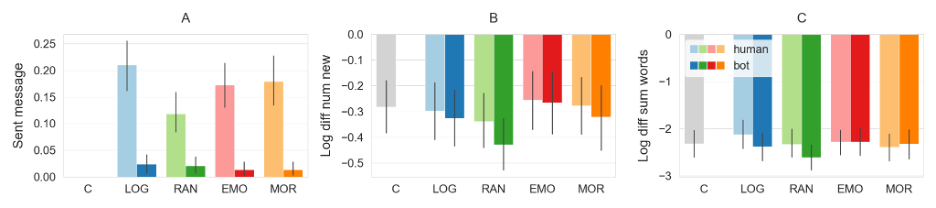
Fig 1: The direct effects of award account and rationale on the award recipient’s A)
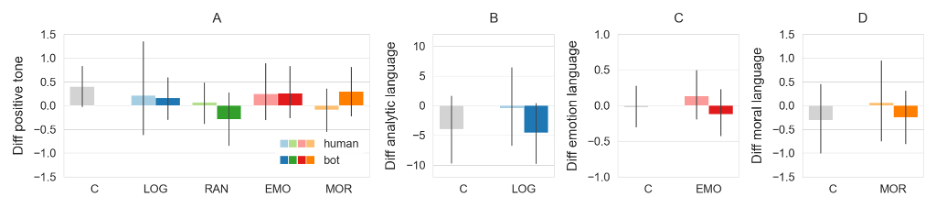
Fig 2: The direct effects of award account and rationale on the A) positive tone
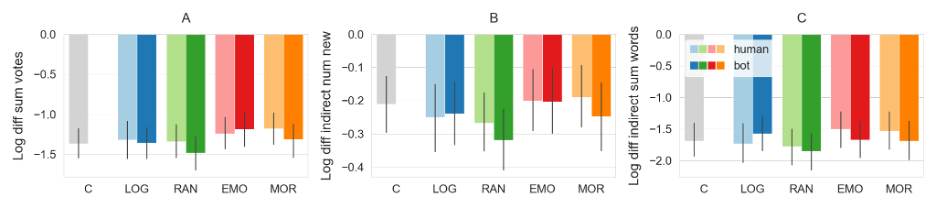
Fig 3: The indirect effects of award account and rationale on the A) total votes and
Fig 4 (page 18).
Fig 5 (page 18).
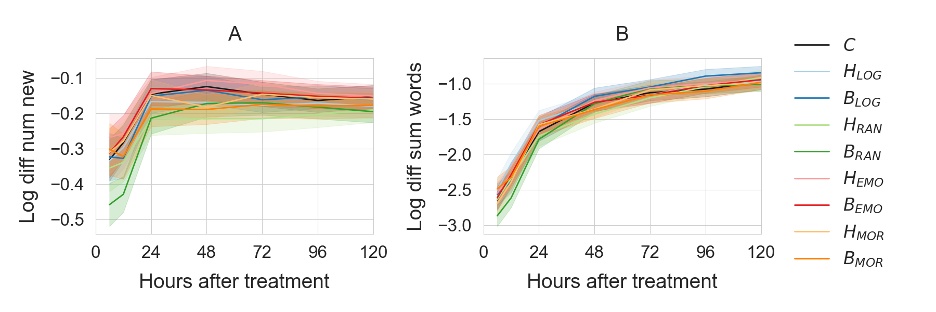
Fig 6 (page 18).
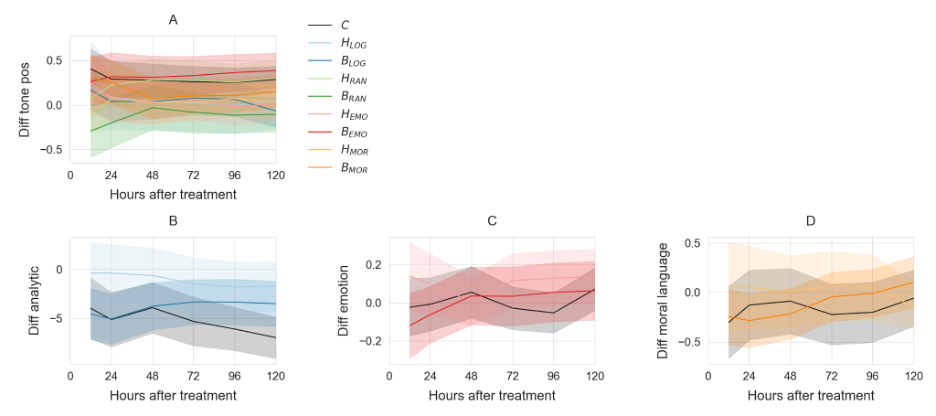
Fig 7 (page 19).
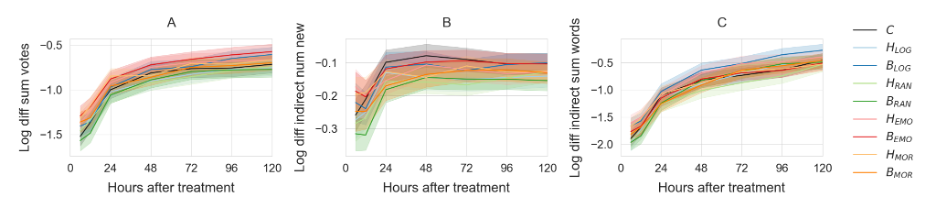
Fig 8 (page 19).
Limitations
- Limited to a single platform (Reddit) and specific subreddits, so generalization to other communities or platforms is uncertain.
- Probable underpowered analysis for detecting small effects due to many treatment conditions and highly bursty user activity.
- No direct verification that award recipients actually read or cognitively processed the award rationale, except by the subset who sent replies.
- Majority of results are null or small effect sizes; some significance disappeared with conservative corrections for multiple testing.
- Only positive symbolic awards were tested — no negative or punitive interventions studied.
- Ethical constraints limited the scale and deeper manipulation complexity; more sophisticated bot-human conversational strategies remain unevaluated.
Open questions / follow-ons
- How would more sophisticated, context-aware conversational bots affect user behavior and contagion compared to simple symbolic awards?
- What is the long-term effect of repeated bot and human interventions on user trust and platform engagement?
- Does explicit disclosure or non-disclosure of bot identity moderate social influence effects differently across user demographics or communities?
- How do negative or punitive social signals from bots versus humans impact user behavior in online communities?
Why it matters for bot defense
For bot-defense and CAPTCHA engineers, this study indicates that simple bot-driven positive social manipulations—such as giving symbolic awards with generic messages—may have limited impact on increasing genuine user engagement or content generation on platforms like Reddit. Moreover, naive bot interventions can backfire and reduce user activity, raising caution for algorithmic systems that attempt easy influence without nuanced human-like interaction. Transparency about bot identity remains crucial, as users respond differently to bots versus humans. This suggests that CAPTCHAs and bot-detection techniques should consider more sophisticated behavioral signals beyond simple social pedigree or reward-based interactions, since users appear resilient to low-effort bot maneuvers. Future bot defense systems might need to address subtle conversational and social dynamics bots could exploit to affect network influence.
Cite
@article{arxiv2607_00854,
  title={ A field experiment of social influence and behavioral contagion with bots on Reddit },
  author={ Hiroki Oda and Kinga Makovi and Taha Yasseri and Milena Tsvetkova },
  journal={arXiv preprint arXiv:2607.00854},
  year={ 2026 },
  url={https://arxiv.org/abs/2607.00854}
}