
A forgery attack on the Block.co blockchain-based digital credential certification system
Source: arXiv:2606.31462 · Published 2026-06-30 · By Giacomo Zonneveld, Giulia Rafaiani, Marco Baldi
TL;DR
This paper investigates a critical vulnerability in Block.co, a blockchain-based system for certifying digital credentials such as academic certificates. While blockchain immutability ensures that certificates cannot be tampered with once issued, the system lacks a robust mechanism to authenticate the real-world identity of issuers. By exploiting design choices in Block.co’s hybrid verification architecture—specifically its decentralized issuer verification that trusts externally hosted URLs and Bitcoin wallet addresses—the authors demonstrate a practical forgery attack that allows an attacker to create fraudulent certificates accepted as valid by the system. The attack requires only control over a Bitcoin address and a public URL, enabling impersonation of legitimate institutions without detection. This flaw highlights an inherent limitation in decentralized credential certification when no trusted authority certifies issuer identity. The attack is validated by fabricating a certificate falsely issued by an Italian university and successfully verifying it using Block.co’s public tools. The authors analyze how this design issue likely affects other similar blockchain credential platforms and propose countermeasures that trade off decentralization for stronger issuer authentication, including permissioned blockchains and external trusted authorities. Overall, the work offers a rare in-depth security analysis emphasizing the identity binding weakness in blockchain-based certification systems, raising important considerations for future designs.
Key findings
- Block.co’s certificate verification accepts forged credentials if the Issuer metadata contains 'block_co=false' or the field is omitted, enabling bypass of the centralized verification.
- An attacker controlling a Bitcoin wallet and hosting a public URL can produce fraudulent PDF credentials with manipulated metadata that pass Block.co’s validation.
- The attack requires only minimal resources—a Bitcoin transaction embedding the Merkle root in the OP_RETURN field, which incurs standard mining fees but no other privileges.
- The forged certificate’s Chainpoint Proof metadata can be constructed to pass integrity and authenticity verification despite no legitimate link to the claimed issuer.
- Block.co’s hybrid architecture with centralized and decentralized issuer verification creates a circular trust problem when decentralized verification alone is relied upon.
- Verification screenshots (Fig. 9) show the system producing positive validation results and issuer identity confirmation solely from the external decentralized verification.
- Responsible disclosure was performed; as of June 2026, Block.co acknowledged the vulnerability and temporarily suspended verification services to review the issue.
- The attack generalizes an earlier forgery attack on the Blockcerts protocol but extends it to a system using PDF metadata and a hybrid verification approach.
Threat model
The adversary is a resourceful attacker who can generate Bitcoin transactions and control a public URL hosting arbitrary content. They do not possess legitimate signing keys of accredited issuers and cannot compromise Block.co’s internal infrastructure or exploit cryptographic weaknesses. Their goal is to impersonate accredited institutions within the Block.co ecosystem and produce forged digital credentials that verify successfully under current Block.co verification logic, particularly through the decentralized verification path when centralized checks are bypassed. The adversary leverages self-asserted issuer metadata fields and blockchain anchoring to fool verification without privileged network or cryptanalysis capabilities.
Methodology — deep read
The authors start by defining a threat model where the adversary’s goal is to create forged digital credentials recognized as valid by the Block.co system despite lacking any legitimate relation to the real issuer institution. The attacker is assumed to possess a Bitcoin wallet capable of issuing transactions and control over a publicly accessible HTTPS URL. The attacker can arbitrarily populate PDF metadata fields, including the critical Issuer field. Block.co certificates are PDFs containing embedded metadata with issuer information, certificate recipient data, and Chainpoint Proof structures anchoring the document fingerprint in the Bitcoin blockchain.
The forgery attack exploits the decentralized issuer verification mode of Block.co, triggered when the metadata flag 'block_co' is false or omitted. In this mode, the system validates the issuer identity by verifying that the Bitcoin address declared matches the one reachable via the specified public URL, without any cross-checking against internal registries or verification of the claimed issuer’s actual ownership of that identity. The attacker fabricates a PDF certificate representing the target institution and modifies its metadata to include a malicious Bitcoin address owned by the attacker and a URL controlled by the attacker exposing that address.
To certify the forged credential, the attacker hashes the malicious PDF and constructs a Merkle tree with multiple leaves of identical hashes to produce a Merkle root. The attacker then issues a Bitcoin transaction embedding this Merkle root in the OP_RETURN field, an accepted standard Bitcoin operation, only requiring payment of mining fees. After the transaction is confirmed and recorded on the blockchain, the attacker updates the forged certificate’s Chainpoint Proof metadata with the transaction ID, Merkle root, Merkle proof, and target hash.
Verification is demonstrated by uploading the forged certificate to Block.co’s verifier, resulting in a positive validation of certificate integrity and issuer authenticity using the decentralized verification path. Screenshots confirm the attack’s success, with the system unable to detect the forgery. The authors compare this attack to prior work on Blockcerts, noting differences in credential format (PDF vs JSON), verification architecture (hybrid vs fully decentralized), and the need for metadata manipulation to disable centralized checks.
Reproducibility is facilitated by full disclosure of metadata formats, the crafted certificate example, transaction details, and verification steps. The authors confirm the attack remains effective on the public Block.co service as of May-June 2026. Responsible disclosure procedures were followed with the vendor. Limitations of the attack include reliance on Block.co’s specific verification behavior and assumptions about attacker control of supporting infrastructure, but these are realistic and typical for blockchain-related forgery threats. The authors also discuss potential mitigation approaches and the fundamental difficulty of achieving fully decentralized yet trustworthy issuer authentication.
Overall, the methodology combines thorough protocol analysis, attacker modeling, crafted artifact generation, blockchain transaction creation, and empirical verification with the official Block.co system to validate the practical feasibility and impact of the presented forgery attack.
Technical innovations
- Identification of a novel forgery attack vector against a hybrid centralized/decentralized blockchain credential verification system exploiting external issuer identity verification via manipulated PDF metadata.
- Discovery that Block.co verification treats untrusted issuer metadata as authoritative when the 'block_co' flag is false or omitted, enabling circumvention of centralized issuer registry checks.
- Use of Bitcoin OP_RETURN transactions embedding Merkle roots as a low-cost, public mechanism to validate falsified credentials despite lacking legitimate issuer signatures.
- Comparison of attack surface and techniques between Block.co’s PDF-based, hybrid model and the prior JSON-based fully decentralized Blockcerts system, highlighting unique attack steps.
- Analysis showing that fully decentralized issuer authentication is inherently infeasible without some trusted authority, due to circular trust in self-asserted identity data.
Baselines vs proposed
- Blockcerts forgery attack [1]: relied on JSON Open Badges format with full decentralization; attack bypass not needed.
- Block.co (this paper): uses PDF+metadata with hybrid architecture; attack requires setting block_co=false to bypass centralized checks; successfully forged certificate accepted by official verifier.
Figures from the paper
Figures are reproduced from the source paper for academic discussion. Original copyright: the paper authors. See arXiv:2606.31462.
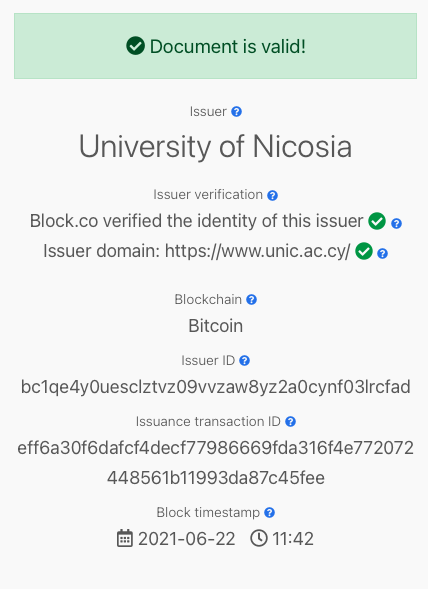
Fig 3: Issuer metadata format
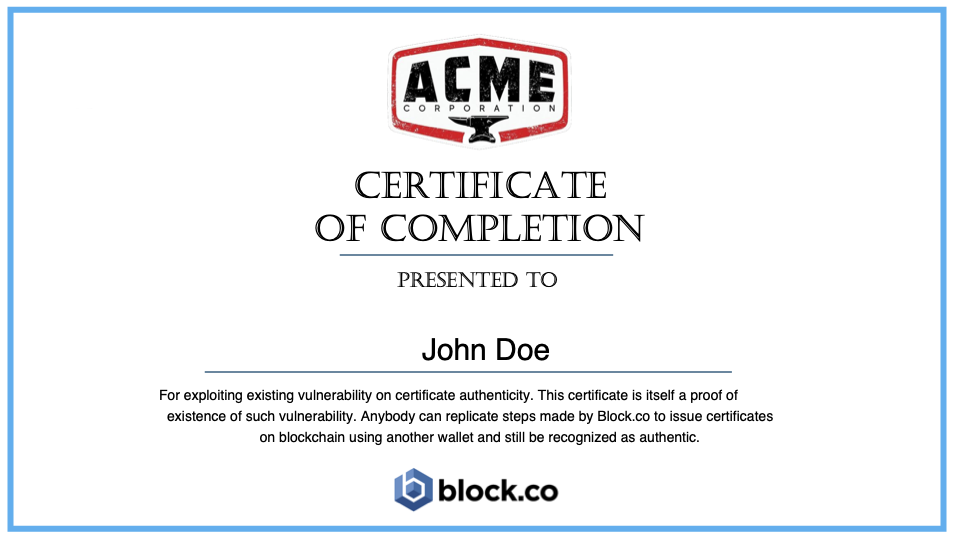
Fig 5: Malicious Issuer metadata
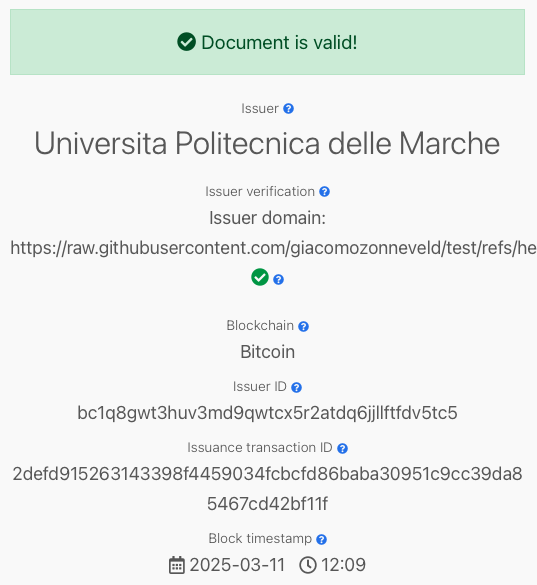
Fig 7: Malicious metadata before the transaction on blockchain
Limitations
- The attack depends on Block.co’s handling of the 'block_co' metadata flag and lack of cross-checking against a trusted issuer list, which may differ in other systems.
- No adversarial testing reported against alternative blockchain credential platforms beyond Block.co and Blockcerts.
- Attack requires attacker coordination of a public URL and Bitcoin transaction, which may be detectable with enhanced monitoring or protocol changes.
- Countermeasures proposed indicate a trade-off between decentralization and trust, but no fully decentralized secure authentication solution is offered.
- Evaluation is limited to the experimental demonstration on the Block.co public service; performance impact or detection rates under realistic usage not studied.
- No user-side or verifier-side behavioral analyses or mitigations are empirically evaluated.
Open questions / follow-ons
- How can decentralized identity authentication frameworks (e.g., DIDs combined with verifiable credentials) be integrated in blockchain-based certificate issuance to provide strong issuer guarantees without central authorities?
- What monitoring or anomaly detection measures can identify rogue issuer claims or unusual Bitcoin OP_RETURN transactions to prevent or flag potential forgery attempts?
- How can hybrid blockchain credential systems balance decentralization benefits with the need for trusted issuer validation to minimize forgery risk?
- Can zero-knowledge proofs or anonymous credential schemes be adapted to prove issuer authenticity while preserving privacy and decentralization?
Why it matters for bot defense
For bot-defense and CAPTCHA engineers, this work underscores the critical importance of tying digital identities to real-world entities robustly when designing decentralized verification systems. Just as CAPTCHAs and behavioral analytics must resist impersonation and spoofing, blockchain certification protocols must prevent forgery by binding issuer identity to verifiable trust anchors. The demonstrated attack warns practitioners to be skeptical of decentralized issuer verification methods relying solely on self-hosted data without authoritative cross-checking.
In practical bot-defense contexts, this parallels the need for layered, multi-factor verification and detection of metadata manipulation or spoofing. The paper illustrates how trust assumptions embedded in verification workflows create exploitable loopholes. Applying these lessons, bot-defense engineers might consider how decentralized or federated identity controls need accompanying strong attestations or out-of-band verification to prevent identity spoofing. Overall, the case study encourages integrating robust identity proofing into systems that claim decentralization benefits to maintain security and trustworthiness.
Cite
@article{arxiv2606_31462,
  title={ A forgery attack on the Block.co blockchain-based digital credential certification system },
  author={ Giacomo Zonneveld and Giulia Rafaiani and Marco Baldi },
  journal={arXiv preprint arXiv:2606.31462},
  year={ 2026 },
  url={https://arxiv.org/abs/2606.31462}
}