
C$^{2}$R: Cross-sample Consistency Regularization Mitigates Feature Splitting and Absorption in Sparse Autoencoders
Source: arXiv:2606.30609 · Published 2026-06-29 · By Haoran Jin, Xiting Wang, Shijie Ren, Hong Xie, Defu Lian
TL;DR
This paper addresses fundamental reliability issues in Sparse Autoencoders (SAEs) used to interpret large language model (LLM) activations by breaking them down into sparse, human-understandable features. The authors identify two pervasive problems: feature splitting, where coherent semantic concepts fragment into multiple redundant latent features, and feature absorption, where latent features create exceptions that distort general features. These pathologies arise from a lack of cross-sample consistency in the latent assignments, as prior per-sample sparsity regularizers (e.g., L1 or TopK) do not enforce unified latent activations for the same concept across a batch. To mitigate these problems, the paper proposes C2R (Cross-sample Consistency Regularization), a novel batch-level penalty that encourages consistent representation of semantic features by a single latent variable across samples. C2R uses the geometry of the Minkowski inequality and cosine similarity of decoder weights to selectively penalize redundant latent activations and enforce orthogonality where appropriate. Extensive experiments on multiple models and datasets show that C2R strongly reduces feature splitting and absorption compared to prior SAE baselines, while preserving or improving reconstruction fidelity, interpretability, and disentanglement. A theoretical analysis provides conditions under which C2R guarantees mitigation of splitting and absorption. Overall, this work offers a principled, theoretically grounded regularization approach to significantly enhance the reliability and semantic purity of SAE latent features applied to LLMs.
Key findings
- Per-sample sparsity constraints (L1 and TopK) intrinsically favor feature splitting and absorption (α → 1) over ideal orthogonal feature decomposition (α = 0), which fragments semantic features (Lemma 4.1).
- C2R enforces cross-sample consistency via a batch-level L2 norm penalty weighted by squared cosine similarity of decoder vectors, forcing consolidation of split or absorbed features while preserving distinct semantics (Eq.16).
- The cross-sample consistency condition in Eq.13 is empirically satisfied in 88.1% of absorption pairs on a 65,536-latent SAE trained on a 4M-token test set, validating the theoretical guarantee.
- C2R-enhanced Batch TopK SAE maintains reconstruction fidelity at or above vanilla baselines across sparsity levels k ∈ {60, 80, 100, 120}, evidenced by Loss Recovered and KL Divergence metrics in Figure 2a,b.
- C2R achieves the lowest feature absorption fraction and feature splitting counts compared to TopK, Batch TopK, OrtSAE, and Matryoshka SAEs at fixed sparsity, while Matryoshka compromises reconstruction (Figure 3a,b).
- C2R produces more atomic latent features with significantly reduced average cosine similarity between decoder weights, outperforming all baselines on feature composition metrics (Figure 3c).
- Automated interpretability scores (AutoInterp) and disentanglement on the RAVEL benchmark show that C2R preserves latent interpretability and the manipulability of semantic factors (Figure 2c,d).
- C2R's gradient decomposes into two forces: merging redundant features into a single latent and implicitly encouraging orthogonality between distinct latents, adaptively weighted by latent activation magnitudes.
Threat model
n/a — This paper focuses on intrinsic representational issues in sparse autoencoders interpreting language model activations rather than adversarial or malicious threat actors.
Methodology — deep read
Threat model and assumptions: The adversary is not explicitly modeled, as this work focuses on the reliability and semantic purity of latent representations within sparse autoencoders interpreting LLM activations rather than security threats. The main assumption is that semantic concepts should ideally map to atomic and consistent latent features across samples, and that splitting/absorption arise from inconsistent latent assignment due to per-sample sparsity constraints lacking cross-sample regularization.
Data: The training data consists of 500 million tokens sampled from the OpenWebText dataset, applied as input to residual stream activations from the 12th layer of Gemma-2-2B (a 2B-parameter language model). The SAE dictionary size used is 65,536 latents, approximately 28x the model's residual dimension, facilitating observation of splitting and absorption. Evaluation uses a 4M-token test set for condition validation and SAEBench for metric computation. Additional scales include Qwen3-8B and Llama-3-8B at layer 20.
Architecture/algorithm: The Sparse Autoencoder encodes input activation vectors x ∈ R^d_model into higher-dimensional sparse latent codes f ∈ R^d_dict using an encoder matrix W_e and non-linearity inducing sparsity (e.g. Batch TopK). The decoder reconstructs x as x̂ = W_d f + b_d. The novel component C2R adds a cross-sample consistency regularization term L_C2R to the standard reconstruction plus sparsity objective. This leverages the Minkowski inequality by penalizing the sum of L2 norms across batch for pairs of latents weighted by squared, rectified cosine similarity of decoder weights: — For each latent i, find its nearest neighbor j* in decoder space by cosine similarity. — Compute L_C2R = (1/k) Σ_i ρ_i,j*^2 (||Z_:,i||2 + ||Z:,j*||_2), where ρ_i,j* = ReLU(cos_sim(w_i,w_j*) )^2. This encourages merging activations of redundant latents across samples while preserving orthogonality of distinct latents.
Training regime: Optimization uses Adam with a learning rate of 2e-4, batch size of 2048, context length 1024, and SAE dictionaries of 65,536 latents. A hyperparameter sweep for λ_C2R ∈ {0.1, 0.5, 1, 5, 10} found λ_C2R = 5 maximizes regularization strength without degrading reconstruction. To reduce O(k^2) cost of pairwise similarity, a chunked block-wise approximation computes L_C2R every 5 steps with chunk size 8192.
Evaluation protocol: Metrics include reconstruction fidelity (Loss Recovered, KL Divergence), interpretability (AutoInterp using an LLM explainer/judge framework validated by human studies), feature hierarchy (feature splitting count, absorption fraction), composition (average max cosine similarity between latent decoder vectors), and disentanglement (RAVEL causal benchmark). Experiments compare C2R-augmented Batch TopK SAE to TopK, Batch TopK, OrtSAE, and Matryoshka SAE baselines across sparsity levels k ∈ {60, 80, 100, 120}, using SAEBench tools. Statistical validation includes 5 independent runs with different seeds.
Reproducibility: Source code is publicly released on GitHub (https://github.com/hr-jin/Cross-sample-Consistency-Regularization). The main datasets used (OpenWebText, Gemma-2-2B activations) and SAEBench evaluation suite are public or open license. Detailed hyperparameters, evaluation prompts, and statistical validations are included in appendices.
Example end-to-end: For a batch of 2048 samples, the SAE encodes activations into k=65,536 latents using Batch TopK sparsity. The C2R loss is computed by finding each latent’s nearest decoder vector neighbor, calculating their decoded activations norms across the batch, and applying the squared cosine similarity gate. Gradients push the model to unify latent activations representing the same semantic feature consistently across samples, reducing splitting and absorption patterns. Reconstruction loss and sparsity penalty balance with C2R to maintain fidelity. The model is optimized for multiple epochs until convergence, then evaluated on held-out data for reconstruction and feature metrics.
Technical innovations
- Formal unification of feature splitting and feature absorption pathologies as instances of latent redundancy characterized by feature component overlap parameter α.
- Theoretical analysis proving per-sample sparsity objectives (L1, TopK) systematically favor splitting/absorption by minimizing sparsity budgets without cross-sample consistency.
- Cross-sample Consistency Regularization (C2R) leveraging the strict convexity of the ℓ2 norm and Minkowski inequality to penalize redundant latent activations across samples via batch statistics.
- Selective weighting of the C2R penalty using squared rectified cosine similarity between decoder weights to only apply consistency constraints among potentially redundant latents, avoiding feature collapse.
- Gradient decomposition of C2R into two forces: consistency pressure merging redundant activations and implicit orthogonality pressure tailoring feature diversity adaptive to feature magnitude.
Datasets
- OpenWebText — 500M tokens — open dataset
- SAEBench Test Set — 4M tokens — open benchmark for SAE evaluation
Baselines vs proposed
- TopK SAE: Loss Recovered ≈ 1.0 vs C2R-enhanced Batch TopK SAE: ≥1.0 (Figure 2a)
- Batch TopK SAE: KL Divergence Score ≈ 0.956 vs C2R Batch TopK SAE: ~0.96-0.964 (Figure 2b)
- OrtSAE: Feature Absorption Fraction ~0.15 vs C2R: ~0.07 at k=100 (Figure 3a)
- Matryoshka SAE: Lowest Feature Absorption but with degraded reconstruction fidelity vs C2R: best balance of low absorption and preserved fidelity (Figures 2 and 3)
- Batch TopK SAE: Average latent cosine similarity ~0.3 vs C2R: ~0.12 indicating more atomic features (Figure 3c)
- AutoInterp score (interpretability) similar between Batch TopK SAE and C2R-enhanced SAE (Figure 2c)
- Disentanglement score on RAVEL benchmark comparable between Batch TopK and C2R SAE (Figure 2d)
Figures from the paper
Figures are reproduced from the source paper for academic discussion. Original copyright: the paper authors. See arXiv:2606.30609.

Fig 1: Overview of C2R (Cross-sample Consistency Regularization). Each mini-batch contains activations of multiple samples

Fig 2: Quantitative comparison of SAE performance across different sparsity levels. (a) and (b) evaluate reconstruction fidelity
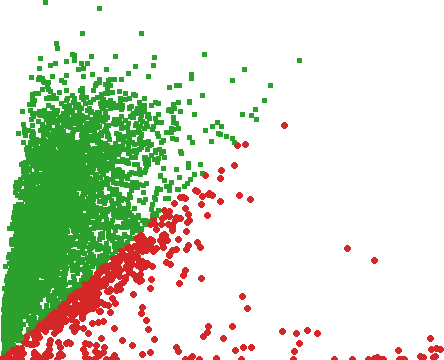
Fig 5: Scatter plot of α vs. RHS of Eq. 13 (N=4,555). 88.1% of pairs satisfy the condition.
Limitations
- The theoretical guarantee for C2R mitigating splitting and absorption holds conditionally under Eq. 13, which is empirically satisfied in 88.1% of cases; marginal cases may not obtain full benefit.
- Computational overhead for pairwise similarity calculations in large dictionaries, although amortized via chunking and infrequent updates, remains a potential scalability bottleneck.
- Evaluation is limited to specific models (Gemma-2-2B, Qwen3-8B, Llama-3-8B) and datasets; generalization to other architectures or domains requires confirmation.
- The study does not perform explicit adversarial or robustness tests against crafted inputs designed to exploit SAE latent inconsistencies.
- Interpretability metrics rely in part on automated LLM judges validated with humans but may still reflect subjective biases inherent in LLM explanations.
- The impact on downstream LLM interpretability tasks beyond latent fidelity and disentanglement was not deeply explored.
Open questions / follow-ons
- How does C2R perform on different layers of LLMs and other model architectures beyond those evaluated?
- Can the cross-sample consistency principle be adapted to other forms of latent representation beyond sparse autoencoders, e.g., variational or transformer-based?
- What is the impact of C2R on causal interpretability and circuit analysis workflows applied to LLM internal activations?
- Can optimization techniques further reduce the computational complexity of C2R to scale to even larger latent dictionaries or real-time applications?
Why it matters for bot defense
For bot-defense and CAPTCHA practitioners using sparse autoencoders or similar latent decompositions to interpret model internals or user behavior features, this work highlights critical pitfalls where latent feature fragmentation and absorption can undermine the interpretability and reliability of extracted semantic components. C2R offers a theoretically principled regularization technique to enforce cross-sample consistency, improving the semantic coherence and atomicity of latent features without sacrificing fidelity. This can translate into more robust feature sets for anomaly detection or bot behavior modeling, reducing noise from redundant or irregular latent splits. Practitioners should consider incorporating cross-sample consistency objectives when designing sparse latent representations to enhance their stability across varied user sessions or attack patterns. The paper’s evaluation on large-scale models and datasets suggests the approach is scalable and effective, with open-source code available for integration into existing SAE pipelines. However, computational cost and domain adaptation remain considerations.
Cite
@article{arxiv2606_30609,
  title={ C$^{2}$R: Cross-sample Consistency Regularization Mitigates Feature Splitting and Absorption in Sparse Autoencoders },
  author={ Haoran Jin and Xiting Wang and Shijie Ren and Hong Xie and Defu Lian },
  journal={arXiv preprint arXiv:2606.30609},
  year={ 2026 },
  url={https://arxiv.org/abs/2606.30609}
}