
Emergence of beating in a magnetic flagellum consisting of active bots
Source: arXiv:2606.29499 · Published 2026-06-28 · By Francisca Guzmán-Lastra, Daniel Hernández, Nicolás Quintriqueo, Enkeleida Lushi, Erick Burgos
TL;DR
This work studies the emergence of flagellar beating—periodic oscillations resembling biological flagella—in linear chains of magnetic self-propelled robots (MSPPs) built from Hexbug Nano units embedded with neodymium magnets. By anchoring one chain end and activating self-propulsion, longitudinal stress builds until it overcomes magnetic bending stiffness, triggering buckling and sustained beating. Combining experiments and overdamped inertial simulations, the authors identify three dynamic regimes depending on active force, chain length, and magnetic stiffness: stable straight chains, stable beating, and chain fission. They show the beating onset is a supercritical Hopf bifurcation driven by a seed misalignment from the competition between magnetic torques and rotational noise. A kinematic analytical model accurately reproduces particle orientation dynamics. The key novelty is tuning bending stiffness and activity independently via dipole strength and chain length, enabling controlled study of force-induced buckling and self-oscillations. The results realize a macroscopic analog to microscopic active filaments, revealing generic physical principles of flagellar motility across scales.
Key findings
- A dimensionless buckling parameter Πbuck = F0 N^3 σ^2 / kmag with kmag = μ0 m^2 / 2π σ^2 predicts chain regime: Πbuck ≪ 1 leads to straight chain (N=3), ~1 to stable beating (N=4,5), ≫1 to fission (N=6).
- Self-propulsion force F0 = 2×10⁻⁴ N and dipole moment m = 0.6 Am² with chain diameter σ=5cm yield kmag = 2.88×10⁻⁵ N·m².
- Flagellar beating amplitude increases along the chain from the anchored head, consistent in experiments and simulations (Fig. 2c,d).
- Oscillation frequency ratios Ti/T2 for particles i=3,4 average ~1.6 and 1.9, respectively, showing frequency increases downchain with variability due to rotational noise.
- Rotational noise parameter ΠR = 4π γR DR σ^3 / μ0 m^2 quantifies noise-induced misalignment; stable beating requires ΠR ≪ 1, fulfilled at low DR = 10⁻⁵ in experiments.
- A theoretical kinematic model (Eq. 8) accurately replicates particle orientation evolution, validating physical mechanism of beating.
- Bending stiffness kmag provides tunable chain flexibility scaling as kmag/(Nσ)^2, confirmed by bond angle energy variation (Fig. 4d), with longer chains more flexible and easier to buckle.
- Beating onset corresponds to a supercritical Hopf bifurcation illustrated by limit cycle dynamics in orientation and bond angle order parameters (Fig. 4a,c).
Methodology — deep read
Threat model & assumptions: Not a security paper; the study assumes an experimental macroscopic system of magnetically interacting, self-propelled particles anchored at one end, focusing on physical dynamics rather than adversarial threat.
Data: The data consists of experimental trajectories and orientations of chains of N=3 to 6 MSPPs made from Hexbug Nano robots with embedded neodymium rod magnets (m=0.6 Am²) enclosed in 3D-printed disk armors (σ=5cm diameter). Experiments were conducted with consistent propulsion speed u0=2 cm/s using fresh batteries. Videos were recorded with a phone camera and processed with custom Python code extracting particle positions and orientations. Simulations matched parameters and reproduced N=4 and N=5 cases.
Architecture / algorithm: Numerical simulations model each MSPP as a disk-shaped particle with a point dipole moment mi = m pi parallel to its propulsion direction pi. Equations of motion combine inertial translational dynamics with overdamped rotational dynamics. Interactions include Weeks-Chandler-Anderson excluded volume potential and magnetic dipole-dipole potentials for cohesive forces and torques. Rotational Gaussian white noise models diffusion with coefficient DR = 10⁻⁵ rad²/s. The magnetic torque balances rotational noise. Self-alignment torque was considered but omitted as negligible under dominant magnetic torques in anchored chains.
Training regime: Not applicable as this is a physics experiment and simulation study. Simulations employed parameters consistent with experiments to ensure accurate dynamics.
Evaluation protocol: The system dynamics were characterized by observing chain shapes (straight, beating, or fission), measuring oscillation amplitude and frequency of the transverse displacement for each particle, analyzing orientation angles over time, computing bond angles and bending energies, and comparing experiments and simulations. Dimensionless parameters (Πbuck and ΠR) defined regimes. A kinematic analytical model describing orientation dynamics was validated through direct comparison with experimental/simulation data. The onset of beating was identified as a supercritical Hopf bifurcation by limit cycle analysis in order parameter phase space.
Reproducibility: The study provides detailed experimental parameters and simulation equations; code and raw datasets are not explicitly stated to be released. Supplemental materials include movies illustrating behaviors.
Example end-to-end: For N=4 MSPP chain, experiments with anchored head and self-propulsion activated at F0=2×10⁻⁴ N showed longitudinal stress accumulation leading to buckling at predicted Πbuck=1.11, triggering sustained transverse oscillations (flagellar beating). Particle angular orientations increased downchain as rotational noise balanced magnetic torques (ΠR ≈ 0.006). Simulations with matching model parameters reproduced arc displacements and oscillation frequencies observed. The analytical kinematic model solving Eq.(8) with imposed transverse displacement amplitudes reproduced the orientation dynamics, confirming the beating origin from coupled active forcing, magnetic cohesion, and rotational noise breaking symmetry.
Technical innovations
- Identification of a dimensionless buckling parameter Πbuck balancing active forcing, magnetic bending stiffness, and chain length to predict onset of flagellar beating and fission.
- Experimental and numerical demonstration that magnetic dipole-dipole interactions directly define an effective, tunable bending rigidity kmag, allowing independent control of activity and stiffness.
- Development of a kinematic orientation dynamics model accurately reproducing flagellar beating via coupled magnetic torques and rotational noise, validating the role of seed misalignment in beating onset.
- Use of macroscopic centimeter-scale active robots with embedded magnets to experimentally realize flagellar beating driven solely by self-propulsion and magnetic interactions, bridging scales from micro to macro.
Datasets
- Hexbug MSPP chains — approximately 4 to 6 particles per chain — experimental video and tracked position/orientation data — data collected at Universidad de Chile lab
Baselines vs proposed
- N=3 chain (Πbuck=0.47): remains straight vs N=4 chain (Πbuck=1.11): stable flagellar beating
- N=5 chain (Πbuck=2.17): stable flagellar beating vs N=6 chain (Πbuck=3.75): chain fission
- Simulated oscillation amplitudes and periods match experimental measurements within noise variability (Fig. 2 and 4)
- Kinematic model reproduces orientation time series with excellent agreement compared to experiments and simulations (Fig. 3c)
Figures from the paper
Figures are reproduced from the source paper for academic discussion. Original copyright: the paper authors. See arXiv:2606.29499.
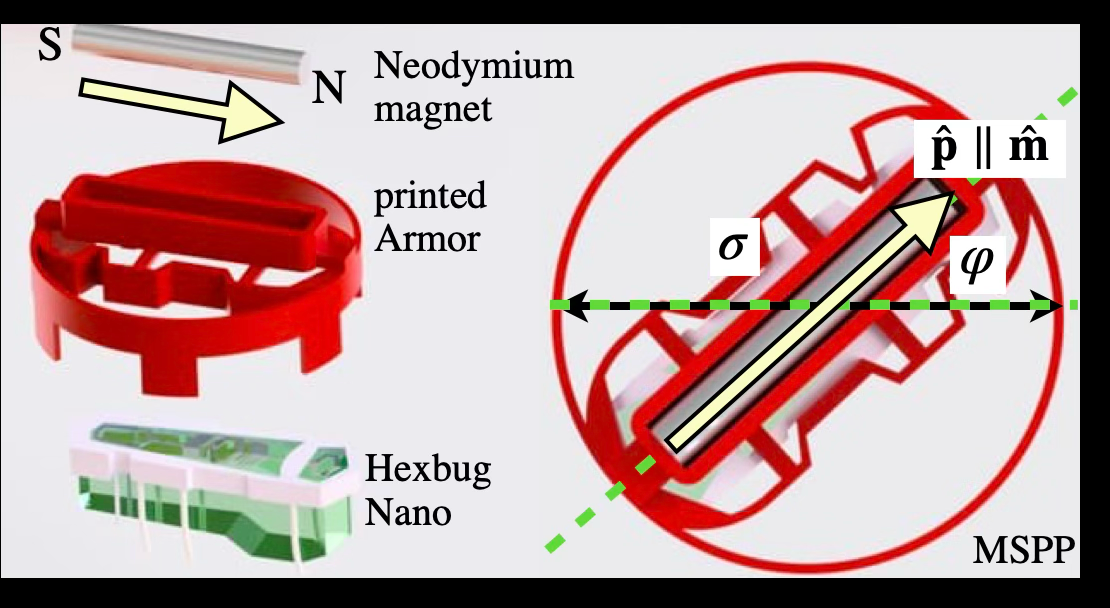
Fig 1: Magnetic self-propelled particle (MSPP). Left: compo-
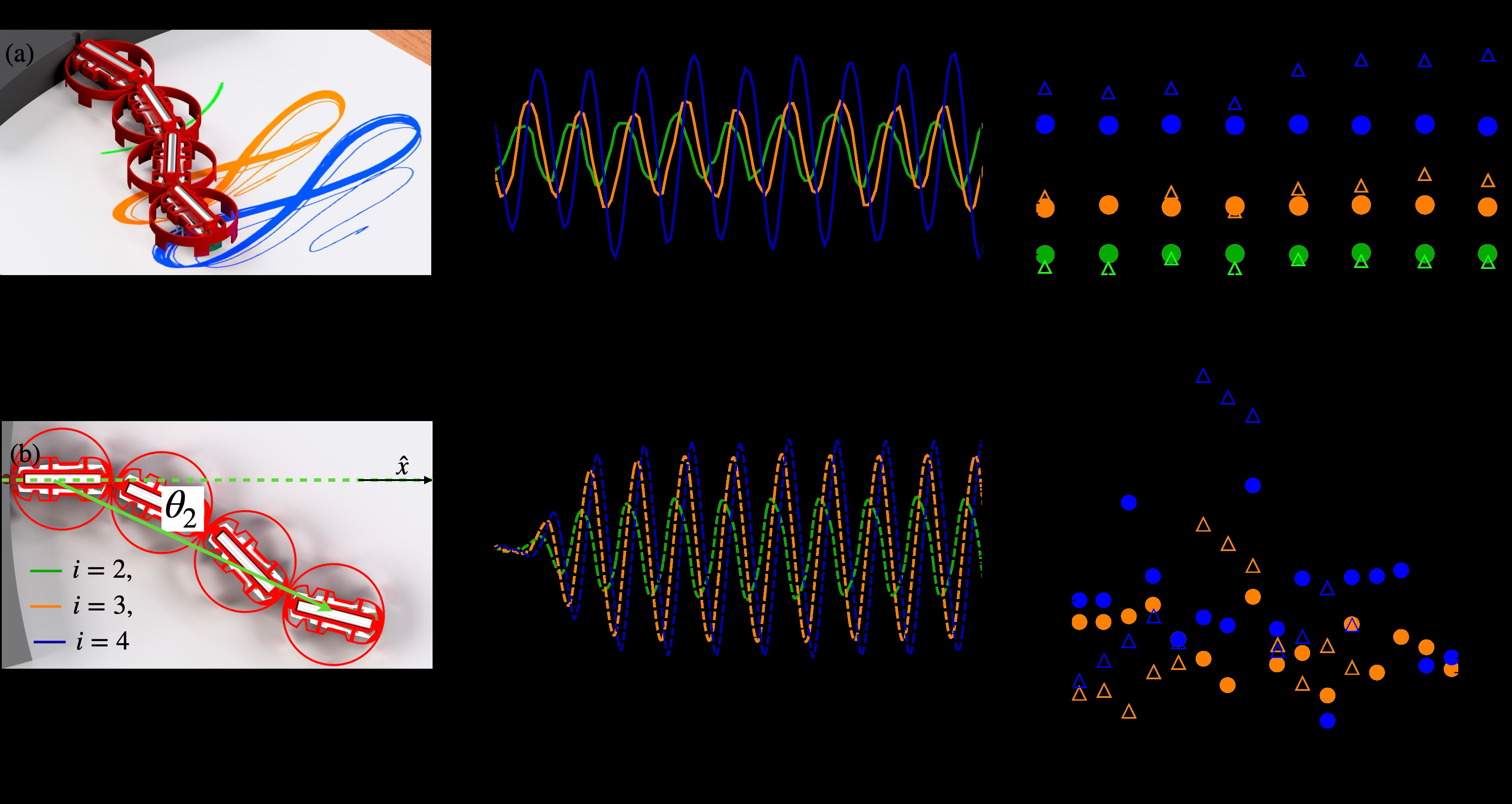
Fig 2: Flagellar beating of a N = 4 MSPP chain. (a) Experimental photograph showing the trajectories of individual MSPPs during
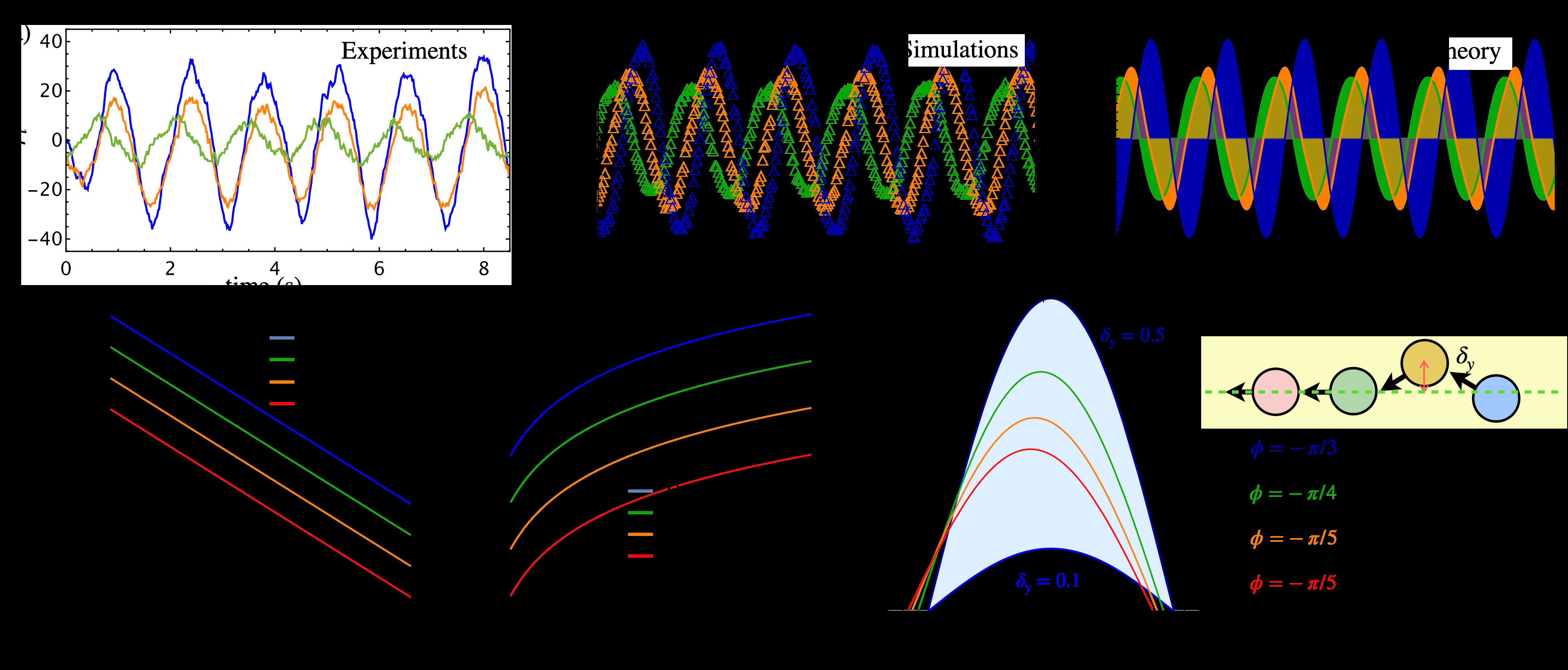
Fig 3: Orientation dynamics and onset of flagellar beating. (a) Time evolution of the orientation angle φi for each particle during
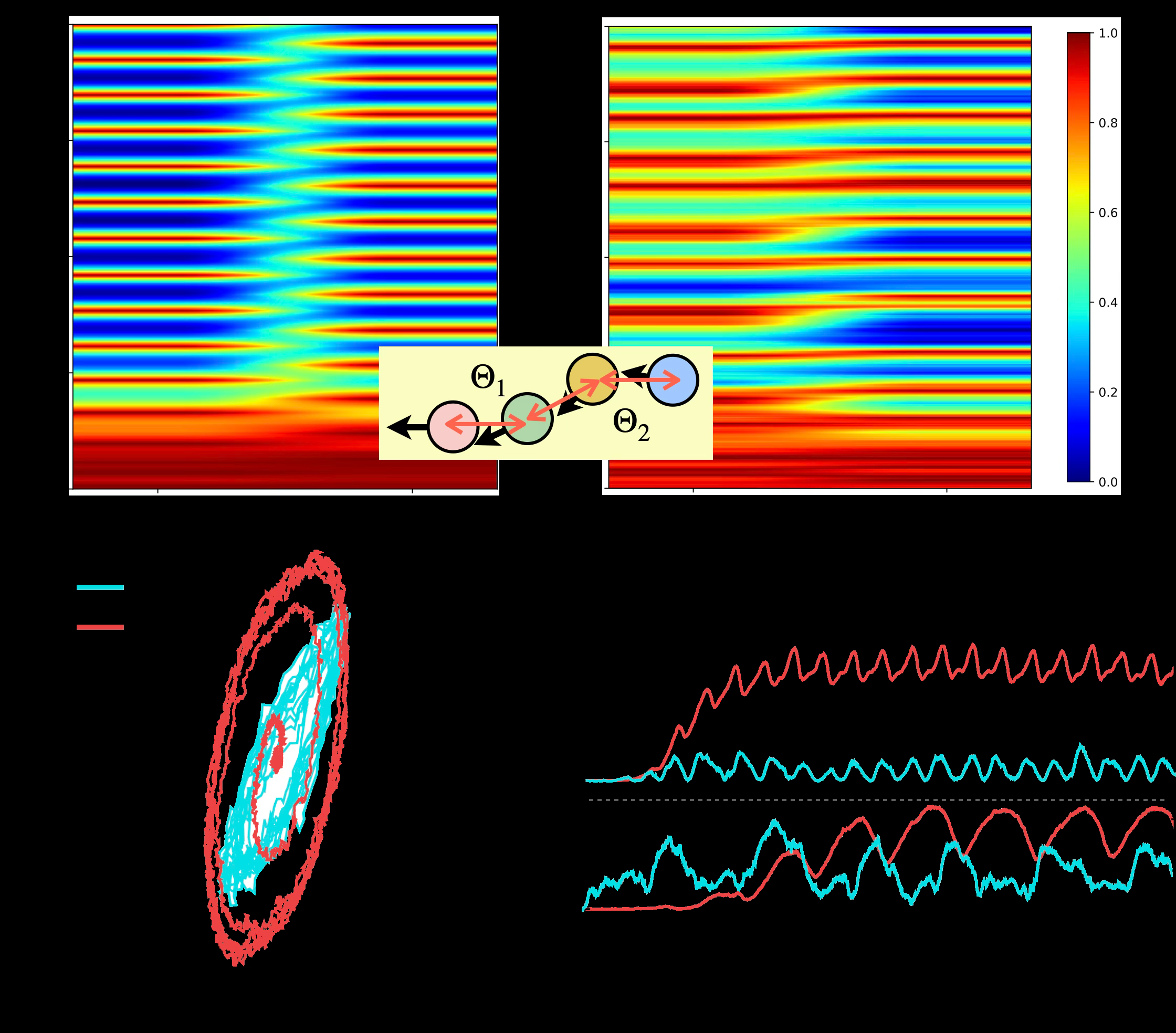
Fig 4: Chain flexibility and limit cycle dynamics. (a),(b) Kymographs showing the temporal evolution of the bond angles Θ1 and Θ2
Limitations
- Small system sizes studied experimentally limited to N=3 to 6 due to Hexbug propulsion constraints.
- Rotational friction and diffusion coefficients (γR, DR) not measured directly but inferred from previous studies and simulation fitting, introducing uncertainties.
- No explicit tests of environmental perturbations or adversarial disturbances impacting robustness of beating.
- Simulations omit hydrodynamic interactions and external fluid effects present at microscopic scales, limiting generalization to microswimmers.
- Code and data availability not explicitly confirmed, potentially hindering exact reproduction.
- Frequency variability across realizations indicates sensitivity to initial orientation noise not fully characterized quantitatively.
Open questions / follow-ons
- How does coupling multiple magnetic active chains lead to collective beating synchronization behaviors analogous to biological cilia arrays?
- What is the influence of hydrodynamic interactions and fluid environments on the flagellar dynamics observed in this macroscopic system?
- Can tuning dipole configurations enable programmable beating modes or directional swimming trajectories?
- How do frequency and amplitude fluctuations depend quantitatively on noise parameters, and can beating robustness be enhanced?
Why it matters for bot defense
While this research is primarily a physics and active matter study, the findings have conceptual relevance for bot-defense engineers exploring mechanical and motility-based CAPTCHA concepts mimicking biological flagella or cilia dynamics. The clear delineation of regimes controlled by dimensionless parameters (active force, rigidity, noise) suggests design principles for synthetic active structures that self-oscillate due to forced buckling and magnetic interactions. Understanding how seed misalignment and noise trigger oscillatory modes informs the design of resilient mechanical CAPTCHAs that resist simple static or random motion. The platform’s experimental accessibility using programmable macro-scale robots offers opportunities to prototype and study active mechanical puzzles as human-interaction tests. However, the inertial and magnetic-specific nature limits direct transfer to microfluidic CAPTCHA or software bot detection systems.
Cite
@article{arxiv2606_29499,
  title={ Emergence of beating in a magnetic flagellum consisting of active bots },
  author={ Francisca Guzmán-Lastra and Daniel Hernández and Nicolás Quintriqueo and Enkeleida Lushi and Erick Burgos },
  journal={arXiv preprint arXiv:2606.29499},
  year={ 2026 },
  url={https://arxiv.org/abs/2606.29499}
}