
Star Formation and Accretion in Nearby Galaxies
Source: arXiv:2606.28191 · Published 2026-06-26 · By J. Moldon, A. Alberdi, M. Perez-Torres, G. Lucatelli, R. Beswick, M. Sargent et al.
TL;DR
This chapter outlines the transformative potential of the Square Kilometre Array (SKA) AA4 configuration for disentangling and characterizing star formation and accretion processes in nearby galaxies through radio continuum observations. The key advance is the SKA's unique combination of micro-Jansky sensitivity, sub-arcsecond angular resolution, and nearly continuous frequency coverage from 50 MHz to 15 GHz. This enables spatially and spectrally resolved separation of thermal free-free emission (tracing recent massive star formation) and non-thermal synchrotron emission (tracing cosmic rays and magnetic fields), as well as identification of accretion-powered sources such as low-luminosity AGN. The chapter synthesizes the physical framework, diagnostic methodologies, and proposed observational strategies to exploit SKA data cubes spanning compact nuclei to diffuse galaxy-wide components. Results include robust spectral decomposition, environmental calibration of radio–SFR relations, and combinatory metrics to systematically identify accreting black holes versus star-forming regions.
Key findings
- Thermal free-free emission fraction in star-forming regions often exceeds 50%, reaching 70-80% at 33 GHz in nearby non-AGN complexes.
- Non-thermal synchrotron spectral slope typically ~ -0.8 for star formation, while accretion-powered AGN cores show flat/inverted spectra with indices α > -0.3, distinguishable by brightness temperatures Tb > 10^5-10^6 K.
- CR transport mechanisms (diffusion vs advection) can be spatially resolved by spectral index mapping and halo scale heights at multiple frequencies; advection creates large halos with gentle steepening, diffusion creates smaller halos with near-plane steepening.
- Magnetic field strength correlates with star formation surface density as B ∝ Σ_SFR^{0.3-0.4}, with equipartition fields from a few µG in disks to 50-100 µG in starburst nuclei.
- Frequency-dependent diagnostics: low frequencies (50–350 MHz) trace long-lived synchrotron emission and free-free absorption turnovers; mid (950–8500 MHz) allow spectral fitting to separate thermal and non-thermal components; high (8.3–15.4 GHz) maximize thermal fraction for direct SFR estimates.
- Brightness-temperature and spectral slope criteria combined with variability (10–50% on months to years) enable robust AGN identification uncontaminated by star formation.
- Core-collapse supernova rates measured via deep, high-cadence radio monitoring provide direct, extinction-free probes of massive star formation and constraints on IMF variations.
- The radio continuum–SFR calibration varies with environment due to CR escape and magnetic field strength, requiring multi-frequency and spatially resolved measurements to model radio efficiency.
Threat model
n/a - This is an astrophysical observational study focused on diagnostics and separation of physical emission components in galaxies; no adversarial threat model applies.
Methodology — deep read
The chapter presents a comprehensive observational and analysis framework leveraging SKA-AA4 capabilities. The threat model involves separating emission from star formation processes versus compact accretion sources within nearby galaxies up to ~200 Mpc, with assumptions that thermal free-free emission traces ionizing photons from massive stars and non-thermal synchrotron traces cosmic ray electrons accelerated by supernovae and affected by transport and losses.
Data provenance includes multi-band SKA-Low (50–350 MHz) and SKA-Mid (0.95–15.4 GHz) observations at matched resolutions where feasible, combined with complementary datasets from PHANGS, THINGS, KINGFISH and others for molecular and dust diagnostics. The target sample consists of nearby galaxies spanning quiescent spirals, starbursts, and AGN hosts.
The core analysis involves per-pixel broadband spectral energy distribution fitting using a two-component model (thermal free-free + non-thermal synchrotron) with Bayesian methods to estimate thermal fractions, non-thermal spectral indices, and curvature accounting for absorption. High-frequency Bands 5a and 5b anchor the thermal component, SKA-Low constrains spectral curvature and absorption features. This approach disambiguates embedded star formation from AGN jets.
Brightness temperatures are calculated using measured flux densities and deconvolved source sizes, with Tb > 10^6 K indicating non-thermal AGN cores. Variability monitoring on months-to-years timescales, combined with spectral slope and compactness, further supports AGN identification.
Cosmic ray transport is constrained by mapping spectral index variations across disks and halos, differentiating diffusion and advection regimes via scale heights and spectral gradients. Magnetic fields are estimated via equipartition arguments and rotation measure synthesis from polarization data across the frequency bands to reveal 3D magnetic structure.
Core-collapse supernova rates are derived from VLBI imaging detecting radio supernovae and remnants, with high cadence enabling light curve tracking and IMF slope constraints.
The observational program is tiered: deep sub-100 pc resolution studies of ~5-10 nearby galaxies; intermediate-depth samples across a broad range of environments; and wide-area surveys for statistical scaling relations. The methodology includes matched-resolution imaging across SKA-Low and SKA-Mid, multi-frequency spectral fitting, polarimetry, and time-domain monitoring.
Reproducibility aspects include reliance on publicly accessible SKA datasets and software tools for Bayesian SED fitting, although some datasets remain proprietary or under preparation (Lucatelli et al.). The framework emphasizes systematic error propagation and environment-dependent calibrations to enable robust interpretation in unresolved or high-redshift analogs.
A concrete example is the spectral decomposition of a star-forming galaxy's radio SED into thermal and synchrotron components, using high-frequency SKA-Mid Band 5b data as a thermal anchor and low-frequency SKA-Low data to detect free-free absorption turnovers, yielding maps of SFR surface density and cosmic ray transport timescales at ~50–500 pc resolution.
Technical innovations
- Use of continuous broadband SKA coverage (50 MHz to 15 GHz) with matched spatial resolution enables per-pixel multi-component spectral energy distribution fits separating thermal free-free and non-thermal synchrotron emission.
- Combining brightness temperature thresholds (Tb > 10^6 K) with spectral slope and variability criteria for robust, model-independent AGN core identification distinct from star-forming regions.
- Application of Bayesian spectral fitting incorporating free-free absorption optical depth to characterize deeply embedded star formation and constrain ionized gas properties.
- Use of multi-frequency polarimetric rotation measure synthesis to map three-dimensional magnetic field structure alongside cosmic-ray transport diagnostics.
- Tiered tier observational strategy linking sub-100 pc resolved studies to wide-field surveys, enabling scalable calibrations of radio–SFR relations across environments and galaxy types.
Datasets
- PHANGS, THINGS, KINGFISH — nearby galaxy multi-wavelength ancillary datasets for molecular and dust diagnostics — public or consortium data
- Simulated SKA-Low & SKA-Mid continuum observations of nearby galaxies — parameters described in Beswick et al. (2015) and in-prep Lucatelli et al.
- VLBI-scale imaging of compact sources in local starburst galaxies such as M82 (∼0.1 Jy flux sources)
Baselines vs proposed
- Canonical radio continuum–SFR calibration: used as baseline, environmental deviations identified where low-metallicity dwarfs show sub-linear relation due to CR escape (Heesen et al., 2014).
- SKA high-frequency thermal fraction mapping (Band 5b, 8.3–15.4 GHz): thermal fractions of 0.7–0.8 achieved in nearby star-forming complexes vs typical 0.3–0.5 in nuclear starbursts.
- AGN identification baseline from pre-SKA VLBI surveys limited to Tb >10^7 K cores; SKA extends sensitivity by orders of magnitude enabling detection of LLAGN cores with Tb >10^6 K at 200 Mpc.
- Comparison of synchrotron halo scale heights and spectral index profiles validate CR transport differentiation: advection halos several kpc vs diffusion halos <1 kpc as shown in Heesen et al. (2016).
Figures from the paper
Figures are reproduced from the source paper for academic discussion. Original copyright: the paper authors. See arXiv:2606.28191.

Fig 1 (page 1).
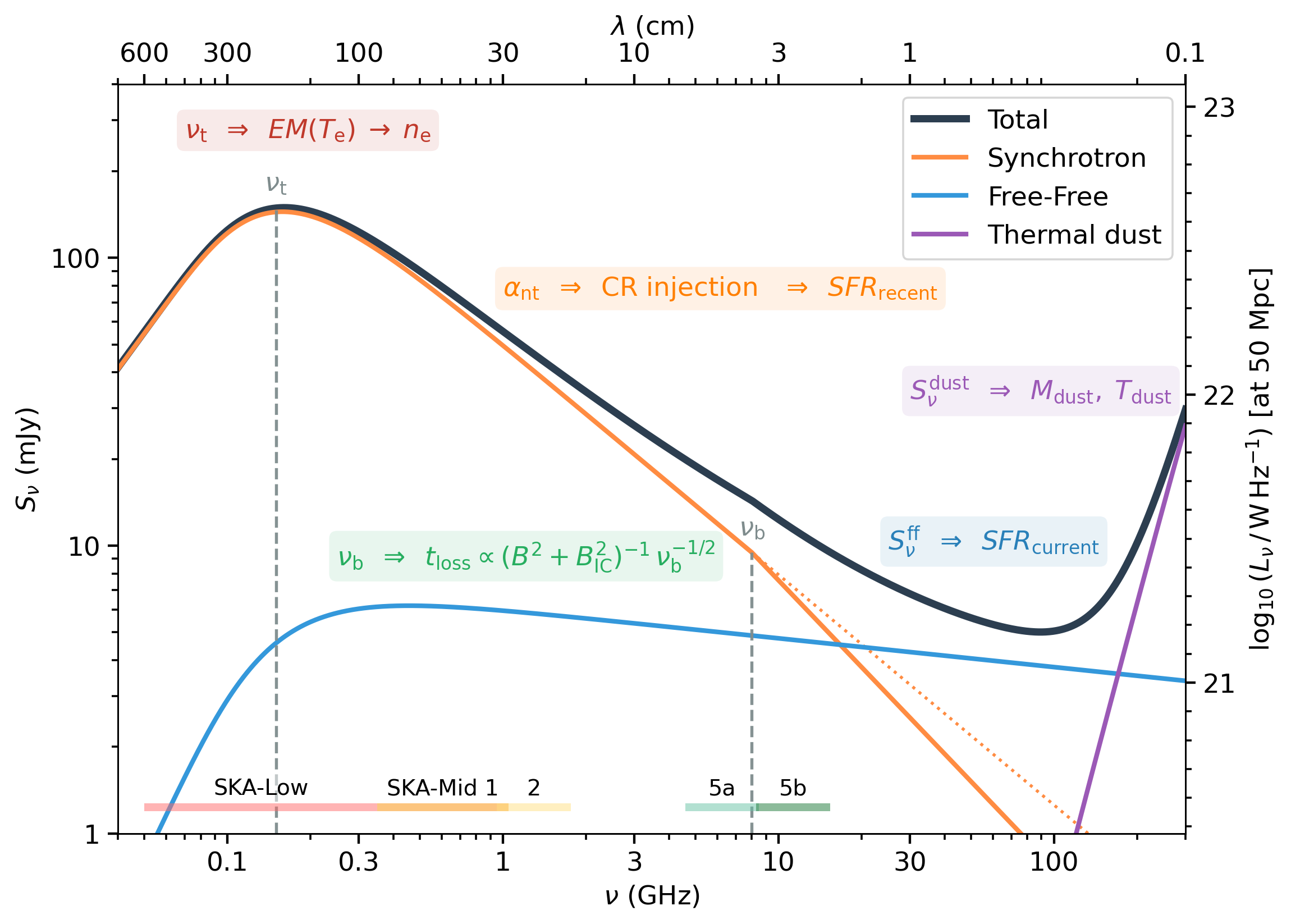
Fig 1: Broadband radio-to-mm spectral energy distribution of a nearby star-forming galaxy, showing
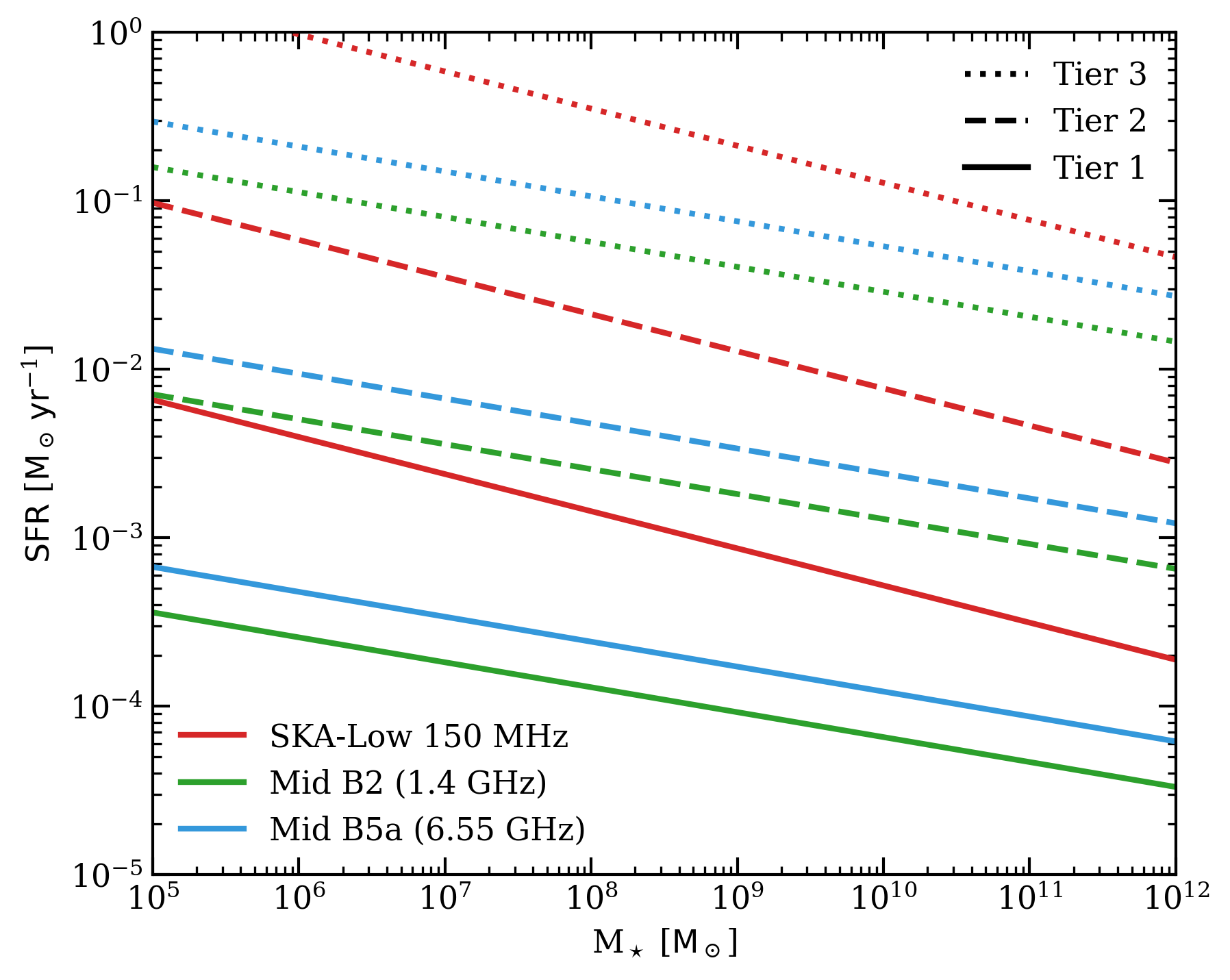
Fig 2: SFR–𝑀★3𝜎detection threshold for the proposed observations, assuming 10, 5 and 0.5 hours for
Limitations
- Empirical radio–SFR calibrations remain uncertain in low-metallicity and extreme starburst regimes due to complex cosmic-ray and magnetic-field coupling.
- Current CCSN rate statistics are limited by small number and require expansion to larger homogeneous samples to disentangle IMF effects.
- Disentangling AGN from compact starburst emission can be complicated in luminous infrared galaxies with free-free absorption mimicking flat spectra, requiring very high resolution and variability data.
- Full SKA-AA4 capabilities and datasets are future projections; current empirical results rely on precursor arrays or partial frequency coverage, limiting immediate validation.
- Polarimetric decomposition of thermal vs non-thermal emission remains model-dependent due to beam depolarization and Faraday complexity in turbulent magnetic fields.
- Bayesian spectral fitting and SED decomposition methods are computationally intensive and require high SNR data; error propagation details may vary with data quality.
Open questions / follow-ons
- How do cosmic ray transport parameters and magnetic field strengths vary systematically across galaxy morphology and environment?
- Can robust, universally applicable radio–SFR calibrations be defined that incorporate metallicity, density, and CR escape effects for high-redshift analogs?
- What is the prevalence and radio emission properties of low-luminosity or radio-quiet AGN populations in the local Universe detectable with SKA sensitivity and resolution?
- How do time-domain radio signatures from tidal disruption events and other compact accretors impact contamination in SFR measurements?
Why it matters for bot defense
While this chapter is rooted firmly in radio astronomy and galaxy evolution, the methodologies for disentangling overlapping emissions using multi-scale, multi-frequency spectral decomposition have conceptual parallels to separating bot traffic signals from legitimate user activity in bot-defense. The idea of leveraging multi-dimensional data (spectral slope, variability, morphology, polarization) to classify compact vs extended sources could inspire sophisticated feature fusion and anomaly detection approaches in CAPTCHA and bot detection pipelines. The tiered strategy of high-resolution targeted analysis supplemented by wide-area statistical surveys also parallels layered threat detection regimes. However, the astrophysical processes, data types, and physical constraints differ fundamentally, so direct analogies are limited. For CAPTCHA engineers, the paper is a reminder of how combining orthogonal observational axes and physical priors enables robust source separation under complex signal mixing, which is a useful conceptual insight when designing multilayer bot defense mechanisms or layered CAPTCHAs that exploit multiple discriminative cues.
Cite
@article{arxiv2606_28191,
  title={ Star Formation and Accretion in Nearby Galaxies },
  author={ J. Moldon and A. Alberdi and M. Perez-Torres and G. Lucatelli and R. Beswick and M. Sargent and E. Brinks and R. D. Baldi and S. Dey and F. S. Tabatabaei and K. Rubinur and N. Seymour and M. Pandey-Pommier and C. Bot },
  journal={arXiv preprint arXiv:2606.28191},
  year={ 2026 },
  url={https://arxiv.org/abs/2606.28191}
}