
Hybrid Quantum-Classical Neural Networks for Recognizing Quantum Phases
Source: arXiv:2606.28201 · Published 2026-06-26 · By Colin Scarato, Johannes Knörzer, Markus K. Hoffmann, Leon C. Sander, Luca Hofele, Shengpu Wang et al.
TL;DR
This paper addresses the challenging problem of identifying quantum phases of matter, particularly topologically ordered phases such as those realized by the surface code, using quantum machine learning methods. The authors introduce and experimentally implement a hybrid quantum-classical neural network architecture that integrates a parameterized quantum circuit with a classical feedforward neural network. This hybrid approach is trained jointly via superconducting quantum hardware in the optimization loop to classify quantum phases prepared on up to 16 qubits arranged in 4×4 surface code lattices subject to a magnetic field.
The key novelty lies in leveraging a hardware-efficient parameterized quantum circuit as a nonlocal basis transformation encoding quantum correlations, followed by a classical neural network processing bit string measurement outcomes. The training is performed using only topological ground states and a featureless ensemble representing trivial phases, avoiding reliance on locally-easy phases. Experimentally, the trained hybrid classifier achieves over 85% accuracy in single-shot measurements and over 99% when averaging ten measurement runs, distinguishing topological states from random product states and resilience to single-qubit Pauli errors. This demonstrates efficient quantum phase recognition directly on hardware, with promising scaling prospects beyond classical approaches that suffer unfavorable sample complexity.
Key findings
- The hybrid quantum-classical neural network achieves classification accuracy above 85% for single-shot measurements on a 4×4 (16 qubit) surface code lattice.
- Accuracy rises above 99% after averaging over 10 measurement samples.
- The trained classifier successfully distinguishes topological ground states from random product states even when subjected to any single-qubit Pauli error.
- The parameterized quantum circuit and classical neural network are jointly optimized using measurement data from superconducting quantum hardware with up to 17 transmon qubits.
- The approach uses a hardware-efficient gate set with continuously parameterized CZθ and Yθ gates, enabling low-depth circuits that scale as the square root of the number of qubits.
- Experimental state preparation and measurement fidelity are validated by stabilizer expectation values and topological entanglement entropy consistent with theory, despite noise-induced deviations.
- The training cost function (binary cross-entropy) decreases from near-random initialization to about 0.06 experimentally, indicating successful feature extraction and class separation.
- Numerical simulations show the method reduces sample complexity compared to classical shadow-based neural network classifiers.
Threat model
n/a – the paper focuses on quantum phase recognition using hybrid quantum-classical neural networks rather than security or adversarial scenarios. The adversary is not defined in this context.
Methodology — deep read
Threat model & assumptions: The adversary is not directly considered as this work focuses on quantum phase recognition, not adversarial settings. The setup assumes access to intermediate representation states prepared by a quantum processor, and the goal is to classify topological vs trivial quantum phases. Noise and imperfections are present but modeled and accounted for.
Data: Input quantum states are ground states of the 2D surface code Hamiltonian on 3×3 and 4×4 lattices in a longitudinal magnetic field h ∈ {0, 0.05, ..., 1}. Topological states correspond to h near zero, trivial paramagnetic states for large h. States are prepared experimentally on a superconducting processor with up to 17 flux-tunable transmon qubits using optimized gate sequences. Labels are binary: 1 for topological (ground state at h=0), 0 for trivial (maximally mixed state emulating featureless product states). Additional test sets include states with single-qubit Pauli errors and random tensor product Pauli eigenstates.
Architecture/algorithm:
- Quantum circuit: Uses an ansatz structured as the inverse of the ground-state preparation circuit, parameterized by continuously tunable CZθ two-qubit gates and Yθ single-qubit rotations, native to hardware. The circuit acts as a nonlocal basis transform disentangling the topological state into a separable product state.
- Classical neural network: Feedforward network with 16 input nodes (one per qubit), one hidden layer with 32 nodes using ReLU activations, and a single sigmoid output node providing a confidence score between 0 and 1 representing topological likelihood.
- The quantum circuit outputs computational basis measurement bitstrings which are the input to the classical classifier.
Training regime: Joint training is performed in nested loops. The outer loop optimizes quantum circuit parameters by sampling 8 sets of gate parameters around the current values. For each set, 8192 measurement repetitions are performed to collect bitstrings. An inner loop trains the classical neural network parameters via backpropagation using the collected bitstrings and binary cross-entropy loss. The eight resulting costs feed into an approximate gradient calculation to update quantum parameters. Training is done for 10 random initializations to confirm reproducibility and robustness.
Evaluation protocol: Metrics include binary cross-entropy cost during training and classification accuracy computed via receiver operating characteristic (ROC) curves from single-shot and batched measurement outputs. Tests include generalization across field strengths not in training, and robustness against all 48 single-qubit Pauli errors on the topological ground state. Averaging multiple measurements reduces classification errors significantly. Baseline comparisons include numerical simulations with noiseless and noisy quantum circuit models. Final performance is assessed experimentally on hardware.
Reproducibility: The quantum circuits and neural network architectures are described in detail, and implementation relies on standard methods (ADAM optimizer, binary cross entropy). Source quantum hardware is a 17-qubit transmon superconducting processor with full connectivity as per Fig 1(a). Dataset details, gate calibrations, hardware parameters, and data preprocessing (leakage rejection) are elaborated in appendices. Code release is not explicitly mentioned.
Overall example: Beginning with random quantum circuit parameters that produce indistinguishable measurement distributions, the joint training incrementally finds parameter updates via measured data, improving separation of the topological vs trivial bitstring distributions. After about 300 training iterations, the cost reduces from ~0.5 to approximately 0.06, corresponding to a well-performing classifier. The resulting model generalizes to intermediate magnetic field states and holds robustness under injected single-qubit Pauli noise verified through ROC curves and error probability analysis.
Technical innovations
- Joint hybrid training of parameterized quantum circuits and classical neural networks directly on superconducting quantum hardware for quantum phase recognition, rather than purely numerical or classical training.
- Use of a hardware-efficient ansatz formed by the inverse of ground-state preparation circuits enabling a nonlocal basis transform that simplifies classification of topological quantum states.
- Training primarily on topological ground states combined with a maximally mixed trivial ensemble, promoting generalization to a broad class of trivial states instead of relying on easy-to-identify locally trivial phases.
- Demonstration that low-depth continuously parameterized CZθ and Yθ gates native to superconducting circuits maintain sufficient expressivity to capture topological order in noisy experimental conditions.
Datasets
- Surface code lattices 3×3 and 4×4 — 9 and 16 qubits respectively — experimentally prepared on a 17-qubit superconducting transmon processor
- Test sets: Topological ground states with all single-qubit Pauli errors (48 distinct errors) — 8192 repetitions per state
- Test sets: Random tensor product Pauli eigenstates — 100 samples, 8192 repetitions each
Baselines vs proposed
- Noiseless numerical simulation binary cross-entropy after training: 0.0004 vs experimental: 0.06
- Single-shot measurement classification accuracy: classical baseline not explicitly given vs hybrid neural network 85%
- Classification accuracy after averaging 10 shots: hybrid neural network 99% (no direct classical baseline reported)
Figures from the paper
Figures are reproduced from the source paper for academic discussion. Original copyright: the paper authors. See arXiv:2606.28201.
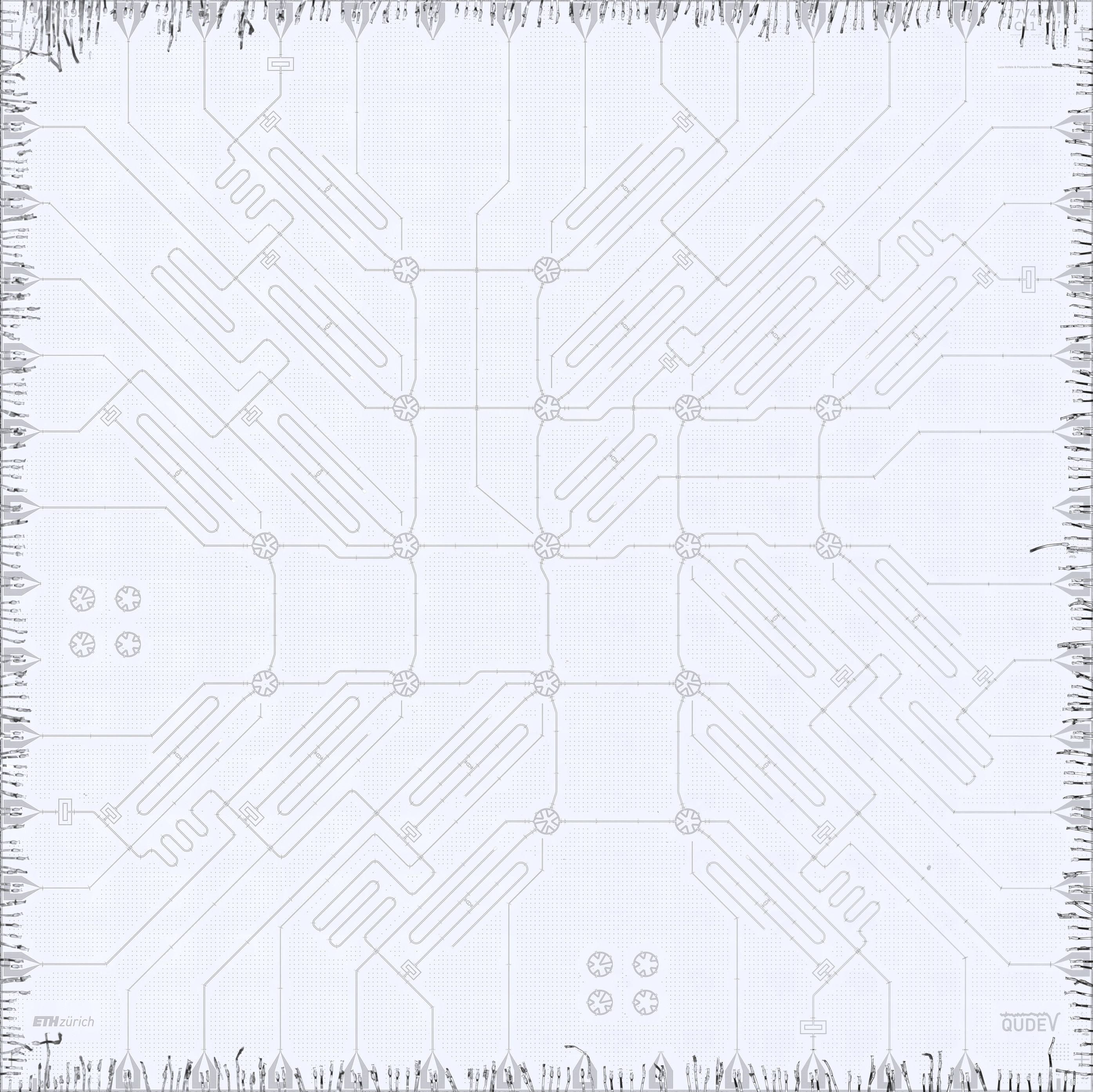
Fig 4: False-color micrograph of the superconducting quantum processor used in the experiment. Each transmon qubit consists
Limitations
- The system size is limited to 16 qubits (4×4 lattice); scalability to larger lattices remains to be experimentally validated.
- The method’s tolerance to noise and imperfect gates is empirically demonstrated but not systematically characterized under adversarial noise or hardware drift.
- The classical neural network architecture is relatively simple (one hidden layer); effects of more sophisticated classical models are not explored.
- The training relies on prepared ground states at two extremes (h=0 and h→∞) and a maximally mixed trivial ensemble; intermediate phases or other topological models are not studied experimentally.
- Reproducibility depends on experimental quantum hardware details that are complex and not fully disclosed publicly (e.g., custom calibration, leakage rejection methods).
Open questions / follow-ons
- How well does the hybrid quantum-classical neural network scale to larger quantum systems beyond 16 qubits in terms of training complexity, fidelity, and classifier accuracy?
- Can the training approach generalize to other types of quantum phases, such as symmetry-protected topological phases or those in higher dimensions?
- What are the trade-offs between trainability and expressivity when using physics-inspired ansatz circuits versus more generic data-driven parameterized circuits?
- How robust is the method to realistic experimental noise models over extended operation, including correlated noise or drift in multi-qubit devices?
Why it matters for bot defense
For bot-defense and CAPTCHA practitioners, this paper demonstrates a sophisticated hybrid quantum-classical approach to pattern recognition in highly nonlocal and structured quantum data. The fundamental concept of jointly training quantum feature extractors with classical classifiers to distinguish complex data classes has parallels in bot detection tasks where complex user behavior or sensor data requires extracting subtle correlations. Although not directly related to CAPTCHA solving, the demonstrated robustness of hybrid neural networks to noise and error injection suggests such architectures could improve resilience to noisy or adversarial inputs in security-sensitive classification problems. Additionally, the methodology exemplifies how integrating domain-specific physics knowledge (here topological quantum phases) into the model architecture and training data design can yield substantial gains in generalization and sample efficiency. This insight is transferable to security ML pipelines by emphasizing the importance of tailored feature extraction and hybrid training frameworks for challenging classification tasks.
Cite
@article{arxiv2606_28201,
  title={ Hybrid Quantum-Classical Neural Networks for Recognizing Quantum Phases },
  author={ Colin Scarato and Johannes Knörzer and Markus K. Hoffmann and Leon C. Sander and Luca Hofele and Shengpu Wang and Kilian Hanke and Ashay Sathe and Dominic Hagmann and Alexander Flasby and Michael J. Hartmann and Petr Zapletal and Andreas Wallraff and Christoph Hellings },
  journal={arXiv preprint arXiv:2606.28201},
  year={ 2026 },
  url={https://arxiv.org/abs/2606.28201}
}