
Mapping Political-Elite Networks in Europe with a Multilingual Joint Entity-Relation Extraction Pipeline
Source: arXiv:2606.27347 · Published 2026-06-25 · By Kirill Solovev, Jana Lasser
TL;DR
The paper addresses the challenge of mapping complex, informal, and adversarial political-elite networks at scale from multilingual news text. Traditional manual coding is labor-intensive and prior automated techniques mostly rely on co-occurrence rather than extracting directed, typed, and signed relations. The authors propose a fully open-weight, modular, multilingual joint entity-relation extraction pipeline that constructs temporal, signed knowledge graphs grounded in a fixed ontology and linked to Wikidata. By combining span-based NER, a three-stage entity linking cascade, and an ontology-constrained mixture-of-experts LLM for relation extraction with guided decoding, the pipeline bridges raw unstructured text and structured relational data across languages. Evaluation against a 3,491-relation gold standard on Polish news yields a textual correctness ranging from 68.2% (strict) to 93.7% (lenient), supported by a careful spot-check annotation and adjudication procedure. Two case studies—reconstructing an Austrian political party’s lifecycle and discovering state-enterprise patronage and conflict networks in Poland—validate its ability to recover known network structures from the public record at scale. This work provides a replicable foundation for large-scale computational social science on elite networks.
Key findings
- The pipeline achieves textual correctness between 68.2% (strict matching) and 93.7% (lenient scoring) based on a full-coverage spot-check against a 3,491-relation gold standard from 252 Polish news articles.
- Named-entity recognition using GLiNER-X-Large scored an F1 of 83.8% (precision 85.5%, recall 82.3%) on a separate German-language gold entity set.
- Exact match linking resolves ~55% of entity mentions, fuzzy and vector search link an additional ~1.3% and remaining entities respectively, improving multilingual entity disambiguation with morphologically rich languages.
- Inter-annotator agreement on relation extraction is 0.926 lenient type alpha (post-adjudication), indicating high type consistency when entity pairs are matched.
- About 40.3% of extracted relations match gold exactly; another 27.9% are valid relations missing from the gold, showing incomplete gold coverage.
- False positive rate from hallucinations is about 20.1%, with only 8.7% wrong relationship types and 3% wrong relation directions.
- Among false negatives, 42.3% stem from the LLM not extracting relations despite detected entities, 28.9% from missed NER, indicating recall bottlenecks in both components.
- Case studies independently confirm that the pipeline reconstructs a political party lifecycle in Austria and captures signed conflict and patronage networks in Poland that match public records.
Threat model
The adversary is the complexity and noise inherent to massive multilingual news text describing political elite networks, including ambiguous entity mentions, morphological variation, multilingual aliases, and implicit, often adversarial relationships. The pipeline assumes no access to proprietary APIs or closed models and must robustly anchor entities to an open knowledge base (Wikidata). The adversary is essentially the natural language variability and ambiguities that could cause entity fragmentation, incorrect linking, or erroneous relation extraction. The pipeline cannot defend against fabricated text or misinformation but focuses on accurate entity-relation extraction from public reliable newspapers.
Methodology — deep read
The authors define a threat model of political science researchers extracting relational data on elites from noisy, large-scale multilingual news corpora. The adversary is essentially the complexity of natural language, multilingual entity variations, lexical ambiguity, and informal/adversarial relations recorded implicitly in news text. They assume no access to proprietary or closed models and require a fully open-weight pipeline.
The data provenance includes 502 Polish articles annotated for relations (3,491 relations total) used as a gold standard through multi-model annotation with GPT-5.4, Gemini 3.1, and Mistral Large 3 models, external to the pipeline’s extraction model family. This gold standard is split into 250/252 dev/test with proportional stratified sampling over source and time. Validation against independent public records is done through Austrian party news and Polish economic/governance networks from Factiva/Infininews corpora.
The pipeline architecture is modular with four streaming asynchronous stages: chunking of long articles (~4800 character chunks), NER using GLiNER-X-Large for 7 coarse labels, a three-stage entity linking cascade (exact lookup via SQLite alias index, fuzzy SymSpell+RapidFuzz matching, and dense vector search with a Qwen3.0-Embedding-0.6B and Qdrant index), and finally relation extraction via a mixture-of-experts, 3B active parameter Qwen3.6-35B model served by vLLM with guided decoding tightly constrained by a fixed SKOS ontology of 109 entity and 99 relationship types. Guided decoding enforces 100% adherence to the ontology token-level grammar and produces typed, directed, signed, and temporal relations including canonical names and Wikidata QID assignments.
The fixed ontology is domain-specific and seeded from political science literature with iterative empirical refinement by unconstrained extraction on a stratified corpus sample to discover missing types before freezing the taxonomy. The ontology supports signed networks (positive, neutral, negative relation valences) and temporal scopes (event, state, property).
Training details of the LLM are not fully disclosed but it operates in “non-thinking” instruct mode optimized for high throughput rather than exploratory reasoning. Relation extraction is performed with additional logic for direction validation and candidate indexing to avoid hallucinated QIDs. The pipeline supports extensions to incorporate structured data sources beyond Wikidata for entity linking.
Evaluation includes inter-annotator agreement calculations, NER comparison against a human-annotated German gold, strict and lenient text-grounded relation extraction correctness scoring on a 100-article spot-check, and external validation of recovered networks via two detailed case studies in Austria and Poland against known historical political facts.
The strict correctness measure requires exact triple matches with the gold or valid missed relations, while lenient correctness counts near-synonymous relations as correct. Error taxonomy is analyzed to identify hallucinations, wrong types, direction errors, and extraction misses in both NER and LLM components. The pipeline’s modularity allows replacement of components or upgrading to thinking-mode LLMs.
In an end-to-end example, a Polish news article mentioning “Andrzej Duda” and “Prawo i Sprawiedliwość” is chunked, entities recognized and linked to Wikidata IDs, and the relation extraction LLM outputs structured tuples including relation type (position_held), temporal scope (state), sentiment (neutral), canonical names, and QID indices. These outputs are post-processed and integrated into a multiplex Neo4j knowledge graph representation.
Technical innovations
- A fully open-weight, multilingual joint entity-relation extraction pipeline that integrates span-based NER, a three-stage multilingual entity linking cascade, and ontology-constrained LLM relation extraction with guided decoding.
- Enforcement of a fixed, extensible SKOS ontology with 109 entity and 99 relation types at token-level generation in the LLM to guarantee consistent, typed, signed, and temporal relation extraction across languages and corpora.
- A three-stage entity linking approach combining exact lexicon matching, fuzzy approximate matching, and dense-vector semantic search for robust multilingual grounding in Wikidata including morphologically rich language adaptation.
- Use of a mixture-of-experts large language model with ~3B active parameters optimized for high-throughput, non-reasoning (instruct) mode in a streaming pipeline processing millions of articles with guided decoding to prevent hallucinations.
Datasets
- Polish News Corpus — 502 articles — human-annotated for relations (3,491 relations gold standard)
- German NER Gold — 100 articles — human annotated entity spans
- Wikidata JSON dump — millions of entities and aliases — public/open knowledge base
Baselines vs proposed
- GLiNER-X-Large NER: F1 = 83.8% (precision 85.5%, recall 82.3%)
- Pipeline relation extraction: Strict correctness = 68.2%, Lenient correctness = 93.7% vs incomplete gold baseline
- Inter-annotator agreement on relation types: 0.926 lenient alpha post-adjudication
Figures from the paper
Figures are reproduced from the source paper for academic discussion. Original copyright: the paper authors. See arXiv:2606.27347.
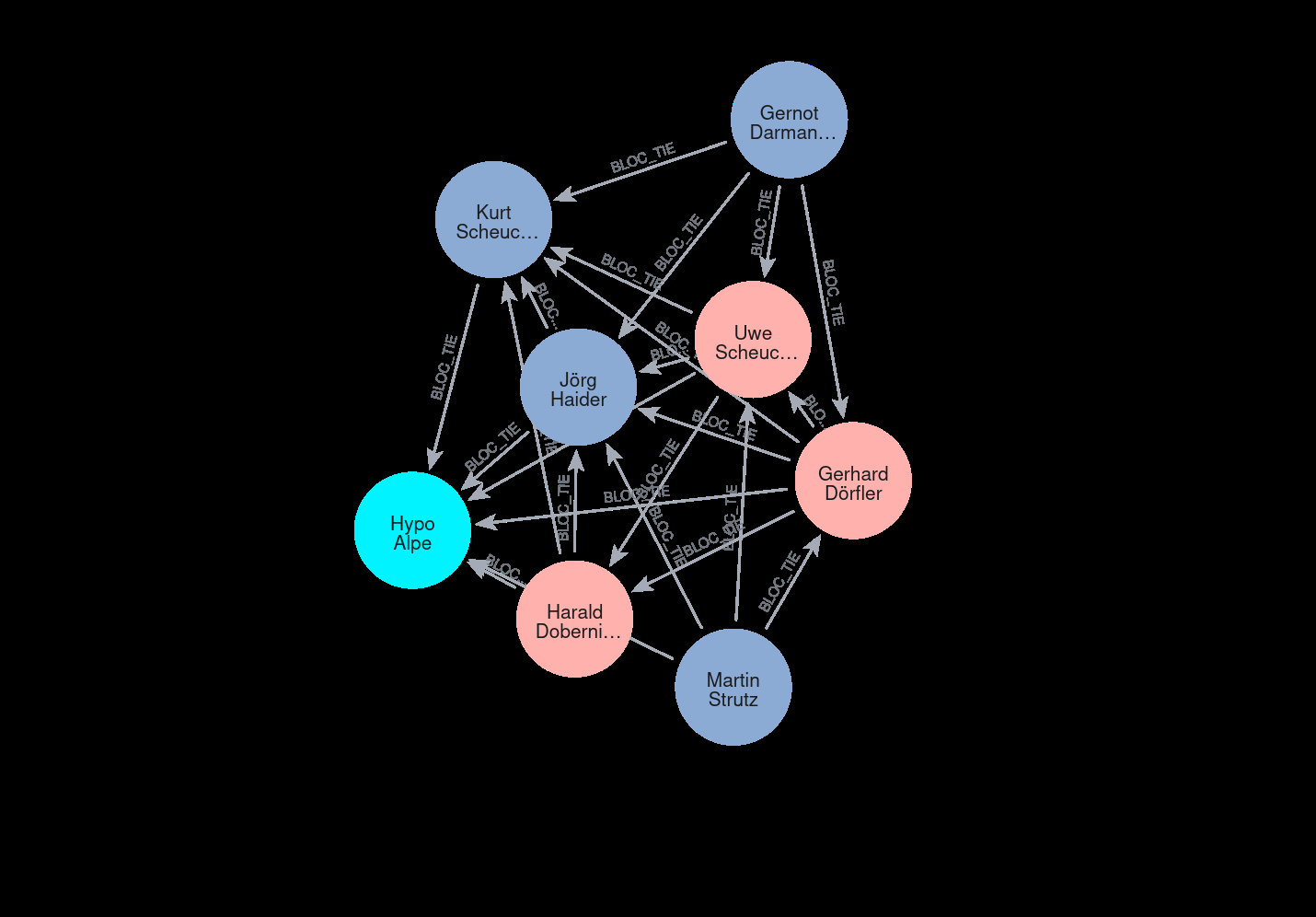
Fig 7: The Carinthia/Hypo bloc, a resolution-stable community on the BZÖ ego-network, exported from Neo4j. Nodes are
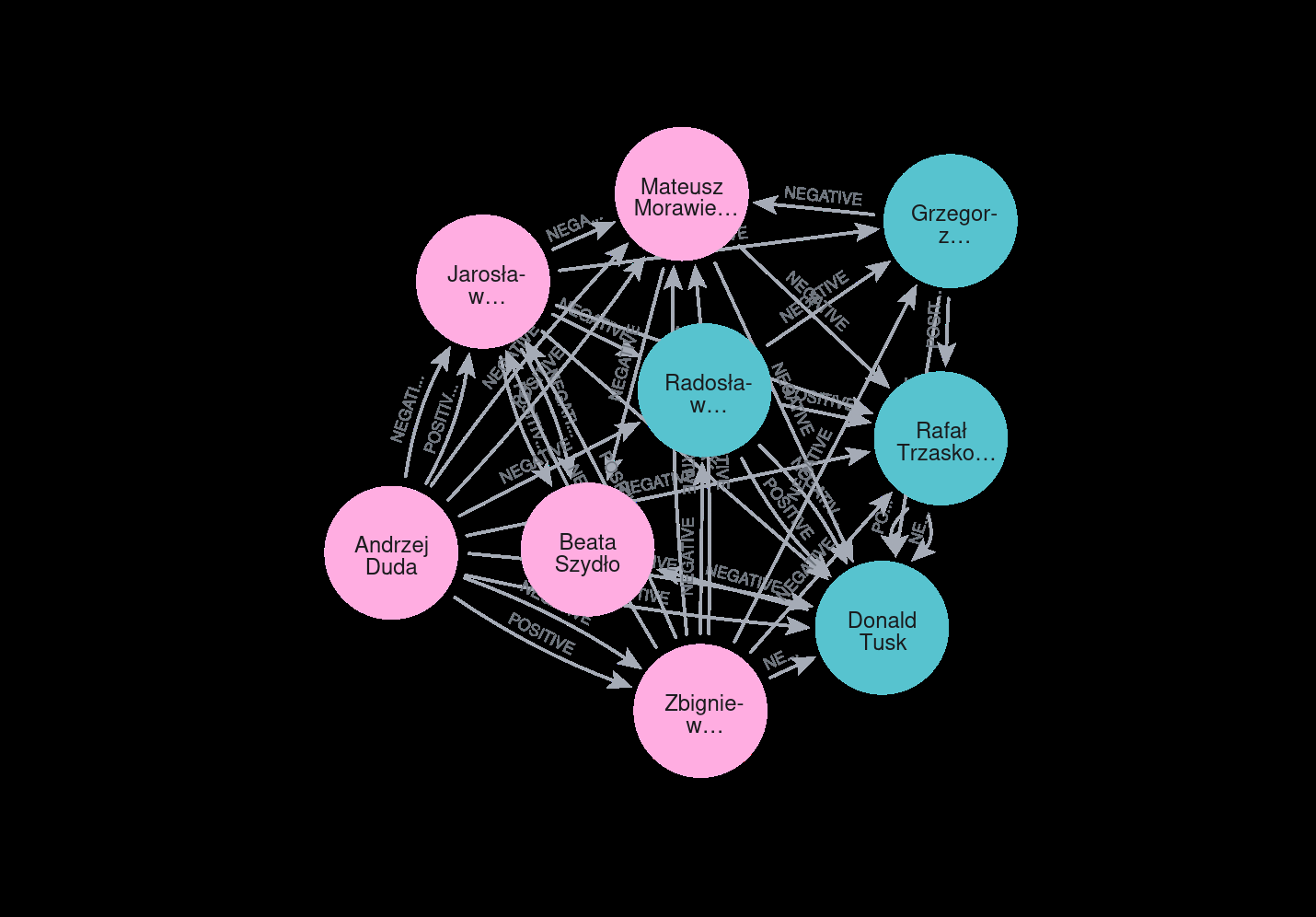
Fig 15: The signed PO–PiS cleavage among nine front-line leaders, exported from Neo4j. Node colour is camp (P102-grounded:
Limitations
- Gold standard is incomplete with a known open ontology extraction recall challenge, leading to underestimates in standard precision/recall metrics.
- LLM relation extraction recall limited by both entity recognition misses (29%) and model extraction misses (42%) on detected entities, pointing to room for improved recall.
- Hallucination rate of about 20.1% in relation extraction implies false positives remain a concern for downstream analyses.
- Evaluation focused on Polish and German corpora; coverage and performance on lower-resource languages or domains outside political elites untested.
- Relation temporal scope classification granularity may obscure some dynamics in long-term or overlapping relationships.
- Dependency on Wikidata coverage may limit entity linking for less prominent actors or firms absent from Wikidata.
Open questions / follow-ons
- How to improve recall of relation extraction, especially reducing misses by the LLM on already detected entity pairs?
- Can the pipeline performance be extended reliably to very low-resource languages with sparse Wikidata coverage and limited training data?
- How to incorporate streaming, real-time updates and evolving network dynamics with temporal scopes beyond static snapshots?
- What is the impact of extending the ontology or domain adaptation on extraction precision and practical utility in other political or social science fields?
Why it matters for bot defense
For bot-defense and CAPTCHA practitioners focused on distinguishing automated manipulations or misinformation narratives involving political elites, this paper provides a cutting-edge approach to extract rich, signed, and temporal relational data from multilingual unstructured text. Its robust open-weight pipeline paired with disambiguated entity grounding to Wikidata can enable more fine-grained network-level analysis to detect coordinated bots or information operations that form or exploit elite coalitions or fractures. The modular architecture and ontology-constrained decoding serve as a model for building reliable large-scale extraction tools that mitigate hallucination and enforce consistency, potentially applicable in fraud or identity graph construction. However, the recall limitations and reliance on curated knowledge bases highlight ongoing challenges in fully automating trustworthy extraction from noisy, adversarial text streams.
Cite
@article{arxiv2606_27347,
  title={ Mapping Political-Elite Networks in Europe with a Multilingual Joint Entity-Relation Extraction Pipeline },
  author={ Kirill Solovev and Jana Lasser },
  journal={arXiv preprint arXiv:2606.27347},
  year={ 2026 },
  url={https://arxiv.org/abs/2606.27347}
}