
BetXplain: An Explanation-Annotated Dataset for Detecting Manipulative Betting Advertisements on Social Media
Source: arXiv:2606.27274 · Published 2026-06-25 · By MSVPJ Sathvik, Parmitha Vangapadu, Nishit Rane, Sathwik Narkedimilli, Mark Lee, Akrati Saxena
TL;DR
This paper addresses the problem of detecting manipulative and deceptive betting advertisements on social media, which present significant societal risks including financial harm and mental health issues. Prior work lacks publicly available datasets with fine-grained, explanation-annotated labels for betting-related ads, limiting development of explainable detection models. The authors contribute BetXplain, a new dataset of 3,779 English-language Instagram and Reddit betting ads manually labeled as manipulative, deceptive, or responsible. Each label is supported by human-written explanations describing the persuasive or misleading elements. The dataset supports analysis of advertising tactics and evaluation of transformer-based and large language models in classifying and explaining manipulative promotions.
Experimental results show fine-tuned ELECTRA achieves the best macro-F1 of 0.6946 for 3-class classification, outperforming GPT-4o prompting (max macro-F1 0.6898). Explanation quality metrics indicate GPT-4o chain-of-thought prompting generates rationales with moderate semantic alignment (cosine similarity 0.5776) to human annotations. Linguistic and psychological analysis reveals manipulative betting ads heavily emphasize reward framing (42-47%) and urgency (35-38%), while downplaying risks (8-13%). The paper also maps persuasion triggers to clinical mental health risks including gambling disorder and suicidal ideation, underscoring the serious impact of deceptive betting ads. BetXplain thus fills a critical gap enabling explainable ML approaches to identify and mitigate harmful betting advertisements on social media.
Key findings
- The BetXplain dataset contains 3,779 annotated betting advertisements from Instagram and Reddit, categorized as 39.9% manipulative, 10.5% deceptive, and 49.6% responsible promotion.
- Fine-tuned ELECTRA achieves top classification macro-F1 of 0.6946 versus GPT-4o CoT prompting macro-F1 of 0.6870 and BERT macro-F1 of 0.6752.
- Deceptive promotion is the hardest class to identify, with per-class F1 scores ranging from 0.43 to 0.51 across models.
- Reward-focused messaging dominates betting ads (42-47%), urgency tactics follow (35-38%), and risk-minimizing language is underrepresented (8-13%).
- Social proof cues appear in 12-16% of ads, while deceptive financial claims occur in 18.5-25.4%, highest in color prediction ads at 25.4%.
- GPT-4o CoT prompting yields explanation cosine similarity to human rationales of 0.5776, higher than zero-shot (0.540) and few-shot (0.496).
- Risk severity scoring maps betting ad linguistic features to clinical outcomes, with gambling disorder and suicidal ideation scored at 9.0–9.5/10 severity.
- Fine-tuning on domain-specific annotated data outperforms large language model prompting without fine-tuning on manipulative detection.
Threat model
The adversary is non-adaptive manipulative or deceptive betting advertisements distributed on social media platforms aiming to influence users via psychological and linguistic tactics. The detection models do not assume that adversaries can dynamically alter or adversarially target the system but must contend with overlapping persuasive vocabulary that makes discrimination challenging especially between manipulative and deceptive ads.
Methodology — deep read
Threat Model & Assumptions: The adversary consists of manipulative or deceptive betting advertisements on social media platforms (Instagram and Reddit) promoting betting applications. These ads employ persuasive or misleading tactics to influence user gambling behavior and financial decisions. The adversary is not assumed to have direct knowledge of detection models but actively uses psychological and linguistic strategies to evade scrutiny. The system does not assume a malicious adversarial attacker performing adaptive evasion but focuses on static detection of manipulative content.
Data Collection & Annotation: The authors collected 4,000 betting-related advertisements via Meta Ads Library using strategic keyword queries such as "betting apps," "online betting," and "sports betting." After filtering for relevance and removing duplicates, 3,779 unique ads remained. Two volunteer annotators manually labeled each ad as manipulative, deceptive, or responsible, following structured guidelines. Manipulative ads use persuasive psychological tactics; deceptive ads contain misleading or false claims; responsible ads present neutral or transparent information. Annotators additionally provided free-text explanations justifying their labels, highlighting linguistic cues like exaggeration, urgency, or risk omission. Annotation quality was ensured by clear guidelines, manual verification, and balanced labels.
Dataset Composition: The dataset includes text caption, link, betting category (e.g., slots, poker, cricket), label (manipulative, deceptive, responsible), and explanation fields. The dataset distribution is imbalanced (50% responsible, 40% manipulative, 10% deceptive). Text is short (median 13 words). Ads span 19 categories to cover gambling and non-gambling sports content.
Model Architectures & Training: The authors experimented with multiple transformer-based architectures fine-tuned on the dataset: encoder-only models (BERT, RoBERTa, DistilBERT, ELECTRA, ALBERT), a long-context encoder (Longformer), and encoder-decoder models (BART, T5). All models used cross-entropy loss with inverse-frequency class weighting to address imbalance. They trained for 5 epochs using AdamW optimizer with weight decay and linear warmup, batch size 16, max sequence length 256 tokens, on an NVIDIA RTX 5060 Ti GPU. The best checkpoint was selected by validation macro-F1.
They also evaluated closed-source API large language model (GPT-4o) under zero-shot, few-shot (5 examples), and chain-of-thought (CoT) prompting without fine-tuning. Two open-source LLMs (LLaMA-3-8B and Mistral-7B) were tested similarly.
Evaluation Protocol: Data was split via stratified sampling into 70% train (2,645 samples), 10% validation (378) and 20% test (756). Metrics reported include accuracy, macro-F1 (primary), weighted-F1, and micro-F1 with 95% bootstrap confidence intervals. Per-class F1 scores were analyzed, especially for deceptive ads. Explanation quality was measured by ROUGE-1, ROUGE-L, BLEU-1, and cosine semantic similarity against human-written rationales. Ablations include comparing prompting strategies, model types, and relation of linguistic features to classification results.
Reproducibility: The dataset is planned for public release upon acceptance. Model training details, hyperparameters, and evaluation settings are documented. Code release is implied but not explicitly confirmed. The dataset contains public social media content but links require careful handling due to ethical concerns.
Example end-to-end: A betting ad was retrieved from Instagram via Meta Ads Library with keywords “sports betting.” Annotators verified relevance, then assigned the label manipulative due to persuasive urgency language (“limited-time bonus”), lack of risk disclosure, and aspirational framing. They wrote an explanation describing these cues. The text and label were input to ELECTRA which fine-tuned on the training split and classified the ad with high confidence. GPT-4o CoT prompting also generated a rationale matching annotated explanation with moderate semantic overlap. Final evaluation metrics reflect aggregate performance over test ads.
Technical innovations
- Creation of BetXplain, the first publicly available social media dataset for manipulative betting advertisement detection with human-annotated explanations.
- Annotation framework combining multi-class labels (manipulative, deceptive, responsible) with free-text explanations to support explainable detection approaches.
- Systematic linguistic and psychological analysis linking betting ad persuasive techniques to mental health risk factors like gambling disorder and suicidal ideation.
- Comprehensive benchmarking of fine-tuned transformer models and large language model prompting strategies on the new dataset, revealing strengths and limitations.
Datasets
- BetXplain — 3,779 advertisements — collected via Meta Ads Library from Instagram and Reddit (to be publicly released)
Baselines vs proposed
- BERT: macro-F1 = 0.6752 vs ELECTRA: 0.6946
- RoBERTa: macro-F1 = 0.6685 vs ELECTRA: 0.6946
- DistilBERT: macro-F1 = 0.6899 vs ELECTRA: 0.6946
- Longformer: macro-F1 = 0.6711 vs ELECTRA: 0.6946
- BART: macro-F1 = 0.6763 vs ELECTRA: 0.6946
- T5: macro-F1 = 0.6519 vs ELECTRA: 0.6946
- GPT-4o zero-shot: macro-F1 = 0.6871 vs ELECTRA: 0.6946
- GPT-4o few-shot: macro-F1 = 0.6898 vs ELECTRA: 0.6946
- GPT-4o CoT: macro-F1 = 0.6870 vs ELECTRA: 0.6946
- LLaMA-3-8B few-shot: macro-F1 = 0.680 vs ELECTRA: 0.6946
- Mistral-7B few-shot: macro-F1 = 0.665 vs ELECTRA: 0.6946
Figures from the paper
Figures are reproduced from the source paper for academic discussion. Original copyright: the paper authors. See arXiv:2606.27274.
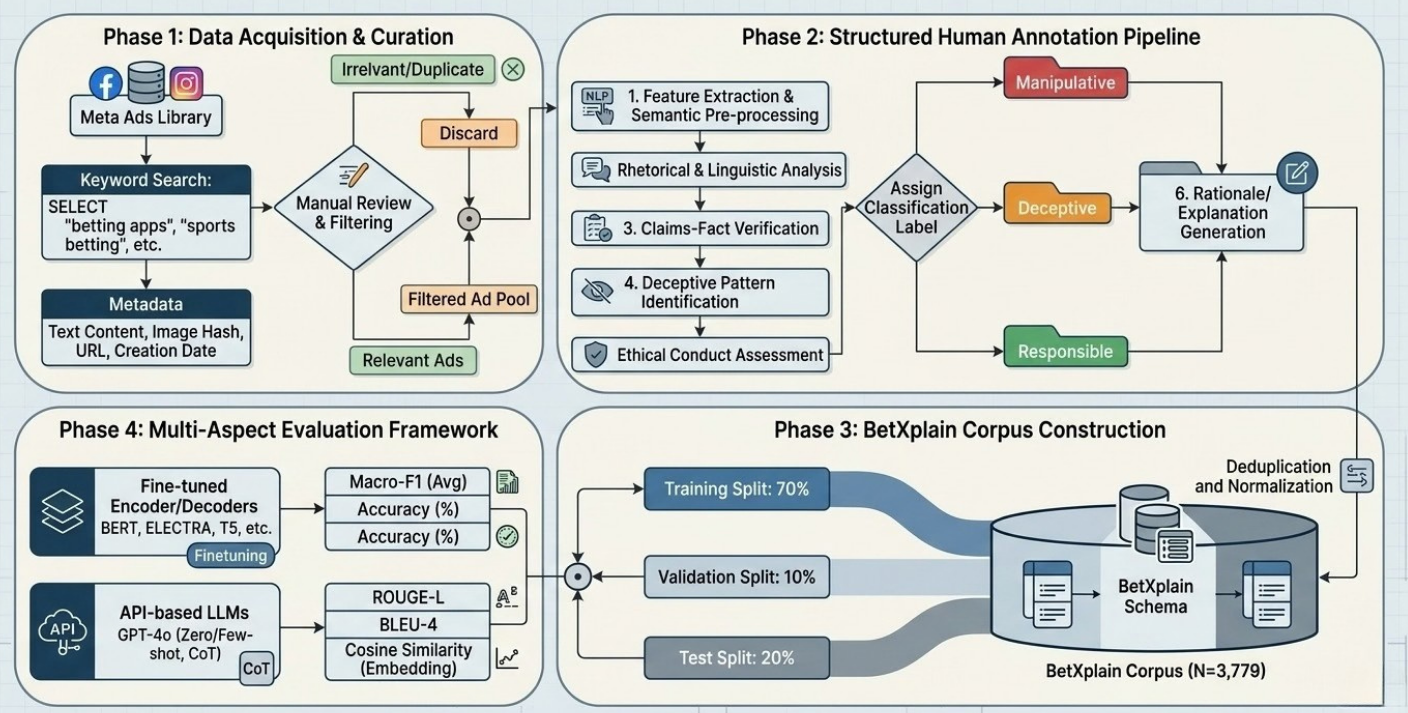
Fig 1: Overview of the BetXplain framework, illustrating the pipeline from betting advertisement data collection
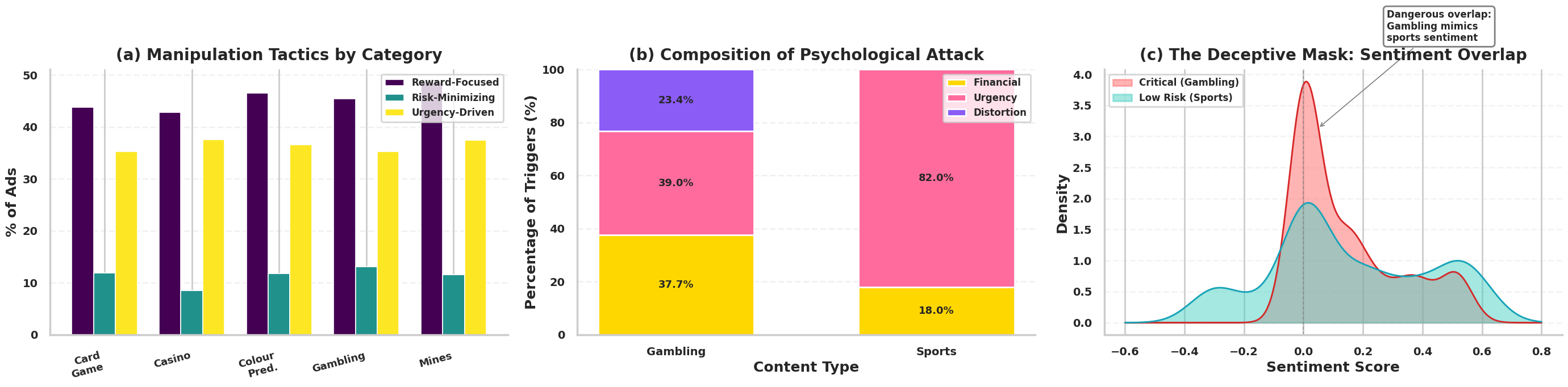
Fig 2: Psychological manipulation, architecture, and mental health impact(a) Keyword frequency heatmap across
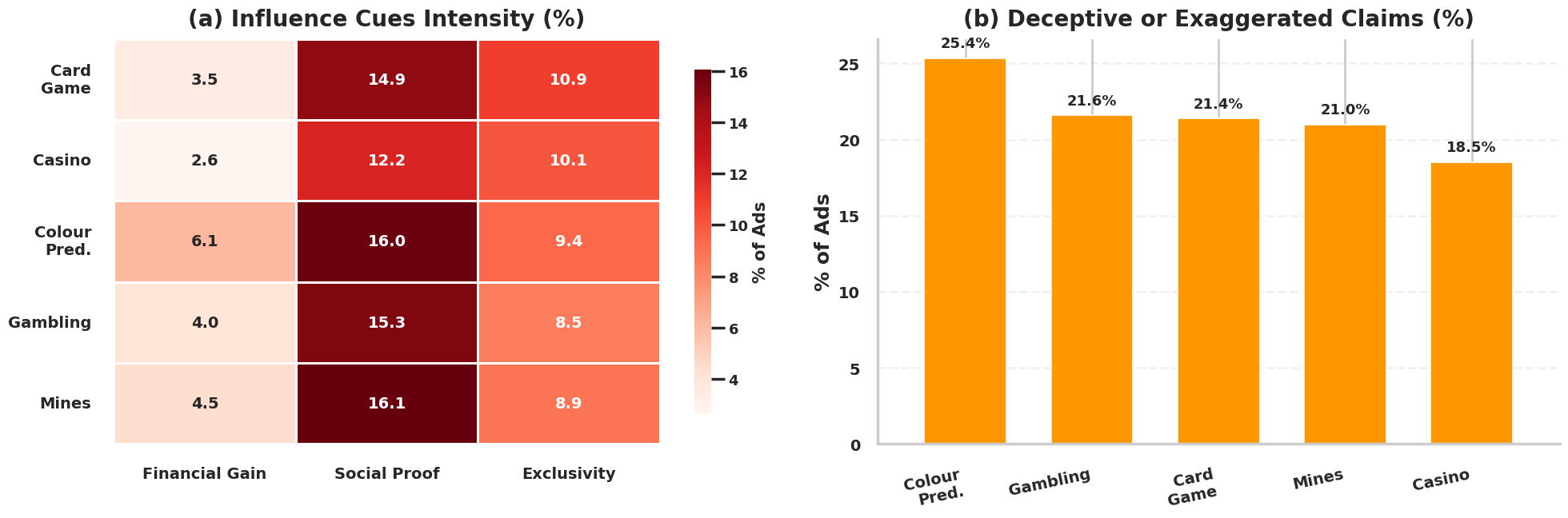
Fig 3: Influence cues and deceptive claims across categories: (a) Influence cues intensity by category. (b)
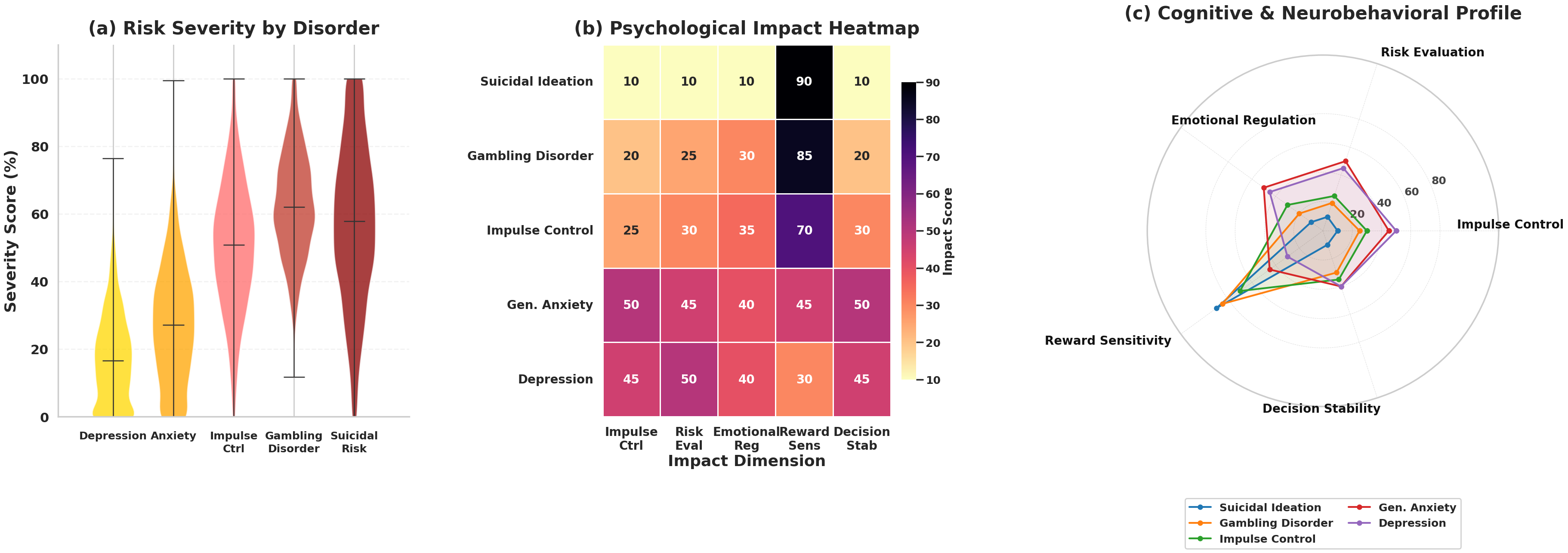
Fig 4: Clinical risk profile: (a) Risk severity distributions by disorder. (b) Psychological impact heatmap across
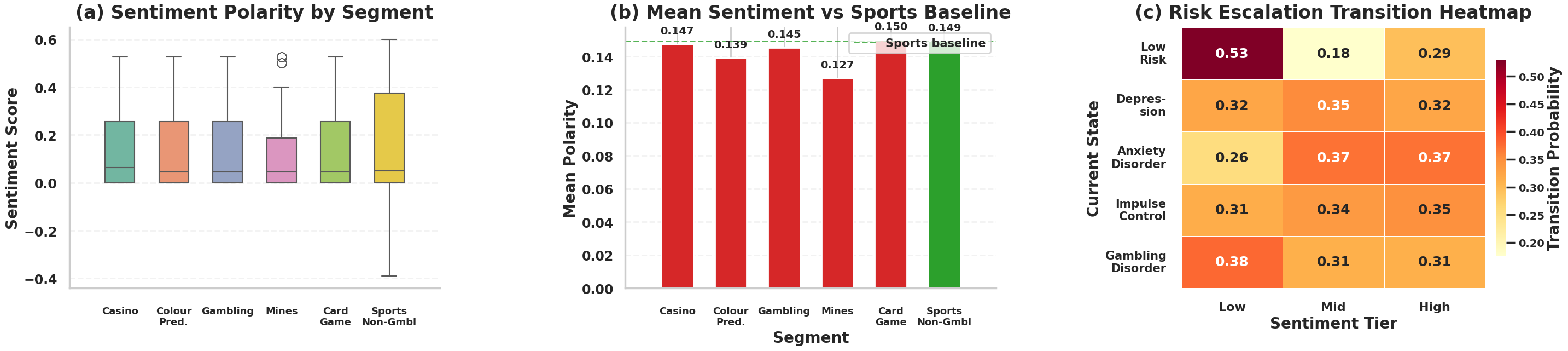
Fig 5: Sentiment, emotional tone, and the deceptive positivity effect: (a) Sentiment polarity by segment. (b)
Limitations
- Dataset is limited to English-language advertisements primarily from Instagram and Reddit, restricting geographic, linguistic, and platform diversity.
- The deceptive class is underrepresented (10.5%), making classification and explanation generation for this class particularly challenging.
- Explanations are concise human-written rationales focusing on key persuasive features; richer or multi-perspective annotations were not explored.
- No evaluation of model robustness against adaptive adversarial evasion techniques or cross-lingual generalization was performed.
- Dataset contains publicly accessible ads but includes links that may require responsible use and oversight to avoid ethical concerns.
- Limited testing on distribution shifts or evolving gambling advertising trends outside the captured period.
Open questions / follow-ons
- How can detection models better distinguish subtle deceptive claims from manipulative but technically permissible promotions in imbalanced datasets?
- What is the effectiveness of multi-lingual or culturally-situated datasets for detecting manipulative betting advertising across global online ecosystems?
- Can richer explanation formats supporting multi-modal or hierarchical reasoning improve explainable detection of harmful advertisements?
- How do adaptive adversaries change betting advertisement tactics over time and what defenses can maintain robustness under distribution shift?
Why it matters for bot defense
This work is directly relevant to bot-defense and CAPTCHA practitioners focusing on online abusive content and deceptive marketing detection. BetXplain provides a novel resource to train and benchmark machine learning systems that must identify manipulative betting advertisements on social media, a domain with high stakes for financial fraud and mental health harms. The inclusion of human-annotated explanations enables development of explainable detection models, which is critical for transparency and regulatory compliance in automated moderation.
Bot-defense systems could incorporate such detection models to detect and mitigate harmful betting promotions before they reach vulnerable users. The analysis linking linguistic cues to psychological triggers informs feature engineering and domain-specific threat signals. Moreover, the challenges revealed by deceptively similar manipulative vs deceptive ads highlight the need for fine-grained classification and reasoned justifications—areas closely aligned with CAPTCHA and bot-detection tasks that require interpretability alongside accuracy.
Cite
@article{arxiv2606_27274,
  title={ BetXplain: An Explanation-Annotated Dataset for Detecting Manipulative Betting Advertisements on Social Media },
  author={ MSVPJ Sathvik and Parmitha Vangapadu and Nishit Rane and Sathwik Narkedimilli and Mark Lee and Akrati Saxena },
  journal={arXiv preprint arXiv:2606.27274},
  year={ 2026 },
  url={https://arxiv.org/abs/2606.27274}
}