
Fractional phase slips across the charge-density-wave domain walls in 1-T TiSe2
Source: arXiv:2606.25963 · Published 2026-06-24 · By Haotian Zhang, Zihao Song, Zhongchen Xu, Jun Shu, Zhongxu Wei, Zunming Lu et al.
TL;DR
This paper tackles the long-standing debate about the microscopic origin of the charge density wave (CDW) in the layered transition metal dichalcogenide 1T-TiSe2. Previous hypotheses have diverged between a purely phonon-driven lattice instability and an electronically-driven excitonic mechanism, or some interplay of the two. The authors combine ultra-low temperature scanning tunneling microscopy (STM) with advanced two-dimensional lock-in phase analysis to directly image the local phase of the triple-Q CDW order parameter in real space, including across individual domain walls. Their key experimental finding is a robust and reproducible fractional 2π/3 phase slip occurring simultaneously in all three symmetry-related CDW components at domain walls, in contrast to the π phase slip predicted by simple lattice commensurate lock-in models. They develop a minimal Ginzburg-Landau free-energy model that incorporates both electron-phonon and electron-hole (excitonic) interactions. This model quantitatively reproduces the experimentally observed phase shifts and indicates that electronic interactions substantially influence the detailed phase structure of the CDW order in 1T-TiSe2. Consequently, the results challenge purely phonon-driven pictures and establish CDW domain walls as real-space probes of the microscopic interactions underlying multicomponent electronic order. Their phase-resolved framework offers a new route to discriminate competing ordering mechanisms in quantum materials beyond standard amplitude-sensitive measurements.
Key findings
- Low-temperature STM combined with 2D lock-in phase analysis reveals uniform CDW phase inside domains but a robust 2π/3 phase slip across domain walls simultaneously in all three symmetry-equivalent CDW components.
- Phase histograms show sharply peaked relative phases inside uniform domains near (ϕ1,ϕ2,ϕ3) ≈ (0, 4π/3, 0) mod 2π.
- The observed 2π/3 fractional phase slip contradicts the π phase slip expected from a purely phonon-driven McMillan commensurate lock-in mechanism.
- A minimal Ginzburg-Landau free-energy incorporating electron-phonon (Ve-ph) and electron-hole (Ve-h) interactions reproduces the 2π/3 phase slip when the ratio Ve-h/Ve-ph exceeds approximately 0.45.
- Phase domain walls are spatially separated for the three CDW components, suggesting component-resolved lock-in energies rather than rigid triple-Q locking.
- The competing bilinear and cubic phase coupling terms in the free energy determine the uniform phase-locked ground state and domain-wall phase shifts.
- Their findings support a cooperative electron-phonon and excitonic mechanism for 1T-TiSe2 CDW order rather than a pure lattice instability.
- Phase-resolved STM imaging of domain walls provides a direct real-space probe of microscopic interactions constraining correlated order parameters.
Threat model
n/a — This is a condensed matter physics study focused on charge density wave phase structure. No adversarial threat model applies.
Methodology — deep read
Threat model & assumptions: The study is experimental and phenomenological focusing on probing intrinsic CDW phase structure in 1T-TiSe2, a correlated quantum material. The 'adversary' analogy is irrelevant here; rather, the assumption is that STM can spatially resolve modulation amplitude and phase at atomic scale under ultra-high vacuum and cryogenic conditions. The authors assume that domain walls represent local disruptions of CDW order that reflect underlying microscopic couplings.
Data: High-quality single crystals of 1T-TiSe2 were grown by chemical vapor transport and cleaved in ultra-high vacuum. STM imaging was performed at temperatures below 4.5 K to minimize thermal fluctuations. Topographic images were collected over areas (e.g., 70nm ×70nm and 40nm×40nm fields of view), capturing both uniform domains and domain walls. The data include multiple repeat scans over defect-free and domain boundary regions.
Architecture / algorithm: The key analytic method is a two-dimensional lock-in technique applied to STM topographic images to decompose the real-space modulation into complex order parameters Ψ_j(r) = A_j(r) e^{iϕ_j(r)} for each of the three symmetry-equivalent CDW wave vectors Q_j. This produces spatial maps of amplitude A_j(r) and phase ϕ_j(r) for each component. By examining these maps, particularly phase distributions and differences across domain walls, the authors extract quantitative phase slips.
Training regime: n/a for this experimental physics work. The modeling employs a Ginzburg-Landau free-energy functional described analytically and solved variationally to minimize energy and predict phase configurations.
Evaluation protocol: Phase histograms and statistical analysis of phase discontinuities across domain walls were performed to confirm reproducibility and sharpness of the 2π/3 phase slip. Theoretical predictions from the phenomenological GL free-energy model incorporating electron-phonon (Ve-ph) and electron-hole (Ve-h) lock-in terms were compared quantitatively to observed phase slips. The phase diagram of domain-wall phase shift vs Ve-h/Ve-ph ratio was mapped to identify crossover from π to 2π/3 phase slips.
Reproducibility: Detailed data and analysis procedures are described. Sample growth and STM settings are well documented. The GL model form and parameters are fully presented. The authors note that all data are available upon reasonable request, but no public code or frozen weights are provided given the experimental nature.
Concrete example: Starting with a clean area, STM topography was analyzed via 2D lock-in to reveal uniform amplitude and sharp, locked relative phases among the three CDW components, e.g. ϕ2 peaked near 4π/3. Then, analyzing an adjoining region containing a domain wall, the phase maps showed abrupt, correlated ~2π/3 phase shifts for each component simultaneously, confirmed statistically across many sampling points. A minimal GL model with appropriate Ve-ph and Ve-h correctly predicts this fractional slip, demonstrating cooperative electron-hole and phonon interactions define the complex CDW phase behavior in 1T-TiSe2.
Technical innovations
- Application of two-dimensional lock-in phase analysis to low-temperature STM enables direct, spatially resolved measurement of internal CDW phase structure for all three Q components simultaneously.
- Identification and quantitative characterization of a robust 2π/3 fractional phase slip across CDW domain walls, challenging previously assumed π phase slip behavior.
- Development of a minimal Ginzburg-Landau free-energy model with combined electron-phonon and electron-hole cosine-locking terms that reproduces the observed phase slip crossover driven by Ve-h/Ve-ph ratio.
- Demonstration that domain walls serve as real-space, phase-resolved probes constraining microscopic interaction hierarchies in multicomponent electronic orders.
Datasets
- 1T-TiSe2 STM topographic data — multiple ~70nm and ~40nm fields of view — data collected in-house, available upon request
Baselines vs proposed
- Pure electron-phonon McMillan lock-in model: predicts π phase slip across domain walls vs combined electron-phonon plus electron-hole model: predicts observed 2π/3 phase slip when Ve-h/Ve-ph > 0.45
Figures from the paper
Figures are reproduced from the source paper for academic discussion. Original copyright: the paper authors. See arXiv:2606.25963.
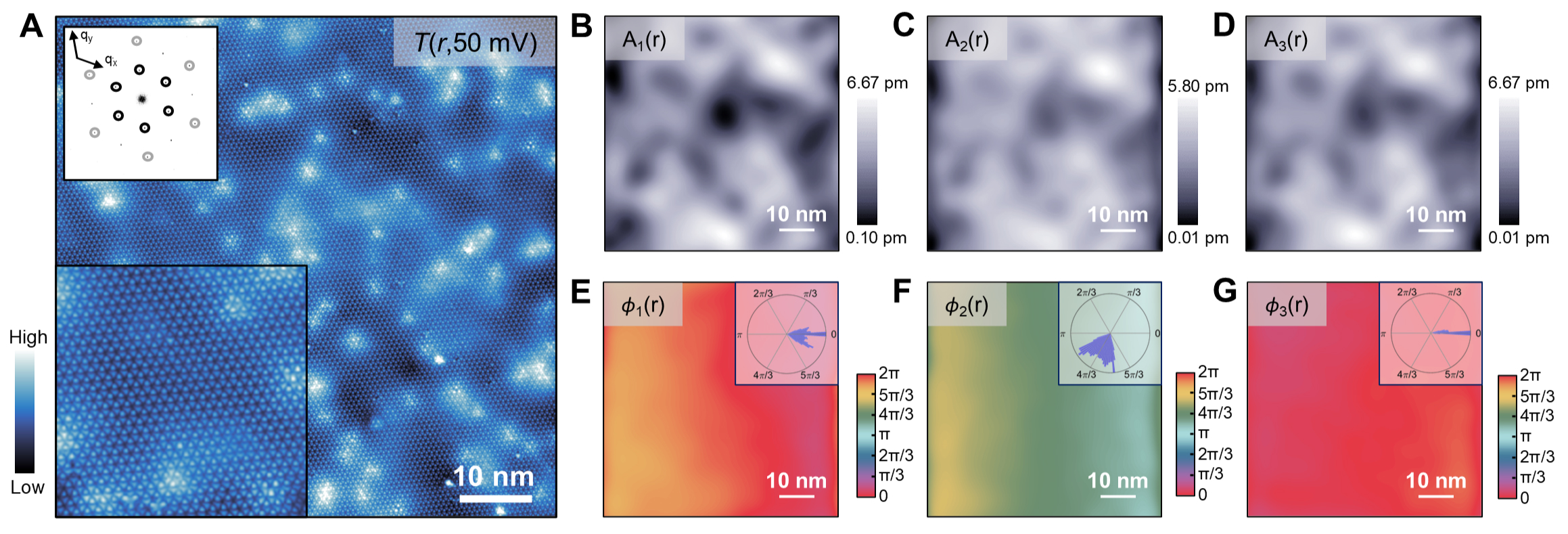
Fig 1: 2D lock-in analysis of the uniform triple-Q CDW state. (A) STM topographic image acquired (V = 50 mV,
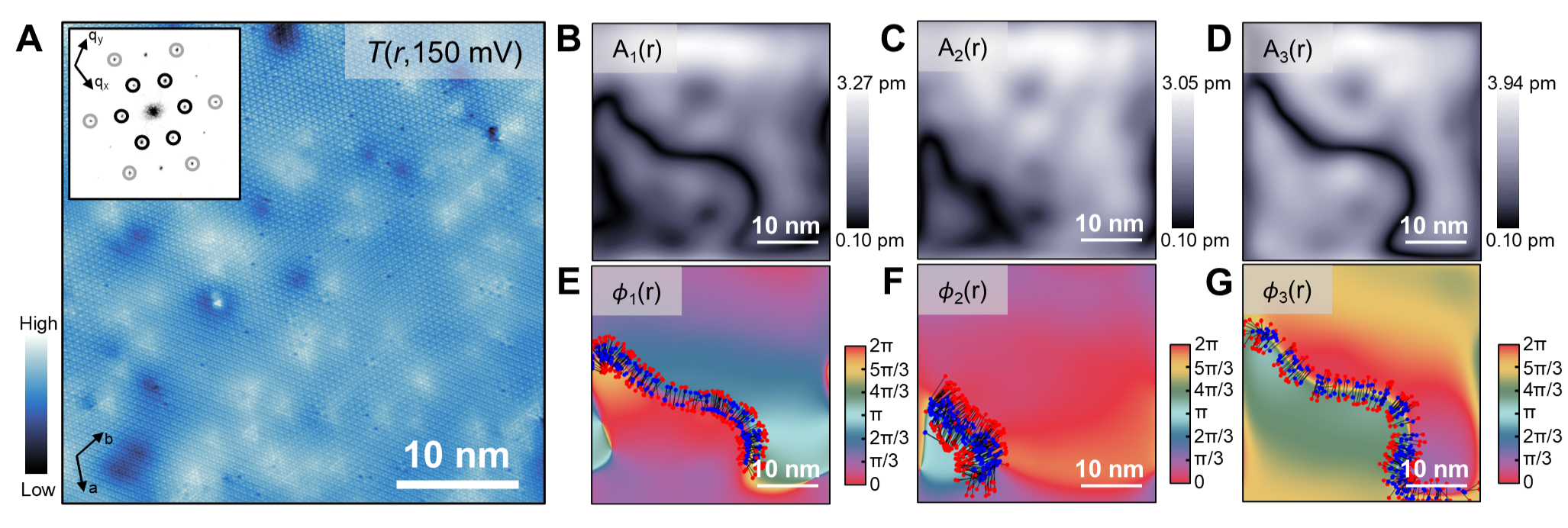
Fig 2: 2D lock-in analysis of CDW at the domain wall regions. (A) STM topographic image acquired (V = 150 mV,
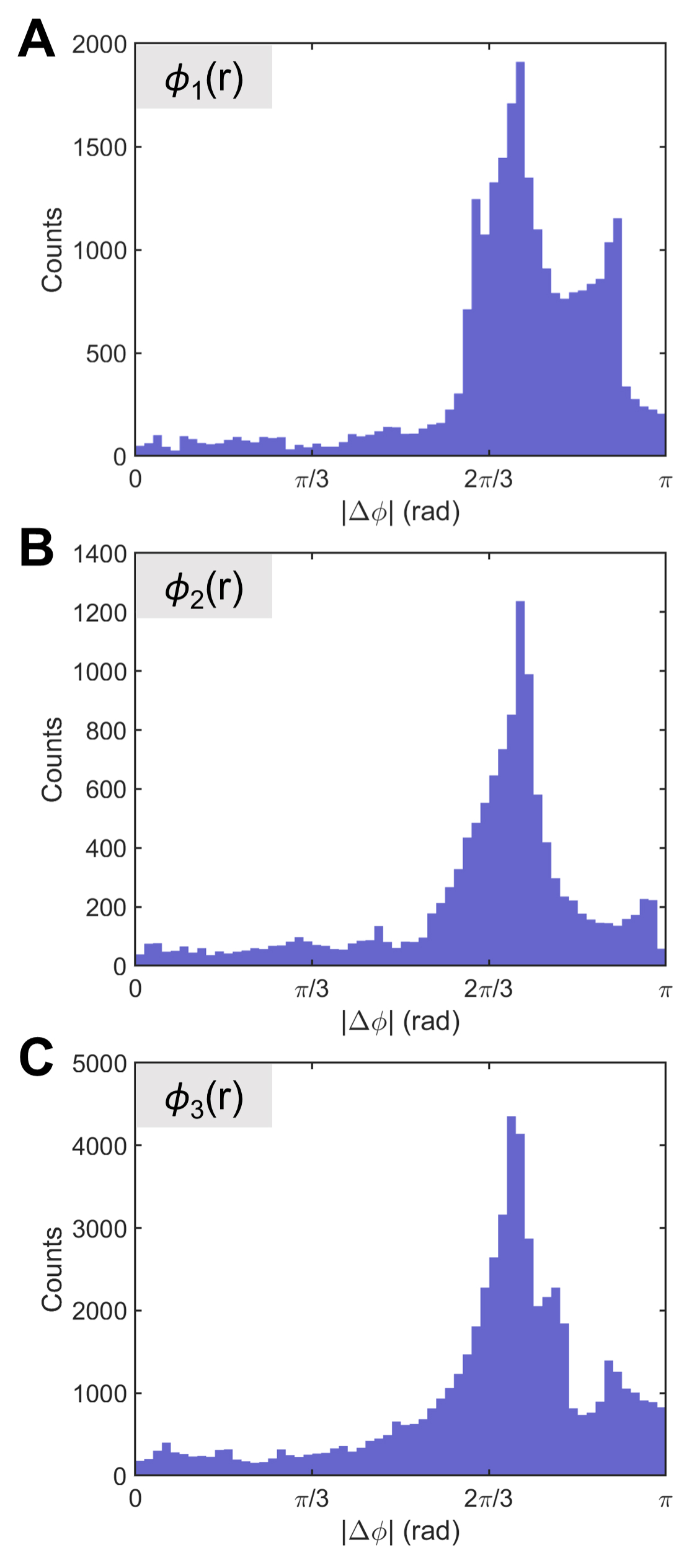
Fig 3: Statistical analysis of phase differences
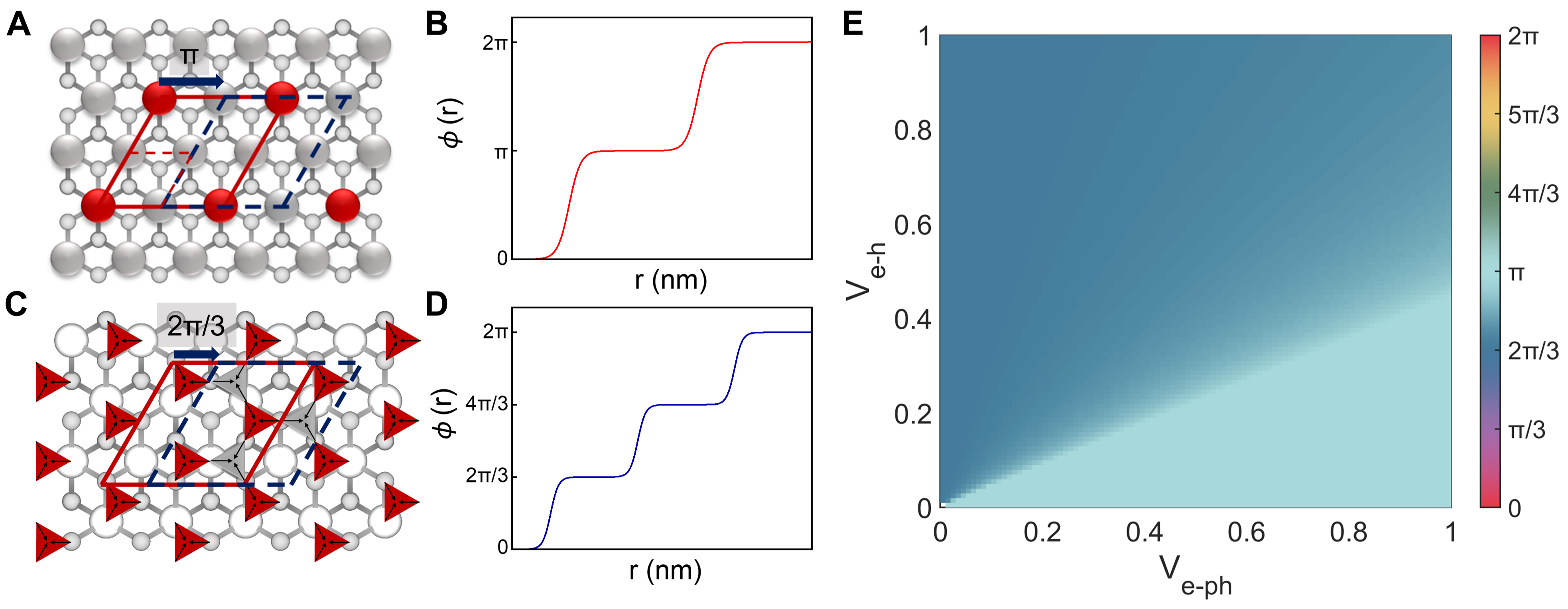
Fig 4: Mechanism of the phase shift across the domain walls. (A,B) Electron–phonon-driven scenario. The 2 × 2
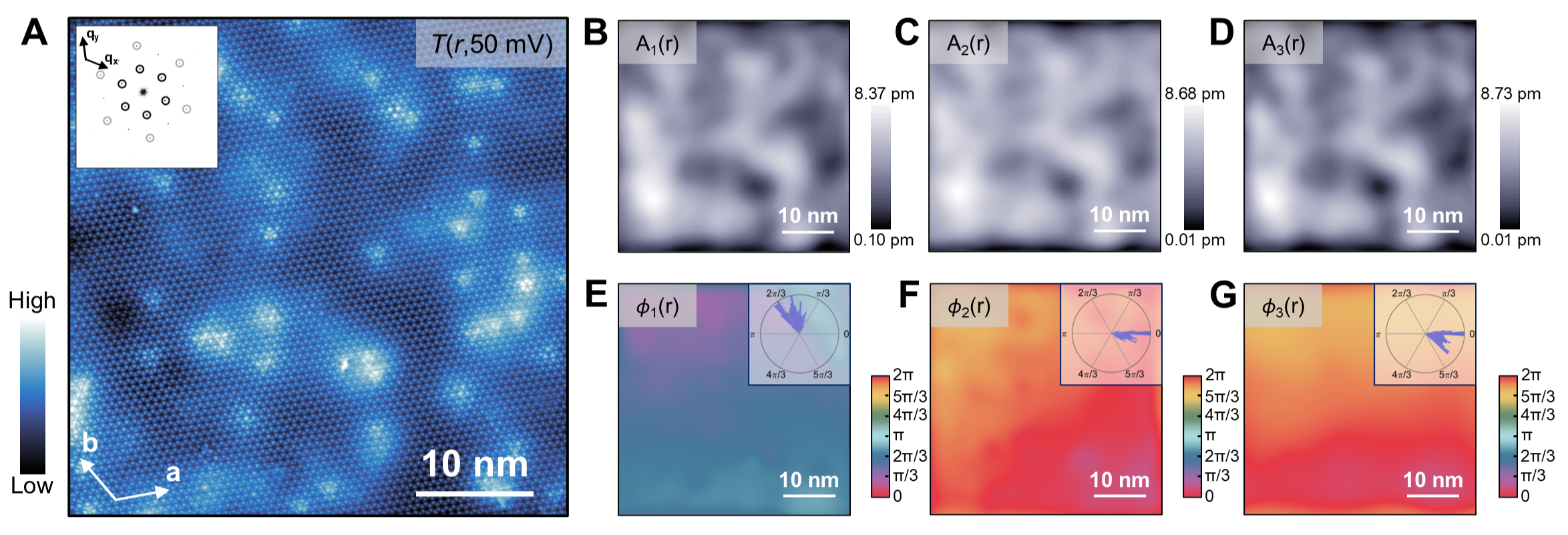
Fig 5 (page 10).
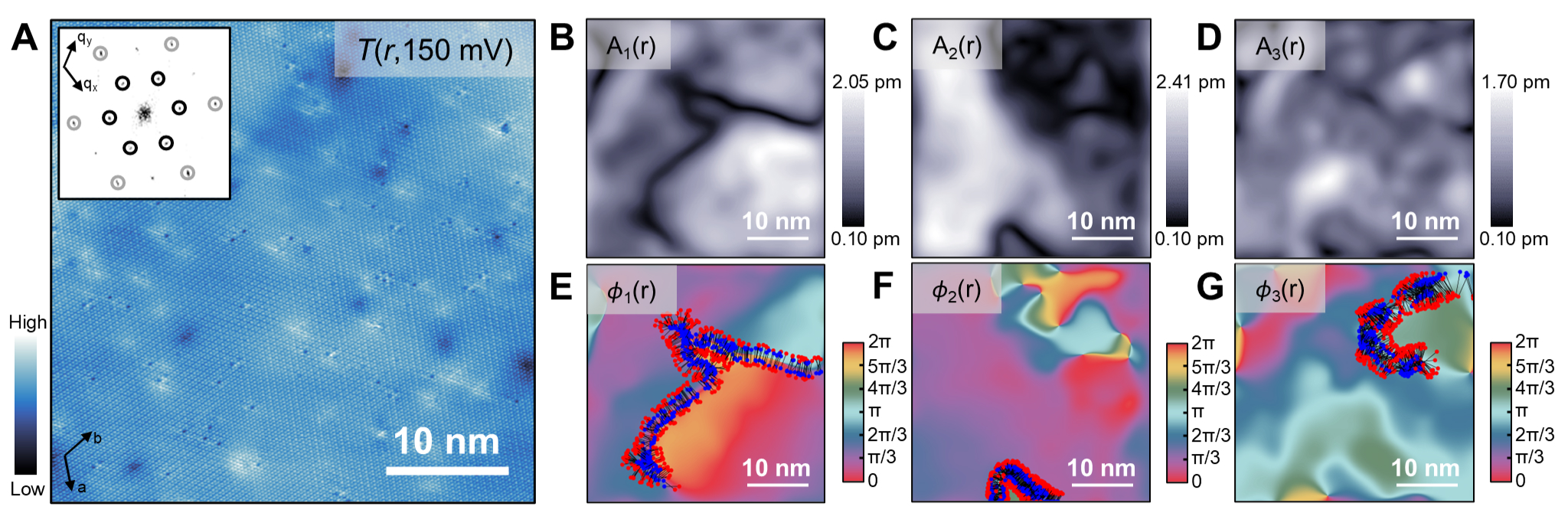
Fig 6 (page 11).
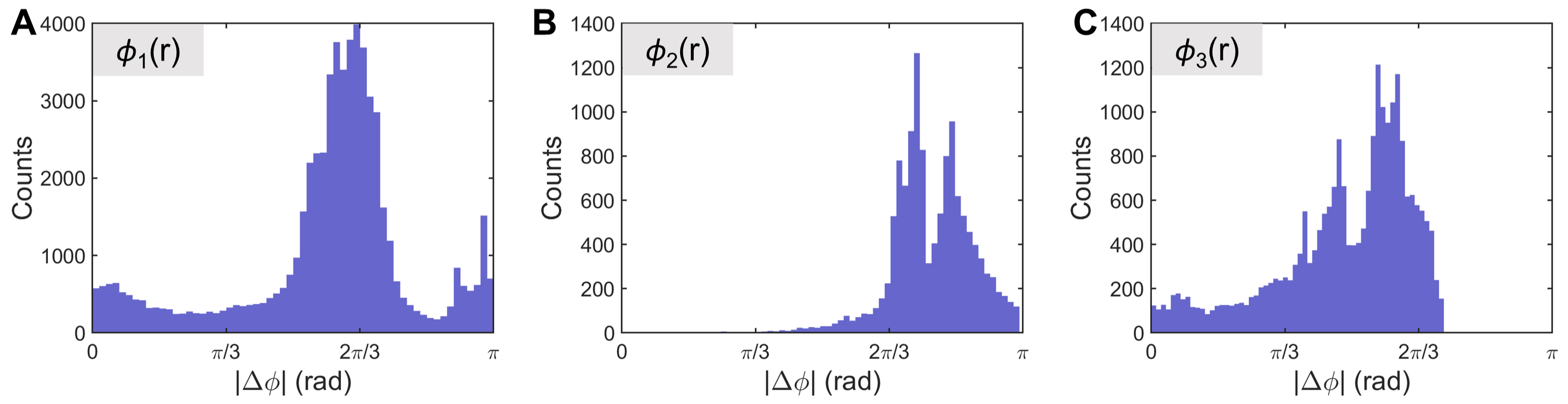
Fig 7 (page 12).
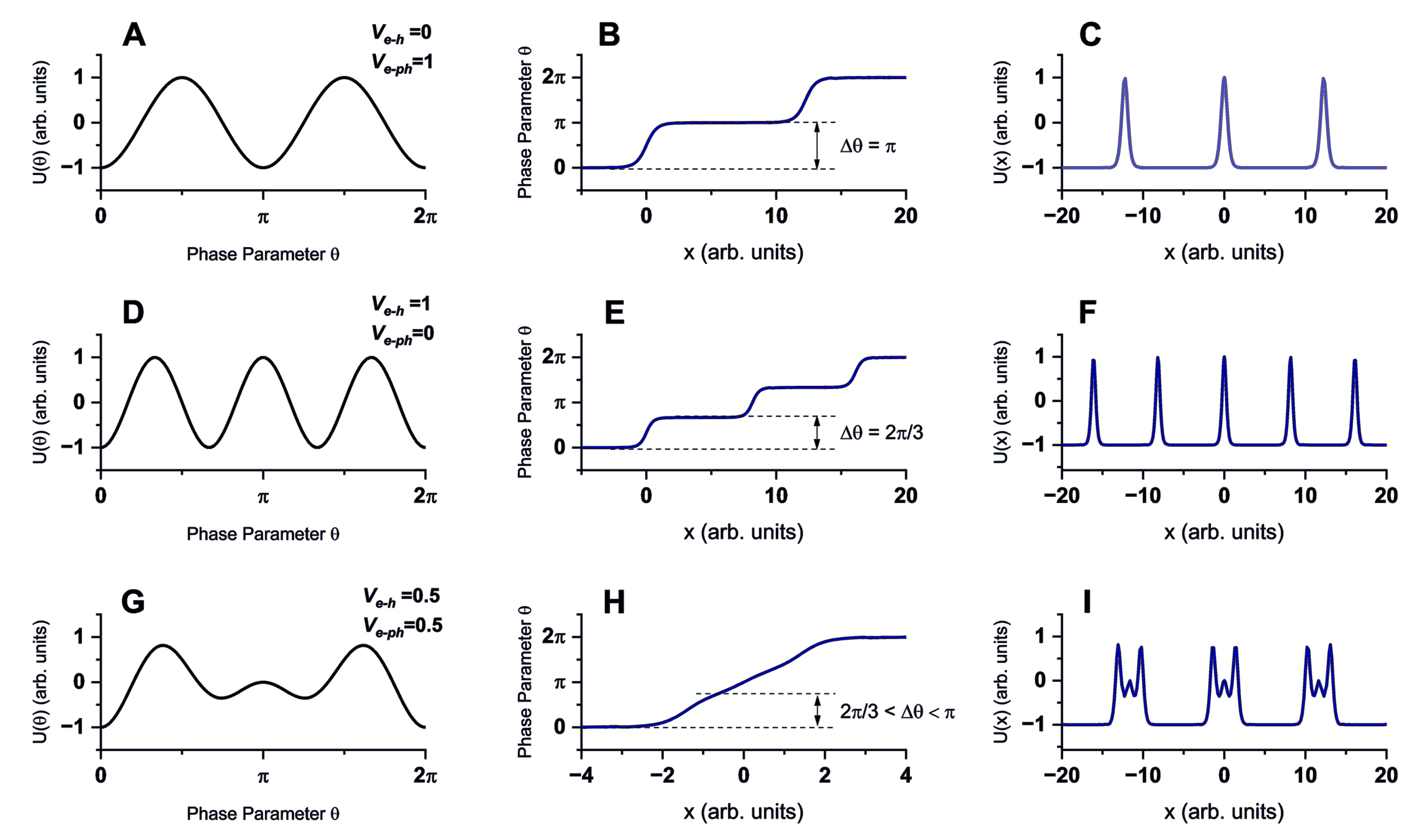
Fig 8 (page 13).
Limitations
- The free-energy model is minimal and phenomenological, lacking microscopic derivation of coupling constants Ve-ph and Ve-h from first principles.
- No direct spectroscopic measurement of Ve-ph and Ve-h strengths; tuning parameters are adjusted phenomenologically to match observed phase slips.
- Limited temperature range explored (very low temperature); possible thermal fluctuations effects on phase slips are not assessed.
- Phase imaging relies on assumption of clean sample surfaces and ideal quasi-static CDW order, potential influence of defects/strain not fully ruled out.
- Generalizability to other CDW materials beyond 1T-TiSe2 remains to be demonstrated.
- Data and code are not publicly released, requiring requests for full reproducibility.
Open questions / follow-ons
- Can the microscopic electron-phonon and electron-hole interaction strengths (Ve-ph, Ve-h) be quantitatively derived from ab initio calculations to benchmark the phenomenological parameters?
- How does temperature or external perturbations (strain, doping) influence the fractional phase slip magnitude and domain wall structure?
- Are similar fractional phase slips present in other multi-Q CDW or correlated materials, suggesting a universal phenomenon governed by multi-component coupling?
- What role do disorder, defects, or sample thickness play in modulating the coupling between CDW components and domain wall phase textures?
Why it matters for bot defense
The paper is focused on fundamental condensed matter physics of charge density waves and does not address security or bot defense topics. However, the methodological advance of two-dimensional lock-in phase analysis applied to spatially resolve multi-component electronic order parameters can inspire analogous approaches in analyzing complex patterns or states in security contexts, e.g., to characterize spatial heterogeneities or transitions in network or user behavior signals. The concept of domain walls as localized boundaries with distinct phase shifts could analogously inform detection of subtle, correlated state changes in complex multi-channel data relevant for bot detection or CAPTCHA generation schemes. Overall, this work primarily strengthens understanding of emergent order and phase competition in correlated systems rather than directly impacting CAPTCHA or bot defense engineering.
Cite
@article{arxiv2606_25963,
  title={ Fractional phase slips across the charge-density-wave domain walls in 1-T TiSe2 },
  author={ Haotian Zhang and Zihao Song and Zhongchen Xu and Jun Shu and Zhongxu Wei and Zunming Lu and Jun Liu and Zengyi Du and Jinxing Zhang and Youguo Shi and Ge He and Jun Shen },
  journal={arXiv preprint arXiv:2606.25963},
  year={ 2026 },
  url={https://arxiv.org/abs/2606.25963}
}