
FAR-LIO: Enabling High-Speed Autonomy through Fast, Accurate, and Robust LiDAR-Inertial Odometry
Source: arXiv:2606.26010 · Published 2026-06-24 · By Maximilian Leitenstern, Marcel Weinmann, Patrick Haft, Tobias Lasser, Dominik Kulmer, Markus Lienkamp
TL;DR
FAR-LIO addresses the challenge of providing fast, accurate, and robust LiDAR-inertial odometry for high-speed autonomous systems, particularly in environments exhibiting high dynamics and sensor noise such as autonomous racing. Unlike prior CPU-based LIO methods that struggle to meet low-latency and robustness requirements under extreme speeds (up to 250 km/h) and complex conditions, FAR-LIO introduces a CUDA-accelerated framework leveraging a novel voxel hashmap data structure optimized for parallel nearest-neighbor search and map updates, combined with a sparsity-aware Generalized ICP (GICP) algorithm and an Extended Kalman Filter (EKF) backend with delay compensation and upsampling of measurements.
The system achieves significantly lower odometry latency while improving accuracy across diverse datasets, including public benchmarks (KITTI, MulRan) and proprietary autonomous racing data. Evaluations show a consistent 6.9% average positional error reduction and 38.4% faster runtime compared to state-of-the-art baselines using a single parameter set across all datasets. The work demonstrates that such GPU-accelerated odometry can provide reliable and smooth pose estimation critical for fast closed-loop autonomous vehicle control in highly dynamic scenarios.
Key findings
- FAR-LIO reduces average absolute positional error (APE) by 6.9% across autonomous racing, KITTI, and MulRan datasets compared to state-of-the-art LIO methods.
- Average runtime per LiDAR frame callback is reduced by 38.4%, with FAR-LIO processing racing data concatenated from three LiDARs in 19.23 ms vs next best method at ~31 ms.
- Using a CUDA-based voxel hashmap and sparsity-aware GICP enables consistent and low-latency nearest neighbor search scaling well with point cloud density.
- FAR-LIO completes all evaluation sequences with a single parameter set, while other methods diverge or fail on at least one challenging sequence.
- Ablation studies show that delay compensation and motion undistortion modules decrease both APE and relative positional error (RPE), with sparsity-aware GICP and adaptive submap density critical for reducing drift.
- Latency above 60-100 ms in odometry processing leads to sharp degradation and divergence; FAR-LIO runtime remains well below this threshold on target hardware.
- FAR-LIO maintains robust performance under IMU noise and LiDAR distortions induced by speeds above 250 km/h, validating applicability in extreme autonomous racing conditions.
- Evaluation conducted on dSpace AUTERA Autobox with Intel Xeon D-2166NT CPU and NVIDIA RTX A5000 GPU aligns with real deployment scenarios.
Threat model
The implicit adversary is environmental and operational challenges that degrade odometry accuracy—high-speed vehicle motion causing LiDAR scan distortions, sensor noise in IMU and LiDAR, and computational delays introducing latency. The system assumes no malicious attackers but aims to robustly operate under noisy, dynamic real-world conditions with limited computational resources. It does not consider active adversarial tampering or sensor spoofing.
Methodology — deep read
Threat Model & Assumptions: This work targets autonomous robotic platforms operating in highly dynamic, unstructured environments such as race tracks and urban roads where sensor noise, high vehicle speed (up to 250 km/h), and latency critically affect localization accuracy and stability. The adversary, implicitly, is the environmental noise and rapid motion challenging accurate odometry. The system assumes access to raw LiDAR scans and synchronized IMU measurements, and a computing platform with a GPU (NVIDIA RTX A5000) suitable for CUDA acceleration. There is no assumption of loop closures or global map availability.
Data: Evaluation data consists of four heterogeneous setups across public and proprietary datasets: KITTI Odometry (Velodyne HDL-64 at 10 Hz, IMU at 10 Hz), MulRan (Ouster OS1-64 LiDAR at 10 Hz, IMU at 100 Hz), and two autonomous racing datasets (Autonomous Motorsport data from Indy Autonomous Challenge and Abu Dhabi Autonomous Racing League featuring multi-LiDAR rigs producing concatenated high-density scans at 10 or 20 Hz and high-frequency IMUs up to 800 Hz). Lengths range from 0.4 km to over 20 km per sequence. Data preprocessing includes motion undistortion using velocity estimates to correct raw LiDAR points.
Architecture / Algorithm: The core innovation is the incorporation of a CUDA-accelerated voxel hashmap (cuVoxelMap), a static hash map keyed by 3D voxel indices which stores fixed numbers of points per voxel allowing highly parallelized k-nearest neighbor (kNN) search within voxels and their 26 neighbors (27 total). This replaces incremental kd-trees or CPU-tree structures to massively speed up nearest-neighbor computations critical to GICP registration.
GICP is adapted to be sparsity-aware: points with insufficient neighbors revert to point-to-point metric while other correspondences use covariance-weighted point-to-plane metrics. Adaptive thresholding rejects outliers dynamically based on deviation from initial pose guess. Incoming LiDAR scans are registered to an adaptive, local submap (also a cuVoxelMap) that updates voxel densities depending on point density around the current pose to maintain consistent registration quality at varying ranges.
The backend is a kinematic Extended Kalman Filter (EKF) running at 100 Hz, fusing registered LiDAR poses and high-frequency IMU measurements. The filter state includes position, orientation, and velocity. IMU biases are calibrated offline during standstill. The EKF implements delay compensation using an extrapolation method projecting delayed measurements to current state, mitigating the effect of odometry processing delay. Odometry output is smoothly upsampled to provide high-rate pose estimates.
Training Regime: No learning-based training is involved; all components are algorithmic and parameter settings are fixed across datasets. The codebase releases pre-implemented CUDA kernels and uses ROS for integration and reproducibility. Hyperparameters such as voxel size (4 m), max points per voxel (40), and maximum registration time (twice LiDAR frame period) are empirically chosen based on prior literature and ablation.
Evaluation Protocol: FAR-LIO is benchmarked against four strong baselines—KISS-ICP (LiDAR only), Fast-LIO2, Faster-LIO (both Kalman filter LIOs with incremental datastructures), and D-LIO—across multiple datasets with diverse sensor setups. Metrics include RMSE of absolute positional error (APE) and relative positional error (RPE) per 100 m, with experiments run three times and best results reported. Runtime is measured per LiDAR callback including preprocessing, registration, map update, and overhead separately. Ablation studies disable components to quantify their impact. Simulated latency experiments add delay to registered poses to study robustness. Tests run on real autonomous racecar hardware (dSpace AUTERA Autobox).
Reproducibility: The authors provide open-source code at https://github.com/TUMFTM/FAR-LIO enabling reproduction. Dataset availability is mixed (public KITTI, MulRan, private racing data). Experiments use a fixed, single parameter set demonstrating transferability. The system runs embedded within ROS ensuring practical real-world integration.
Example Workflow: A raw LiDAR scan arrives at ~10-20 Hz and is motion-undistorted using recent velocity estimates from the EKF. The scan points are inserted into voxels of the adaptive local submap held in GPU memory. The sparsity-aware CUDA GICP uses the voxel hashmap to search nearest neighbors and compute covariances for matched points. It optimizes the pose iteratively within a 2-frame max time. The resulting registered pose and velocity estimate are passed to the EKF, which fuses it with asynchronous IMU measurements, compensates for delay, and outputs an updated odometry estimate at 100 Hz. This odometry is used for subsequent LiDAR undistortion and provides input to vehicle controllers.
Technical innovations
- A novel CUDA-accelerated voxel hashmap data structure enabling extremely fast, parallelized nearest-neighbor search and map updates in LiDAR scan registration.
- Sparsity-aware Generalized ICP formulation that dynamically switches between covariance-weighted and point-to-point metrics based on local point density.
- Adaptive local submap density scheme that adjusts voxel inclusion thresholds to match spatial variations in LiDAR point cloud density.
- Integration of an Extended Kalman Filter backend with a delay compensation and upsampling strategy to fuse asynchronous LiDAR poses and high-frequency IMU data for smooth, robust odometry.
- Systematic demonstration of odometry latency thresholds beyond which pose estimation diverges and runtime guarantees via GPU acceleration to stay well below these limits.
Datasets
- KITTI Odometry 00-10 — ~0.4 to 5.1 km — public
- MulRan All sequences — 4.9 to 23.4 km — public
- Autonomous Racing yas_10, yas_20, mon_20 — ~8.3 to 10.5 km — proprietary TUM Autonomous Motorsport
Baselines vs proposed
- KISS-ICP: Average APE higher, runtime slower; failed to complete racing sequences vs FAR-LIO completed all sequences with 6.9% lower APE and 38.4% faster runtime
- Fast-LIO2: Competitive accuracy on KITTI but failed some sequences; runtime 50 ms+ vs FAR-LIO ~20 ms
- Faster-LIO: Runtime comparable to FAR-LIO but with 6.9% higher positional error on average
- D-LIO: Failed some sequences, slower runtime, higher APE and RPE than FAR-LIO
Figures from the paper
Figures are reproduced from the source paper for academic discussion. Original copyright: the paper authors. See arXiv:2606.26010.
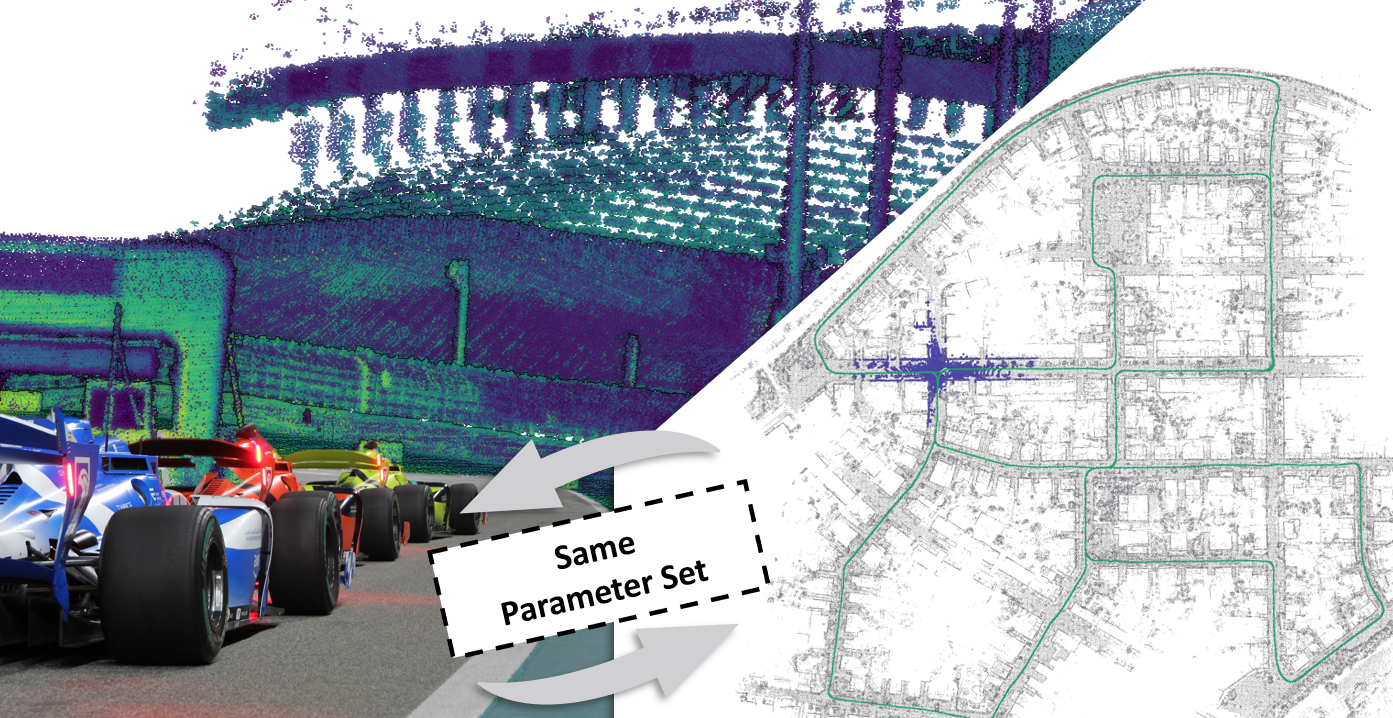
Fig 1: Point cloud maps of the Yas Marina Circuit (Abu Dhabi

Fig 2: Architecture Overview of FAR-LIO. Modules colored in blue are executed on the CPU, while those colored green are GPU-accelerated using

Fig 3: Structure of the CUDA-accelerated cuVoxelMap.
Limitations
- Evaluation on private autonomous racing datasets limits external reproducibility on those sequences.
- Reported best results from three runs possibly optimistic; no confidence intervals or statistical significance tests provided.
- Latency analysis based on simulated delays may not capture all real-world delay variabilities or asynchronous system effects.
- Robustness to adversarial attacks or sensor spoofing not evaluated—security assumptions implicit.
- EKF backend assumes fixed IMU calibration; no online bias estimation limits adaptation to sensor drift.
- High VRAM usage (~2 GB) may restrict deployment on less powerful embedded GPUs.
Open questions / follow-ons
- Can learned components or neural enhancements be integrated with the voxel hashmap to further improve robustness?
- How would FAR-LIO perform under severe sensor faults or adversarial spoofing attacks on LiDAR/IMU?
- What is the impact of asynchronous sensor frequencies and network delays in distributed multi-robot use cases?
- Could the EKF backend be extended to estimate and correct IMU biases online for longer-term deployments?
Why it matters for bot defense
For bot-defense and CAPTCHA practitioners, FAR-LIO’s techniques illustrate how GPU-accelerated data structures and algorithms can dramatically reduce latency and improve robustness in real-time state estimation under noisy and adversarially challenging conditions. The adaptive density voxel hashmap and sparsity-aware registration approach could inspire methods for fast approximate nearest neighbor searches or real-time spatial data association in CAPTCHAs involving 3D geometric challenges or behavioral biometrics in autonomous systems. Additionally, the latency and delay compensation strategies highlight the critical importance of accounting for sensor and processing delays to maintain system stability — a principle transferrable to any real-time recognition or adversarial detection pipeline.
While FAR-LIO is focused on physical sensor fusion for robotics, its core innovations around parallelized, deterministic lookup and fusion under high dynamics provide valuable insights for designing fast, robust, and scalable defenses against automated or adversarially noisy inputs in CAPTCHA or bot-detection contexts. Understanding the delicate balance between latency, accuracy, and robustness in such fused systems helps inform system designs that must operate under time constraints and noise.
Cite
@article{arxiv2606_26010,
  title={ FAR-LIO: Enabling High-Speed Autonomy through Fast, Accurate, and Robust LiDAR-Inertial Odometry },
  author={ Maximilian Leitenstern and Marcel Weinmann and Patrick Haft and Tobias Lasser and Dominik Kulmer and Markus Lienkamp },
  journal={arXiv preprint arXiv:2606.26010},
  year={ 2026 },
  url={https://arxiv.org/abs/2606.26010}
}