
A Simple Numerical Method for Non-Gaussian Signal Ensembles in Nonlinear Power Amplifiers
Source: arXiv:2606.26020 · Published 2026-06-24 · By Cameron M. Pike, Animesh Yadav
TL;DR
This paper addresses the challenge of characterizing nonlinear distortion and noise propagation through memoryless nonlinear RF power amplifiers, particularly relevant for millimeter-wave vehicular communication systems using narrow beams. Existing methods for stochastic nonlinear analysis, such as Rice's characteristic function (ch. f.) method, typically involve computationally intensive integrals and often assume Gaussian inputs. The authors propose a novel reformulation of Rice's ch. f. method by representing the nonlinearity as a Fourier series (periodic extension) instead of using Fourier transforms. This transforms the evaluation of output correlation functions into tractable summations, applicable to arbitrary input distributions including non-Gaussian noise and multiple sinusoids.
The approach retains the generality of the original method but enables efficient numerical evaluation, supporting memoryless nonlinear systems driven by stochastic processes with non-Gaussian characteristics. A concrete numerical example of a nonlinear GaN high-electron-mobility transistor (HEMT) transconductance curve under sinusoidal input and Gaussian noise validates the method, revealing the impact of input amplitude and bias voltage on output distortion and noise power. This framework thus provides a powerful analytical tool to study nonlinear front-end impairments affecting beamforming, beam tracking, and link reliability in future 5G/6G and vehicular wireless systems without resorting to costly simulations.
Key findings
- Representing nonlinearities as Fourier series of their periodic extensions reduces the complexity of output correlation calculation from multidimensional improper integrals to summations over series terms (Eq. (7), (14)).
- The output correlation function Ψ(τ) decomposes into a harmonic series of the fundamental frequency and noise exponents, allowing isolation of spectral components around input harmonics (Eq. (15)).
- Fourier series coefficients of the nonlinearity and characteristic functions of input signal and noise combine multiplicatively, accommodating arbitrary distributions (Eqs. (14)-(16)).
- Numerical evaluation with a GaN HEMT class-AB transconductance shows compression of sinusoidal output terms at large input amplitudes, with higher-order noise terms diminishing rapidly (Fig. 4).
- Bias voltage significantly affects noise power and spectral shape of the output distortion, exhibiting localized nulls as bias deviates from the transconductance peak (Fig. 5).
- The method applies beyond Gaussian noise by replacing the characteristic function accordingly, preserving analytical tractability.
- The method enables quantitative evaluation of signal-to-distortion ratio and noise contributions without heavy Monte Carlo simulations.
- The framework supports extending analysis to multiple sinusoids and non-Gaussian noise models, useful for vehicular mmWave and 6G communication system impairments.
Threat model
Not a security paper; threat model not directly applicable. The adversary context is replaced by analysis of nonlinear distortion and noise effects due to hardware impairments in RF front ends impacting communication link performance.
Methodology — deep read
The paper begins by setting a threat model (implicitly) of analyzing nonlinear distortion propagation in RF front-end devices subject to stochastic input signals composed of a sinusoid plus noise. The input signals x1(t) and x2(t) include sinusoidal components with random uniform phase θ, additive noise processes n1(t), n2(t) modeled as jointly Gaussian with zero mean and known correlation ρ(τ), plus a dc bias β.
The nonlinear memoryless device applies transfer functions f(x) and g(x), producing outputs y1(t) and y2(t). The central problem is numerically characterizing the output correlation function Ψ(τ) = E{y1(t+τ)y2(t)} accounting for nonlinearities and noise.
Step 1: The nonlinear transfer functions f(x) and g(x) are represented by their Fourier series over a periodic extension with period 2c (and 2d). This contrasts with prior reliance on Fourier transforms involving multidimensional improper integrals. The periodic extension is chosen to exactly match the nonlinear function over the input signal range and zero elsewhere to handle finite input amplitude.
Step 2: The output correlation Ψ(τ) is expressed as a double summation over Fourier series indices q and r. Expectations separate into three characteristic functions — the dc bias term, the sinusoidal signal term (with random phase), and the noise process term. The sinusoidal characteristic function is identified as a zeroth order Bessel function J0, and expanded into its harmonic components via Neumann’s addition formula.
Step 3: The noise characteristic function is derived assuming jointly Gaussian noise (but accommodating other distributions in principle). It is expanded as a Maclaurin series polynomial in correlation ρ(τ), relating the output spectrum to kth autoconvolutions of the input noise spectrum.
Step 4: Combining all terms yields the key expression (Eq. (14)) for Ψ(τ) as a summation over harmonic number n, noise polynomial order k, and Fourier series indices q,r. This expression allows isolating contributions from signal harmonics and noise powers.
Step 5: Simplifications for the single input/output and equal noise variance cases yield a clean series expansion (Eq. (15)).
Step 6: The procedure is applied to a practical example—a GaN HEMT in class-AB operation, with an input sinusoid SNR = 40 dB and bias near the Gm peak. The nonlinear transconductance curve is approximated as a polynomial periodic extension over -11V<VGS<0, with Fourier coefficients computed. The output harmonic and noise expansion coefficients hn,k are numerically evaluated across input amplitudes and bias voltages.
The evaluation highlights nonlinear compression of the sinusoid term and bias-dependent noise shaping. The method is computationally efficient and avoids costly Monte Carlo simulations.
Reproducibility: The paper does not mention code releases or publicly available datasets. The example is based on published device transconductance data adapted from [28], and standard mathematical functions (Bessel, Fourier series). The procedure is fully described with equations allowing implementation.
Technical innovations
- Reformulation of Rice's characteristic-function method by representing nonlinearities as Fourier series of periodic extensions rather than Fourier transforms, enabling simpler numerical evaluation.
- Decomposition of output correlation function into harmonic and noise polynomial expansions linking non-Gaussian inputs to output spectra.
- Integration of characteristic functions for bias, sinusoid, and noise into a unified framework accommodating arbitrary noise distributions beyond Gaussian.
- Demonstration of analytical outputs enabling the study of nonlinear RF front-end impairments without multidimensional integrals or extensive Monte Carlo simulation.
Datasets
- GaN HEMT transconductance curve — derived polynomial approximation over -11V to 0V — adapted from [28]
Baselines vs proposed
- Rice characteristic function method (original): requires evaluation of double or triple improper integrals vs. Proposed Fourier series approach: reduces to computationally efficient summations over series terms.
- Noise process with Gaussian distribution and correlation ρ(τ): higher order noise terms diminish rapidly for SNR=40 dB, validating truncation of series expansions.
- Nonlinear output compression point observed approximately at input sinusoid amplitude corresponding to 1-dB compression in Fig. 4.
Figures from the paper
Figures are reproduced from the source paper for academic discussion. Original copyright: the paper authors. See arXiv:2606.26020.
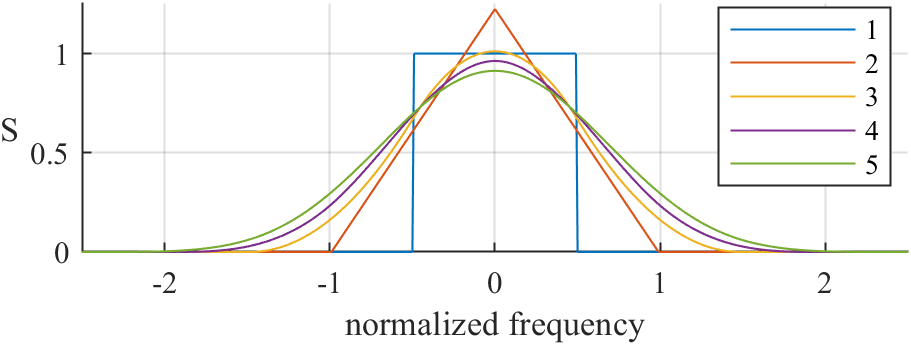
Fig 1: Spectra of the noise contributions in (15) for
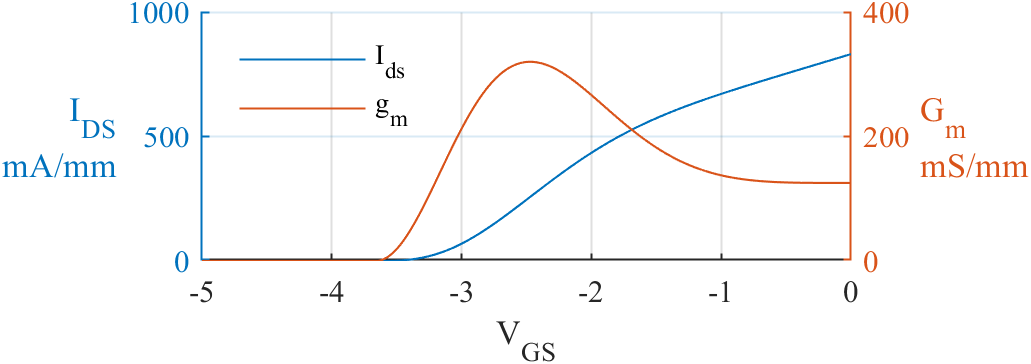
Fig 2: Nonlinear transfer function of GaN HEMT, adapted
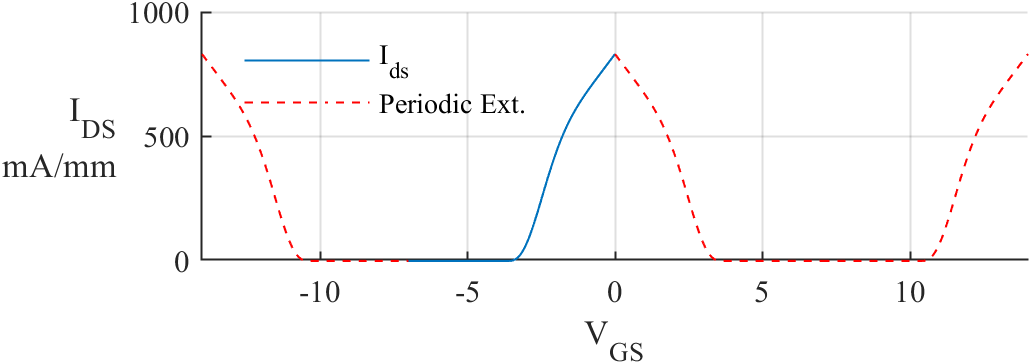
Fig 3: Periodic extension of the IDS vs. VGS curve in Fig. 2,
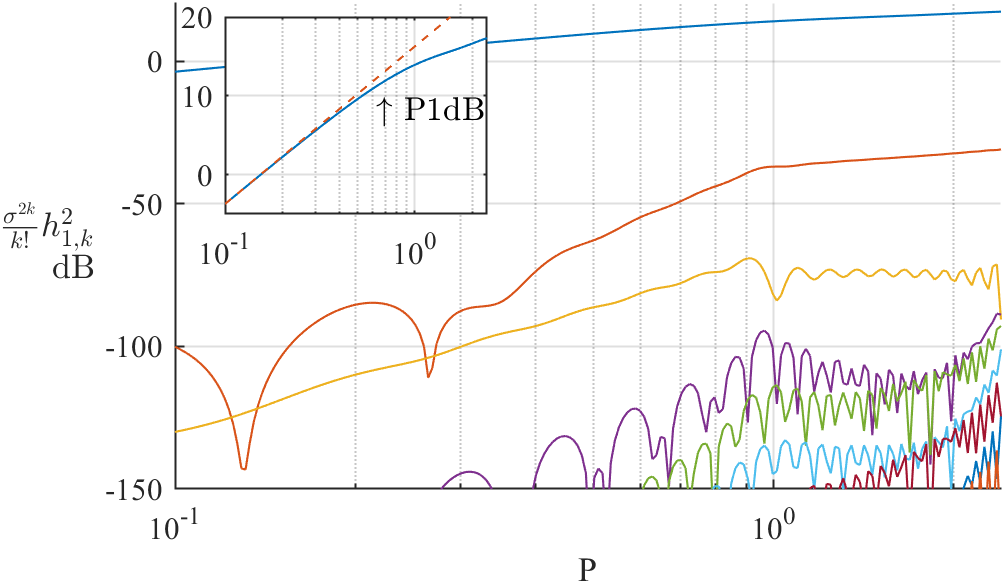
Fig 4: Expansion coefficients vs. input sinusoid amplitude P,
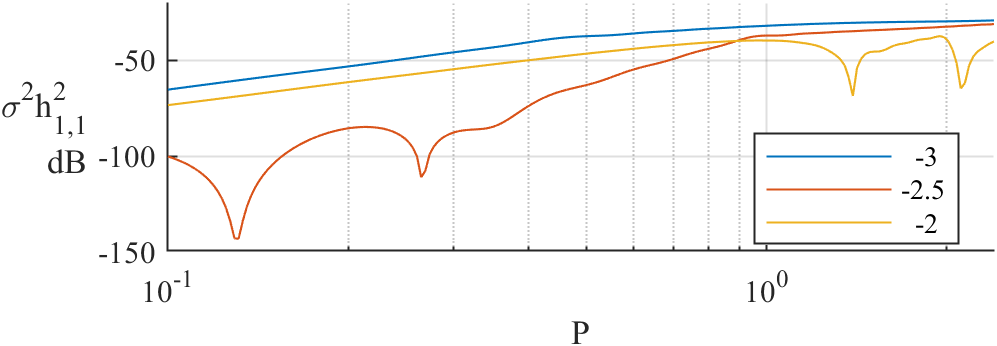
Fig 5: Expansion
Limitations
- The method assumes memoryless nonlinearities; dynamic or memory effects common in RF PAs are not modeled.
- Periodic extension of nonlinearities is an approximation; large amplitude excursions beyond periodic bounds are neglected.
- Numerical examples focus on Gaussian noise; extension to other noise distributions is noted but unvalidated empirically.
- No experimental validation of predicted noise power or distortion patterns presented; future work suggested.
- Analysis excludes modulated signals beyond single or multiple pure sinusoids; complexity may increase for realistic modulations.
- Reproducibility could be hindered by lack of publicly released code or datasets.
Open questions / follow-ons
- How to extend the Fourier series-based characteristic function approach to non-memoryless (dynamic) nonlinearities common in practical PAs?
- What is the empirical accuracy of the method when tested against measured RF front-end hardware output with realistic modulated signals and non-Gaussian noise?
- Can the framework be adapted to model and compensate nonlinear distortion within receiver algorithms beyond beamforming, such as likelihood-based detection for modulated data?
- How do non-Gaussian noise models affect distortion patterns and impact system performance metrics when integrated into this framework?
Why it matters for bot defense
From a bot-defense or CAPTCHA perspective, this work informs the broader understanding of how analog front-end nonlinearities shape signal distortion and noise characteristics in complex communication channels, particularly millimeter-wave vehicular systems. Although the immediate focus is not on bot detection, the framework provides a rigorous analytical tool to quantify non-Gaussian distortions that could affect channel estimation, beam tracking, and waveform integrity.
For CAPTCHA engineers working on radio-frequency or physical-layer bot-detection (e.g., PHY-layer fingerprinting or anomaly detection), understanding how nonlinear PA impairments distort signal statistics beyond Gaussian noise assumptions is valuable. The Fourier series characteristic function method offers a tractable analytic way to model and predict distorted output statistics, which can guide the design of more robust detection metrics or distortion-aware preprocessing. This could assist in distinguishing legitimate devices from spoofed or bot-generated signals in high-frequency, high-mobility scenarios.
However, applying this method directly to CAPTCHA or bot-detection requires augmenting the framework with real-world modulation, time-varying channels, and adversarial signal manipulation models — which remain to be explored.
Cite
@article{arxiv2606_26020,
  title={ A Simple Numerical Method for Non-Gaussian Signal Ensembles in Nonlinear Power Amplifiers },
  author={ Cameron M. Pike and Animesh Yadav },
  journal={arXiv preprint arXiv:2606.26020},
  year={ 2026 },
  url={https://arxiv.org/abs/2606.26020}
}