
Resolving support-mismatch by local basis rotation in variational Monte Carlo
Source: arXiv:2606.23657 · Published 2026-06-22 · By Jia-Lin Chen, Zhen Fan, Canhui Yan, Yantao Wu, Tao Xiang
TL;DR
Variational Monte Carlo (VMC) methods are widely used to simulate quantum many-body dynamics, but real-time evolution following a local quench by a charged operator suffers from a severe ‘‘support mismatch’’ problem. This occurs because the projective action of the charged operator annihilates an exponentially large subset of basis configurations, assigning them zero probability under standard Monte Carlo sampling. These missing configurations still influence dynamics, so their zero sampling weight biases estimators and causes the time evolution to freeze from the first step onward. This work identifies that this support mismatch is not fundamental to the quantum state but an artifact of the chosen computational basis. The authors introduce a novel local basis-rotation sampling scheme that locally rotates the sampling basis on the quench site and supplements it with a parameter-independent helper state in a symmetry sector orthogonal to the physical state. This recovers the lost sampling support without changing the underlying variational dynamics or estimators.
The paper thoroughly demonstrates that this rotation sampling approach resolves the support mismatch both analytically with a toy two-site example and numerically for larger systems. Benchmarks include accurate simulation of real-time local-quench dynamics and corresponding dynamical structure factors (DSFs) in 1D spin-1/2 XY and Heisenberg models using time-dependent variational Monte Carlo (tVMC) with matrix product states. The approach also enables previously impossible unbiased local-operator quench simulations in 2D using projected tVMC. Furthermore, rotation sampling accelerates ground-state optimization in challenging frustrated spin models by mitigating sign-structure related sampling issues. Overall, the method opens the door to accurate and scalable variational simulations of spectral functions and quench dynamics in systems with Abelian symmetries.
Key findings
- Standard tVMC fails for a two-site XY model local quench due to force component estimator F1 vanishing from zero sampling weight on contributing configurations (Fig.1(a)).
- Basis rotation with a one-site unitary removes zero amplitude configurations and restores finite sampling weight, enabling the correct force and evolution (Fig.1(b)).
- In a 4×4 periodic square-lattice XY model local quench, standard tVMC freezes at initial magnetization while rotation sampling (rot-tVMC) tracks exact dynamics up to t=10 (Fig.2).
- In a N=64 periodic XY chain local quench, rot-tVMC with D=16 periodic MPS accurately reproduces ballistic spin wavefront propagation, local magnetization dynamics at sites i=0,16, and dynamical structure factors matching exact results at multiple momenta and times up to t=40 (Figs.3).
- For the frustrated N=64 periodic Heisenberg chain, rot-tVMC recovers dynamical structure factor S-+(k, w) closely matching algebraic Bethe ansatz (ABACUS) results, including two-spinon continuum boundaries and sum rules (Figs.4,5).
- Standard projected tVMC (p-tVMC) with local linear product expansion (LPE) suffers from frozen magnetization in a 4×4 XY lattice local quench, whereas rotation sampling enhanced rot-p-tVMC follows the exact result (Fig.6).
- Rot-p-tVMC simulates local-operator quench dynamics on an 8×8 periodic square lattice XY model capturing ballistic diamond-shaped wavefront propagation with low energy drift (<1‰) and average infidelity <6×10⁻⁶ (Fig.7).
- Ground-state energy optimization of the frustrated 4×4 J1-J2 model with stochastic reconfiguration (SR) stagnates, but switching to rotation sampling enhanced rotSR after step 1000 resumes rapid energy decrease and improves the sign match to near 100% (Fig.8).
Threat model
The adversary is the structural zeroes in the Monte Carlo sampling distribution induced by charged local operators acting on the variational quantum state, which annihilate physically relevant basis configurations and cause biased estimator calculation. The adversary cannot alter the underlying quantum state or Hamiltonian dynamics but prevents unbiased sampling and therefore corrupts the variational time evolution. The solution treats this as a computational obstacle arising from fixed basis choice rather than an external malicious adversary.
Methodology — deep read
Threat Model & Assumptions: The adversary is conceptualized as the incompatibility between the physically relevant Hilbert space configurations contributing to the dynamics post-local quench and the Monte Carlo sampling distribution limited by the chosen computational basis. The key assumption is that charged local operators (e.g. spin raising operator S+) impose local constraints forcing zero amplitude on certain basis configurations, creating a support mismatch that prevents unbiased Monte Carlo estimation. The method does not assume adversarial attacks but addresses structural sampling failure inherent in standard VMC.
Data: Datasets include various spin-1/2 quantum lattice models: two-site XY toy model, 4×4 and 8×8 periodic square-lattice XY models, N=64 periodic spin-1/2 XY chain, and N=64 periodic Heisenberg chain. Data are generated via exact diagonalization, algebraic Bethe ansatz (ABACUS), and variational methods with restricted Boltzmann machine (RBM) or periodic matrix product state (MPS) ansatzes. System sizes range from 2 to 64 sites for 1D chains and up to 64 sites in 2D lattices. Training data consists of sampled quantum states with labels given implicitly by basis configurations; the focus is on sampling distribution correctness and dynamics reconstruction.
Architecture / Algorithm: The core technical innovation is rotation sampling, which introduces a local unitary rotation U acting on the quench site to rotate the sampling basis. This rotation mixes zero-amplitude configurations with finite ones. Since U is often non-Sz_tot-conserving (breaking symmetry), an auxiliary parameter-independent helper state |ψh⟩ from an orthogonal symmetry sector is added to augment the physical variational state |ψ⟩. The augmented state |Ψ⟩=|ψ⟩+ch|ψh⟩ is sampled in the rotated representation |˜Ψ⟩=U|Ψ⟩. This restores sampling weight to previously inaccessible configurations. The underlying Hamiltonian is also rotated ˜H=UHU† to maintain consistency. Variational updates use time-dependent VMC (tVMC) or projected tVMC (p-tVMC) frameworks, with restricted Boltzmann machine (RBM) and periodic matrix product state (MPS) ansatzes as variational wavefunctions.
Training Regime: Time evolution simulations run up to tmax=40 with discretized time steps appropriate for stable TDVP integration. RBM ansatzes use hidden-unit density α=4 or 8 with stochastic optimization of thousands of parameters. Periodic MPS ansatzes have bond dimension D=16. Projected tVMC (p-tVMC) uses a third-order linear product expansion (LPE) with typically 50 optimization steps per substage. Ground-state optimizations perform stochastic reconfiguration (SR) with and without rotation sampling (rotSR) over thousands of optimization steps (e.g. 5000) applying random two-site unitaries that conserve Sz_tot to each bond sequentially.
Evaluation Protocol: Benchmarks compare rotation sampling methods against exact diagonalization references for small systems, algebraic Bethe ansatz data (ABACUS) for the Heisenberg model, and exact MPS results for XY chains. Metrics include site-resolved magnetization Sz_i(t), dynamical structure factors S^{-+}(k, ω) obtained via Fourier transforms of unequal-time correlators, spectral sum rules (first moment M1(k)), energy conservation and infidelity during dynamics, and ground-state energy and sign fidelity during optimization. Comparisons include standard tVMC vs rot-tVMC, standard p-tVMC vs rot-p-tVMC, and SR vs rotSR. Stability and freezing are assessed via observable freezing and relative energy drift.
Reproducibility: The authors indicate plans to publicly release their implementation built atop NetKet and ptvmc-systematic-study libraries after publication. Datasets are generated within simulations and not externally provided. Exact references from ABACUS and MPS are established open methods. Appendix A details mathematical derivations of the rotation sampling scheme. Experimental results are reproducible given access to these codebases and parameter settings.
Concrete Example: For the two-site XY model, initial state |↑↓⟩ has zero amplitude on |↓↑⟩, which is critical for the force calculation. Standard tVMC sampling excludes |↓↑⟩, estimating force F1=0 instead of correct F1=−1/2, freezing evolution. Applying a one-site Hadamard-like rotation U mixes |↑↓⟩ and |↓↑⟩, equalizing amplitudes and restoring support to |↓↑⟩ in the rotated basis. Monte Carlo samples from the rotated state correctly estimate the force, enabling faithful evolution. This minimal example illustrates how a local basis rotation removes support mismatch and fixes dynamical freezing.
Technical innovations
- Identification of local support mismatch induced by charged local-operator quenches as a basis-dependent sampling artifact in real-time variational Monte Carlo.
- Introduction of a local basis-rotation sampling scheme applying a one-site unitary rotation at the quench site combined with a parameter-independent helper state in an orthogonal symmetry sector to restore missing sampling support without altering physical dynamics.
- Extension of the rotation sampling method to projected time-dependent variational Monte Carlo (p-tVMC), enabling stable and unbiased 2D local-quench simulations.
- Application of stochastic reconfiguration augmented with random two-site local basis rotations (rotSR) to accelerate and stabilize ground-state optimization by mitigating amplitude sign-structure induced sampling zeroes.
Datasets
- Two-site XY model — 2 spins — simulated for analytical illustration
- 4×4 periodic square lattice XY model — 16 spins — simulated numerically with RBM ansatz
- 8×8 periodic square lattice XY model — 64 spins — numerically simulated with RBM
- N=64 periodic spin-1/2 XY chain — 64 spins — numerically simulated with periodic MPS
- N=64 periodic spin-1/2 Heisenberg chain — 64 spins — benchmarked against algebraic Bethe ansatz (ABACUS)
Baselines vs proposed
- Standard tVMC: quench-site magnetization freezes at initial value vs rot-tVMC follows exact dynamics up to t=10 (4×4 XY lattice)
- Standard p-tVMC: quench-site magnetization pinned at initial value vs rot-p-tVMC follows exact reference (4×4 XY lattice local quench)
- tVMC dynamical structure factor vs exact solution: rot-tVMC reproduces peak positions and spectral weight distributions in XY and Heisenberg chains up to t=40
- Ground-state optimization: SR energy stagnates, rotSR resumes rapid decrease approaching exact ground state and improves sign match to ~100% (4×4 J1-J2 model)
Figures from the paper
Figures are reproduced from the source paper for academic discussion. Original copyright: the paper authors. See arXiv:2606.23657.

Fig 3: Local-operator-quench dynamics and dynamical structure factor of the N = 64 periodic XY chain. (a) Space–time
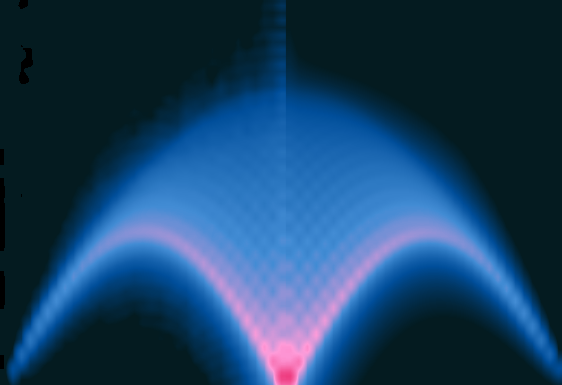
Fig 4: Dynamical structure factor S−+(k, ω) of the N = 64

Fig 7: Local-operator-quench dynamics of the 8 × 8 periodic square-lattice XY model. (a) Relative energy drift ∆E/|E|. The

Fig 8: compares the two optimization methods for

Fig 6: shows this issue for a standard p-

Fig 6 (page 6).

Fig 7 (page 6).

Fig 8 (page 6).
Limitations
- Rotation sampling requires adding a helper state and local unitary rotations, which increase computational cost by a small factor related to connected basis configurations.
- The method as presented is focused on spin-1/2 lattice systems with U(1) symmetries; generalization to other symmetries or higher spins may require adaptation.
- The choice of the helper state and rotation is heuristic; optimal or adaptive choices to minimize variance remain unexplored.
- Benchmarks do not evaluate robustness under distribution shifts or non-Abelian symmetry groups or strongly disordered systems.
- Validation is limited to relatively small system sizes (up to 64 spins); scalability to larger or more entangled systems is not demonstrated.
- The technique addresses sampling zero amplitudes from local operator quenches but may not fully resolve sign problems or support mismatch in global quenches or measurement-induced dynamics.
Open questions / follow-ons
- Can adaptive or optimized local basis rotations be devised to systematically minimize sampling variance and improve convergence speed beyond heuristic fixed rotations?
- How does rotation sampling perform in systems with non-Abelian symmetries or beyond Abelian U(1) conserved sectors?
- Can the helper state approach be generalized to more complex auxiliary sectors or entangled helper states to further enhance sampling support?
- Could rotation sampling principles be integrated into quantum variational algorithms directly implementable on quantum hardware, leveraging native basis rotations?
Why it matters for bot defense
Bot-defense engineers rarely deal directly with quantum Monte Carlo dynamics, but the key insight—that sampling bias can arise from zero-probability configurations directly induced by local conditions and that changing the sampling representation can restore unbiased estimation—is broadly applicable. In CAPTCHA security or bot detection, this mirrors challenges where certain event spaces or behavioral patterns are inherently unsampled due to representational choices or measurement strategies, biasing detection algorithms. The concept of augmenting sampling with a rotated or transformed basis to recover missing support without altering the underlying system behavior can inspire novel defenses against bot evasion or adversarial inputs that strategically exploit sampling or measurement blind spots. Moreover, the use of helper states or auxiliary data channels to enrich sampling coverage could analogously improve robustness of stochastic detection models. Practitioners should consider how measurement or data representation constrains sampling support in their systems and whether basis transformations can mitigate sampling bias in dynamic or adversarial environments.
Cite
@article{arxiv2606_23657,
  title={ Resolving support-mismatch by local basis rotation in variational Monte Carlo },
  author={ Jia-Lin Chen and Zhen Fan and Canhui Yan and Yantao Wu and Tao Xiang },
  journal={arXiv preprint arXiv:2606.23657},
  year={ 2026 },
  url={https://arxiv.org/abs/2606.23657}
}