
Quantum-Resilient Decentralized AI Economies: Proof-of-Useful-Work and Post-Quantum Security
Source: arXiv:2606.24942 · Published 2026-06-22 · By Connor Barbaccia, Sudip Vhaduri, Sayanton Dibbo
TL;DR
This paper addresses inefficiencies and security limitations of classical proof-of-work (PoW) blockchains, which consume vast energy producing hash puzzles with no external utility and face emerging post-quantum attack threats. Instead, the authors propose a decentralized AI economy that replaces the traditional PoW task with "proof-of-useful-work" (PoUW) rooted in machine learning computations—specifically inference and training. They introduce a three-layer architecture separating compute, validation, and economic coordination layers, and formalize a closed-loop token economy to align incentives for honest participation. The quantum-resilience analysis shows that while Grover's algorithm provides only quadratic speedup against hash puzzles, it does not accelerate ML-native linear algebra computations. Meanwhile, vulnerabilities from Shor’s algorithm breaking classical signatures can be mitigated by post-quantum cryptographic schemes. Thus, useful-work consensus offers both economic value and structural quantum security advantages over classical PoW consensus. The paper also rigorously analyzes incentive compatibility, validation approaches, and incentive thresholds for honest work, and contrasts inference versus training work demands. While practical zkML proofs remain expensive, layered verification combining cryptographic proofs with reputations and benchmark injection provides a scalable alternative. Overall, this framework bridges AI workload coordination with quantum-resilient blockchain consensus and closed-loop tokenomics.
Key findings
- The proposed three-layer decentralized AI architecture consists of compute nodes (performing inference/training), validation nodes (verifying correctness by zkML proofs, peer review, benchmark injection, reputation), and economic coordination (linking validated work to token rewards).
- Definition 1 formalizes a (θc, θw, W)-closed-loop token economy where at least 75% of node compensation Cτ(t) and new token issuance Iw(t) is linked to validated useful work over a 90-day window, ensuring token value aligns with real AI service demand.
- Proposition 1 derives a sufficient stake condition for honest participation: S ≥ (β(cH − cL) − α(qH − qL)) / (γ p), balancing compute cost, quality gap, slashing fraction γ, and challenge detection probability p.
- Grover’s quantum algorithm provides only a quadratic speedup against hash-puzzle PoW but does not accelerate ML-native linear algebra tasks such as forward inference passes or gradient updates.
- Shor’s algorithm threatens classical blockchain signature schemes (ECDSA, ECDH) but can be mitigated by migrating to NIST-standardized post-quantum schemes such as CRYSTALS-Dilithium and SPHINCS+ for transactions and STARKs for validation proofs.
- Table 4 shows existing decentralized AI systems (Bittensor, Gensyn, Akash, opML, zkML) lack a fully closed-loop token economy combining inference, training, and economic coordination.
- Verification cost trade-offs exist: zkML proofs give strong cryptographic guarantees but remain computationally expensive for large models, thus hybrid verification combining zkML with statistical reputation and benchmark injections is recommended.
- A decentralized AI economy replacing hash puzzles with ML computations structurally avoids Grover-style preimage search quantum attacks at the work layer, offering inherent quantum resilience beyond classical PoW.
Threat model
The adversary is a polynomial-time quantum-capable attacker controlling fewer than one-third of validator stake, able to attempt forging transactions via Shor's algorithm or use Grover's algorithm to accelerate unstructured search. Compute nodes act rationally, potentially deviating if profitable, but the incentive design, slashing, and validation mechanisms aim to make honest participation individually rational. The adversary cannot break post-quantum cryptographic primitives, nor evade the layered validation combining zkML proofs, peer review, and benchmark injections.
Methodology — deep read
Threat Model and Assumptions: The authors assume a partially synchronous blockchain network with Byzantine adversaries controlling less than one-third of validator stake, following standard BFT consensus assumptions. Compute nodes behave rationally, meaning they follow the protocol if it is their best response economically. Adversaries are polynomial-time quantum-capable attackers able to leverage Grover’s and Shor’s algorithms but cannot break verification soundness assuming post-quantum cryptography is adopted at the transaction layer. The public model registry prevents model-identity spoofing.
Data and Workloads: The system targets AI tasks—two main types: inference (stateless, low-latency mapping input x to output y via model parameters θ) and training (stateful gradient updates involving large bandwidth and synchronization). The architectural design highlights the differing demands and attack surfaces. No specific dataset is used; instead, the analysis is workload-agnostic regarding model or task specifics.
Architecture and Algorithms: The core innovation is the three-layer architecture: compute nodes perform ML tasks, validation nodes check correctness using a hybrid approach combining zkML proofs (zero-knowledge proofs over ML inference), peer rankings (reputation and majority vote among replicas), benchmark injections (hidden known inputs to detect shortcuts), and reputation weighting. The economic layer closes the token cycle by linking user payments, token issuance, and node rewards through a single native token τ forming a (θc, θw, W)-closed-loop economy (Definition 1).
The reward function (Equation 2) balances protocol reward rate per unit quality α, compute cost proxy C(y), and slashing penalties P(y, x) staked by nodes. Honest participation is incentivized by requiring the staked bond S to exceed a threshold factoring in quality differences and verification strength (Proposition 1).
Training regime: As this is a systems and theoretical framework paper, no concrete training experiments or epochs are run. Instead, the training discussion focuses on decentralized challenges—high communication cost, synchronization bottlenecks, and Byzantine-resilient aggregation methods (Krum, trimmed mean) for robust gradient updates. Optimization techniques such as DiLoCo and SWARM for communication efficiency are noted.
Evaluation Protocol: The authors do not provide empirical benchmarks but perform a layered quantum threat analysis. Transaction signatures are vulnerable to Shor’s attacks; migrating to NIST post-quantum signatures (CRYSTALS-Dilithium, SPHINCS+) is recommended. Hash-based PoW puzzles face Grover’s quadratic speedup, but ML computations do not exhibit unstructured search properties exploitable by Grover’s algorithm, offering structural quantum resilience. Table 3 summarizes risk and mitigations per architectural layer. Verification soundness and incentive proofs rely on standard BFT assumptions and formal propositions.
Reproducibility: No code release or dataset is provided as this is a theoretical research contribution focused on architectural design, formal tokenomic definitions, and cryptographic threat models. Future work calls for formal post-quantum security proofs for ML-work consensus.
Example walk-through: A compute node performing an inference task applies model fθ on input x producing y, which is submitted to validators. Validators combine zkML proofs, benchmark injection checks, and peer rankings to compute quality score Q(y, x) and verify compute cost C(y). Based on these, node reward is computed per Equation 2, and token payments are issued only if quality thresholds meet honest-effort conditions. Continuous user payments paying in token τ fund new token issuance, satisfying closed-loop economy conditions θc and θw over window W.
Technical innovations
- Formalization of a (θc, θw, W)-closed-loop token economy ensuring token value aligns with validated AI service demand over a rolling window, closing economic incentive loops.
- Three-layer decentralized AI architecture separating compute, validation (combining zkML proofs, peer rankings, benchmark injection), and economic coordination, addressing scalability and trust in ML workloads.
- A sufficient stake condition (Proposition 1) deriving minimum bond requirements balancing verification strength, quality gaps, compute costs, and slashing penalties to incentivize honest ML work in the network.
- Architectural quantum-resilience analysis showing ML-native linear algebra workloads structurally evade Grover-based quadratic speedups, unlike classical hash puzzle PoW.
- Layer-wise recommendations for post-quantum cryptography adoption at transaction (ML-DSA, SLH-DSA) and validation layers (STARK-based proofs) to mitigate Shor’s algorithm threats.
Baselines vs proposed
- Bitcoin PoW hash puzzle: Effective security reduced from 2^256 classical to ~2^128 quantum by Grover vs proposed ML-work consensus: no Grover acceleration as ML matrices lack unstructured search structure.
- Bittensor: partially closed-loop token economy vs proposed system: strictly closed-loop under (θc=0.75, θw=0.75, W=90d) conditions.
- zkML cryptographic verification: high prover overhead for large models vs proposed hybrid validation combining zkML, peer review, and benchmark injection to balance correctness and cost.
Figures from the paper
Figures are reproduced from the source paper for academic discussion. Original copyright: the paper authors. See arXiv:2606.24942.
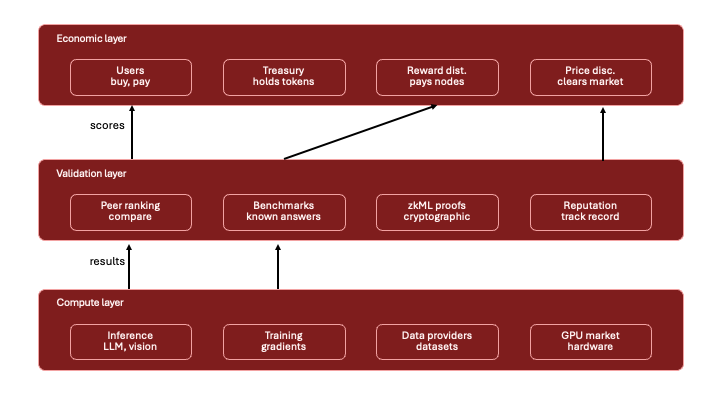
Fig 2: Three-layer reference architecture for a decentralized AI economy. Compute
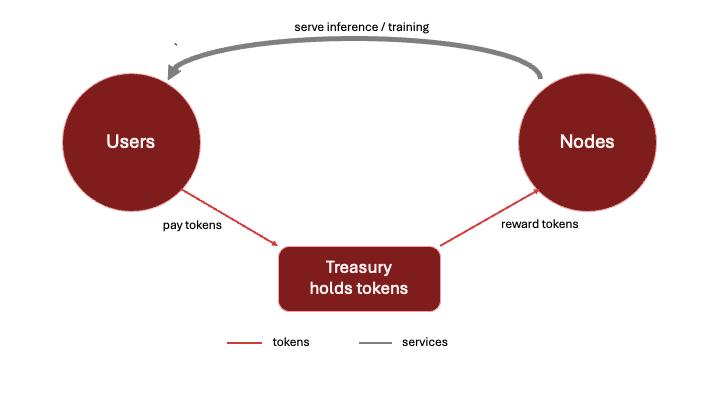
Fig 3: Closed-loop token economy: users pay tokens into the treasury, which rewards
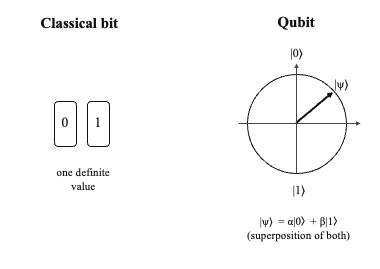
Fig 4: Classical bit versus qubit. A classical bit is fixed at 0 or 1; a qubit occupies
Limitations
- The quantum-resilience argument for ML-work is architectural and informal, lacking a formal cryptographic security proof or quantum security game model for ML-consensus.
- zkML proofs remain computationally expensive for large models, limiting practical scalability of fully cryptographic validation.
- No empirical benchmarks or deployed prototype are presented; validation, incentives, and network dynamics remain theoretical.
- The threat model assumes < 1/3 Byzantine validator stake and rational compute participants, but real-world adversaries may behave differently or coordinate more strongly.
- Token economy thresholds θc, θw, and window W are arbitrary defaults and not empirically tuned; economic dynamics under varying demand or speculation remain unexplored.
- Training coordination remains a complex open challenge especially regarding synchronization cost, Byzantine-resilient aggregation, and incentive alignment for convergence.
Open questions / follow-ons
- Can a formal post-quantum security game and cryptographic proof framework be developed for ML-based proof-of-useful-work consensus?
- How to reduce zkML prover costs to practical levels for large-scale, real-time ML inference in decentralized networks?
- How to integrate decentralized training methods with communication-efficient protocols and Byzantine-tolerant aggregation while maintaining incentive compatibility and convergence guarantees?
- What governance, data provenance, model ownership, privacy, and adversarial robustness mechanisms are necessary for wide-scale trust and adoption of decentralized AI economies?
Why it matters for bot defense
From a bot-defense and CAPTCHA engineering perspective, this work provides foundational insights for integrating computational proof systems that generate externally useful work into decentralized consensus, rather than wasteful puzzles. The layered validation approach—combining cryptographic proofs with reputation and ground-truth benchmarks—suggests hybrid verification schemes optimized for different security and cost tradeoffs, which is relevant when verifying human versus bot interaction workloads at scale. Additionally, the quantum resilience analysis indicates that moving beyond hash puzzles to computations that inherently resist quantum acceleration could future-proof proof mechanisms against emerging quantum threats. While the tokenomic formalization is outside the direct scope of CAPTCHA design, aligning economic incentives with verified human-computation or AI tasks may be a promising direction for designing next-generation robust bot defenses integrated with decentralized identity or reputational networks.
Cite
@article{arxiv2606_24942,
  title={ Quantum-Resilient Decentralized AI Economies: Proof-of-Useful-Work and Post-Quantum Security },
  author={ Connor Barbaccia and Sudip Vhaduri and Sayanton Dibbo },
  journal={arXiv preprint arXiv:2606.24942},
  year={ 2026 },
  url={https://arxiv.org/abs/2606.24942}
}