
Farmer Connect: Improving Farmers' Access to Produce Markets
Source: arXiv:2606.20465 · Published 2026-06-18 · By Micheal Amanya, Darius Kainamura, Christine Namatovu, Lailah Kobugabe, Solomon Buwule Fortune, Adones Rukundo
TL;DR
This paper addresses the persistent market access challenges faced by smallholder maize farmers in Uganda, including weak bargaining power, low price transparency, reliance on intermediaries, poor produce coordination, delayed payments, and opaque cooperative governance. To overcome these issues, the authors design and implement Farmer Connect, a cooperative-centered digital platform that integrates farmer group management, produce contribution recording and verification, marketplace listing with FIFO-based allocation, transparent earnings tracking, mobile money payment support, and notification services. The system supports four roles—administrators, supervisors, farmers, and customers—and is accessible via a mobile-first architecture with cloud backend and an administrative web dashboard. Functional evaluation indicates approximately 85% of identified user requirements are met, supporting key workflows necessary for collective maize marketing and cooperative coordination.
Farmer Connect’s organizational focus on grouped farmers rather than individuals aims to improve collective bargaining power and reduce reliance on intermediaries. By enabling supervisors to verify produce quality and using automated FIFO stock allocation, the platform seeks to strengthen produce traceability, fairness, and reduce post-harvest losses. Integrated mobile money payments and SMS notifications improve transparency and timeliness of payments, addressing long-standing trust issues among cooperative members. Overall, the system offers a practical digital framework for enhancing market participation, transparency, coordination, and financial inclusion among smallholder maize farmers in Uganda.
Key findings
- Approximately 85% of identified user requirements were functionally implemented in the Farmer Connect platform.
- Platform supports four distinct user roles with tailored functionalities: administrators (governance), supervisors (produce verification), farmers (contribution and earnings tracking), and customers (marketplace ordering).
- Implemented FIFO produce allocation prioritizes oldest verified contributions to promote fairness and reduce spoilage risk.
- Mobile money integration enables advance payments and reconciled final settlements, improving payment timeliness and transparency.
- SMS notifications extend platform visibility to farmers without smartphones, supporting inclusion despite varied device ownership.
- Cooperative-based grouping enabled collective produce aggregation and direct buyer access, aiming to reduce middleman exploitation.
- Supervisors can capture photographic evidence and assign quality grades (A, B, C) to contributions before marketplace listing, enhancing quality assurance.
- Administrative dashboard provides real-time cooperative oversight, transaction monitoring, and performance reporting to strengthen governance.
Threat model
The threat model involves systemic challenges faced by smallholder maize farmers including information asymmetry, market fragmentation, unreliable payment flows, and exploitation by intermediaries. The adversary is primarily the opaque market environment and stakeholders leveraging weak cooperative governance rather than a malicious technical attacker. The proposed system assumes trusted supervisors to verify produce and manage groups; the platform cannot eliminate risks from poor leadership or internal fraud.
Methodology — deep read
The authors begin with a threat model centered on smallholder maize farmers in Uganda who currently suffer from information asymmetry, weak collective bargaining, payment delays, and exploitative intermediaries. The adversary is the systemic market environment and actors exploiting opacity and fragmentation rather than an explicitly malicious attacker with hacking capabilities.
Data provenance is primarily qualitative user requirements collected via consultations with farmers, supervisors, buyers, and administrators in Ugandan maize cooperatives, focusing on domain-specific workflows and pain points. The system design translates these requirements into detailed roles and functionalities.
The Farmer Connect platform architecture is three-layered: presentation (mobile apps for farmers, supervisors, customers; web dashboard for administrators), application layer (business logic: authentication, produce verification, marketplace operations, earnings calculations, notification management), and data layer (cloud-hosted databases storing user profiles, groups, contributions, orders, payments).
The system supports four user roles: administrators register/manage groups and supervisors, supervisors register farmers and verify produce contributions with quality grades and images, farmers track their contributions, earnings, and payment notifications, and customers browse listings and place orders with mobile money payments. Role-based access control ensures permission boundaries.
Workflows were implemented for farmer onboarding (via supervisor registration), produce delivery recording and verification (supervisors log quantity, grade, images before publish), marketplace browsing and ordering (customers place orders fulfilled using FIFO produce allocation by contribution age), and payment settlement (mobile money payments made post-sale or as advance payments reconciled later). Earnings are computed real-time as proportional shares based on verified contributions.
The system was developed as a mobile-first responsive platform using cloud backend services supporting authentication, image storage, and secure financial transactions. SMS notifications and offline-capable features improve accessibility in rural environments with low smartphone penetration and intermittent connectivity.
The evaluation is functional and formative, confirming support for major cooperative workflows and role-specific features with approximately 85% requirements coverage. No formal quantitative user study or adversarial testing was reported. Reproducibility is not explicitly mentioned; no public code or datasets were referenced.
A concrete example: A supervisor registers a farmer group, registers individual farmers, and verifies maize produce deliveries by inspecting and grading them in the app. Once verified, produce is listed in the digital marketplace, where a buyer places an order. The system allocates produce based on FIFO of verified stocks, and mobile money is used to settle payments to farmers, raising notifications at each step.
Technical innovations
- Cooperative-centered platform integrating group management, produce verification, FIFO-based marketplace allocation, and transparent earnings tracking tailored for smallholder maize farmers.
- Role-based access with four distinct user types (administrator, supervisor, farmer, customer) enabling structured workflows supporting cooperative governance and collective marketing.
- Automated FIFO produce allocation algorithm prioritizing oldest verified contributions to minimize spoilage and ensure fair stock rotation.
- Integration of mobile money for advance and deferred payments with reconciliation and digital payment record keeping to enhance trust and financial inclusion.
- Mobile-first design complemented by SMS notifications to maximize accessibility in low connectivity, low smartphone penetration rural settings.
Figures from the paper
Figures are reproduced from the source paper for academic discussion. Original copyright: the paper authors. See arXiv:2606.20465.
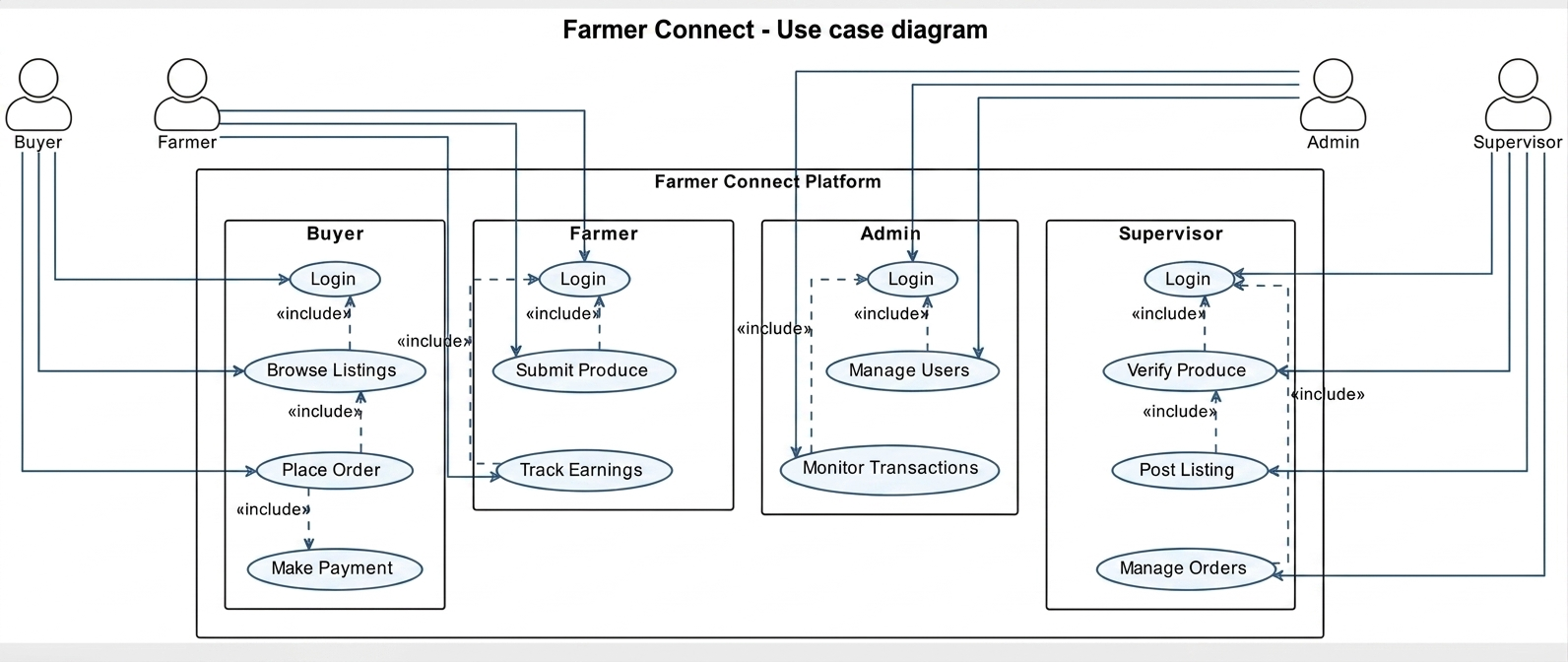
Fig 1: Use Case Diagram
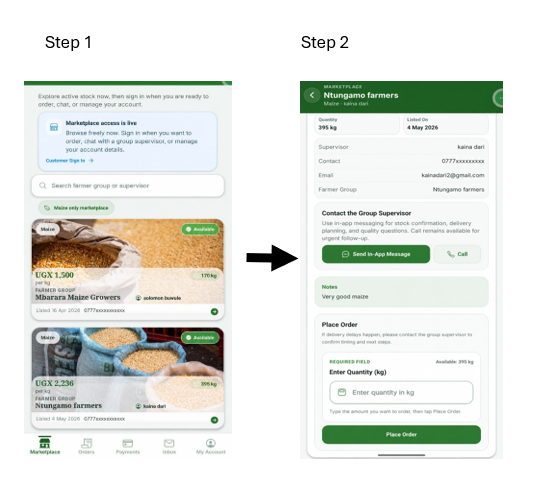
Fig 2: Marketplace interface showing produce listings from farmer groups.
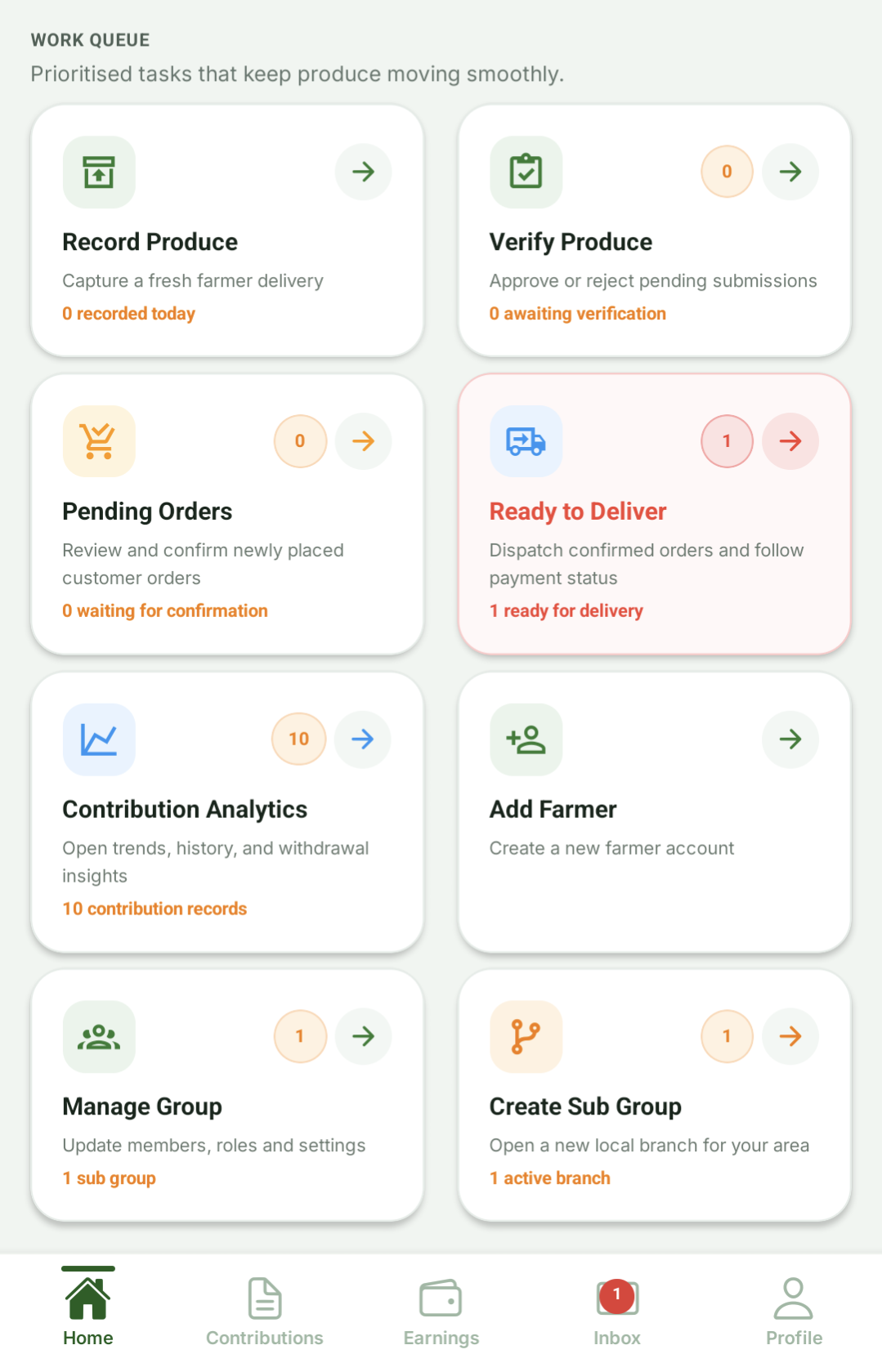
Fig 3: Supervisor interface .
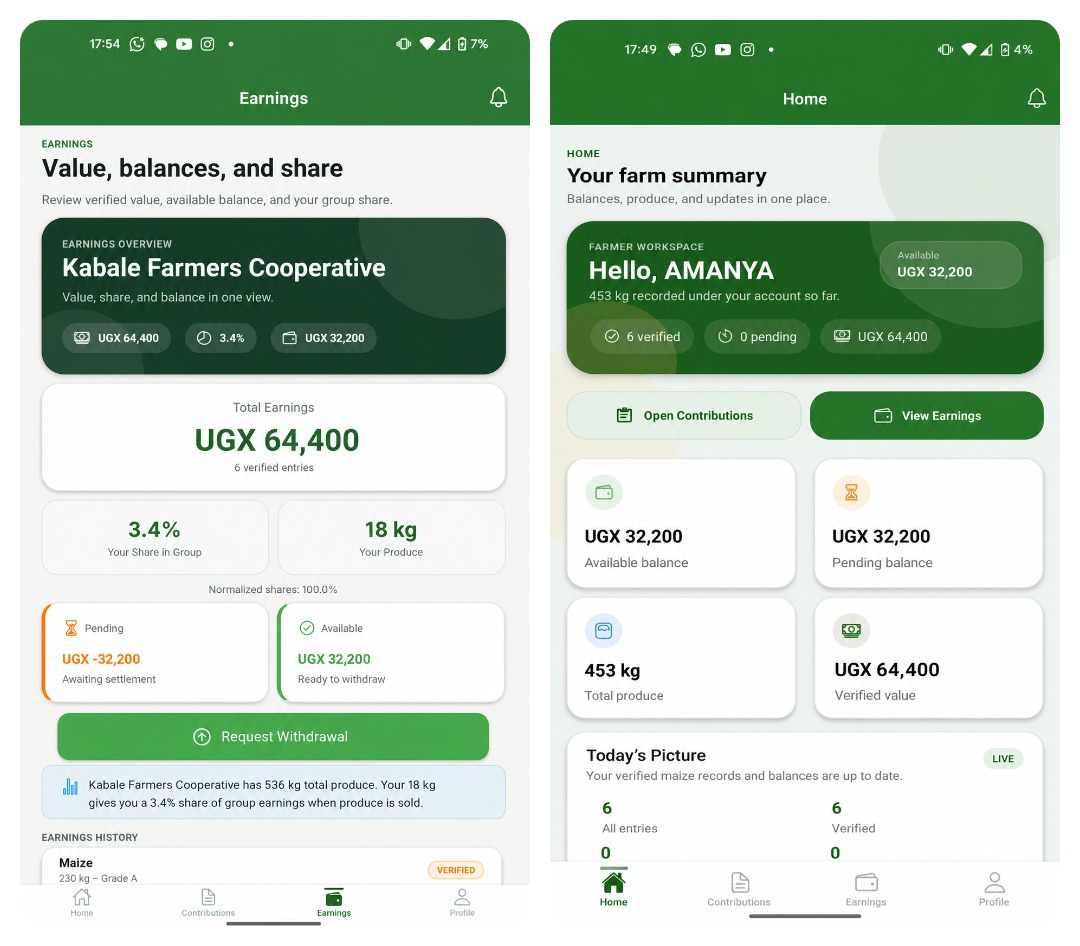
Fig 4: Farmer interfaces showing their statistics.
Limitations
- Evaluation focused on functional implementation completeness (~85% requirements coverage) without quantitative user impact or outcome metrics such as income improvement or reduced payment delays.
- No adversarial security or abuse-resistance testing reported; institutional risks like weak cooperative leadership or misuse of supervisory authority remain outside technical scope.
- Dependence on reliable supervisor participation and digital literacy may limit effectiveness in some rural contexts.
- Connectivity and smartphone availability constraints addressed by SMS but may still pose barriers to full adoption.
- No public source code, datasets, or system deployment details provided, limiting external reproducibility and benchmarking.
Open questions / follow-ons
- How does Farmer Connect impact farmers' actual incomes, price realization, and payment speed in longer term field deployments?
- What mechanisms can strengthen supervisory accountability and prevent misuse of authority within cooperatives?
- How robust is the platform under connectivity outages and varying digital literacy among farmers? Are there effective fallback workflows?
- Can the system be integrated with formal credit, savings, or government subsidy schemes to enhance financial inclusion?
Why it matters for bot defense
This study provides an example of using digital platforms and role-based access controls to increase transparency and fairness in cooperative agricultural markets. For bot-defense and CAPTCHA practitioners, although the application domain differs, some parallels exist in designing systems that ensure trustworthy, authenticated user roles with different privilege levels interacting in a distributed environment. The paper highlights the importance of role separation, transparency, and traceability in reducing fraud and misuse within a multi-actor platform, themes relevant to security design.
Additionally, the usage of SMS notifications to extend visibility beyond smartphones and the handling of asynchronous state changes (produce verification, sales, earnings) could be informative when designing robust user interactions under partial connectivity and varying user device capabilities—challenges sometimes faced in global bot-defense deployments. However, complex adversarial threats like bot farming or spoofing are not addressed here, so applicability is limited mostly to trustworthy cooperative processes rather than hostile user adversaries.
Cite
@article{arxiv2606_20465,
  title={ Farmer Connect: Improving Farmers' Access to Produce Markets },
  author={ Micheal Amanya and Darius Kainamura and Christine Namatovu and Lailah Kobugabe and Solomon Buwule Fortune and Adones Rukundo },
  journal={arXiv preprint arXiv:2606.20465},
  year={ 2026 },
  url={https://arxiv.org/abs/2606.20465}
}