
Beyond the Grave: An Empirical Study of Dormancy and Revival in Scientific Open-Source Software
Source: arXiv:2606.20966 · Published 2026-06-18 · By Addi Malviya Thakur, Bogdan Vasilescu, Audris Mockus
TL;DR
This paper investigates the limitations of classifying scientific open-source software (OSS) projects as abandoned using fixed inactivity thresholds and instead presents a nuanced taxonomy of dormancy and revival. Using the SciCat corpus of 18,247 scientific OSS repositories, the authors identify 2,984 projects exhibiting dormancy followed by revival activity. They perform detailed qualitative coding on a stratified sample of 750 projects with rigorous inter-rater adjudication, resulting in a five-dimensional taxonomy characterizing dormancy causes, revival mechanisms, work types, sustainability of revival, and lifecycle archetypes. Their analysis reveals that over half of dormancy causes cannot be resolved from repository data alone, that feature freeze outnumbers research-output completion as a dormancy cause, and that most revivals are not sustained, with many simply transient or bot-generated. Importantly, they find that lifecycle archetypes better predict revival sustainability outcomes than revival triggers or work types. These findings challenge the prevalent reliance on fixed inactivity cutoffs to classify project abandonment and argue for multidimensional, lifecycle-aware assessments for better understanding and supporting scientific OSS sustainability.
Key findings
- Changing the inactivity threshold from 1 month to 36 months reduces projects classified as abandoned in the SciCat corpus from 18,030 to 8,010 (>50% drop), driven solely by threshold choice.
- 52.5% of dormancy causes in the 750 coded sample are unresolvable from repository evidence, setting a measurement-validity ceiling for automated analysis.
- Among resolvable dormancy causes, feature/milestone freeze outnumbers research-output completion by a factor of 5.4:1 (156 vs 29 projects).
- Non-sustained revival outcomes outnumber sustained recovery by 2.14:1; recovered-then-declined projects form 31.6% (n=237) of the sample.
- 11.5% of apparent revivals are bot-only or single-spike artifacts, not genuine human-led recovery.
- Lifecycle archetype (T5) shows a stronger association with revival sustainability outcome than revival mechanism (T2) or revival work type (T3), with medium effect size on archetypes without predetermined sustainability.
- The rule-based classifier applied to coded fields achieves post-adjudication Cohen’s κ between 0.779 and 0.857 for the five categorized dimensions.
- A deterministic, reproducible five-dimensional taxonomy (T1–T5) operationalizes dormancy and revival into discrete classes enabling richer classification beyond binary active/abandoned labels.
Threat model
n/a - This is an empirical study of software evolution and dormancy in scientific open-source projects without explicit security threat modeling or adversarial capabilities.
Methodology — deep read
Threat Model & Assumptions: This is an empirical software engineering study on scientific OSS dormancy and revival. There is no adversary per se, but the framing addresses measurement threats from relying solely on inactivity thresholds which ignore temporary dormancy and bot artifacts. The authors assume repository data and tooling can yield meaningful, though limited, signals about project dormancy causes and revival dynamics.
Data: The study uses the SciCat corpus of 18,247 scientific OSS GitHub repositories drawn from 13 STEM fields and three software stack layers (publication-specific, domain-specific, infrastructure). Among these, 2,984 projects meeting a 6-month inactivity abandonment cut-off but having subsequent commits were identified as dormant-revived candidates. A stratified proportional sample of 900 (ultimately 750 valid) projects was selected, balancing across fields, stack layers, and GitHub star counts (median stars 170 in sample vs 9 in parent abandoned corpus), ensuring visibility for richer evidence trails.
Qualitative Coding & Classification: Seven primary fields per project were coded by 75 analyst-coders (graduate/advanced undergraduates), each coding 10 projects. Coders followed a structured rubric prioritizing evidence from commit messages, issues/PRs, then README updates. Coding fields include gap length, dormancy cause hypotheses, revival triggers, contributor types, and thematic commit content before and after inactivity gaps. The team conducted a two-phase inter-rater reliability process: first blinded peer reviews, then adjudication meetings with evidence citation, raising Cohen’s κ from moderate (0.543–0.685) to substantial/almost perfect (0.779–0.857). The field codings fed a deterministic, rule-based content analysis classifier that synthesized five categorical taxonomies: dormancy cause (T1), revival mechanism (T2), work type (T3), revival sustainability (T4), and lifecycle archetype (T5).
Training & Validation: No ML training per se; the classification is rule-based grounded in inductive open coding and deductive content analysis traditions. Inductive coding surfaced emergent categories, which were operationalized via keyword dictionaries, numeric thresholds (e.g. >100 post-gap commits for sustained recovery), and disambiguation rules. Sensitivity analyses of thresholds and category definitions were conducted.
Evaluation Protocol: Quantitative analyses include distributional statistics of the 750-project taxonomy, contingency tables, and hypothesis testing using χ2 tests, Cramér’s V for association effect sizes, and Kruskal-Wallis tests for numeric field comparisons. Multiple subsamples examined include all coded, codeable, non-imputed, focal subsets, and structurally independent archetypes. Intra- and inter-coder reliability are explicitly measured. The study also identifies false positives such as bot-only commit revivals and single-spike ephemeral revivals. The lifecycle archetype dimension is evaluated for predictive alignment with revival sustainability.
Reproducibility: All codebooks, coding data, adjudication logs, taxonomy classifier notebooks, and category definitions are released in the replication package, enabling external validation and reuse. The deterministic classifier runs under two seconds on the 750-project sample and reproduces published counts exactly. Some private fields (e.g. coder identities) are omitted to preserve anonymity.
Example End-to-End: For each project, coders identify the longest commit inactivity gap and analyze commit messages, issues, and README entries to infer the dormancy cause (e.g. milestone freeze vs research output), note the type of trigger that caused revival (bot, original maintainer return, new contributor), the nature of post-gap commits (features, bug-fixes, documentation), and measure sustainability by counting commits and inspecting current activity status. These coded inputs are fed into the classifier which deterministically labels the project on T1–T5 axes, enabling the authors to analyze distributions, associations, and evolutionary trajectories across the scientific OSS landscape.
Technical innovations
- A five-dimensional taxonomy for dormant-revived scientific OSS projects characterizing dormancy cause, revival mechanism, work type, sustainability, and lifecycle archetype in a unified framework.
- A rigorous, large-scale application of mixed-methods involving stratified qualitative coding by 75 coders with two-phase adjudication combined with a deterministic rule-based classifier to operationalize taxonomy.
- Quantification and operational treatment of false revivals caused by bot-only commits or transient single-spike activities, a novel contribution to sorting real from artifactual OSS recovery.
- Empirical demonstration that lifecycle archetypes provide stronger signals of revival sustainability than traditional inactivity thresholds or isolated trigger/work-type classifications.
Datasets
- SciCat — 18,247 scientific OSS repositories — publicly released curated corpus from World of Code
- Dormant-Revived Sample — 2,984 candidate projects selected by inactivity threshold plus post-gap commits
- Stratified Sample for Coding — 750 projects randomly sampled with proportional stratification across 13 STEM fields and 3 software stack layers
Baselines vs proposed
- SciCat abandonment classification (6-month cutoff): abandoned count = 11,631 vs varying threshold from 1 month to 36 months changes abandoned count from 18,030 to 8,010
- Dormancy cause resolution: unresolvable from repository evidence = 52.5% vs resolvable cases where feature freeze : research output completion = 5.4:1
- Revival sustainability: non-sustained recovery outnumbers sustained recovery by ratio 2.14:1
- False recovery artifacts: bot-only or single-spike revivals = 11.5% of sample
- Taxonomy classifier agreement compared to human adjudicated labels: Cohen’s κ (post-adjudication) range 0.779–0.857 vs pre-adjudication 0.543–0.685
Figures from the paper
Figures are reproduced from the source paper for academic discussion. Original copyright: the paper authors. See arXiv:2606.20966.
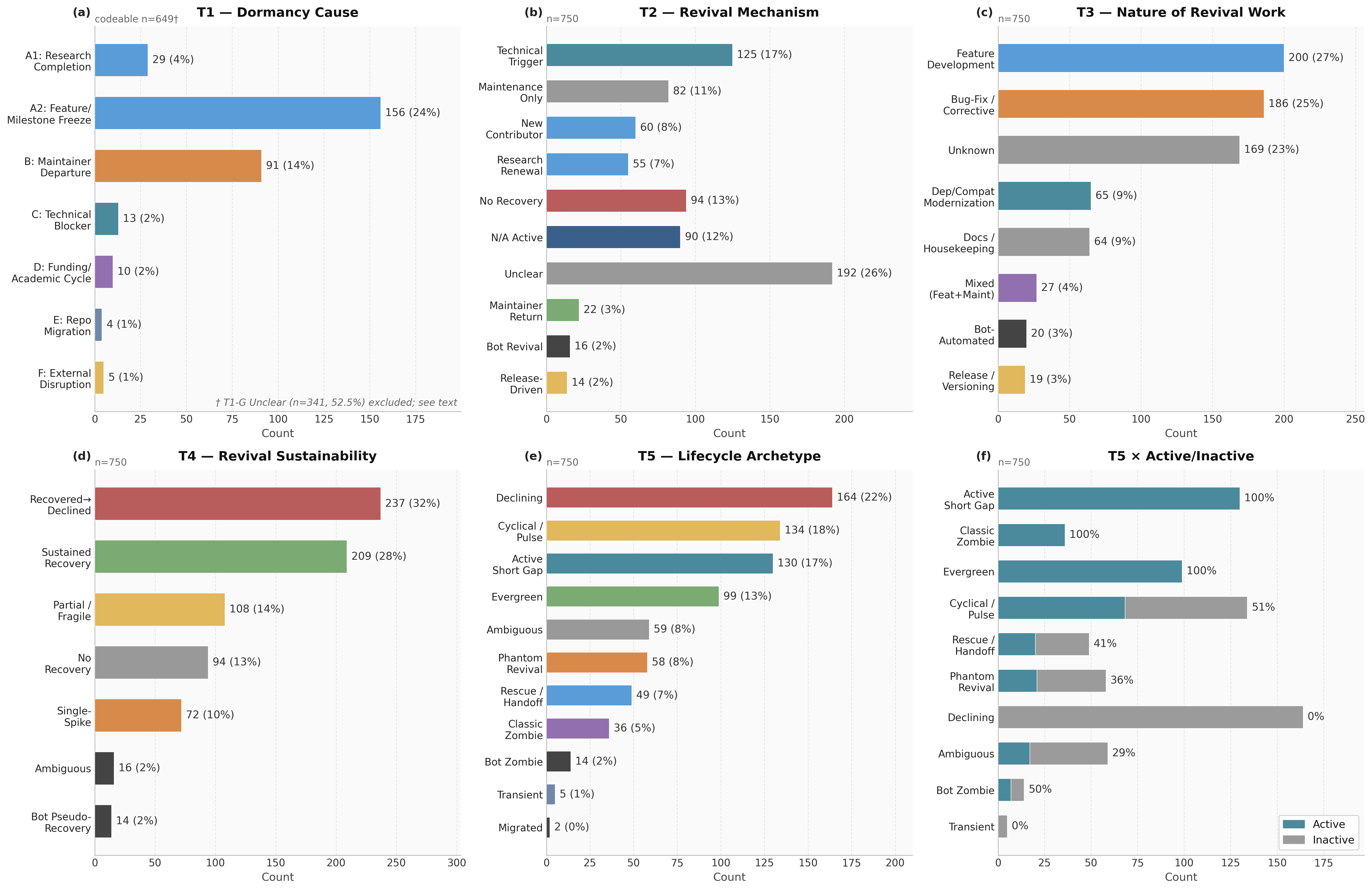
Fig 2: Taxonomy category distributions (n = 750). (a) T1 dormancy cause (codeable n = 649;
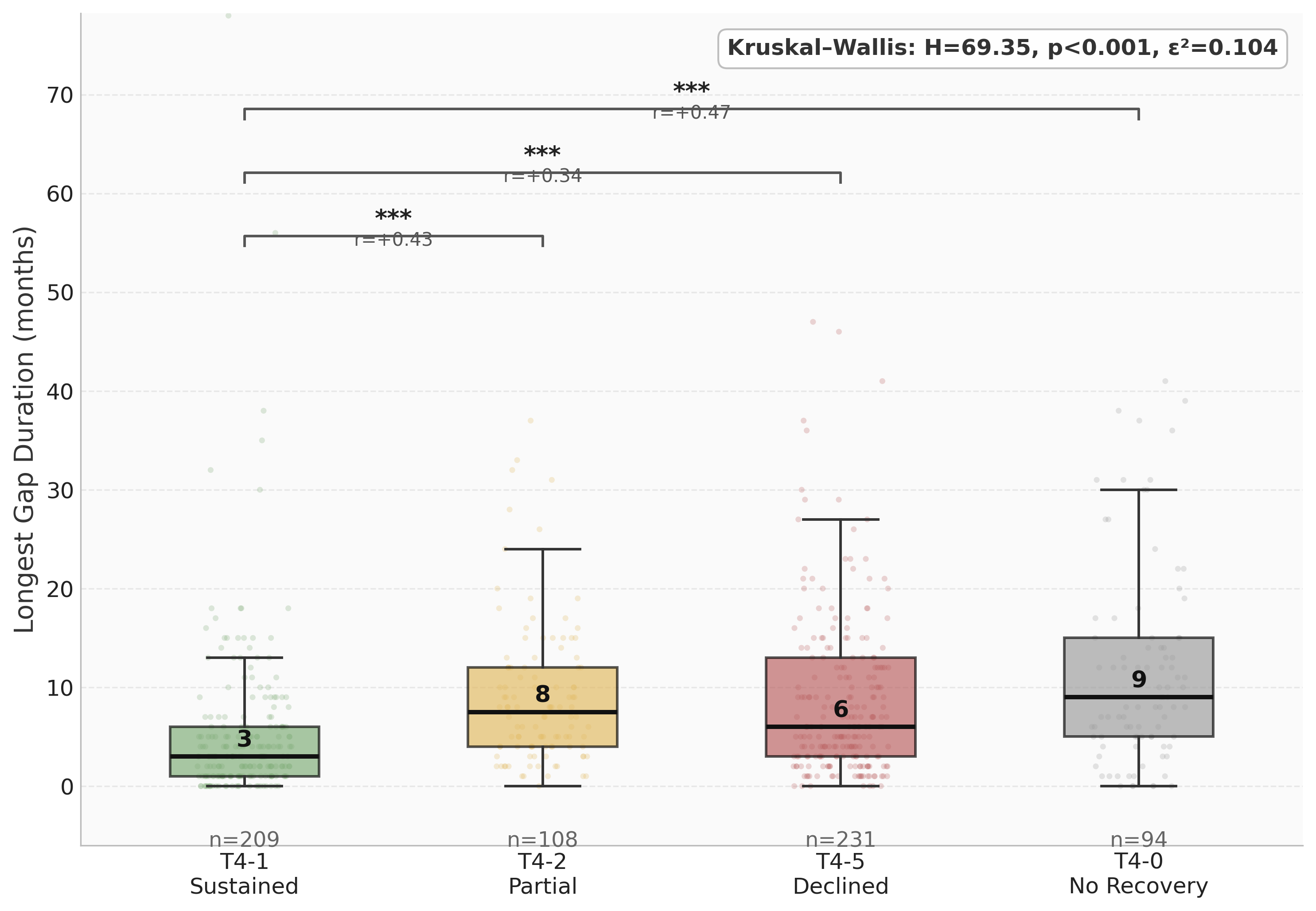
Fig 3: Gap duration by revival sustainabil-
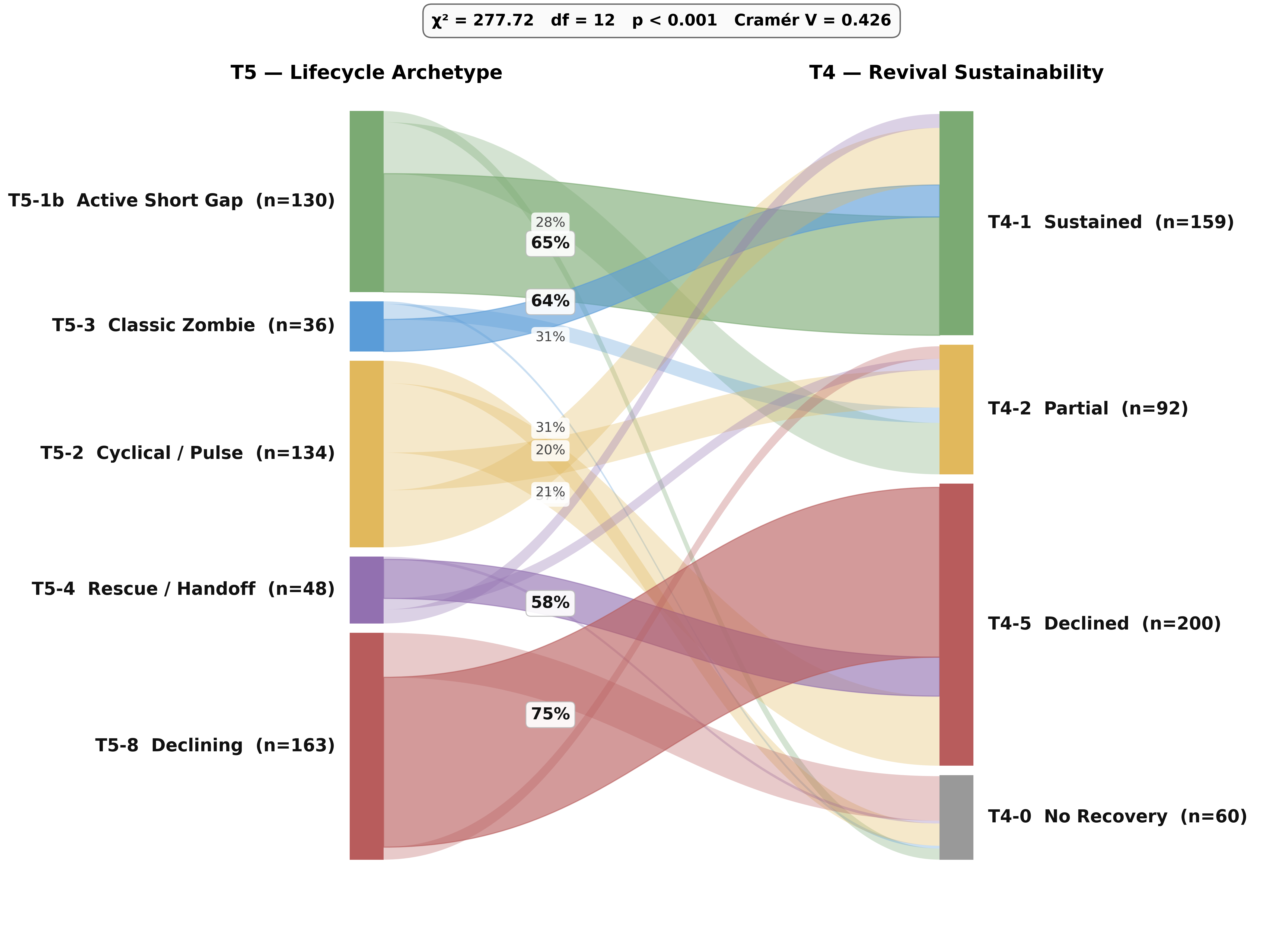
Fig 4: Lifecycle archetype (T5) to revival
Limitations
- Dormancy cause attribution limited by repository-visible artifacts alone; 52.5% of cases remain unclassifiable, creating a measurement-validity ceiling for automated methods.
- Coding performed by a large, distributed student coder pool in a single academic semester with limited per-coder calibration, though mitigated by adjudication and supervision.
- Analyses do not directly include external data sources (e.g. funder information, private communications) that could explain dormancy causes more fully.
- Lack of longitudinal validation beyond April 2025 cutoff; sustainability outcomes may evolve over longer horizons unobserved here.
- Star-weighted sampling biases the sample toward higher visibility projects, limiting generalizability to lower-visibility scientific OSS.
- Deterministic rule-based classifier may encode heuristic biases; sensitivity analysis partially conducted but full robustness under adversarial patterns untested.
Open questions / follow-ons
- How can dormancy cause attribution be improved by integrating external data sources such as funding cycles, institutional records, or developer communications?
- What automated techniques can reliably distinguish bot-driven false revivals from genuine human re-engagements at scale without manual coding?
- How do sustained revival patterns vary across scientific domains, funding regimes, and software infrastructure layers over longer timescales?
- Can machine learning models trained on the five-dimensional taxonomy enhance real-time detection and monitoring of scientific OSS health?
Why it matters for bot defense
For bot-defense and CAPTCHA practitioners, the key takeaway from this study is the recognition that simple binary heuristics based on inactivity thresholds can be unreliable indicators of permanent abandonment versus temporary dormancy. Sophisticated classification acknowledging lifecycle archetypes and contributor continuity provides a far richer and more accurate picture of project vitality. Analogously, bot defense mechanisms relying on single-signal activity timeouts may misclassify benign dormant users or infrequent human activity as bots or abandoned. This research highlights the value of multi-dimensional, temporal, and contributor-pattern-aware signals over rigid thresholds, which could inform more nuanced CAPTCHA triggers, risk scoring, or interaction challenges. Moreover, the identification and quantification of bot-generated false signals in OSS commits parallels challenges in distinguishing automated bot traffic from legitimate human interactions online, reinforcing the importance of discerning transient bot actions from sustained human behavior.
Cite
@article{arxiv2606_20966,
  title={ Beyond the Grave: An Empirical Study of Dormancy and Revival in Scientific Open-Source Software },
  author={ Addi Malviya Thakur and Bogdan Vasilescu and Audris Mockus },
  journal={arXiv preprint arXiv:2606.20966},
  year={ 2026 },
  url={https://arxiv.org/abs/2606.20966}
}