
Agentic AutoResearch forSpace Autonomy: An Auditable, LLM-Driven Research Agent for Aerospace Control Problems
Source: arXiv:2606.20394 · Published 2026-06-18 · By Amit Jain, Richard Linares
TL;DR
This paper addresses the challenge of automating and auditing the iterative research process for developing learned control policies in aerospace guidance, navigation, and control problems. Often, researchers manually select architectures and hyperparameters, run costly stochastic training experiments, and need to discern genuine performance improvements from random seed noise, a known pitfall in machine learning. The paper presents AutoResearch, a novel framework where a large language model (LLM) autonomously drives the research loop—proposing code edits to training scripts, executing experiments, and logging results—while a built-in statistical credibility layer vets every claimed improvement against measured seed noise, holds-out reseeded verification, and quantitative leave-one-out ablation of edits. Notably, the language model functions strictly offline as the research agent; the final control policy it discovers is deployed on spacecraft, but the LLM itself never commands the vehicle.
The approach is demonstrated on two aerospace control problems governed by classical Clohessy–Wiltshire orbital dynamics: an unconstrained relative rendezvous and a safety-constrained collision-avoidance docking task with a keep-out zone. In both, AutoResearch-produced policies clear measured per-problem seed noise by large margins (around 15 sigma in rendezvous), while matched-budget undirected random search fails or yields inferior results—particularly in docking, where random search produces no feasible policies respecting safety constraints. The contributions are the reusable autonomous agentic experimentation framework and the embedded in-loop audit, proving LLM-driven research agents can produce robust, certified improvements on safety-critical aerospace control tasks.
Key findings
- AutoResearch’s audited policy on the rendezvous problem exceeds the baseline seed noise threshold by approximately 15 standard deviations (sigma), showing a statistically significant improvement.
- On the collision-avoidance docking problem with a hard safety constraint, AutoResearch produces a feasible policy that respects the keep-out zone on 100% of held-out seeds, while undirected random search finds no feasible policy at all under a matched per-experiment budget.
- Leave-one-out pruning reveals that among the agent’s edits, some are load-bearing (critical for improvement) and others hitchhike; however, dropping inert parameters jointly degrades performance, indicating complex parameter interactions.
- The embedded credibility layer applies three uniform checks—measured seed noise, reseeded verification on held-out random seeds, and leave-one-out ablation of agent proposals—to certify that reported improvements are statistically real and reproducible.
- The LLM-driven agent loop operates by reading a problem description and run history, proposing a single hyperparameter or script edit per iteration, running the experiment, parsing a single structured metric line, and appending the outcome to the run log.
- AutoResearch’s fixed agent loop runs without modification across two distinct control problems differing in dynamics, constraints, and evaluation metrics, demonstrating framework generality.
- Blind mode tests, limiting the agent’s access to full problem context, confirm that iterative search with LLM guidance outperforms random search driven by the same budget and search space.
- The credibility layer’s reseeded verification rejects any improvements which do not clear a 2-sigma effect size gate and fail feasibility on every seed.
Threat model
The implicit adversary is the inherent stochastic noise arising from system randomness and random seeds during policy training and evaluation; the system assumes no adaptive adversary acting to manipulate the LLM or training infrastructure. The LLM agent is offline and cannot control the spacecraft or operate in situ, eliminating risks of unsafe autonomous vehicle control. The main threat is false positive claims of policy improvements due to seed noise or overfitting random fluctuations, which the credibility layer is designed to mitigate.
Methodology — deep read
Threat model & assumptions: The adversary is implicit as an uncontrolled source of stochastic variation in training outcomes, primarily caused by random initialization seeds and environment stochasticity. The agent assumes no prior knowledge of the optimal solution and cannot modify the core simulator or training data beyond a fixed editable hyperparameter region. The LLM acts as an offline research agent proposing single changes per iteration; it does not operate the spacecraft or execute policies in real-time, avoiding risks related to autonomous deployment or real-time adversarial interaction.
Data & problem provenance: The demonstration problems are classical aerospace control tasks based on Clohessy–Wiltshire–Hill linearized relative orbital dynamics equations, calibrated against known optimal control benchmarks. Two problems are studied: an unconstrained rendezvous and a safety-critical docking problem with a spherical keep-out zone. Expert demonstrations for behavioral cloning come from optimal solvers with nearly zero suboptimality. Training scripts, simulator, and evaluation metrics are fixed and immutable beyond parameter edits within a region of interest.
Architecture & algorithm: The AutoResearch agent operates as a closed-loop state machine composed of three components: the proposer (an LLM prompting interface), the runner (executes patched train.py scripts as subprocesses), and the orchestrator (coordinates, validates proposals, termination criteria). The LLM proposes exactly one structured edit or a stop signal per iteration, modifying only delimited top-level hyperparameters within a predefined editable region of the training script. The evaluation metric is parsed from a single structured output line per run.
The agent’s policy π maps the run history H (including configurations, metrics, and agent annotations) to the next configuration θ to try. Both adaptive (LLM-driven) and baseline random (memoryless) search strategies are compared under matched budgets. The LLM uses Anthropic Claude Sonnet 4.5.
Training regime: Campaigns run until a stopping condition triggers: iteration/time/money budgets, plateau criteria based on sliding metrics windows, consecutive proposal failures, or agent-requested stop justified by results. Each training/configuration run uses a single random seed. Seed noise σ per problem family is estimated from multiple fixed baseline runs. Reseeded verification conditions involve fresh held-out seeds distinct from exploratory seeds.
Evaluation protocol: Metrics include a scalar primary metric per configuration and seed, seed-averaged mean and standard deviation, success rate (feasibility constraints for docking). The credibility layer applies: (a) seed noise thresholding (2σ effect size gate); (b) reseeded re-evaluation of top candidates for fresh-runs reproducibility; (c) leave-one-out pruning of individual hyperparameter edits for contribution attribution. Undirected uniform random search over the same parameter space and budgets is the main baseline. Runs.jsonl and proposals.jsonl provide full experiment and proposal audit trails.
Reproducibility: The framework mandates a fixed family contract with plain-language descriptions, a single editable script (train.py), structured metrics, and append-only logs. Experiments are reproducible by replaying patched scripts under specified seeds. The exact LLM prompting and interface details are described, and support both Anthropic and OpenAI backends; the code repository status is not stated explicitly in the excerpt. The underlying physics models and optimal solvers are classical standard benchmarks.
Concrete example: In the docking problem, the agent reads the problem brief and past runs, proposes a single edit (e.g., changing a hyperparameter), patches train.py in the editable region, runs the model training as a subprocess parsing the FINAL_METRIC line, appends the result to runs.jsonl, compares to prior best, and either continues or stops via the agent’s structured tool call. The credibility layer later measures seed noise from K baseline repeats, executes reseeded verification on the best configuration across held-out seeds, and does leave-one-out pruning across edited parameters to confirm which carried the improvement, ensuring the learned policy respects safety constraints in all seeds tested.
Technical innovations
- An autonomous LLM-driven research agent loop that proposes, executes, and analyzes aerospace control experiments by editing a restricted region of train.py scripts, enabling general-purpose, reusable iterative research across problems.
- A credibility layer built inside the agent loop applying measured per-problem seed noise estimation, reseeded verification on held-out seeds, and leave-one-out ablation of the agent’s edits to certify that reported gains are statistically meaningful and reproducible, guarding against false positives from seed noise.
- A problem-agnostic research family contract defining delimited editable hyperparameter regions, a structured single metric reporter, immutable simulators, and audit logs, enabling an identical LLM agent loop to operate unchanged across diverse aerospace control families.
- Blind mode experimental setup that restricts the agent’s access to problem descriptions and run histories to validate that improvements stem from genuine iterative search rather than data memorization or cheating, verifying honest agentic hyperparameter tuning.
Baselines vs proposed
- Random search baseline: on rendezvous problem, seed-averaged metric best effort falls below AutoResearch by more than 2σ (exact values not given but significant margin described).
- Random search baseline: on docking problem, produces no feasible policy respecting the keep-out zone safety constraint, whereas AutoResearch produces feasible policies on 100% of held-out seeds.
- AutoResearch (LLM agent): effect size on rendezvous problem ≈ 15σ above baseline configuration; random search result within noise floor.
- Effect size thresholds for acceptance gate set at 2σ to promote only statistically significant improvements.
Figures from the paper
Figures are reproduced from the source paper for academic discussion. Original copyright: the paper authors. See arXiv:2606.20394.
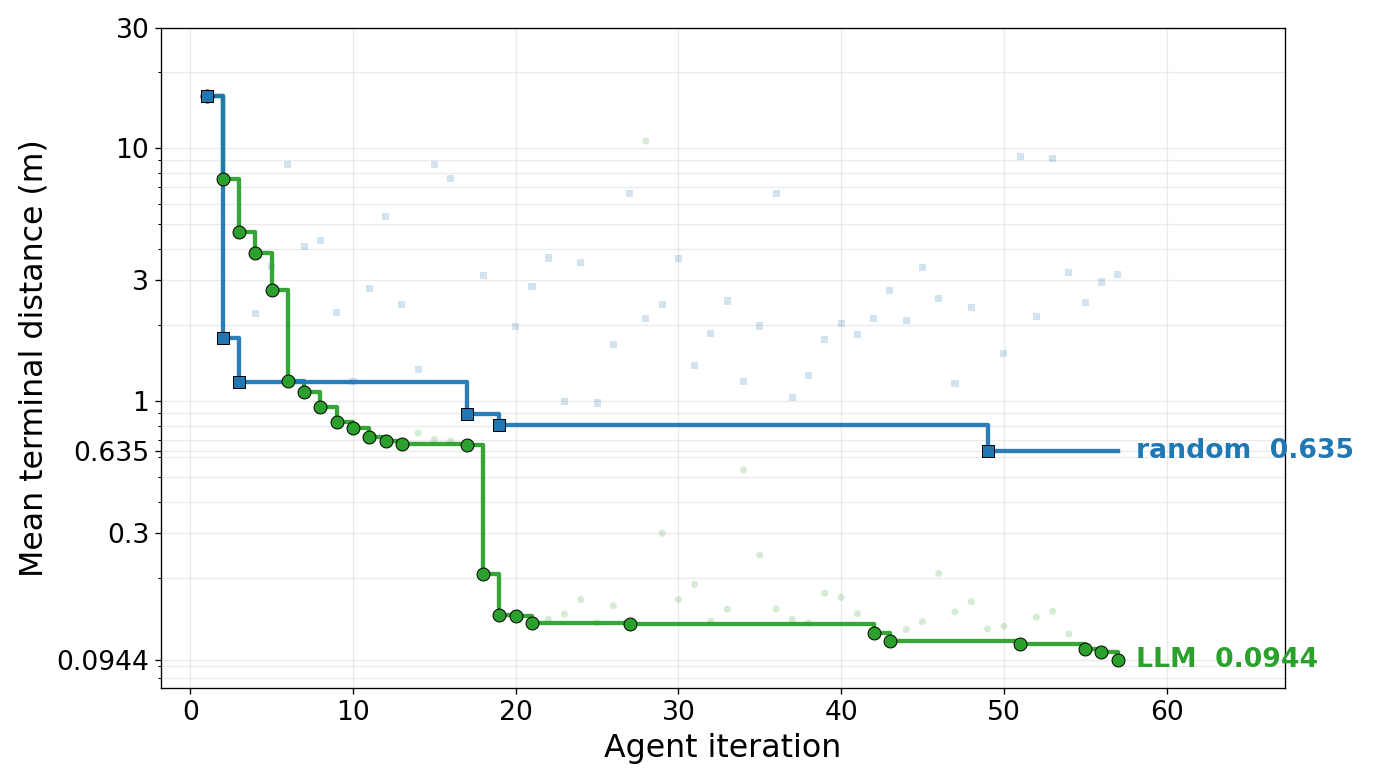
Fig 2: The Clohessy–Wiltshire rendezvous search. (a) The agent (green) drives the cloned policy’s mean
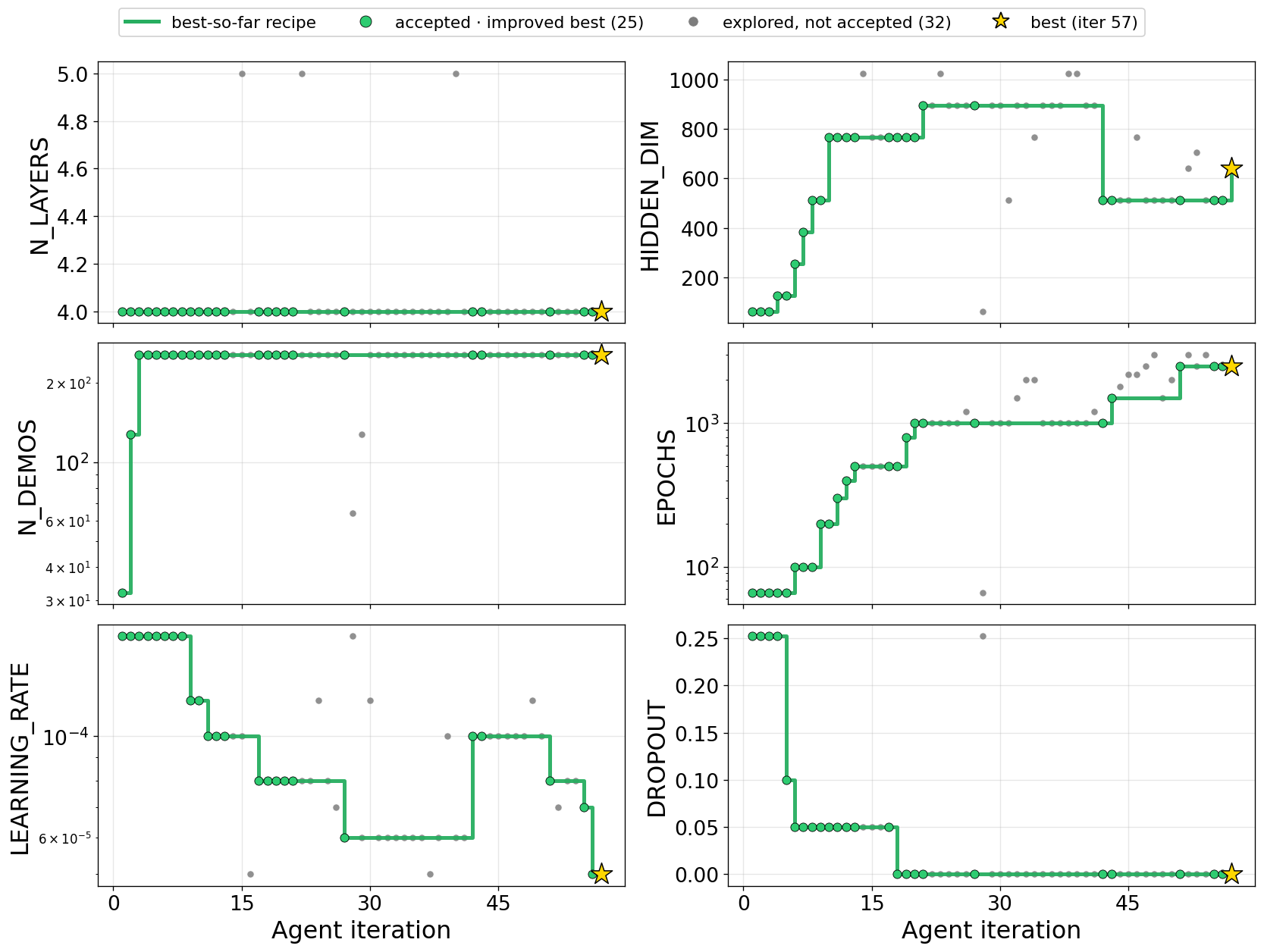
Fig 3: The learned policy flies the rendezvous. From five held-out initial conditions, the cloned policy (solid)
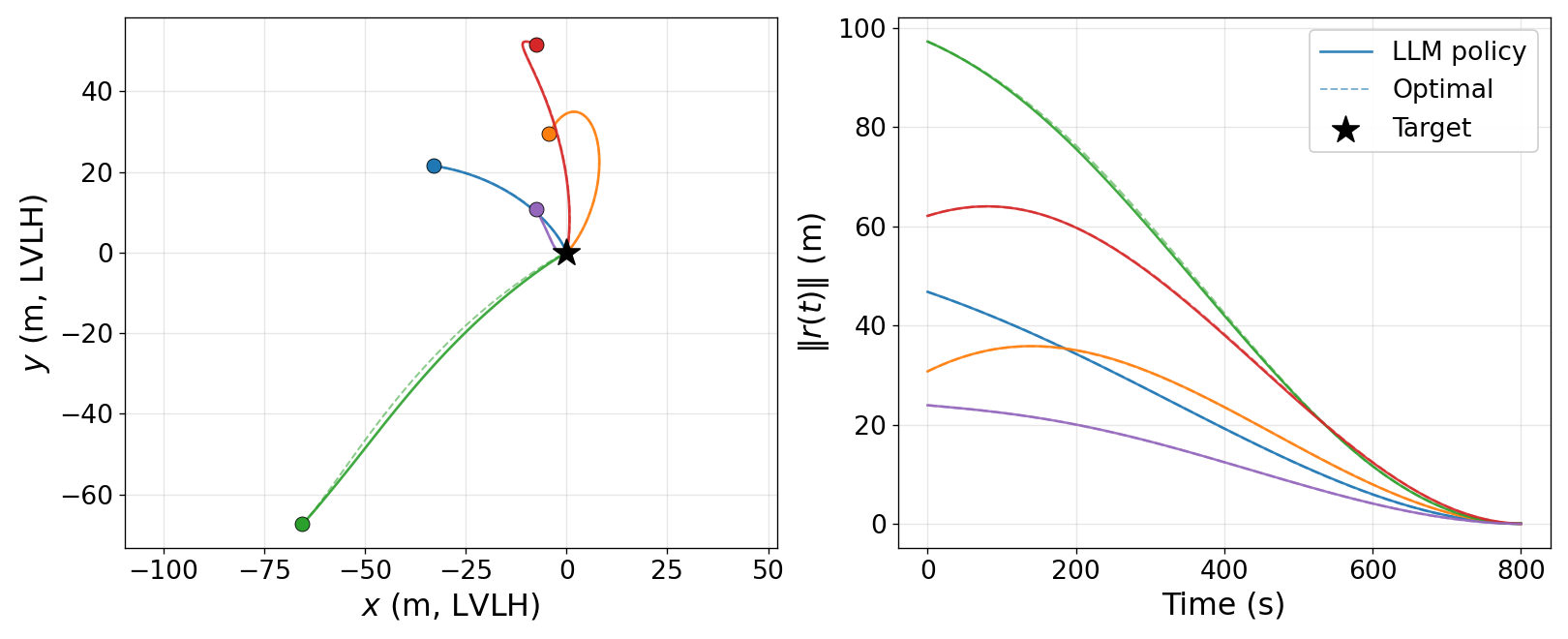
Fig 4: shows the two best-so-far traces over the cloud of raw per-experiment scores.
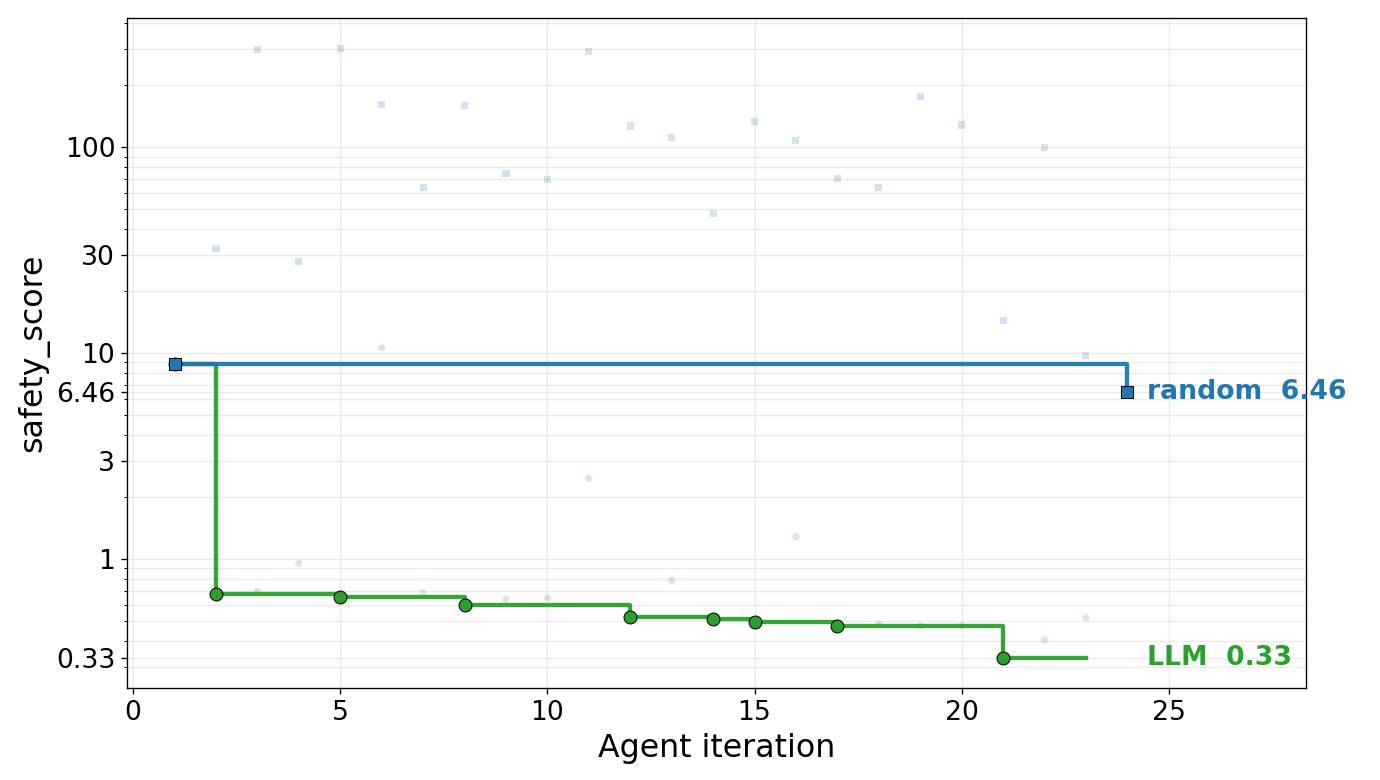
Fig 5: The learned policy docks while respecting the keep-out zone. From held-out far-side initial conditions,
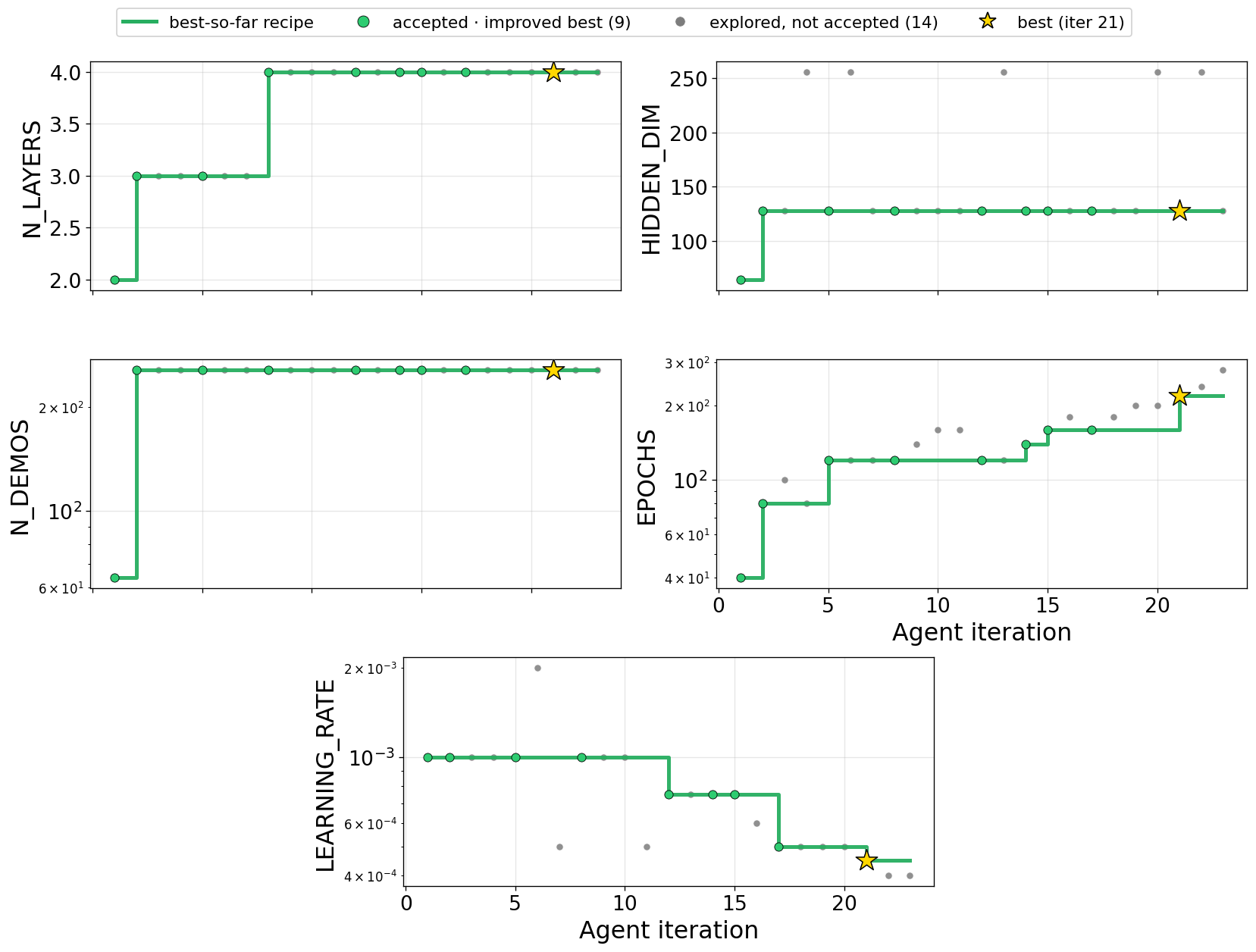
Fig 5 (page 15).
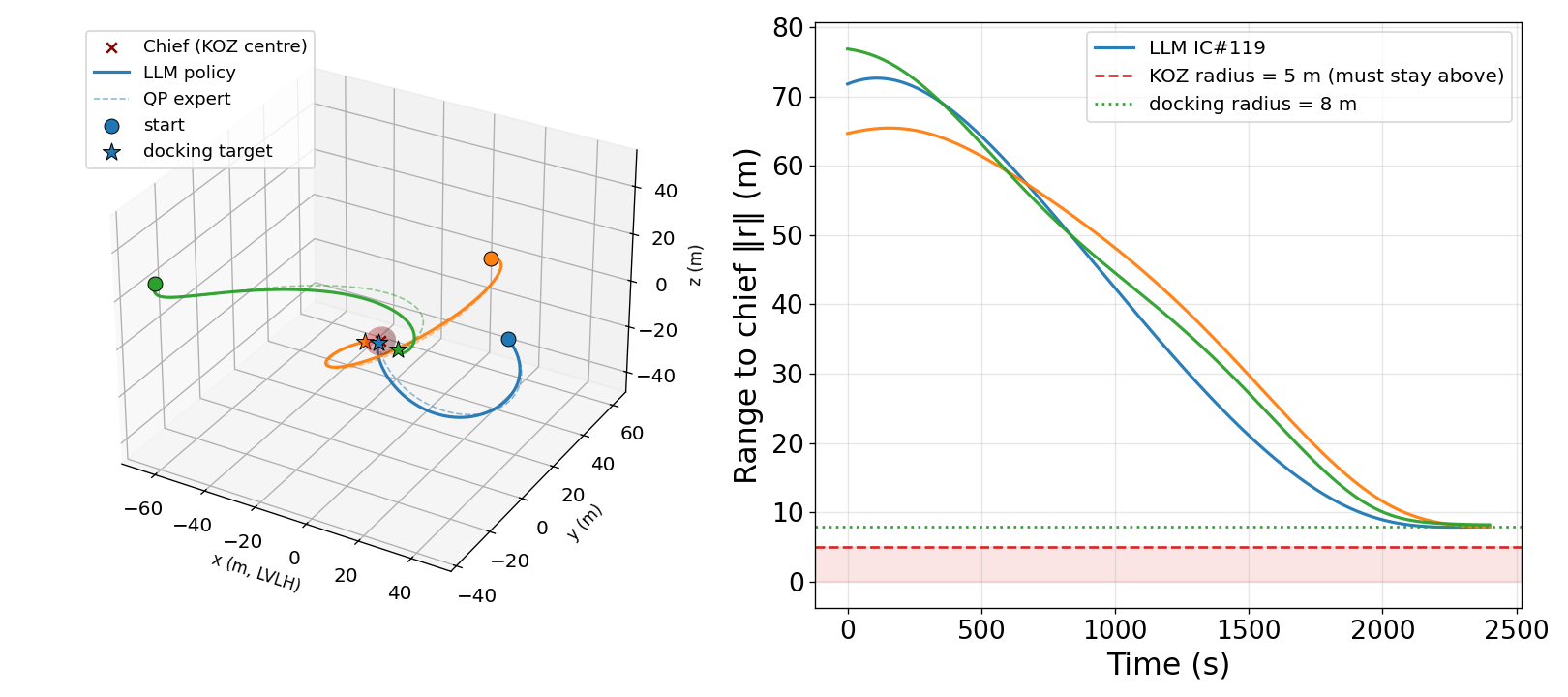
Fig 6 (page 16).
Limitations
- The framework currently only edits predefined hyperparameter regions within a single training script; it cannot introduce new degrees of freedom or modify core dynamics or dataset.
- The credibility layer relies on multiple seeds and reseeded verification but does not explicitly address adversarial or distribution-shift scenarios beyond held-out random seeds.
- The method is demonstrated on two classical aerospace control problems with linear orbital dynamics; generalization to more complex nonlinear or higher-dimensional systems is not shown.
- The LLM agent’s specific decision-making heuristics, prompt engineering details, and sensitivity to model choice or size are not deeply analyzed.
- Reproducibility is constrained by the closed nature of the underlying codebase and environment specifics; code release status is not stated.
- Evaluation focuses on offline policy training and audit; no real-time or on-orbit deployment experiments conducted.
Open questions / follow-ons
- How does the AutoResearch framework scale or adapt to nonlinear, higher-dimensional, or more complex spacecraft control problems beyond Clohessy–Wiltshire dynamics?
- Can the credibility layer incorporate adversarial robustness or domain shift detection to certify policies under realistic operational uncertainties?
- What are the impacts of varying LLM architectures, prompt designs, or multi-agent collaboration on the efficiency and quality of the autonomous research loop?
- Could the framework be extended to enable the LLM agent to propose structural changes beyond hyperparameters, such as model architectures or even dynamics approximations?
Why it matters for bot defense
While this paper focuses on aerospace control policy research automation, the core contribution—the development of an LLM-driven autonomous research agent with a rigorously embedded statistical credibility layer—offers inspiration for bot-defense and CAPTCHA practitioners exploring automated tuning and auditing of detection or mitigation policies. The approach to separate fast but noisy autonomous search from offline statistical verification sets a meaningful precedent for trustworthy automated policy development, where premature or false claims can lead to security and deployment risks. The leave-one-out pruning technique for understanding contribution of individual parameter edits may also provide interpretable audit pathways for complex adaptive models used in bot detection.
In CAPTCHA and bot-defense workflows, applying such agentic experimentation frameworks with strong credibility gating could support systematically tuning models online while preventing overfitting to transient attacker behaviors or random trial noise. However, adaptation would be needed to handle adversarial threat models more explicitly and deal with continuous real-time evaluation rather than offline training. The emphasis on problem-agnostic, generic experimentation contracts and machine-readable logs for audit trails aligns well with security research best practices for accountability and reproducibility.
Cite
@article{arxiv2606_20394,
  title={ Agentic AutoResearch forSpace Autonomy: An Auditable, LLM-Driven Research Agent for Aerospace Control Problems },
  author={ Amit Jain and Richard Linares },
  journal={arXiv preprint arXiv:2606.20394},
  year={ 2026 },
  url={https://arxiv.org/abs/2606.20394}
}