
A Measurement Study of Cryptographic Misuse in Embodied AI Mobile Applications
Source: arXiv:2606.19983 · Published 2026-06-18 · By Junchao Li, Xuelei Wang, Yuhang Huang, Qi Wang, Boyang Ma, Xuelong Dai et al.
TL;DR
This paper addresses the largely overlooked cryptographic security risks present in embodied AI (EAI) mobile applications, which serve as critical control-path components bridging users, cloud services, and physical devices. Unlike prior work focusing on embodied devices or cloud backends, this study zeroes in on the mobile layer as a fragile trust boundary whose compromise has direct cyber-physical consequences. The authors built EAIAppZoo, a curated dataset of 507 real-world Android EAI apps spanning six domains, and developed a semantic-aware static analysis pipeline to detect five key categories of cryptographic misuse such as weak primitives, hardcoded keys, and insecure communication. The measurement uncovered 12,975 misuse instances with 80.74% precision, demonstrating structured security trade-offs driven by engineering constraints like latency sensitivity and legacy SDK reliance. Through detailed case studies including a quadruped robot app, the work concretely connects mobile-side cryptographic flaws to attack scenarios enabling physical device hijacking. This first large-scale ecosystem-wide examination highlights the mobile app layer as a fragile, yet critical, trust boundary in cyber-physical embodied AI systems. It provides evidence that EAI-specific design pressures systematically degrade cryptographic protections, calling for focused security attention on mobile control components.
Key findings
- 12,975 cryptographic misuse instances detected across 507 EAI mobile apps.
- Semantic-aware static analysis pipeline achieves 80.74% precision validated over 244 sampled findings.
- Weak cryptographic primitives (e.g. MD5, DES, SHA1) and insecure communication (plaintext RTSP/MQTT) dominate misuse categories.
- Misuses are unevenly distributed, concentrated in a small subset of apps with domain-specific patterns: UAVs and educational robots show more insecure communication, cleaning and service robots more weak primitives.
- Latency-sensitive control paths trade-off transport security for real-time performance, leading to plaintext communication.
- Heavy reliance on offline provisioning and legacy IoT SDKs causes frequent embedding of hardcoded secrets/keys in code.
- Case study: A Unitree quadruped robot app's hardcoded AES keys enabled attackers to decrypt provisioning traffic, recover Wi-Fi credentials, and hijack device commands.
- Case studies illustrate how mobile app crypto flaws can bypass network protections (e.g. mTLS with embedded keys) to achieve unauthorized physical actuation.
Threat model
The adversary is an unprivileged local attacker who can download and reverse engineer publicly available EAI mobile apps and can position themselves as a Man-in-the-Middle on the local network controlling the embodied AI device. The attacker cannot compromise cloud infrastructure or device hardware but aims to exploit mobile app cryptographic misuses (e.g. hardcoded keys, insecure transport) to bypass authentication and inject unauthorized physical commands to embodied devices.
Methodology — deep read
Threat Model & Assumptions: The adversary is an unprivileged attacker who can access APK files from app markets and reverse engineer them to extract embedded credentials or cryptographic logic. The attacker may also act as a local network Man-in-the-Middle (MitM), observing and injecting traffic in the same LAN or Wi-Fi network as the device and mobile app. The cloud infrastructure and device hardware are assumed secure and trusted. The attacker aims for unauthorized cyber-physical actuation by exploiting weaknesses in mobile app cryptography.
Data: The authors constructed EAIAppZoo, a benchmark dataset of 507 Android apps related to embodied AI across six domains (cleaning robots, service robots, UAVs, industrial/agricultural robots, educational/social robots, wearables). Candidate apps were collected from public markets (Google Play, AndroZoo) using keyword filtering, followed by manual validation to ensure active control paths exist. The dataset is not yet publicly available.
Architecture / Algorithm: The core detection pipeline (EAGLE) integrates dynamic unpacking and static semantic-aware code analysis. APKs are unpacked and decompiled into readable Java-like code using JADX. Third-party libraries are aggressively filtered out unless interacting with security logic. A custom Semgrep ruleset was developed for five cryptographic misuse classes: weak primitives, insecure crypto parameters, weak randomness, hardcoded keys, and insecure communication protocols. This rule-based static analysis scans all source files in each app, yielding a granular JSON report of matched crypto misuse patterns including code context.
Training Regime: Not applicable as this is a static code analysis study. The pipeline ran on a high-end Ubuntu workstation with an Intel i9 CPU and 32GB RAM. No stochastic models or machine learning training was involved.
Evaluation Protocol: To measure precision, 244 findings were randomly sampled across the six domains for manual expert verification, resulting in an overall 80.74% precision. Misuse distributions were analyzed at ecosystem scale, normalized by app size and domain. Case studies were selected to concretely demonstrate exploitability and physical impact of discovered flaws.
Reproducibility: The dataset EAIAppZoo is not publicly released currently. The static analysis relies on open tools (JADX, Semgrep) with a custom ruleset, though the paper does not clarify public availability of the ruleset or extraction toolchain. Some real-world vulnerability details were responsibly disclosed to vendors but no frozen detection model or dataset versions are provided.
Example End-to-End: For a given app, the APK was dynamically unpacked if packed then statically decompiled to Java-like source. The analysis engine executed Semgrep rules against source files to detect occurrences of hardcoded cryptographic keys or insecure transport configurations. Each match was recorded with context metadata and aggregated across apps. Manual verification then sampled matches from each category and application domain to confirm true positives, calibrating precision estimates and enabling risk posture summarization across the EAI ecosystem.
Technical innovations
- Construction of EAIAppZoo, the first large-scale benchmark of realized embodied AI mobile applications for security analysis.
- Development of a semantic-aware static analysis pipeline integrating dynamic unpacking, fine-grained library filtering, and a custom multi-rule Semgrep detection framework targeting five major cryptographic misuse categories.
- Contextualization of cryptographic misuse findings along actual control and authentication paths in mobile apps to assess physical risk relevance.
- Systematic empirical demonstration of structural engineering constraints (e.g., latency sensitivity, offline provisioning) driving widespread cryptographic failures unique to EAI mobile systems.
Datasets
- EAIAppZoo — 507 Android applications — constructed by authors from public app markets and AndroZoo repositories, curated for embodied AI domains.
Baselines vs proposed
- No direct baseline comparison reported, as this is a novel large-scale measurement study.
- Semantic-aware analysis pipeline precision = 80.74% (validated over 244 sampled findings across 6 domains).
Figures from the paper
Figures are reproduced from the source paper for academic discussion. Original copyright: the paper authors. See arXiv:2606.19983.

Fig 1: Dual-mode control interactions in

Fig 2 (page 4).

Fig 2: Overview of the EAGLE framework.
Fig 4 (page 7).

Fig 5 (page 7).

Fig 6 (page 7).

Fig 5: Distribution of cryptographic misuse cat-
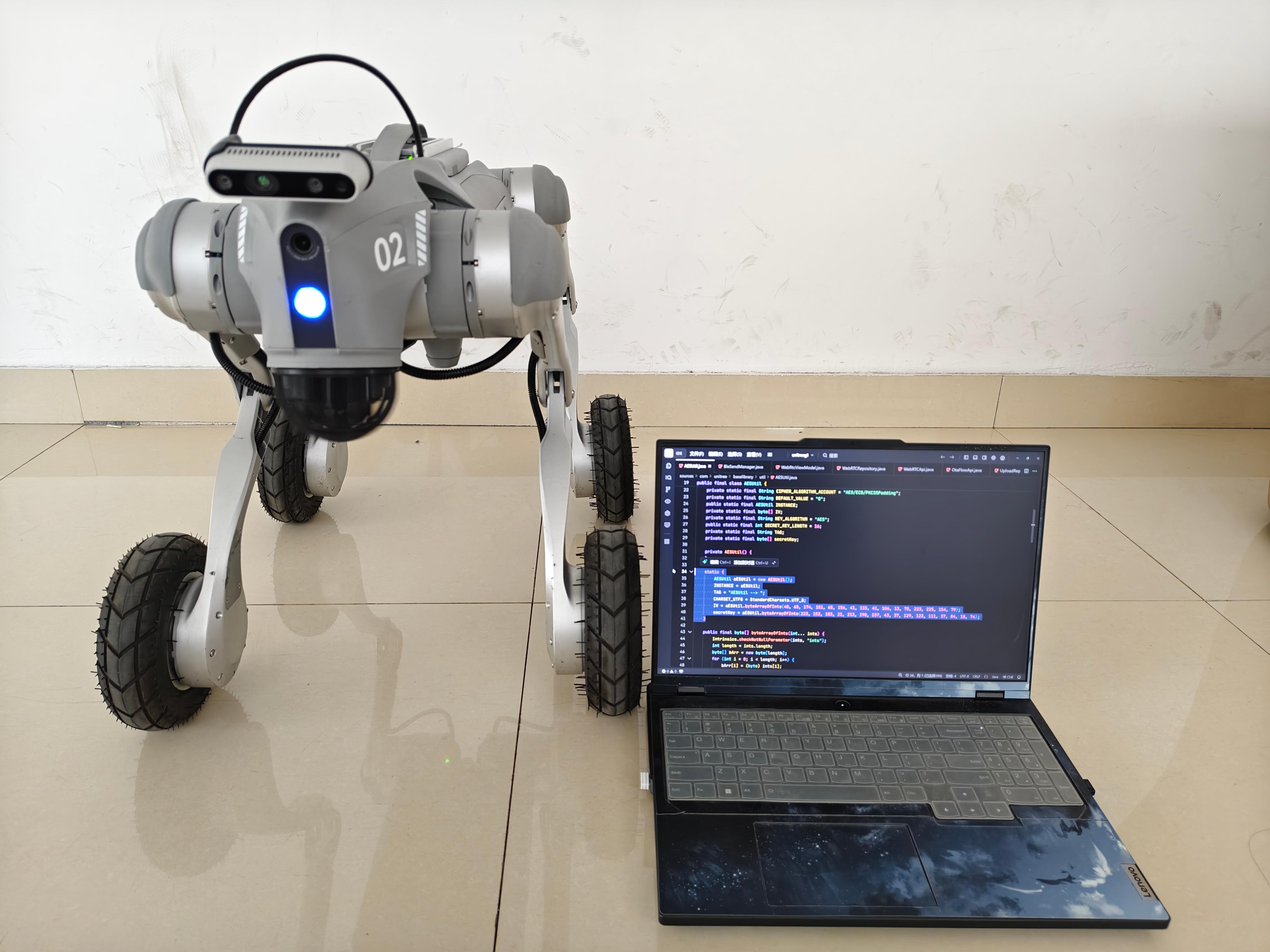
Fig 6: Physical hijacking of a Unitree
Limitations
- Dataset EAIAppZoo is not publicly available, hindering independent validation and replication.
- Static analysis approach may produce false positives or negatives due to obfuscation and complex app logic, despite manual validation.
- No explicit evaluation against active adversaries or penetration testing beyond static code analysis.
- Focuses solely on mobile-side cryptographic vulnerabilities, assuming cloud and embodied devices are secure and trusted.
- Case studies illustrate attacks but do not provide extensive end-to-end exploit implementation or live demonstrations.
- The pipeline does not quantify runtime prevalence of vulnerabilities or incorporate dynamic behavioral analysis.
Open questions / follow-ons
- How can EAI mobile apps balance low-latency operational constraints with rigorous cryptographic protections in practice?
- What mechanisms or frameworks can enable secure offline device provisioning without reliance on hardcoded secrets?
- Can dynamic or runtime monitoring complement static analysis to better catch or prevent cryptographic misuse in EAI apps?
- How might emerging AI-powered EAI systems with richer interaction modalities impact cryptographic trust boundaries and attack surfaces?
Why it matters for bot defense
For bot-defense and CAPTCHA practitioners, this paper surfaces an important and emergent attack surface in cyber-physical systems—the mobile application layer mediating embodied AI devices. The findings underscore that mobile apps are not mere UI components but active trust anchors that require cryptographic soundness to prevent adversaries from gaining unauthorized physical control. Practitioners should be aware that conventional assumptions about mobile app security may not hold in EAI contexts where low latency and offline operation drive risky cryptographic shortcuts. Incorporating semantic-aware static analysis techniques into app vetting pipelines can help detect cryptographic misuses before deployment. Additionally, the structural trade-offs identified suggest that security policies and defense mechanisms for mobile-side cryptography in EAI ecosystems need to explicitly account for domain-specific operational constraints and legacy SDK dependencies. Although this work does not directly address bot or CAPTCHA evasion, it emphasizes that robust cryptographic hygiene at the mobile edge is critical to preventing attacker pivoting from compromised apps to physical device manipulation, an important consideration when designing holistic bot-defense strategies spanning user agents to backend systems.
Cite
@article{arxiv2606_19983,
  title={ A Measurement Study of Cryptographic Misuse in Embodied AI Mobile Applications },
  author={ Junchao Li and Xuelei Wang and Yuhang Huang and Qi Wang and Boyang Ma and Xuelong Dai and Minghui Xu and Yue Zhang },
  journal={arXiv preprint arXiv:2606.19983},
  year={ 2026 },
  url={https://arxiv.org/abs/2606.19983}
}