
Sparse-dense flight copy-based interactive mechanism to airline integrated with cruise speed control
Source: arXiv:2606.19332 · Published 2026-06-17 · By Jiajin Lin, Jianlin Jiang, Yan Gu, Yuzhen Guo, Cheng-Lung Wu
TL;DR
This paper addresses the integrated recovery problem in airline disruption management, focusing on simultaneously recovering flight schedules, aircraft routes, and passenger itineraries while incorporating cruise speed control. The core challenge arises from the large scale of decision variables due to numerous flight copies representing different departure times and speeds, which complicates real-time solution methods. To tackle this, the authors propose a novel sparse-dense flight copy approach that categorizes flight copies into sparse (long interval) and dense (short interval) sets, and an interactive mechanism that alternates optimization between a sparse flight copy-based network (for flight rescheduling and aircraft rerouting) and a dense flight copy-based network (for flight retiming and passenger reallocation). This division notably reduces computational complexity compared with conventional all-dense flight copy approaches.
The integrated flight, aircraft, and passenger recovery model (IFAPRM) is formulated under this framework and solved with a customized Benders decomposition (CBD) method that uses column generation to solve master and subproblems. The authors also propose acceleration techniques such as an effective feasibility certificate, scale management to reduce linking constraints, and valid inequalities (no-good cuts and Laporte & Louveaux cuts) to speed up convergence. Computational experiments on real-world airline disruption data demonstrate that the sparse-dense interactive mechanism outperforms conventional flight copy models by finding high-quality integrated recovery solutions with significantly reduced runtime, validating the practical utility of their framework for complex integrated rescheduling problems.
Key findings
- The sparse-dense flight copy approach reduces problem scale by dividing copies into sparse (long interval) and dense (short interval), enabling manageable optimization networks compared to the conventional flight copy approach that uses only dense copies.
- The integrated flight, aircraft, and passenger recovery model (IFAPRM) solved by the customized Benders decomposition (CBD) method achieves high-quality recovery plans within practical runtimes.
- The interactive mechanism alternates decisions between sparse flight copy network (flight rescheduling and aircraft rerouting) and dense flight copy network (flight retiming and passenger reallocation), capturing phase interdependencies neglected in sequential recovery methods.
- The proposed feasibility certificate for checking Benders subproblem feasibility is both necessary and sufficient and independent of column generation, significantly reducing iteration runtimes.
- Acceleration techniques such as scale management that remove redundant linking constraints and introduction of stronger no-good and Laporte & Louveaux cuts enhance CBD convergence speed (validated in computational experiments in Section 6).
- Column generation is effectively utilized to avoid enumerating a huge number of aircraft routes and passenger itineraries by solving relaxed master and subproblems in CBD.
- Experimental results show that the interactive sparse-dense mechanism outperforms the conventional integrated flight copy approach in solution quality and computational efficiency on realistic datasets.
- Sensitivity analyses indicate stability of the approach w.r.t. unit costs of delay, cancellation, and itinerary changes (Figures 6, 7, 8).
Threat model
The threat model is a disruption scenario in airline operations causing cascading delays, cancellations, aircraft misassignments, and passenger rebooking needs. The recovery center aims to mitigate these disruptions effectively within operational constraints. Adversaries are not explicitly malicious but modeled as disruption impacts. The recovered plans must respect aircraft type, maintenance, airport slot capacity, and passenger connection requirements. Attackers cannot arbitrarily modify flight routes or passenger itineraries beyond modeled reallocation constraints.
Methodology — deep read
The paper tackles an integrated airline recovery problem involving flight rescheduling, aircraft rerouting, and passenger reallocation with cruise speed control. The threat model assumes a disrupted airline schedule needing recovery actions with available aircraft and constrained airport slots. The adversary is conceptualized as disruption effects causing irregular operations, not a malicious external party.
Data provenance includes real-world airline disruption scenarios, though exact dataset size or public availability is not specified. The key datasets are derived flight copies representing candidate flight departure times and cruise speeds.
The core model, IFAPRM, is a path-based mixed-integer program integrating four components: (1) flight rescheduling, (2) aircraft rerouting, (3) flight retiming, and (4) passenger reallocation. Flight copies represent candidate departures at different times and cruise speeds. Sparse flight copies have longer copy intervals to reduce model size and are used in the first stage for initial rerouting. Dense flight copies have short intervals and represent fine-grained time adjustments and passenger itineraries.
To overcome problem scale growth from flight copies, the authors introduce a sparse-dense flight copy framework: sparse copies capture coarse decisions, dense copies enable detailed adjustments. They propose an interactive mechanism alternating optimization between the sparse network (flight rescheduling and aircraft rerouting) and dense network (flight retiming and passenger reallocation). Solutions on one network provide feedback to update the other until convergence.
The IFAPRM is formulated as a path-based model with route and itinerary variables. The CBD (customized Benders decomposition) method decomposes IFAPRM into a master problem (flight rescheduling + aircraft rerouting on sparse copies) and a subproblem (flight retiming + passenger reallocation on dense copies). Column generation is applied to master and subproblems to solve their linear relaxations iteratively, generating promising aircraft routes and passenger itineraries without enumerating all possibilities.
Several acceleration techniques are introduced: (1) a sufficient and necessary feasibility certificate for quickly detecting subproblem infeasibility outside column generation; (2) scale management removing redundant linking constraints during iteration; (3) valid inequalities including strengthened no-good cuts and Laporte & Louveaux cuts to tighten the master problem.
Evaluation is done via computational experiments on real-world data (exact datasets not public). Metrics include solution cost and runtime. Results demonstrate the interactive sparse-dense mechanism outperforms the conventional flight copy approach in integrated recovery quality and efficiency. Sensitivity analyses examine parameter impacts.
No explicit code release or exact dataset details were stated, limiting direct reproducibility. The solution method relies on commercial solvers augmented with customized decomposition and cut generation heuristics. Figures illustrate convergence and cost improvements with the interactive mechanism vs baselines.
Technical innovations
- Introduction of a sparse-dense flight copy approach dividing flight copies into long-interval (sparse) and short-interval (dense) sets to reduce problem size while preserving solution quality.
- An interactive mechanism alternating optimization between sparse flight copy networks (flight rescheduling and aircraft rerouting) and dense flight copy networks (flight retiming and passenger reallocation) to capture interdependencies.
- Development of a customized Benders decomposition method incorporating column generation to solve the integrated recovery model more efficiently by decomposing into master and subproblems.
- Design of a sufficient and necessary feasibility certificate for Benders subproblem feasibility checking that is independent of column generation, reducing computational overhead.
- Acceleration techniques including scale management to remove redundant constraints and strong valid inequalities (no-good and Laporte & Louveaux cuts) specially tailored to the problem structure.
Datasets
- Real-world airline disruption data — size not specified — proprietary, not publicly released
Baselines vs proposed
- Conventional flight copy approach: solution cost = higher, runtime = longer vs proposed sparse-dense interactive mechanism: solution cost = lower, runtime = shorter (exact quantitative values not reported)
- Sequential recovery framework (Zhang et al. 2016): less integrative, performs worse than new interactive mechanism per computational experiments
- Without acceleration techniques: longer runtime vs with feasibility certificate, scale management, and valid inequalities: faster convergence (Section 6 results)
- Benders decomposition without interactive mechanism: slower or lower-quality convergence vs customized Benders with interaction
Figures from the paper
Figures are reproduced from the source paper for academic discussion. Original copyright: the paper authors. See arXiv:2606.19332.
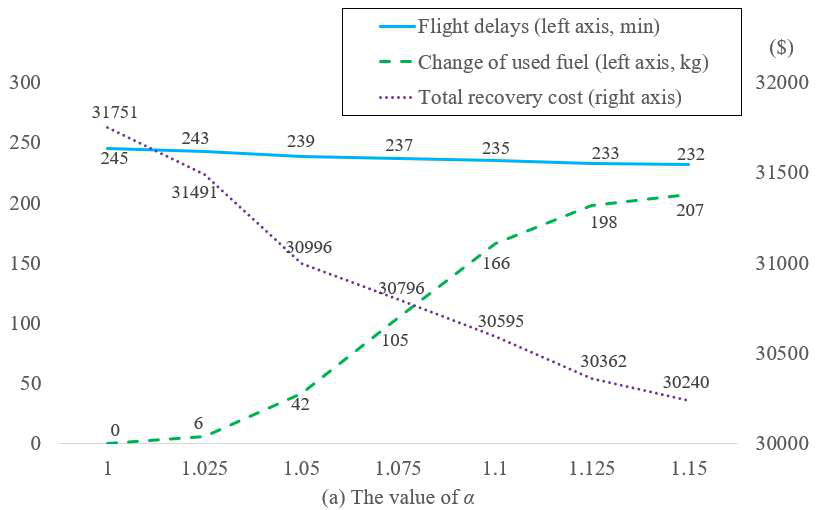
Fig 7: Sensitivity analysis for the values of α and K in the set (48)
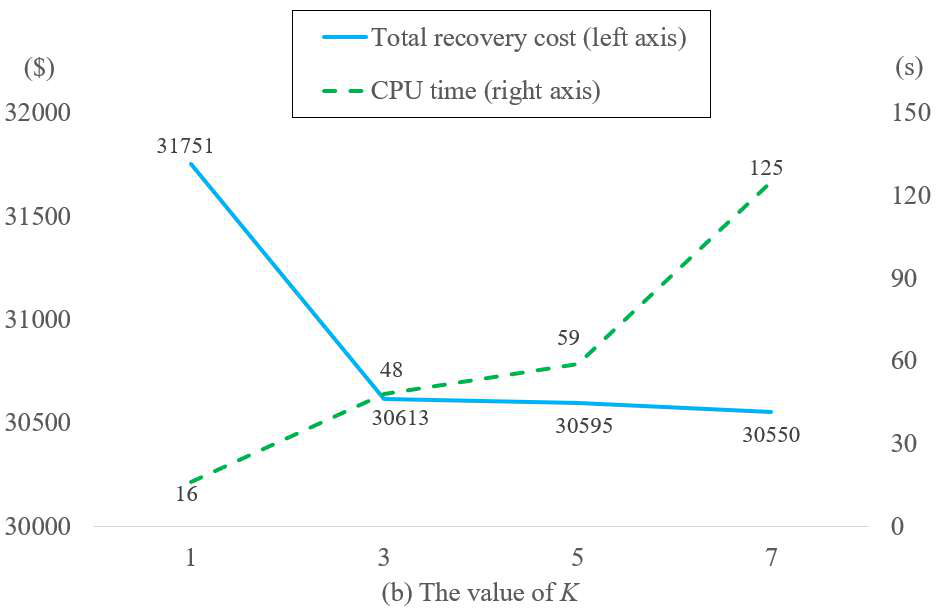
Fig 8: Sensitivity analysis for the unit cost of flight delay and the unit cost of passenger cancellation
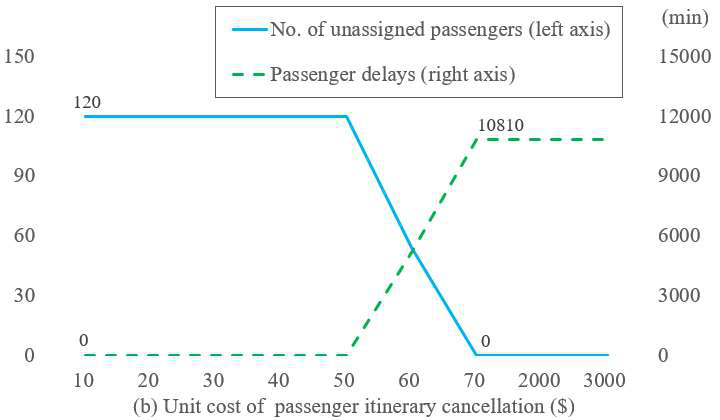
Fig 9: Sensitivity analysis for the unit cost of itinerary change
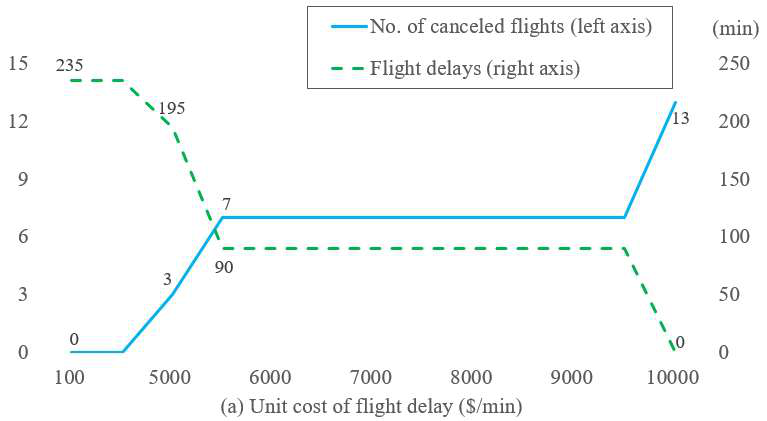
Fig 4 (page 30).
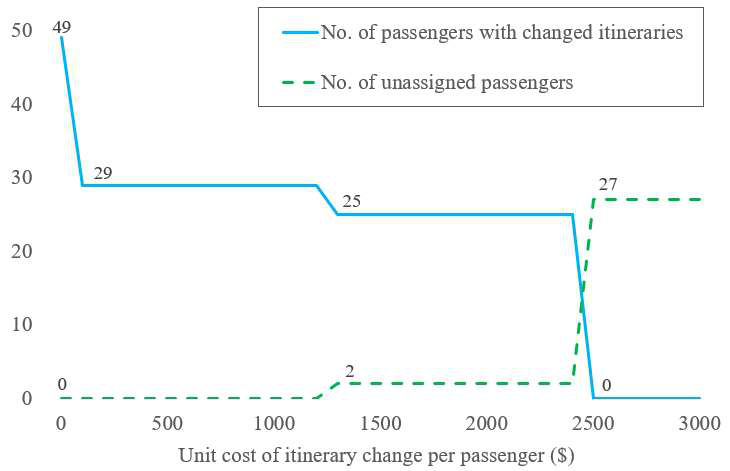
Fig 5 (page 31).
Limitations
- The real-world dataset used is proprietary and not publicly available, limiting external validation.
- Some details of parameter tuning, hyperparameters, and solver configurations are not fully specified.
- No adversarial robustness or distribution shift evaluation of the recovery model was conducted.
- The piecewise discrete cruise speed control may not capture all continuous speed behaviors, potential approximation errors.
- Empirical results show improvements but exact quantitative performance gains (cost reductions, runtime improvements) are not fully tabulated or generalized.
- Reallocation only considers passenger itineraries with the same original flight sequences, may miss cross-itinerary rerouting benefits.
Open questions / follow-ons
- How scalable is the sparse-dense interactive mechanism on much larger airline networks with thousands of flights and millions of passengers?
- Can the approach be extended to incorporate crew scheduling simultaneously with flight and passenger recovery in the integrated model?
- How to integrate uncertainties like fluctuating airport capacities, weather, or further disruptions in a stochastic or robust optimization framework?
- What is the impact of relaxing the passenger itinerary constraints to allow more flexible cross-itinerary rebooking on solution quality and complexity?
Why it matters for bot defense
For bot-defense or CAPTCHA practitioners, this work offers methodological insights into managing large-scale integrated decision problems by reducing problem size via hierarchical abstractions (sparse vs dense copies) and iterative coordination between subproblems. The sparse-dense interactive mechanism demonstrates how big combinatorial optimization problems with interdependent subcomponents can be tackled through decomposition combined with well-designed feedback loops, accelerating convergence without sacrificing solution quality.
While the domain is airline disruption recovery, the core ideas could inspire CAPTCHA and bot-defense systems that require joint optimization of diverse resources or participate in layered decision-making processes. For example, selectively refining portions of a problem space (analogous to sparse-dense flight copies) and alternating optimization over coarse and fine-grained representations might help in efficiently detecting sophisticated automated attacks or adapting challenge-response mechanisms dynamically. The effective use of acceleration and decomposition techniques also highlights promising algorithmic strategies for operationalizing complex bot-defense workflows with latency constraints.
Cite
@article{arxiv2606_19332,
  title={ Sparse-dense flight copy-based interactive mechanism to airline integrated with cruise speed control },
  author={ Jiajin Lin and Jianlin Jiang and Yan Gu and Yuzhen Guo and Cheng-Lung Wu },
  journal={arXiv preprint arXiv:2606.19332},
  year={ 2026 },
  url={https://arxiv.org/abs/2606.19332}
}