
Strategies for preventing and reversing polarized online discourse
Source: arXiv:2606.18226 · Published 2026-06-16 · By Leon Klingborg, Kenneth Mavor, Alexander J. Stewart
TL;DR
This paper addresses the critical problem of political polarization in online discourse, which threatens democratic processes and social cohesion. The authors develop a novel computational model grounded in psychological theory that captures opinion dynamics among individuals with complex, multi-dimensional identities communicating across multiple topics. Unlike prior models that treat agents as holding single opinions with memoryless interactions, this approach incorporates limited memory of past interactions, dynamic in-group/out-group determination based on opinion similarity, and multiple self-aspects representing complex identities. Using this model, the authors systematically explore how key parameters—such as self-consistency, in-group pull, attention bias, and the breadth of acceptable discourse (Overton window)—govern the emergence of consensus, constrained polarization, or runaway polarization.
The study importantly evaluates realistic social media interventions to prevent or reverse polarization. They find that adjusting the Overton window (the range of socially acceptable opinions) alone has limited or even counterproductive effects, sometimes triggering polarization. More effective are strategies that shift user attention toward under-discussed topics, increase costs of norm violations, or highlight influential moderate individuals who model constructive discourse. However, once polarization is entrenched with complex identities, even strong interventions leave latent extremism. The work offers rich insights on psychological and platform-level levers that shape long-run online discourse dynamics and the limitations of censorship-like approaches.
Key findings
- Decreasing self-consistency weight (λ_self) and in-group pull weight (λ_pull) increases likelihood of runaway polarization (Fig 3a).
- Increasing attention bias (α) toward dominant topics strongly promotes runaway polarization, regardless of Overton window width (Fig 3b).
- Narrowing the hard Overton window (w_H) can backfire by increasing runaway polarization as discourse escapes the bounds (Fig 3b).
- Interventions optimizing (shrinking or expanding) the Overton window have limited or negative impact on preventing polarization (Fig 4a).
- Increasing costs for violating existing norms (c_H) effectively prevents polarization but is less successful at reversing it once established (Fig 4b).
- Increasing salience and influence of moderate elites who engage in non-polarized discourse is the most effective intervention for both prevention and reversal of polarization (Fig 4b).
- In simulations with complex identities (multiple self-aspects), even successful interventions lead to latent extremism, indicating persistent radical attitudes despite surface-level consensus.
- Runaway polarization occurs at high rates when at least two of: high attention bias, low self-consistency weight, or low in-group pull weight are present (Table 1).
Threat model
The adversary is conceptualized as emergent social dynamics that drive polarization among typical social media users seeking acceptance and distinction. There is no explicit modeled malicious adversary or attacker with capabilities such as misinformation injection or coordinated manipulation. Instead, the model focuses on how individual psychological and platform-level parameters foster or constrain polarization trajectories in a population of autonomous agents.
Methodology — deep read
The authors construct a computational opinion dynamics model incorporating psychological realism and online discourse features. The threat model assumes adversarial behavior as polarization-driving tendencies among users but does not explicitly model malicious attacks or misinformation agents. The focus is on typical social media interlocutors who seek social conformity and out-group differentiation while maintaining self-consistency.
The population consists of N=100 simulated individuals who hold n=2 attitude dimensions by default (topics). Each individual has D=2 identity dimensions (self-aspects), each with an associated attitude vector. Each individual maintains two memory vectors of fixed size: a self-memory (last s=25 expressed attitudes) and other-memory (last m=50 attitudes expressed by others encountered). Memories are updated sequentially, simulating limited recall of recent interactions.
Dynamic in-group and out-group membership is computed per individual at every step based on the average distance in opinion space between the focal individual's attitude and those in memory. Individuals classify those closer than average as in-group, others as out-group, for each identity and topic dimension separately. This dynamic, opinion-based grouping contrasts with models using fixed group memberships.
At each step, individuals probabilistically decide whether to respond to an unseen post or start a new discussion thread on one of the topics. Threads follow an exponential decay in reply depth to simulate typical social media reply distributions. Attention bias (α) controls the probability of starting a new thread on the dominant topic.
To express an attitude, individuals either post their current attitude or propose a perturbed attitude drawn from a Gaussian distribution. They adopt the perturbation based on a sigmoid probability weighted by the difference in expected utility, which balances self-consistency (λ_self), in-group pull, out-group push (λ_pull), and penalties for violating "soft" (community norms) and "hard" (platform-enforced) Overton window constraints. Utility differences are calculated per identity and topic dimension with softmax-weighted probabilities determining which identity dimension's attitude is expressed.
Model parameters are systematically varied, including attitude update step size (r=0.2), cost parameters (soft and hard Overton costs c_S and c_H), memory sizes, and weights. Simulations run for up to 50 years equivalent (10 million attitude updates) assuming ~5 posts per day per individual. Results are aggregated over 200 runs with randomized initial attitudes within the Overton window.
Outcome states are classified by cluster analysis on attitude distributions: consensus (single cluster within bounds), constrained polarization (two or more clusters within Overton bounds), and runaway polarization (clusters escape bounds). Parameter sweeps reveal critical transitions between these states.
Interventions tested include increasing costs of norm violations, changing the hard Overton window width, reducing attention bias by balancing coverage of topics, and increasing influence of moderate elite agents who model non-polarized discourse. Effectiveness of interventions is measured by reduction in incidence and reversal of runaway polarization.
Technical innovations
- Introduction of multi-dimensional identities and multiple self-aspects within agents, allowing context-dependent attitude expression.
- Dynamic assignment of in-group/out-group membership based on recent memory of expressed attitudes rather than fixed group labels.
- Incorporation of limited memory of past self and other attitudes to capture temporal context and history dependence in interactions.
- Utility-based noisy myopic learning framework balancing in-group conformity, out-group differentiation, self-consistency, and costs for norm violations.
- Combination of soft and hard Overton windows to model emergent community norms and platform rule enforcement effects.
Baselines vs proposed
- Baseline with no intervention: runaway polarization occurs up to 96.5% of simulations under high attention bias, low self-consistency and in-group pull (Table 1).
- Overton window optimization intervention (shrinking or expanding): minimal reduction or increased polarization prevalence (Fig 4a).
- Cost hike on norm violations intervention (c_H increased 100-fold): prevents polarization effectively but less successful in reversal (Fig 4b).
- Moderate elite intervention (increased in-group pull weight of moderate elites to 1.0): most effective in both preventing and reversing runaway polarization (Fig 4b).
- Attention balancing intervention (α=0): broadly effective in reducing runaway polarization (Fig 4a).
Figures from the paper
Figures are reproduced from the source paper for academic discussion. Original copyright: the paper authors. See arXiv:2606.18226.
Fig 1: Structure of the model.
Fig 2: Classification of states. Panels a, b, and c show examples of the three qualitatively different outcome

Fig 3 (page 4).
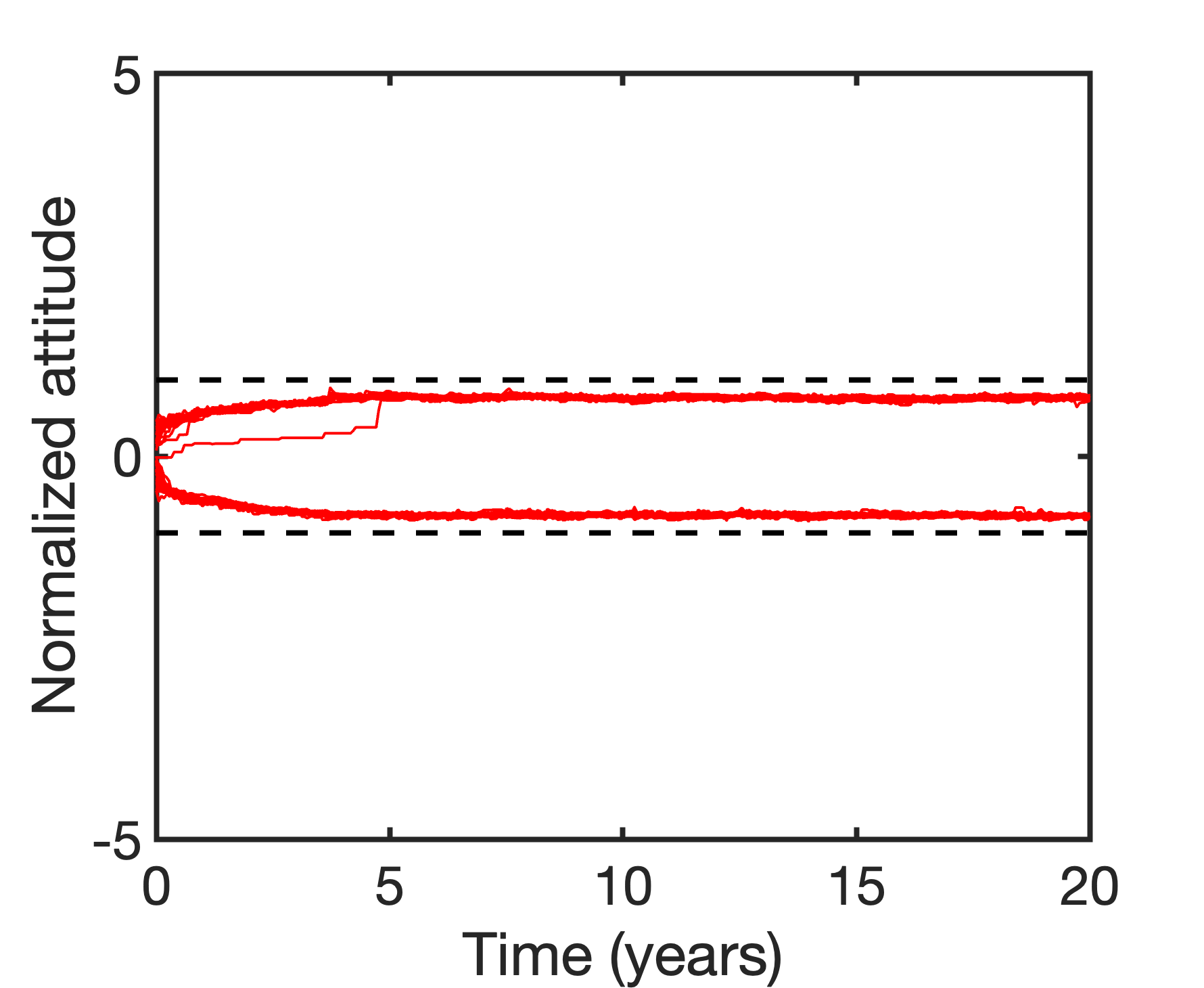
Fig 3: Long-run outcome of discourse. Consensus, constrained polarization and runaway polarization under
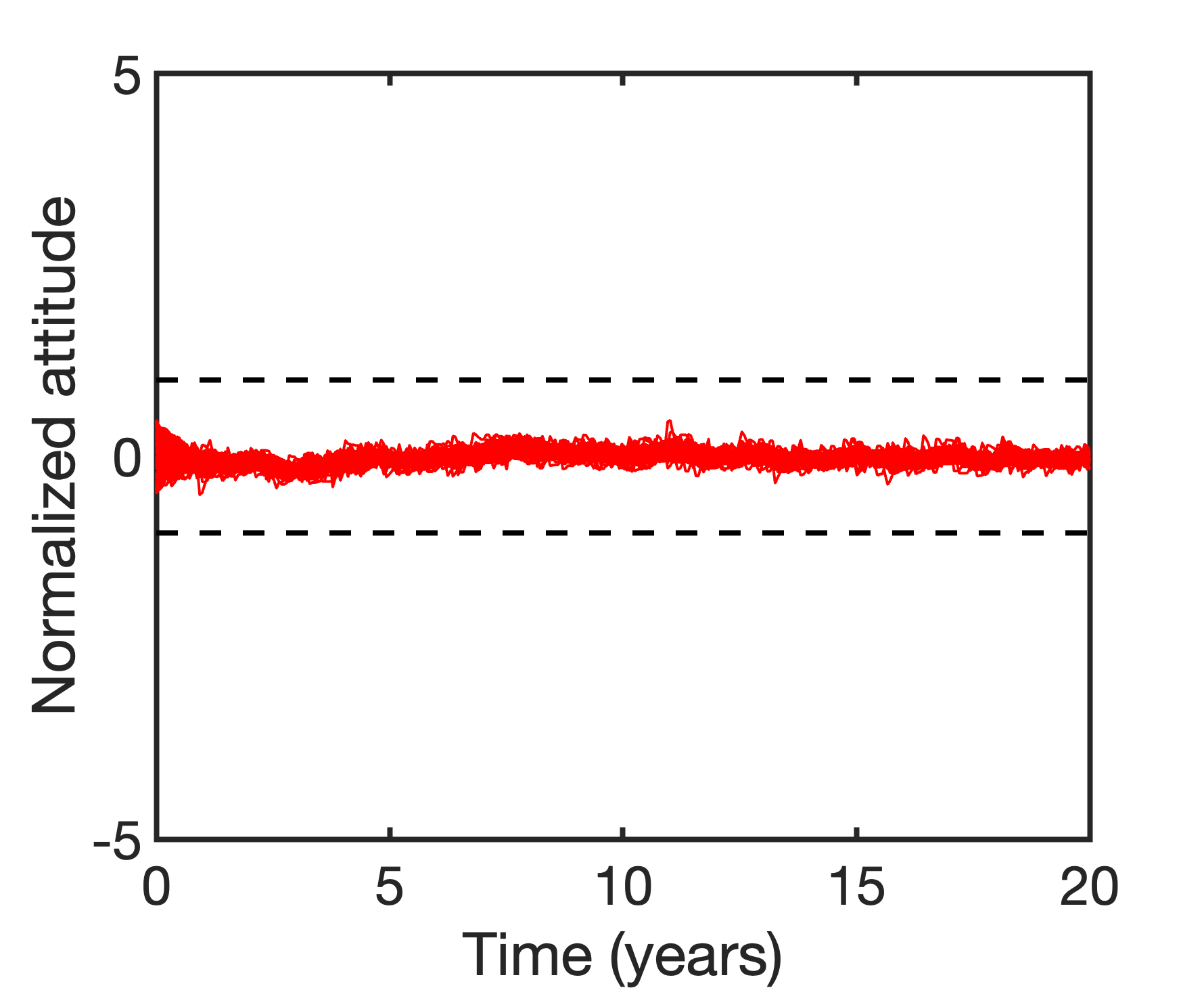
Fig 5 (page 5).
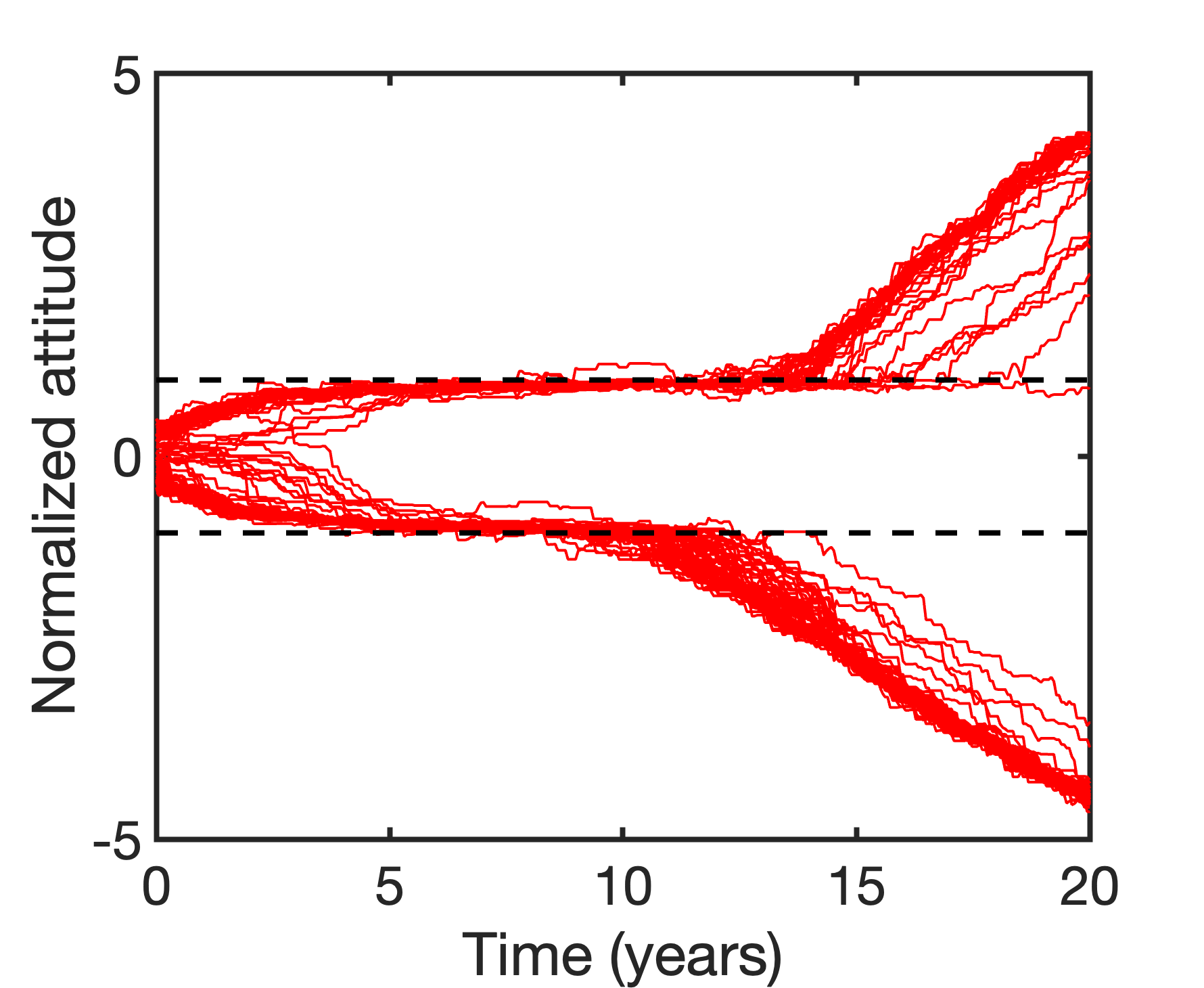
Fig 6 (page 5).
Fig 7 (page 7).
Fig 8 (page 7).
Limitations
- Simplified simulation population (N=100) and default attitude/identity dimensionality (n=2, D=2) may limit generality to real-world scale and complexity.
- Model does not incorporate explicit adversarial or malicious actors, misinformation campaigns, or external coordinated influence.
- Assumption of uniform psychological parameters (λ_self, λ_pull) across individuals; individual heterogeneity is only briefly explored in supplement.
- Social media post rates and memory sizes are approximations; real user behavior and platform dynamics may show greater variability or skew.
- Thread structure follows exponential rather than heavy-tailed distributions seen on real platforms, limiting fidelity to actual discussion dynamics.
- Interventions modeled assume idealized implementations; real-world operational and user acceptance factors are not considered.
- Latent extremism in complex identity scenarios indicates challenges in fully reversing polarization, but implications for offline outcomes are not validated.
Open questions / follow-ons
- How do individual differences in psychological traits or baseline attitudes affect polarization dynamics and intervention efficacy?
- Can integrating explicit adversarial actors and misinformation campaigns refine understanding of intervention robustness?
- How do alternative social media interaction structures (e.g., network topology, asymmetric influence) impact polarization outcomes?
- What are the long-term effects of latent extremism on offline behavior and real-world social cohesion beyond modeled attitude distributions?
Why it matters for bot defense
For bot-defense and CAPTCHA engineers focused on reducing malicious amplification of polarizing content, this work underscores that restricting the range of acceptable speech (via content removal or pruning) is unlikely to be effective alone and may worsen polarization by triggering backlash. Instead, approaches that encourage diversity of discussion topics (counteracting attention bias), enforce social norms consistently, and amplify trusted moderate voices can help prevent extreme polarization emergence. This suggests that technical defenses and bot detection algorithms should also incorporate measures to detect and promote normative, non-polarized discourse signals, not just eliminate 'extreme' content.
Additionally, the finding that complex identity structures lead to latent extremism despite interventions highlights the need for defenses that consider multi-dimensional user behaviors over time, not just isolated suspicious posts. In practice, this could motivate CAPTCHA and bot-detection systems that adaptively assess discourse context, topic diversity, and user influence to balance free expression with social cohesion. This model provides a rigorous, psychologically grounded framework for evaluating platform-level policy or algorithmic designs that interact with user-generated content moderation and automated bot interventions.
Cite
@article{arxiv2606_18226,
  title={ Strategies for preventing and reversing polarized online discourse },
  author={ Leon Klingborg and Kenneth Mavor and Alexander J. Stewart },
  journal={arXiv preprint arXiv:2606.18226},
  year={ 2026 },
  url={https://arxiv.org/abs/2606.18226}
}