
Resolving the smallest scales of massive star formation: A case for next-generation thermal-infrared interferometers
Source: arXiv:2606.18178 · Published 2026-06-16 · By Emma Bordier, Evgenia Koumpia, Lucas Labadie, Joel Sanchez-Bermudez, Alvaro Sanchez-Monge, Jean-Philippe Berger
TL;DR
This white paper addresses the fundamental challenge of understanding massive star formation at the innermost scales (≲100 au), where accretion, ejection, disk fragmentation, and multiplicity are established but remain observationally inaccessible. Existing facilities like ALMA and near-infrared interferometers either lack sufficient angular resolution or are hindered by extinction and limited spectral coverage. The authors advocate for next-generation thermal-infrared (MIR) interferometers operating in the L, M, N, and Q bands, capable of sub-milliarcsecond angular resolution and high spectral resolution to directly observe warm dust and hot gas around massive young stellar objects (MYSOs). Their approach emphasizes heterodyne-based long-baseline interferometry at high, dry sites as the most promising path to pushing MIR interferometry to kilometric baselines, enabling studies of disk structure, chemistry, and kinematics at sub-au scales.
The paper highlights that accessing MIR linewidths and molecular lines invisible to ALMA will allow probing accretion streams, disk winds, and fragmentation mechanisms on dynamical timescales. It also discusses challenges related to atmospheric transmission, thermal background, and phase stability, advocating the use of heterodyne interferometry for its spectral and baseline scalability despite some continuum sensitivity loss. Overall, the paper establishes a compelling technical and scientific case for such next-generation instruments, projecting transformative advances in resolving the smallest scales of massive star formation and disentangling competing formation models across different environments.
Key findings
- Current ALMA and near-infrared (NIR) interferometers cannot resolve the star–disk interaction zone (<1 au) around massive young stellar objects due to limited resolution and extinction.
- Mid-infrared (MIR) bands L, M, N, and Q (3–27 µm) trace warm dust and gas at 100–1000 K on sub-au scales inaccessible to sub-mm or NIR facilities.
- High spectral resolution (R ≈ 50,000 in LMN, 25,000 in Q) is needed to resolve molecular lines with velocity widths of few 10s km/s.
- Important molecular species (e.g., CH4, C2H2, HCN, NH3) and atomic lines ([Fe II], [Ne II], [S I]) are only accessible in MIR bands, offering chemical and kinematic diagnostics.
- Heterodyne interferometry can achieve km-scale baselines with sub-mas resolution in the Q-band, overcoming thermal background and phase stability challenges.
- Disk fragmentation is suggested by ALMA and simulations, but current sample sizes and resolutions are insufficient; next-gen MIR interferometry would enable statistical population studies.
- Atmospheric transmission improves dramatically at high, dry sites (e.g., plateaus) in MIR, which is critical for N and Q-band observations.
- Simulations and existing observations anchor the necessity of sub-au spatial resolution plus spectral resolution to understand accretion, feedback, multiplicity.
Threat model
N/A — this is an instrumentation and observational astronomy proposal, not a security paper. The main constraints are atmospheric transmission, instrumental sensitivity, and physical source properties.
Methodology — deep read
This white paper is a concept and position paper rather than an empirical study but thoroughly lays out the scientific rationale and instrumental requirements for the proposed next-generation thermal-infrared interferometers.
Threat model & assumptions:
- The 'adversary' here is the observational limitation posed by Earth's atmosphere, telescope baseline constraints, and physical properties of massive star-forming regions (e.g., extinction). The paper assumes current instruments cannot penetrate these limitations.
Data:
- The paper synthesizes previous simulation results (e.g., PLUTO hydrodynamic simulations of disk fragmentation) and observational data from ALMA, VLA, VLTI/GRAVITY, CHARA, and others. It references sample sizes of known MYSOs with disk detections numbering less than a dozen above 20 solar masses.
Architecture / algorithm:
- The key architectural proposition is to build long-baseline thermal-IR interferometers using heterodyne detection over km-scale baselines capable of sub-mas angular resolution.
- Heterodyne interferometry converts incoming MIR signals to radio frequencies at each telescope, enabling coherent combination with high spectral resolution independent of thermal background noise.
- Novelty lies in combining heterodyne detection, frequency comb calibration, and high-dry sites to achieve spectral resolutions of R~50,000 and angular sub-mas scale simultaneously in MIR bands.
Training/trials regime:
- The paper references lab-based demonstrations of heterodyne MIR interferometry, but detailed engineering development and on-sky commissioning remain future work.
Evaluation protocol:
- No experimental evaluation is presented; the paper uses simulations, atmospheric models, and prior observations to argue feasibility.
- Figures compare spatial resolutions of current and proposed instruments and atmospheric transmission improvements with elevation.
Reproducibility:
- The concept is forward-looking with no code release or data yet. Reproducibility will depend on instrumentation development.
Concrete example:
- A proposed heterodyne MIR interferometer operating in the N and Q bands with baseline lengths of up to 1 km sited on a high plateau would allow resolving the inner few au of MYSOs located at several kpc, revealing dust temperature distributions, chemical species distribution, and line kinematics tracing accretion and ejection. This is unachievable by current ALMA or NIR instruments.
In summary, the methodology is a comprehensive integration of astrophysical motivations, atmospheric and instrumental modeling, and technology tractability assessments to argue for the necessity and feasibility of next-gen thermal-IR interferometry for massive star formation studies.
Technical innovations
- Proposal of heterodyne-based long-baseline MIR interferometry at km scales to achieve sub-milliarcsecond angular resolution in the L, M, N, and Q bands.
- Integration of frequency comb calibration and photonic technologies to enable coherent combination with high spectral resolution (R ~ 50,000).
- Use of atomic fine-structure and molecular vibration–rotation lines in MIR bands as tracers of physical and chemical conditions unresolved by sub-mm or NIR.
- Site selection emphasis on extremely high, dry plateaus to improve atmospheric transmission and reduce thermal noise in MIR interferometry.
Baselines vs proposed
- ALMA 1.3mm continuum: spatial resolution ~10-100 mas; unable to resolve <1 au disk interaction zone vs proposed: sub-mas resolution <1 au.
- VLTI/GRAVITY NIR interferometry: good angular resolution but limited by extinction and spectral resolution vs proposed: better spectral resolution (R ~50,000) and MIR access to warm dust/gas.
- Simulations (e.g., PLUTO hydro sims): demonstrate disk fragmentation at tens-au scales but require observational confirmation at sub-au scales.
Figures from the paper
Figures are reproduced from the source paper for academic discussion. Original copyright: the paper authors. See arXiv:2606.18178.
Fig 1: Top: : PLUTO simulations showing the early
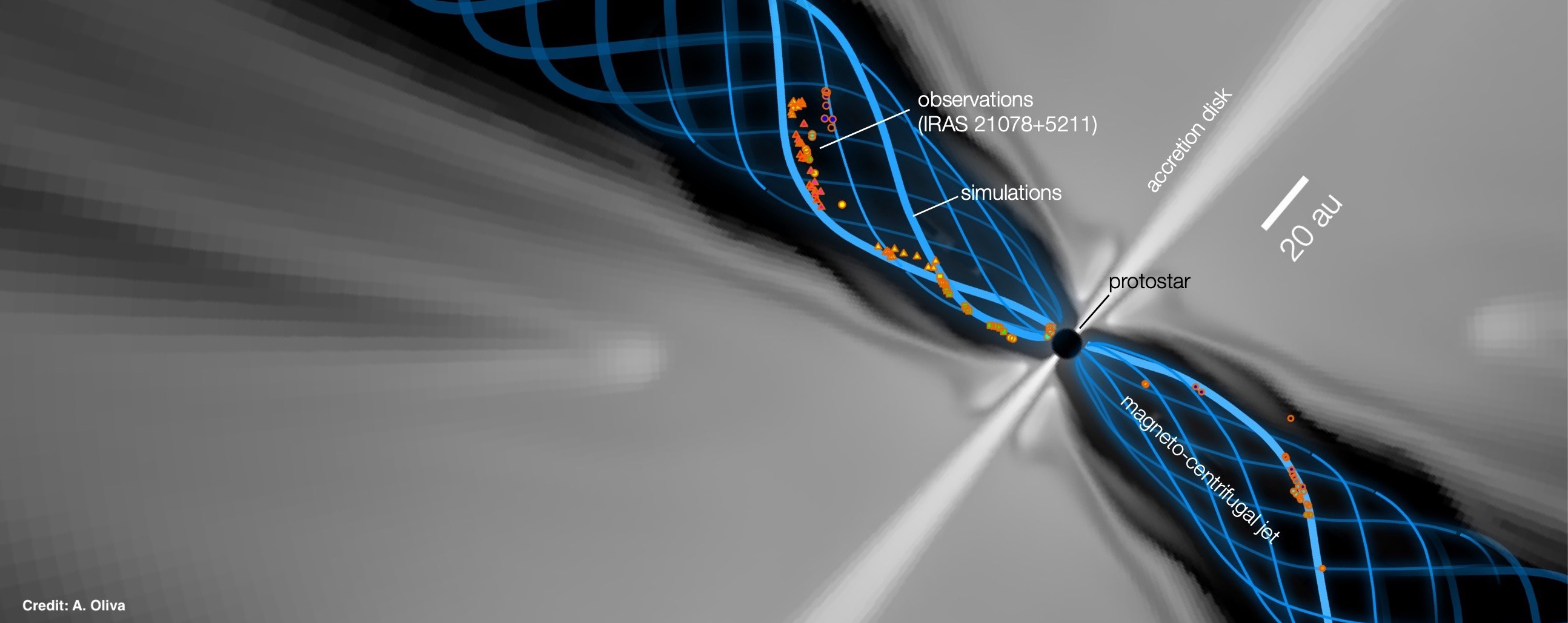
Fig 2 (page 1).
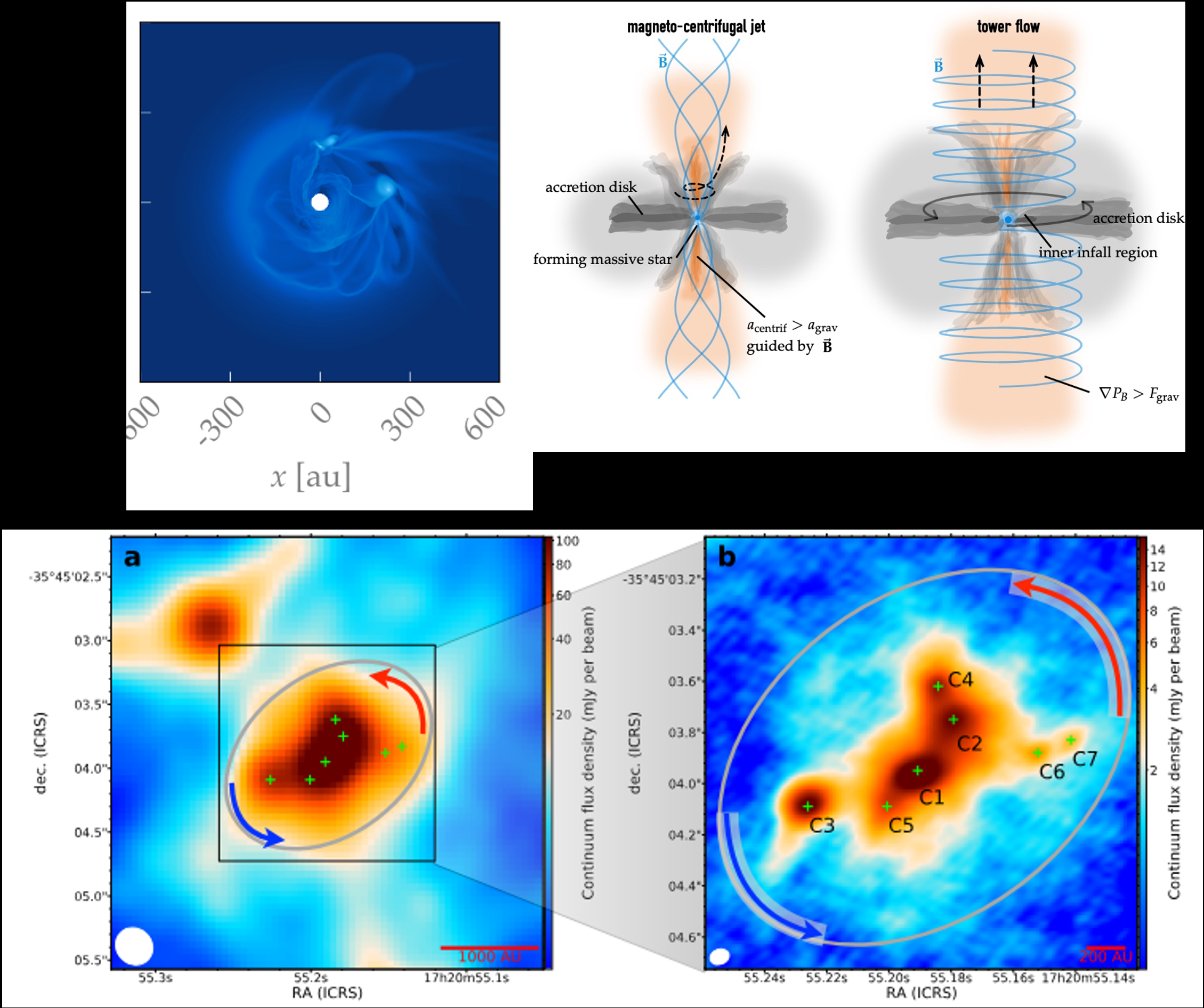
Fig 2: Left: Comparison of spatial resolution of contemporary IR to radio projects, regardless of their sensitivity. Right:
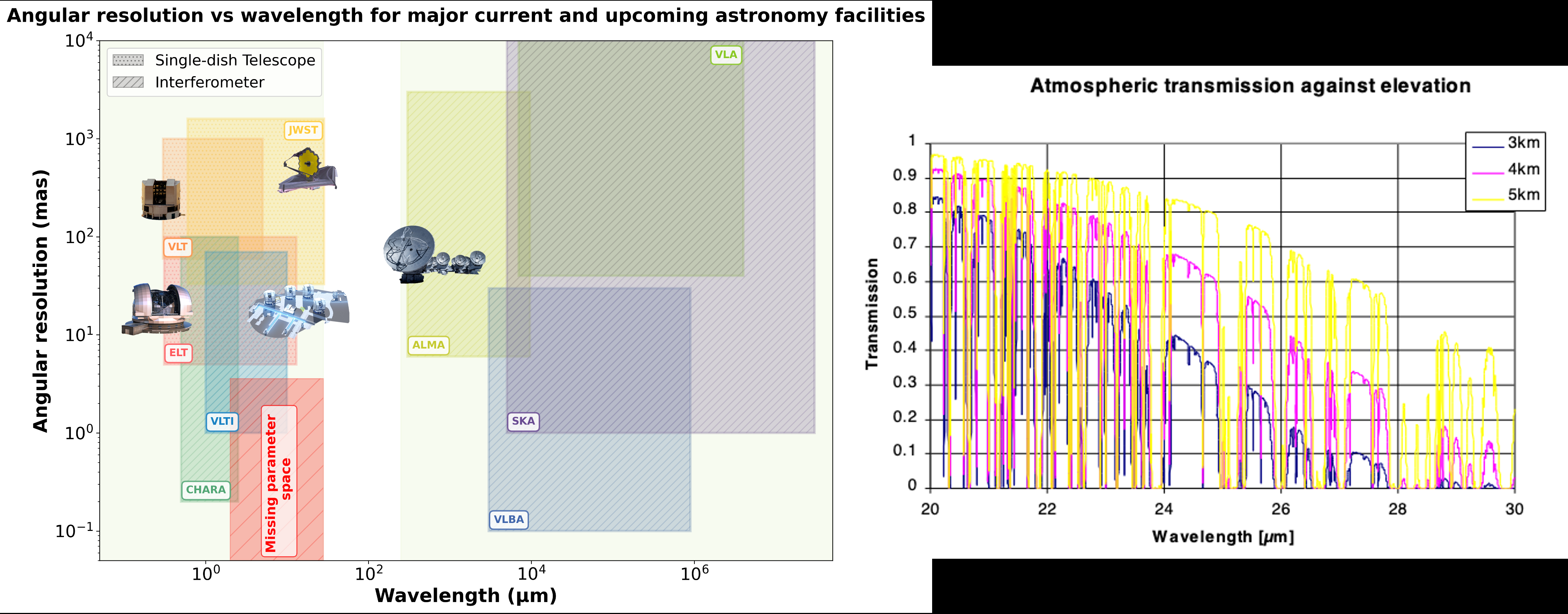
Fig 4 (page 4).
Limitations
- Conceptual/technology readiness level is preliminary; heterodyne MIR interferometry at km baselines has not been field-demonstrated on sky at scale.
- High thermal background and phase stability requirements in MIR Q-band pose significant technical challenges.
- Current models and observations have limited MYSO samples, limiting direct empirical constraints on disk fragmentation and accretion at these scales.
- Methodology lacks experimental validation and depends on future technology development and funding.
- Trade-off with heterodyne interferometry is sensitivity loss to continuum emission, potentially limiting faint source access.
Open questions / follow-ons
- What are the optimal telescope configurations and site conditions to balance sensitivity, baseline length, and phase stability in MIR heterodyne interferometry?
- How do disk fragmentation and multiplicity statistics vary across different galactic environments and metallicities, measurable only with large MIR interferometric samples?
- What new molecular and atomic tracers accessible in MIR bands can be used to uniquely diagnose accretion and feedback in massive star formation?
- Can heterodyne MIR interferometry be combined effectively with other observatories (ALMA, JWST, ELTs) to construct a full chromatic picture of massive star formation?
Why it matters for bot defense
While this white paper focuses on massive star formation and astronomical instrumentation rather than security or bot defense, the methodology — pushing observational resolution and discriminative power by combining high spatial and spectral resolution modalities — is conceptually analogous to approaches in CAPTCHA and bot defense which require resolving subtle signals behind noise and obscuration. For a bot-defense engineer, the emphasis on overcoming fundamental observational constraints (e.g., extinction, limited spectral bandwidth) via heterodyne signal processing and site optimization could inspire approaches to signal extraction improvements. Additionally, the multi-modal data fusion combining spatial, spectral, and temporal dimensions may motivate analogous multi-factor analysis in attack detection frameworks. However, the direct technical contributions around infrared interferometry and astrophysical diagnostics are domain-specific and do not translate into immediate CAPTCHA implementation guidelines.
Cite
@article{arxiv2606_18178,
  title={ Resolving the smallest scales of massive star formation: A case for next-generation thermal-infrared interferometers },
  author={ Emma Bordier and Evgenia Koumpia and Lucas Labadie and Joel Sanchez-Bermudez and Alvaro Sanchez-Monge and Jean-Philippe Berger },
  journal={arXiv preprint arXiv:2606.18178},
  year={ 2026 },
  url={https://arxiv.org/abs/2606.18178}
}