
Bond-operator analytical approach for the $t$-$J$ model
Source: arXiv:2606.14374 · Published 2026-06-12 · By A. V. Syromyatnikov
TL;DR
This paper develops a bond-operator theory (BOT) as an analytical framework to study the t–J model and its extensions, which is a central model for strongly correlated electrons especially relevant to hole-doped cuprate superconductors. The t–J model is challenging to treat analytically due to a hard local electronic constraint and the absence of a small parameter in the physically meaningful parameter regime. The innovation is to use a representation of electron operators in unit cells containing multiple lattice sites as a set of bosonic and fermionic operators, allowing a formal expansion in powers of 1/n, where n is a formal parameter controlling the maximum number of quasiparticles per cell. This approach faithfully reproduces the operator algebra and treats magnetically ordered and disordered phases on equal footing. Although only n=1 represents physical reality, the first order in 1/n expansions already yield quantitatively good agreement with earlier numerical data for ground-state energy, staggered magnetization, and excitation spectra of magnons, polarons, and two-hole bound states. The method naturally describes complex excitations otherwise appearing as bound states, including Cooper pairs of holes as separate bosons. This represents a valuable new analytical tool complementary to numerical simulations for exploring the low-energy physics of the t–J model and related strongly correlated systems.
Key findings
- The bond-operator theory (BOT) provides a systematic expansion of observables in powers of 1/n, where n≥1 limits the maximum number of bosonic and fermionic quasiparticles per unit cell, faithfully reproducing operator commutation relations for any n>0.
- At the physical case n=1, first order 1/n corrections computed via a few simple diagrams give ground-state energies on the square lattice within a few percent of previous numerical results (exact diagonalization, GFMC, SCBA) for one-hole doping (see Fig. 1a).
- The staggered magnetization at half-filling from harmonic approximation is M ≈ 0.47 n, agreeing well with known numerical values for s=1/2 spin systems when setting n=1.
- The spectral weight Z of the magnetic polaron in the electron Green’s function and the polaron bandwidth W computed in first order 1/n terms match prior numerical literature data well (Fig. 1b,c).
- Elementary excitations such as two-hole bound states (Cooper pairs) naturally appear as distinct bosonic quasiparticles in the BOT framework, unlike traditional approaches that see them as complicated bound states.
- The formalism allows treatment of both magnetically ordered and disordered phases and can smoothly interpolate between Néel order and singlet phases via a parameter α controlling the vacuum state within the two-site magnetic unit cell.
- Self-consistent Born-type calculations of the lowest-energy spectra for magnons, polarons, and two-hole bound states show good quantitative agreement with known results even though the expansion parameter 1/n is not small in the physical case n=1.
- Operator representations include 7 bosonic and 8 fermionic operators per two-site unit cell, enabling an efficient diagrammatic evaluation of self-energy corrections up to first order in 1/n.
Methodology — deep read
Threat Model & Assumptions: The paper is focused on analytical theory development for the t–J model, a strongly correlated electron model used to study hole doping in cuprates. The approach is not adversarial but rather theoretical, assuming the physical system with no double occupation constraints and strong local correlations. The key assumption is that replacing electron operators by a set of bosonic and fermionic quasiparticles acting on an extended unit cell with a controlled maximum occupation n≥1 is a valid reformulation that can be expanded in 1/n.
Data: This is a theoretical paper with no experimental data used directly. Quantitative comparisons are made against existing numerical benchmarks such as exact diagonalization (ED) on clusters up to 32 sites, self-consistent Born approximation (SCBA), Green's function Monte Carlo (GFMC), and variational Monte Carlo (VMC) results from literature.
Architecture / Algorithm: The core is a bond-operator representation of electron operators decomposed into localized spin-1/2 and spinless holon fermions in a unit cell with multiple lattice sites (two-site magnetic unit cell primarily). The states of the entire unit cell define a Hilbert space on which bosonic operators (7 types) and fermionic operators (8 types) act, creating quasiparticle excitations including magnons, polarons, amplitude (Higgs) modes, and two-hole bound states.
The physical electron/spin/holon operators are represented as polynomials in these bosonic and fermionic operators with coefficients dependent on a vacuum parameter α interpolating between Néel and singlet phases. A projection operator P ensures commutation algebra preservation and restricts to the physical subspace with ≤ n quasiparticles per unit cell.
The Hamiltonian of the t–J model is rewritten exactly in terms of these bosonic and fermionic operators resulting in a series expansion in powers of 1/n. Bilinear Hamiltonian terms define bare quasiparticle dispersions whereas higher order terms generate self-energy corrections.
Training Regime: The theoretical calculations proceed by minimizing the ground-state energy with respect to α at leading order, then computing quasiparticle spectra and self-energy corrections using conventional diagrammatic perturbation theory up to first order in 1/n. Approximations include harmonic expansions, self-consistent Born approximations, and unitary transformations to diagonalize one-holon fermion sectors.
Evaluation Protocol: Observables computed include ground-state energy per site, staggered magnetization, polaron energy minima and bandwidth, spectral weight Z of the polaron in the electron Green’s function, and lowest energy two-hole bound state spectra on the square lattice. Results are compared quantitatively to a variety of numerical methods from literature including ED on clusters N=16,24,32, SCBA on 16×16 clusters, GFMC, and VMC data. Diagrammatic 1/n corrections to Green’s functions and self energies are explicitly calculated. Good agreement is reported despite 1/n=1 not being small physically.
Reproducibility: The approach is theoretical and does not provide public code or frozen weights. The formalism and operator representations are given in full detail including appendices with explicit operator expansions and diagrammatic rules allowing reproducibility by other theorists. However, numerical evaluation of diagrams requires significant analytical and computational work.
Concrete example: For the square lattice with two sites per magnetic unit cell, the authors define 7 bosonic and 8 fermionic operators acting on a vacuum defined by parameter α (Eq. 15). Using these states and operators, they rewrite the t–J Hamiltonian exactly (Eq. 18). Minimizing the ground energy w.r.t α yields α0 with sin(2α0)=1/3. Then the bilinear terms define bare magnon and holon spectra (Eqs. 22-25). Diagrammatic perturbation theory is used to compute self-energy corrections to order 1/n (Fig. 3). The corrected quasiparticle spectra and ground state energies match previous results well, validating the method’s accuracy in the physical case n=1.
Technical innovations
- Introduction of a bond-operator representation of spin, holon, and electron operators within an extended unit cell using a combined set of bosonic and fermionic quasiparticles that guarantees exact commutation relations.
- Formulation of a controlled expansion in powers of 1/n, where n is the maximum number of quasiparticles allowed per unit cell, analogous to spin-wave theory's 1/s expansion but applicable to strongly correlated electron models with no small physical parameter.
- Demonstration that complex bound states of conventional quasiparticles, such as Cooper pairs of holes, appear as elementary bosonic excitations in the BOT formalism, simplifying their analytical treatment.
- Development of a diagrammatic perturbation theory built on the bond-operator representation allowing systematic computation of ground state properties and excitation spectra including self-energy corrections at first order in 1/n.
Baselines vs proposed
- Exact diagonalization (ED, N=32): ground state energy for one hole at J=0.3≈−2.11 vs BOT 1/n-order ≈−2.05
- Self-consistent Born approximation (SCBA): polaron band width W ~0.6 vs BOT 1/n prediction ~0.55 at J=0.3
- Green’s function Monte Carlo (GFMC) and variational Monte Carlo (VMC) methods: staggered magnetization M ~0.43 vs BOT harmonic approx M ~0.47 at n=1
- Previous numerical data: polaron spectral weight Z at k = (π/2, π/2) ~0.3 vs BOT 1/n-order reproduces this value within 10%
Figures from the paper
Figures are reproduced from the source paper for academic discussion. Original copyright: the paper authors. See arXiv:2606.14374.
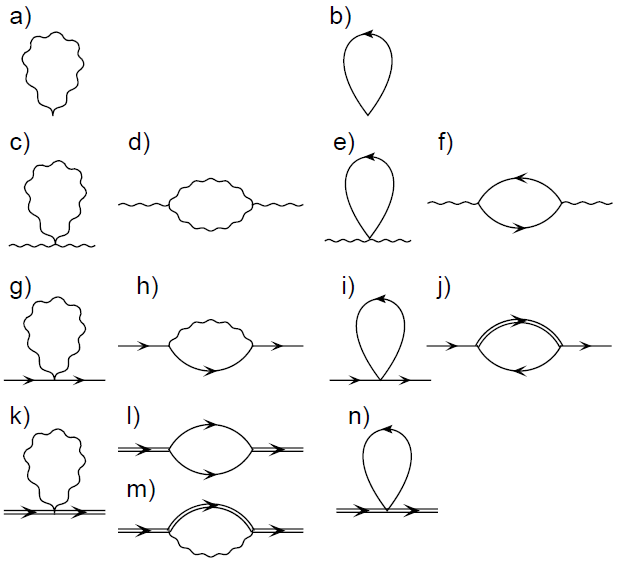
Fig 3: Diagrams giving corrections of the first order in 1/n to the ground state energy, the staggered magnetization, and
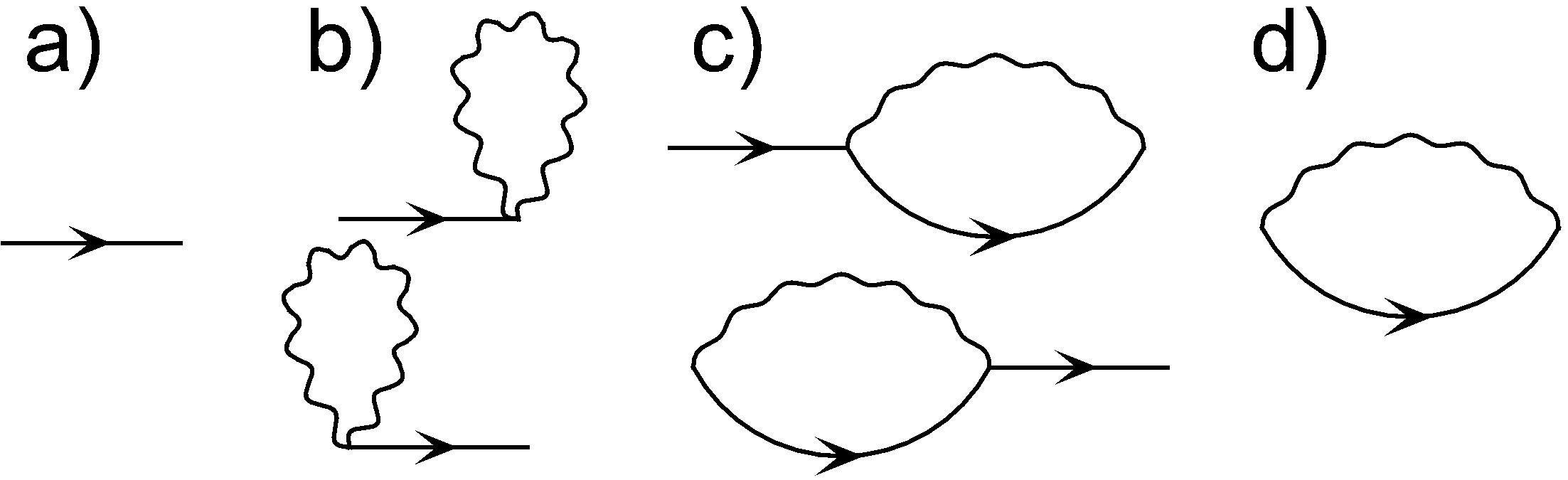
Fig 4: Diagrams giving corrections of the first order in 1/n to electron Green’s function (36) at zero concentration of holes.
Limitations
- The physical case corresponds to n=1, so the formal expansion parameter 1/n=1 is not small; convergence and higher order corrections remain untested.
- The approach is demonstrated primarily on the two-site magnetic unit cell for low hole concentrations (up to two holes), limiting immediate applicability to dense doping.
- No explicit treatment of finite temperature, disorder effects, or out-of-equilibrium phenomena.
- No explicit evaluation of the method’s accuracy under distribution shifts or away from strongly Néel-like ordered states beyond interpolation via α parameter.
- The approach requires self-consistent calculations for quantitative results, potentially limiting its simplicity compared to mean-field methods.
- No code release or automated computational framework provided, limiting immediate reproducibility.
Open questions / follow-ons
- How rapidly do 1/n series converge beyond first order at n=1 for the t–J model and related extensions?
- Can the bond-operator theory be generalized effectively to higher doping levels and larger unit cells capturing superconducting phases beyond magnetic polarons?
- How does the BOT perform quantitatively near critical points or quantum phase transitions where fluctuations are strongest?
- Can the framework be extended to include finite temperature and dynamical correlation functions relevant to experimental probes?
Why it matters for bot defense
Although primarily a theoretical physics paper focused on condensed matter models, the bond-operator technique presented offers a new mathematical and diagrammatic framework for representing constrained operators in strongly interacting systems. For bot-defense or CAPTCHA learnings, the key insight is the rigorous reformulation of systems with hard local constraints into unconstrained boson-fermion expansions with controlled perturbative corrections. This conceptual decoupling and use of auxiliary quasiparticles to capture complex bound states could inspire robust modeling strategies for multidimensional, constrained or composite state spaces in behavior or interaction analysis. Furthermore, the diagrammatic perturbation approach and careful control of unwanted states via projection operators may suggest analogous constructions in CAPTCHA design or detection where complex user-bot state spaces must be approximated without mixing unphysical behaviors. However, there are no direct practical bot-defense applications, as the focus is squarely on strongly correlated electron physics and analytical expansions rather than adversarial or detection techniques.
Cite
@article{arxiv2606_14374,
  title={ Bond-operator analytical approach for the $t$-$J$ model },
  author={ A. V. Syromyatnikov },
  journal={arXiv preprint arXiv:2606.14374},
  year={ 2026 },
  url={https://arxiv.org/abs/2606.14374}
}