
Probing Axion Dark Matter via the Chiral Magnetic Effect in Zero-Bias Weyl Semimetals
Source: arXiv:2606.13595 · Published 2026-06-11 · By Debajit Bose, Prataya Chandra, Sudhansu S. Mandal, Tirtha Sankar Ray
TL;DR
This paper investigates a novel detection method for sub-eV axion dark matter (DM) by exploiting the chiral magnetic effect (CME) in zero-bias Weyl semimetals subjected to an external static magnetic field. Axions, motivated as a solution to the strong CP problem and a candidate for coherent light dark matter, induce an axial chemical potential in the electron states near Weyl nodes. This axial chemical potential causes a chiral imbalance that, combined with the magnetic field, drives a measurable oscillatory current—an axion-driven CME current. The authors show that a realistic setup with a 1 cm2 Weyl semimetal sample in a 10 T magnetic field yields femtoampere scale currents detectable by cutting-edge SQUID current sensors.
Novelty lies in leveraging the topological protection of Weyl nodes to achieve a universal CME current density formula independent of the Fermi velocity and proposing zero-bias Weyl semimetals as axionic transducers, giving laboratory access to axion-electron couplings (gae) below current stellar cooling bounds across a broad axion mass range (10^-17 eV to 10^-4 eV). The detailed modeling includes relaxation time and frequency-dependent noise effects. The work outlines experimental avenues including layer stacking, resonant LC circuits, and flux amplification to further enhance sensitivity.
Key findings
- The bulk CME current density induced by axion DM in a single Weyl node pair is JCME = (e^2 / 2π^2) µ5 B (Eq. 11), where µ5 is the axion-induced axial chemical potential.
- For a 1 cm2 Weyl semimetal sample in a 10 T magnetic field and axion-electron coupling gae = 10^-13 (stellar cooling bound), the CME current amplitude is ~3.9 x 10^-15 A (femtoampere scale).
- Projected sensitivity allows probing gae ~10^-14 for axion masses between 10^-17 eV and 10^-4 eV, exceeding existing astrophysical constraints (Fig. 4).
- Sensitivity degrades above ma ~10^-4 eV due to finite carrier relaxation time (τ ~10^-11 s) causing thermal suppression: sensitivity scales as (1 + (ma τ)^2)^-1.
- At low frequencies (below ~1 Hz), SQUID 1/f noise increases noise floor, limiting sensitivity at low axion masses (ma < 10^-17 eV), as shown by dashed curves in Fig. 4.
- Stacking multiple layers or arrays of Weyl semimetals linearly increases total CME current, improving reach to lower gae couplings.
- Resonant enhancement with high-Q LC circuits and multi-turn superconducting coils can boost the CME signal above detector noise floors.
- Fermi velocity cancels out in the CME current formula due to topological protection, making the effect robust across different Weyl materials.
Threat model
The adversary is the coherent ultralight axion dark matter field permeating the laboratory environment, modeled as a classical oscillating field with frequency set by its mass and unknown coupling gae to electrons. The axion cannot be controlled or shielded but indirectly influences the Weyl semimetal electrons by inducing an axial chemical potential. The setup assumes no adversarial interference, i.e., no active sabotage, and depends on the physical presence of the axion field interacting weakly via CP-violating couplings.
Methodology — deep read
The authors start by defining the threat model as an astrophysical axion DM background modeled as a coherent classical oscillating field a(t) = a0 cos(mat) with local DM density ρ_DM ≈ 0.3 GeV/cm^3, treating axions as ultralight scalar fields with unknown coupling gae to electrons. The adversary here is indirect: the axion field influences electrons in a Weyl semimetal, inducing measurable currents.
Data provenance is primarily theoretical and computational; no experimental data was collected. Material parameters such as Fermi velocity, carrier relaxation time, and magnetic field strengths are taken from reported literature on Weyl semimetals like Co3Sn2S2 or Co2MnGa. The sample size considered is 1 cm2 area with a sample thickness providing Weyl node pairs.
The core algorithm leverages quantum field theory and condensed matter physics methods: starting from the Weyl semimetal Hamiltonian near the node H0 = χ vF σ ⋅ p (with chirality χ= ±1), augmented by the axion-electron coupling term as an axial chemical potential µ5. They calculate the chiral magnetic current density as JCME = (e^2 / 2π^2) µ5 B, arising from an occupation change in the lowest Landau levels induced by µ5. This is confirmed via an independent field-theoretic Fujikawa method derivation.
Training as such is not involved; rather, parameter sensitivity is explored by numerical evaluation of the CME current amplitude for different gae, magnetic field B, sample area A, and axion mass ma. Thermal and relaxation effects are modeled using measured carrier relaxation time τ ~10^-11 s to calculate frequency-dependent dampening of the CME current at higher axion masses/frequencies.
Evaluation simulates projected experimental sensitivity by comparing the expected signal currents to state-of-the-art SQUID detector noise floors, including white noise and 1/f noise regimes. Sensitivity curves (Figs. 3 and 4) map gae upper limits versus axion mass for realistic measurement scenarios (integration time, frequency response, noise floors). Baselines include existing astrophysical and direct detection bounds: stellar cooling from red giants and XENONnT direct detection limits.
The paper is fully theoretical; code and experimental data are not released, and the analysis depends on known Weyl semimetal parameters from prior published materials. The work proposes practical end-to-end detection scenarios: a coherent axion field induces an axial chemical potential in Weyl fermions near nodes; this creates a zero-bias chiral magnetic current in presence of B; the current is oscillatory at frequency ma, which is measured by ultra-low noise sensitive SQUID ammeters. Measurements below 1 fA and magnetic fields around 10 T are used as experimental input benchmarks.
A concrete example: for B=10 T, A=1 cm², a single Weyl node pair, and gae=10^-13, the induced CME current amplitude is ~3.9 fA at frequency set by axion mass ma. This signal level lies within sensitivity ranges of modern SQUID-based measurements, allowing probing of new parameter space beyond astrophysical bounds.
Technical innovations
- Universal expression for axion-induced CME current density in zero-bias Weyl semimetals independent of Fermi velocity due to topological protection of chiral anomaly.
- Modeling of frequency-dependent suppression of CME current by finite carrier relaxation time in Weyl semimetals, refining realistic sensitivity estimates (Eq. 13).
- Integration of ultralight axion DM coherent field effects with chiral magnetic transport phenomena in novel materials to transduce axion interactions into measurable currents.
- Proposal of laboratory axion searches via SQUID-based detection of femtoampere CME currents under accessible magnetic fields (∼10 T) in engineered Weyl semimetal samples.
Baselines vs proposed
- Stellar cooling bound (red giant tip luminosity): gae < 10^-13 (approximate upper bound) vs proposed sensitivity probes below 10^-14 gae for 10^-17 eV < ma < 10^-4 eV
- XENONnT direct detection limit: excludes gae above ~a few ×10^-13 (electron recoil events) vs proposed SQUID measurement reaching gae ~10^-14 in same mass range (Fig. 4)
- SQUID noise floor comparison: Current noise floors of 1 fA and 10 fA define sensitivity curves; 1 fA noise floor improves gae limit roughly by an order of magnitude relative to 10 fA.
Figures from the paper
Figures are reproduced from the source paper for academic discussion. Original copyright: the paper authors. See arXiv:2606.13595.
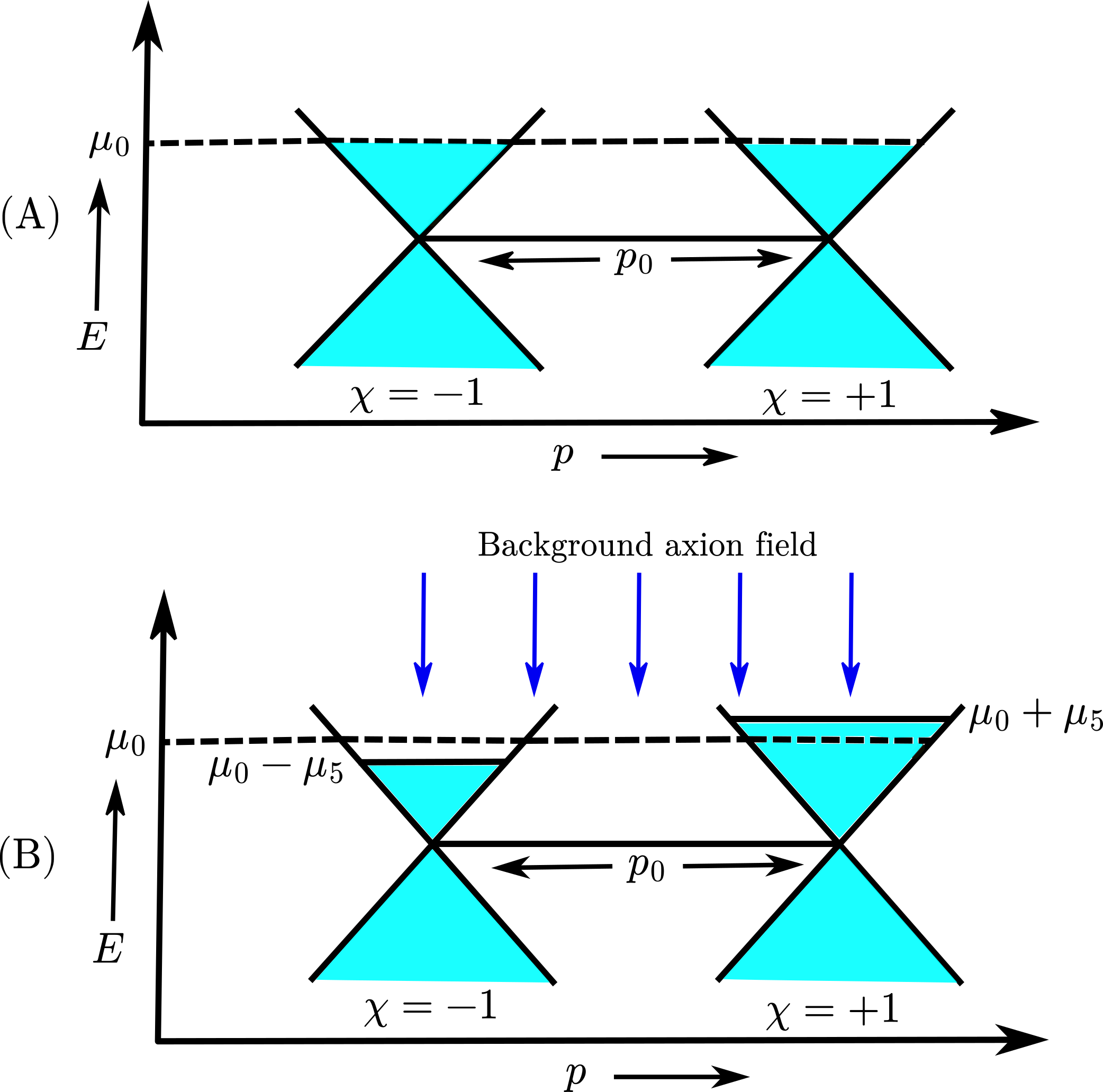
Fig 2: Schematic band structure near Weyl nodes of
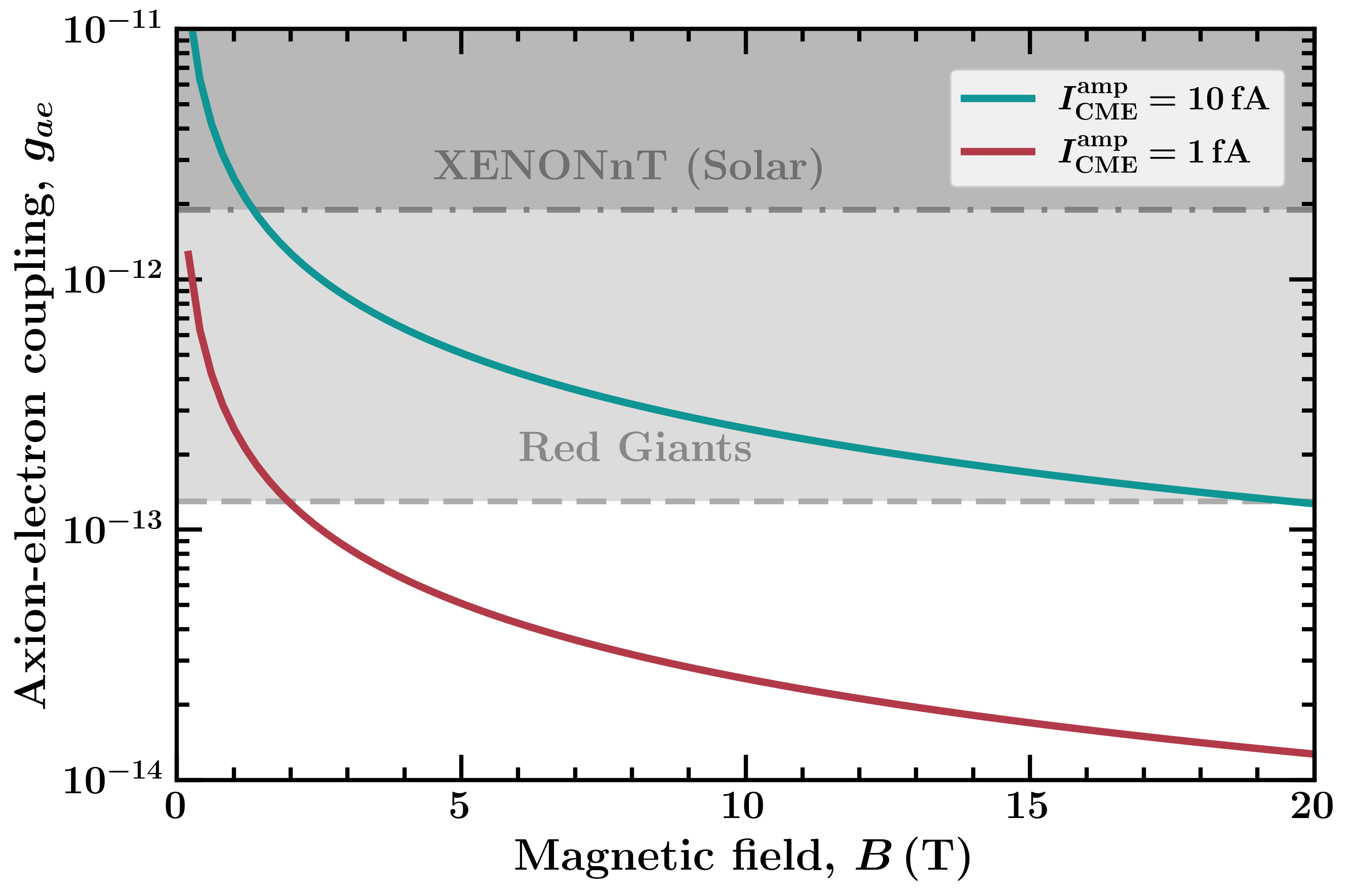
Fig 3: Projected sensitivity to the axion–electron cou-
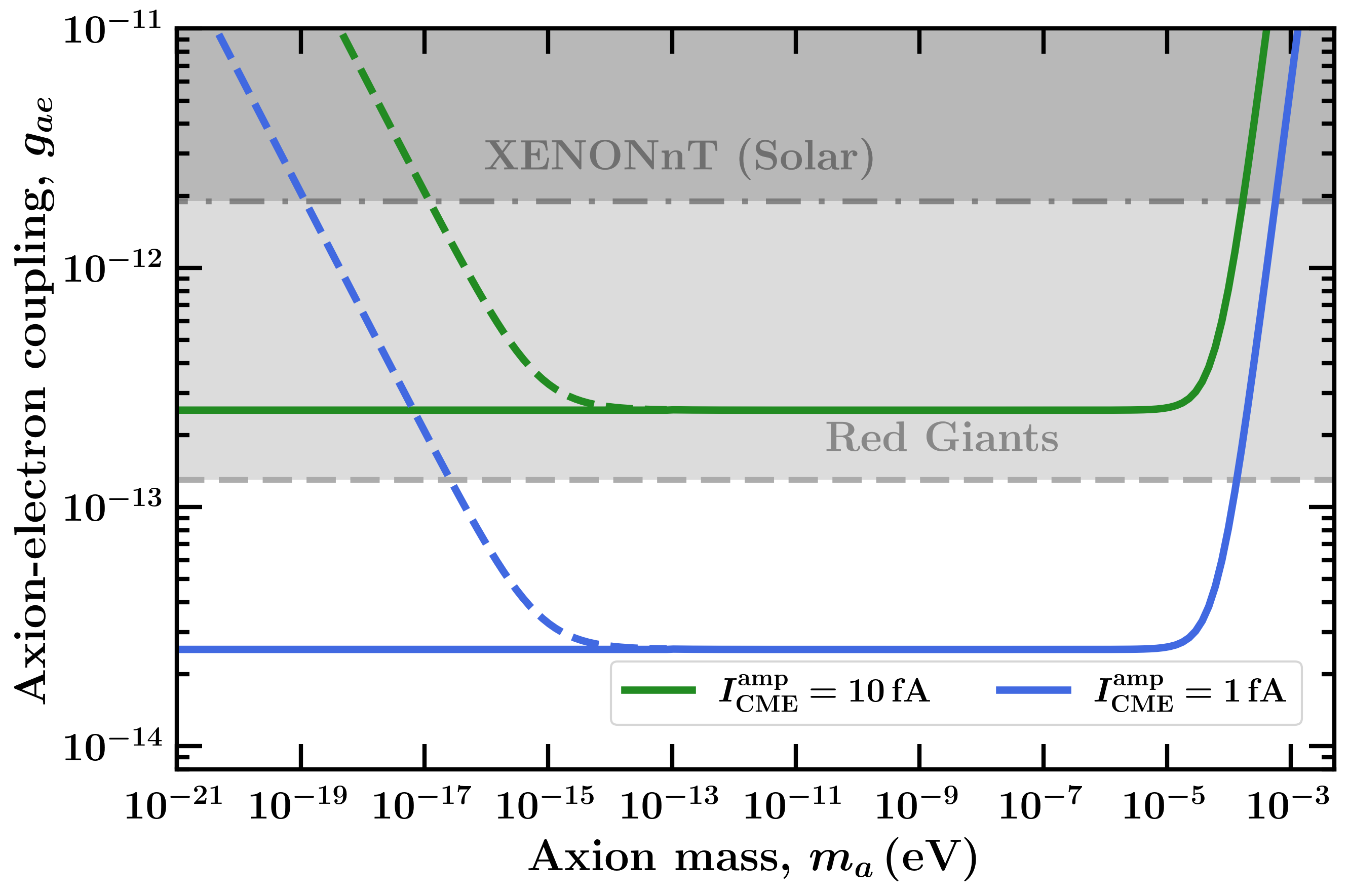
Fig 4: Projected sensitivity to gae as a function of axion
Limitations
- No experimental validation yet; results are theoretical projections dependent on idealized Weyl semimetal properties and magnetic field strengths.
- Relaxation time τ used to model thermal suppression is taken from literature but may vary by material and temperature affecting real sensitivity.
- Detector noise modeling assumes state-of-the-art SQUID devices but 1/f noise and other low-frequency noise may be challenging to mitigate experimentally.
- Axion mass range sensitivity limited at low masses by noise and at high masses by finite relaxation time; sensitivity drops outside 10^-17 to 10^-4 eV mass window.
- Single Weyl node pair assumed; realistic materials may have multiple nodes or complications leading to partial current cancellation not fully explored.
- No detailed study of background contamination or alternative signal sources that could mimic the CME currents at femtoampere levels.
Open questions / follow-ons
- How robust is the CME current signal against realistic material imperfections, disorder, and multiple Weyl node interference effects in candidate semimetals?
- Can experimental measurement techniques be further optimized to overcome 1/f SQUID noise at ultra-low frequencies corresponding to very light axions below 10^-17 eV?
- What alternative condensed matter systems or engineered heterostructures might provide larger or more easily measurable axionic CME responses?
- How does temperature variation and material aging affect carrier relaxation times and consequently the frequency-dependent sensitivity?
Why it matters for bot defense
Though primarily a fundamental physics detection proposal, the paper’s methods and techniques have indirect relevance to bot-defense and CAPTCHA design through the use of ultra-sensitive, low-noise signal detection technologies like SQUID-based amplifiers and quantum materials engineering. The capability to measure femtoampere-scale currents in noisy environments reflects the broader challenge of detecting weak signals against adversarial or noisy backgrounds, a theme common in bot detection contexts. Additionally, the theoretical modeling and experimental design considerations of highly sensitive materials with topological protection could inspire novel sensor designs for security applications that require robustness against subtle evasion attempts.
Practitioners in bot defense may draw parallels from the proposed technique’s need for minimizing noise (e.g., 1/f noise) and enhancing signal-to-noise through layering or resonance, analogous to techniques for hardening CAPTCHA challenges or improving bot-detection throughput under conditions of noisy, adversarial traffic. While the physics context is distinct, insights into balancing signal amplification with noise suppression have conceptual relevance. However, direct application to CAPTCHA challenges is limited since the paper addresses physical particle detection rather than interactive computation or behavioral analysis.
Cite
@article{arxiv2606_13595,
  title={ Probing Axion Dark Matter via the Chiral Magnetic Effect in Zero-Bias Weyl Semimetals },
  author={ Debajit Bose and Prataya Chandra and Sudhansu S. Mandal and Tirtha Sankar Ray },
  journal={arXiv preprint arXiv:2606.13595},
  year={ 2026 },
  url={https://arxiv.org/abs/2606.13595}
}