
Limits of constant-parameter constitutive models for hydrogels under inertial cavitation
Source: arXiv:2606.13584 · Published 2026-06-11 · By Tianyi Chu, Joseph Beckett, Zhiren Zhu, Jonathan B. Estrada, Spencer H. Bryngelson
TL;DR
This paper addresses the challenge of mechanically characterizing soft hydrogels under extremely high strain rates induced by inertial cavitation events, where standard constant-parameter constitutive models are insufficient. The authors focus on laser-induced cavitation (LIC) experiments coupled with inertial microcavitation rheometry (IMR) techniques that infer material parameters by fitting bubble radius dynamics to a bubble dynamics model governed by a neo-Hookean Kelvin-Voigt (NHKV) constitutive law. A key novelty is the use of a sliding-window modified iterative ensemble Kalman smoother with multiple data assimilation (MIEnKS-MDA) to extract time-resolved, evolving material parameters rather than a single effective parameter set. This allows diagnosis of when the constant-parameter assumption breaks down throughout the cavitation event.
By applying MIEnKS-MDA to polyacrylamide (PAAm) hydrogels with different crosslinker concentrations and gelatin gels at different temperatures, the authors reveal that apparent shear modulus and viscosity evolve dynamically during the cavitation process, with marked differences in temperature sensitivity and transient behavior across materials. PAAm gels show a general decrease then plateau of stiffness and viscosity, weakly temperature dependent, whereas gelatin exhibits complex temperature-dependent trends and pronounced variations during bubble collapses. These results demonstrate that constant-parameter NHKV models cannot fully capture the rheological changes during cavitation, motivating improved physics-based models incorporating evolving material states.
Key findings
- Constitutive parameters inferred by IMR vary with the chosen fitting window, indicating constant-parameter models are insufficient to describe full cavitation dynamics.
- MIEnKS-MDA using sliding, overlapping assimilation windows enables time-resolved estimation of material parameters throughout cavitation with better agreement to measurements than fixed-window fits.
- In PAAm hydrogels, inferred shear modulus and viscosity generally decrease during cavitation and then plateau (Fig. 6), with weak temperature dependence across 5-50 °C.
- Gelatin gels show pronounced temperature-dependent constitutive evolution, with distinct trends below and above 30 °C phase transition (Fig. 7).
- Material parameter variations are especially significant during the first two bubble collapses, highlighting transient rheological phenomena.
- Synthetic data testing with constant ground-truth parameters verifies MIEnKS-MDA estimates remain stable, implying observed variations in experiments reflect real physical changes (Fig. 4).
- MIEnKS-MDA improves inference robustness by initializing successive windows with evolved states instead of assuming equilibrium at maximum bubble radius.
- Statistical ensemble-based data assimilation reduces computational costs compared to brute-force standard IMR and provides probabilistic parameter characterizations.
Methodology — deep read
The paper targets rheological characterization of soft hydrogels under microscale inertial cavitation induced by laser pulses, which impose high strain rates (≈10^3 to 10^8 /s) and nonlinear, history-dependent material responses. The adversary is essentially the experimental noise and model uncertainty complicating constitutive inference. The authors assume the neo-Hookean Kelvin-Voigt (NHKV) constitutive model applies but allow parameters to evolve over time.
Data originates from ultra-high-speed camera recordings (approximately 1 million frames per second) capturing radial bubble dynamics R(t) in hydrogel samples subjected to single-shot laser-induced cavitation pulses. Experimental datasets cover polyacrylamide (PAAm) hydrogels with two different crosslinker concentrations, as well as gelatin gels, spanning multiple temperatures (5-50 °C). Bubble radius time-series signals are preprocessed by interpolation to uniform nondimensional timesteps (∆t* = 0.025), corresponding to ~25 ns. Multiple repeated experiments (generally ∼10 per sample) provide ensembles for uncertainty quantification.
The forward model integrates the dimensionless Keller-Miksis equation coupled with NHKV viscoelastic stress models, accounting for noncondensable gas dynamics inside the bubble, temperature, and vapor concentration using finite element or ODE solvers (MATLAB ode23t). The bubble state vector q includes radius, velocity, bubble pressure, stress integral, temperature, vapor concentration, and constitutive parameters. The model inputs are constitutive parameter sets θ = {G, μ} (shear modulus and viscosity). The output is predicted R(t) over time.
Parameter inference employs several IMR variants. Standard IMR fits a constant parameter set θ over a fixed global time window by minimizing least-squares model-data residuals using brute-force or optimization. Parsimonious IMR (pIMR) fits only the first bubble collapse time scalar, simplifying inference but losing time-resolution. A statistical variant, En4D-Var, employs ensemble Kalman smoothing to infer Gaussian posterior distributions over θ with reduced computational cost, still assuming constant parameters.
The main methodological innovation, modified iterative ensemble Kalman smoother with multiple data assimilation (MIEnKS-MDA), applies a sliding-window data assimilation approach. The cavitation duration is split into overlapping time windows (length L=35 steps, shift h=5 steps). Within each window, an ensemble of model parameter realizations is propagated and updated combining forecasts with observed R(t) measurements to produce a local posterior over θ. Importantly, the full physical bubble state q (including stress and temperature fields) from the end of one window is used as initialization for the next, enabling continuity and dynamic evolution of inferred parameters. Window-wise posteriors are fused using weighted precision aggregation to produce smoothed time-resolved θ(t) estimates.
The MIEnKS-MDA inference procedure is verified on synthetic data generated by known constant-parameter NHKV simulations with noise added to bubble radii. The method accurately recovers the fixed parameters across windows, confirming reliability. Experimental analyses show clear temporal evolution of θ(t), demonstrating physical rheological changes during cavitation rather than inference artifacts.
Evaluations report parameter evolution curves, comparisons across temperatures and gel types, and statistical confidence intervals. No adversarial robustness tests or out-of-distribution generalization studies are shown. Code is publicly released for reproducibility, but some experimental data is not fully open.
Overall, the methodology enables nuanced, time-resolved rheometry under extreme mechanical loading by combining detailed bubble dynamics models with advanced ensemble data assimilation techniques in a sliding-window framework.
Technical innovations
- Introduction of a sliding-window modified iterative ensemble Kalman smoother with multiple data assimilation (MIEnKS-MDA) enabling time-resolved inference of evolving constitutive parameters from cavitation bubble dynamics.
- Integration of full bubble state propagation between windows during MIEnKS-MDA, preserving internal variables (stress, temperature) to improve continuity and modeling of transient behavior.
- Application of ensemble-based data assimilation to inertial microcavitation rheometry to probabilistically characterize uncertainty in soft hydrogel material parameters, replacing costly deterministic optimizations.
- Use of overlapping assimilation windows combined with precision-weighted fusion of posteriors to produce smoothed estimates of temporally varying rheological properties.
Datasets
- Polyacrylamide (PAAm) hydrogels — multiple crosslinker concentrations — experimental realistic LIC data
- Gelatin gels — 5% w/w gelatin — experimental LIC data across varied temperature range (5-50 °C)
Baselines vs proposed
- Standard IMR (constant-parameter fit): Cost function minimized on fixed window yields effective parameters but shows strong window-dependence indicating model mismatch.
- Parsimonious IMR (pIMR): Averaging only first bubble collapse time allows faster inference but increases uncertainty and loses dynamic resolution.
- En4D-Var: Statistical ensemble-based single-window DA produces Gaussian posterior estimates consistent with repeated measurements but assumes constant parameters.
- MIEnKS-MDA (proposed time-resolved approach): Produces evolving constitutive parameters over cavitation process, improving model-data fit especially near bubble collapses (Fig. 6 and 7).
- Synthetic data test with known constant parameters shows MIEnKS-MDA infers stable estimates with narrow 95% confidence intervals, verifying method accuracy (Fig. 4).
Figures from the paper
Figures are reproduced from the source paper for academic discussion. Original copyright: the paper authors. See arXiv:2606.13584.
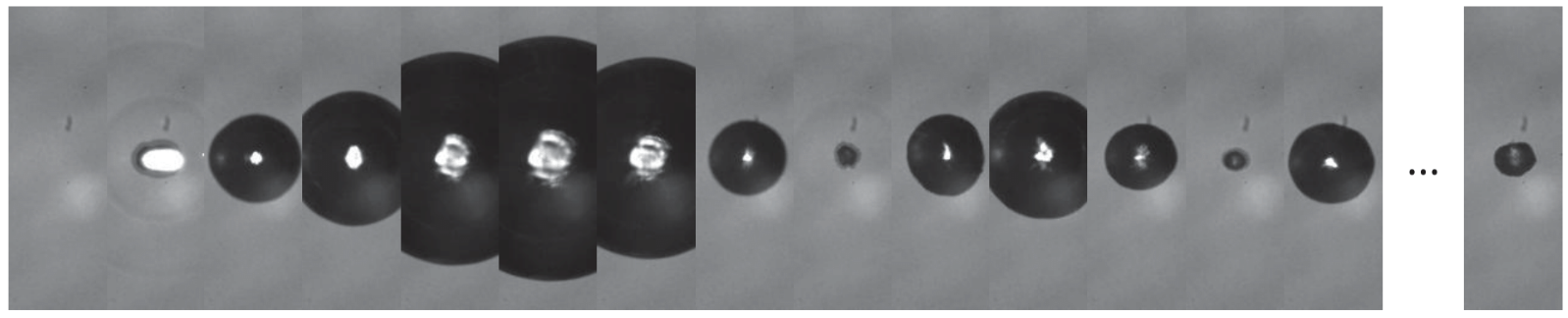
Fig 1: Schematic of bubble evolution during an LIC event: (a) experimental bubble snapshots; and (b)
Fig 2: Schematic of the laser-induced cavitation (LIC) experiments: (a) a single green laser pulse is
Limitations
- Assumes neo-Hookean Kelvin-Voigt constitutive model, potentially oversimplifying complex viscoelastic behaviors and history-dependent phenomena.
- Experimental datasets limited to specific hydrogel formulations (PAAm and gelatin) and restricted temperature ranges; generalization to biological tissues unclear.
- No explicit adversarial or distribution-shift evaluation; uncertain how parameter inference performs under unseen experimental noise or altered conditions.
- Relies heavily on quality and resolution of ultra-high-speed video data; optical measurement noise and segmentation errors could propagate to parameters.
- Computational cost of MIEnKS-MDA remains high due to repeated ensemble forward simulations over many overlapping windows.
- Some critical experimental data and full parameter posteriors are not publicly released, limiting exact reproducibility.
Open questions / follow-ons
- How does the inferred time evolution of constitutive parameters map to specific physical or structural changes in hydrogels during cavitation?
- Can more complex constitutive models with explicit history or state dependence improve fits and reduce parameter non-constancy observed here?
- What is the impact of incorporating thermal and chemical kinetics modeling coupled with cavitation on parameter inference?
- How robust is MIEnKS-MDA inference under different sources of measurement noise, non-ideal experimental conditions, or alternative bubble nucleation methods?
Why it matters for bot defense
While this work does not address CAPTCHA or bot defense directly, it exemplifies advanced data assimilation techniques applied to time-series experimental data with nonlinear dynamics and uncertainty. Practitioners designing bot-detection systems can draw parallels in leveraging sliding-window ensemble Kalman filters to adaptively track evolving system states or parameters over time. The methodological insights on modeling time-varying parameters rather than static ones can inform CAPTCHA strength assessments under evolving attack strategies or user behavior changes. Furthermore, the probabilistic inference framework to quantify uncertainty could inspire more robust bot detection metrics relying on noisy or partial observations. However, the domain-specific physics of inertial cavitation limits direct transfer; adaptation would be needed for network or behavioral data contexts.
Cite
@article{arxiv2606_13584,
  title={ Limits of constant-parameter constitutive models for hydrogels under inertial cavitation },
  author={ Tianyi Chu and Joseph Beckett and Zhiren Zhu and Jonathan B. Estrada and Spencer H. Bryngelson },
  journal={arXiv preprint arXiv:2606.13584},
  year={ 2026 },
  url={https://arxiv.org/abs/2606.13584}
}