
A local Universe catalogue of structures and voids dynamically identified using Cosmic-Flows4++ZOA peculiar velocities
Source: arXiv:2606.13538 · Published 2026-06-11 · By A. M. Hollinger, H. M. Courtois
TL;DR
This paper presents a comprehensive catalogue of large-scale cosmic structures—voids and knots (superclusters)—in the local Universe out to redshift z=0.1, using the updated peculiar velocity dataset CosmicFlows-4++ Zone of Avoidance (CF4++ZOA). Unlike traditional density-based void finders, the authors employ the V-web algorithm which classifies the cosmic web dynamically by analyzing the eigenvalues of the velocity shear tensor derived from reconstructed 3D peculiar velocity fields. This approach identifies expanding regions as voids and converging regions as knots, directly linking classification to gravitational flows. The catalogue robustness is validated by an ensemble of 10,000 Hamiltonian Monte Carlo (HMC) reconstructions, with structures required to appear in ≥68% of realizations to be included. The final catalog contains 37 voids with effective radii 13–38 h⁻¹ Mpc and 42 knots with volumes 10⁴ to 3.3×10⁵ h⁻³ Mpc³. Comparisons to published void catalogs using geometric/ watershed methods reveal substantial but limited overlap, highlighting methodological dependencies in cosmic structure identification. The authors provide locations, volumes, and enclosed masses for knots, including prominent superclusters such as Shapley and Vela, finding broadly consistent mass estimates with prior works but slightly higher due to peculiar velocity data usage. The catalogues will be publicly released for use in environmental studies of galaxies, gravitational flow characterization, and comparison with simulations. Overall, this work demonstrates that velocity field reconstructions combined with the V-web offer a physically motivated, dynamically consistent framework to map the largest cosmic structures in the local Universe, complementing density-based approaches.
Key findings
- The final catalogue contains 37 voids with effective radii between 13 and 38 h⁻¹ Mpc, determined via velocity shear tensor eigenvalue analysis.
- 42 knot regions (superclusters) are identified with volumes ranging from 10⁴ to 3.3×10⁵ h⁻³ Mpc³ and enclosed masses up to ~6×10¹⁶ M☉.
- The V-web classification requires structures to appear in at least 68% of 10,000 HMC reconstructions to ensure robustness against reconstruction noise and survey boundaries.
- Using λth=0 as the V-web threshold yields 37 voids and 42 knots; increasing λth to 0.44 increases void counts to 61 but reduces knots to 22, showing threshold sensitivity.
- Galaxies within the CF4++ sample primarily populate knots (7,346 galaxies) and voids (3,041 galaxies) as identified dynamically, compared to 23,020 and 42,313 galaxies classified by simple density thresholding (δ<0 for underdense).
- The Shapley supercluster knot encloses ~6×10¹⁶ M☉, comparable to previous estimates (~5×10¹⁶ M☉) from other studies, validating mass recovery from velocity field reconstruction.
- Comparison with geometric void catalogs (Malandrino et al. 2026 and Douglass et al. 2023) reveals both overlap and discrepancies caused by different methodologies, smoothing scales, datasets, and void definitions.
- Table 1 and Appendix B provide detailed coordinates, volumes, and masses for all catalogued voids and knots, supporting astrophysical and cosmological analyses.
Methodology — deep read
The study uses a Bayesian reconstruction of the local large-scale velocity and density fields based on the CosmicFlows-4++ Zone of Avoidance (CF4++ZOA) peculiar velocity catalog. This catalog extends out to redshift z=0.1 and includes over 10,000 HMC samples to statistically evaluate uncertainties. The grid resolution is 128³ over 1000 h⁻¹ Mpc cube, yielding voxel size ~7.8 h⁻¹ Mpc.
The V-web method classifies the cosmic web by computing the velocity shear tensor Σ_ij from the 3D peculiar velocity field and analyzing its ordered eigenvalues λ1>λ2>λ3. The classification uses a threshold parameter λ_th (chosen as 0) such that:
- Voids: All eigenvalues > λ_th (all positive; expansion in all directions)
- Knots: All eigenvalues < λ_th (all negative; collapse in all directions)
- Sheets, filaments: mixed eigenvalue signs
To identify individual voids and knots, the authors scan the hierarchical field defined by the minimum λ_th for void designation and maximum λ_th for knots, detecting minimum/maximum eigenvalue locations separated by at least 20 h⁻¹ Mpc. From these seeds, a flood-fill algorithm expands regions voxel-by-voxel until boundary criteria are met.
Reconstruction uncertainty is handled by applying the above classification and structure identification individually across all 10,000 HMC samples. Only structures appearing in at least 68% of realizations and with less than 50% of volume beyond survey edges are retained.
Masses of knot regions are computed by integrating the reconstructed density field within identified volumes. The catalog provides equatorial and supergalactic coordinates, ensuring consistency with prior studies.
For validation and comparison, the catalog voids are contrasted with existing void catalogs identified by density-based watershed algorithms such as VIDE/ ZOBOV. Differences highlight the impact of choice of methodology, data (velocity vs galaxy density), smoothing scale, and assumptions (dynamical vs geometric).
This approach provides a dynamically consistent map of the local cosmic web, tracing gravitational flows rather than only density minima/maxima. The extensive HMC sampling quantifies robustness and uncertainty due to measurement errors and survey incompleteness.
Example processing steps for voids:
- Calculate eigenvalues of velocity shear tensor at each voxel for grid of λ_th from most negative to 0.
- Find local minima in minimum λ_th field separated by ≥20 h⁻¹ Mpc as void seeds.
- Run hierarchical flood-fill expansion from seeds labeling distinct voids.
- Discard voids detected in less than 68% of HMC realizations or with >50% volume outside survey boundaries.
- Compute volumes and effective radii from voxel counts. Details on thresholds, reconstruction parameters, and algorithm are fully specified for reproducibility. The full catalog will be publicly released on GitHub.
Technical innovations
- Application of the V-web algorithm combined with a hierarchical threshold and flood-fill method to dynamically identify cosmic voids and knots from peculiar velocity field reconstructions.
- Use of an ensemble of 10,000 Hamiltonian Monte Carlo Bayesian realizations of the CF4++ZOA velocity reconstruction to assess the robustness and uncertainties of structure identification.
- Systematic handling of survey boundaries and selection criteria that remove spurious structures near survey edges based on fractional volume outside coverage and frequency across realizations.
- Providing mass estimates for knot regions derived directly from peculiar velocity-based density reconstruction rather than relying on luminosity-based proxies.
- Demonstrated sensitivity analysis to the choice of V-web eigenvalue threshold parameter λ_th, showing its effect on structure counts and extents.
Datasets
- CosmicFlows-4++ Zone of Avoidance (CF4++ZOA) — Peculiar velocity data out to redshift z=0.1; >10,000 HMC reconstructions internally generated.
Baselines vs proposed
- Density-based classification: 23,020 galaxies in underdense regions vs V-web dynamical voids: 3,041 galaxies in voids.
- Density-based classification: 42,313 galaxies in overdense regions vs V-web dynamical knots: 7,346 galaxies in knots.
- Threshold λ_th = 0: 37 voids and 42 knots vs λ_th = 0.44: 61 voids and 22 knots, showing sensitivity of catalog size to classification parameter.
- Shapley knot mass ~5.9×10¹⁶ M☉ matches literature estimate ~5×10¹⁶ M☉ from Proust et al. 2006, validating reconstruction-derived mass.
- Comparison with Malandrino et al. 2026 and Douglass et al. 2023 void catalogs shows both overlaps and discrepancies, reflecting methodological differences.
Figures from the paper
Figures are reproduced from the source paper for academic discussion. Original copyright: the paper authors. See arXiv:2606.13538.
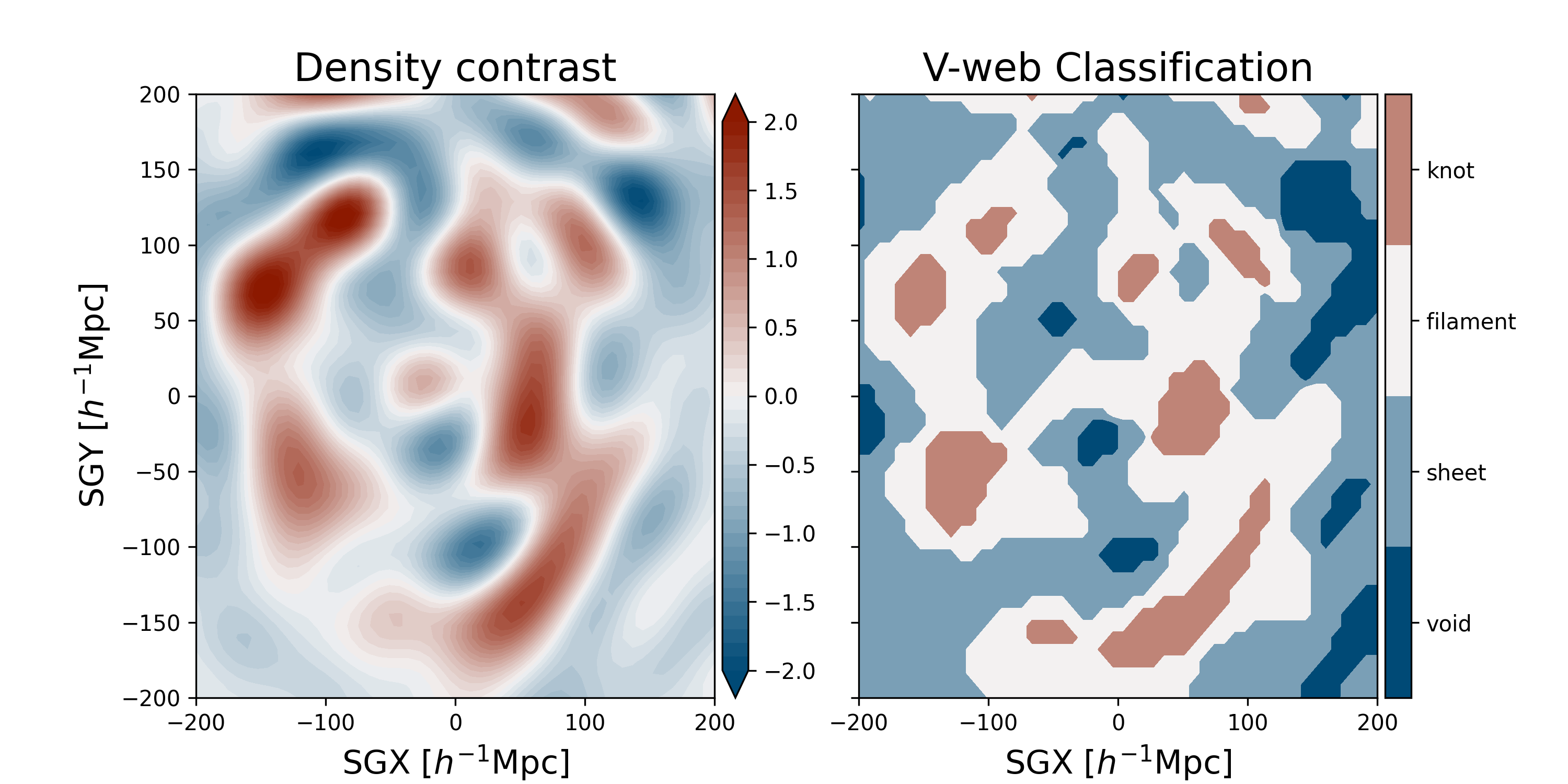
Fig 1: Comparison of the CF4++ZOA local density perturba-
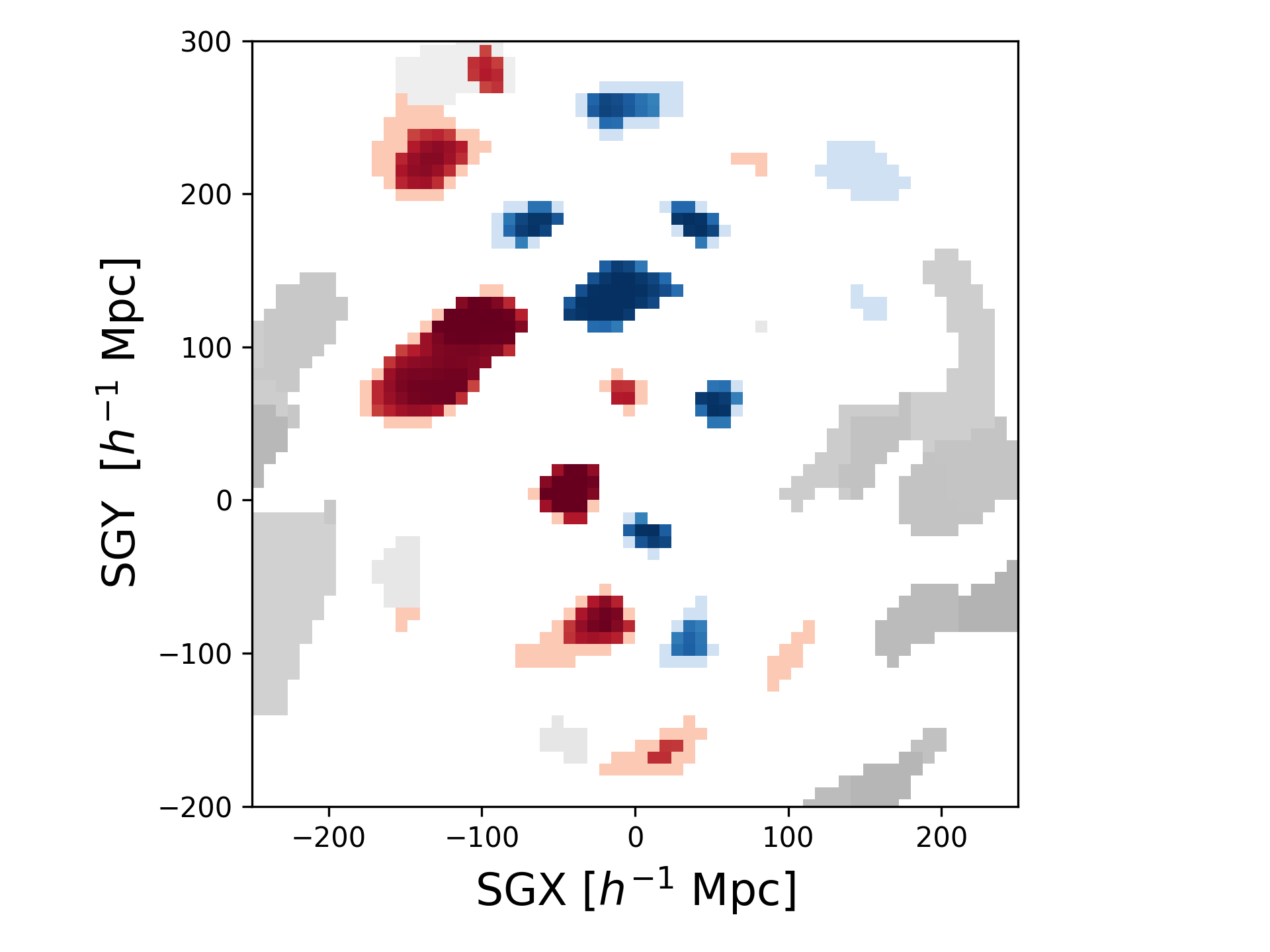
Fig 2: The shaded regions depict the spatial distribution of voids
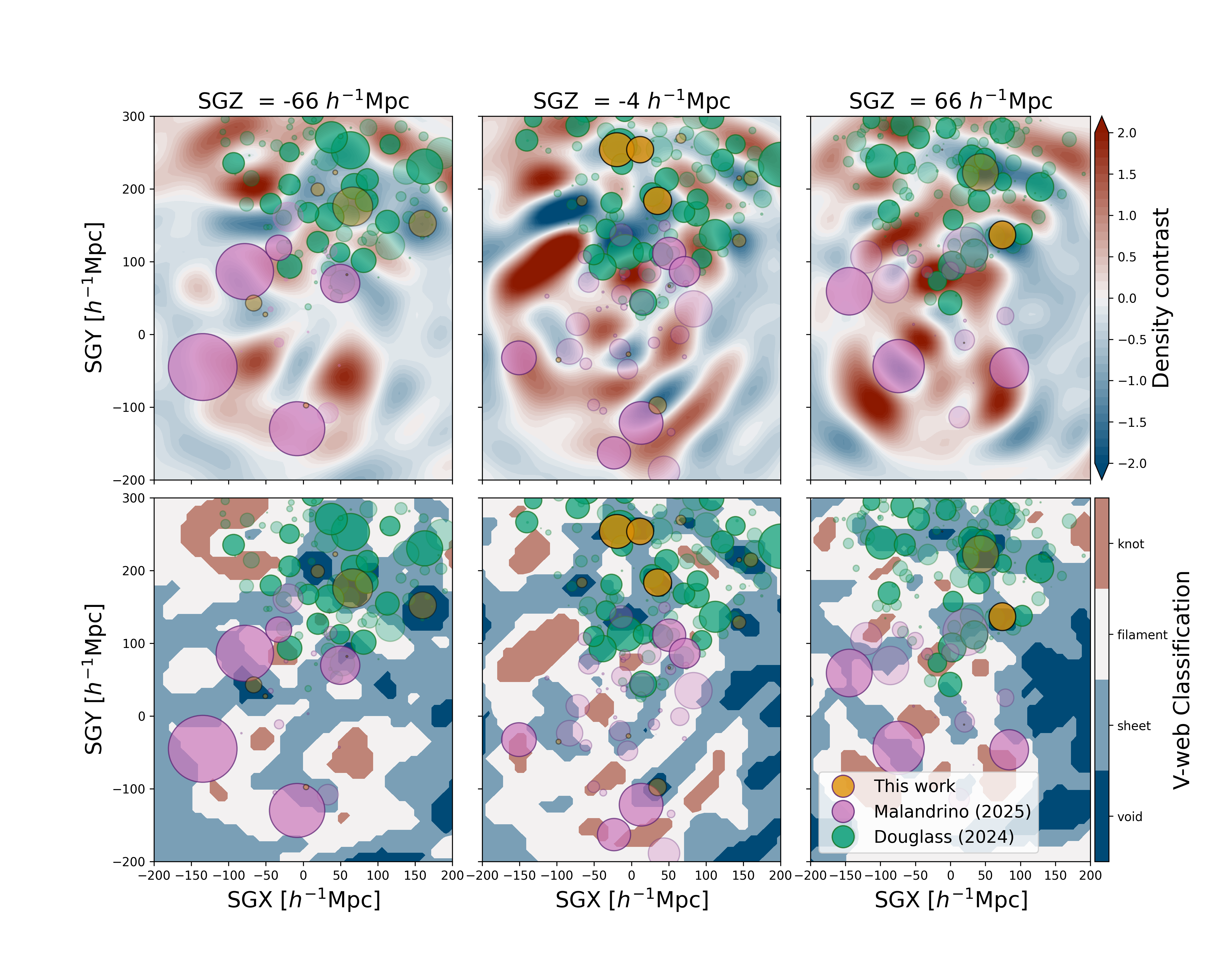
Fig 3: Comparison of the void locations identified in this work
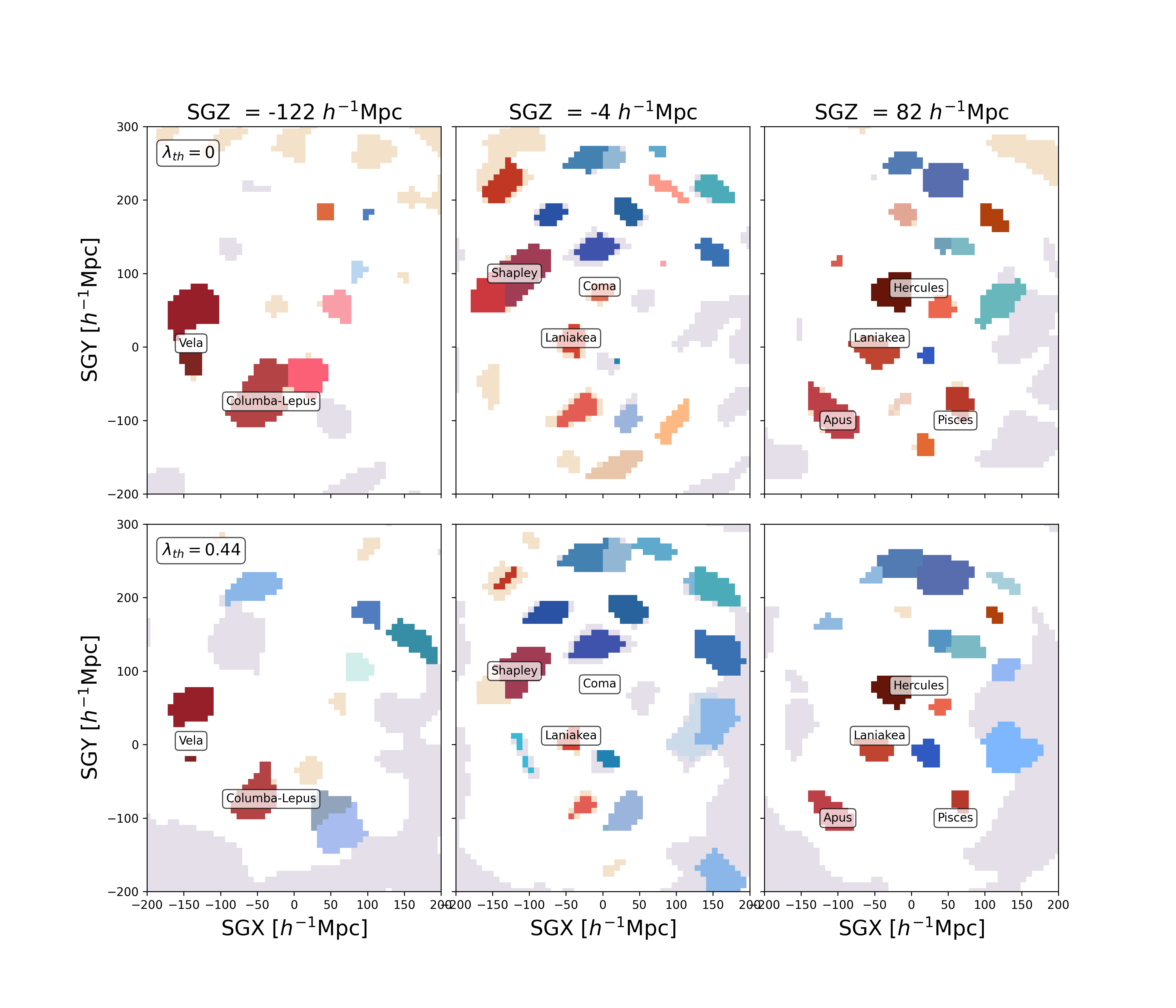
Fig 4 (page 7).
Limitations
- Effective spatial resolution of ~7.8 h⁻¹ Mpc limits identification of smaller cosmic web substructures and finer filaments.
- CosmicFlows-4++ZOA coverage includes regions with few or no velocity measurements, limiting reconstruction fidelity and potentially biasing void/knot identification near boundaries.
- The velocity field reconstruction and V-web classification assume linear galaxy bias and linear growth of structure, which may not hold in highly nonlinear knots.
- Choice of V-web threshold parameter λ_th significantly affects number and sizes of identified structures; no detailed calibration yet for CF4++ZOA volume.
- No explicit tests of the impact of systematic measurement errors or complex survey geometry beyond HMC ensemble averaging.
- Void shapes and boundaries are smoothed and not detailed, possibly missing hierarchical or irregular morphology captured by geometric void-finders.
Open questions / follow-ons
- How would applying non-linear or higher-resolution reconstructions affect the detection and characterization of smaller-scale voids and knots?
- Can the V-web classification thresholds be adaptively calibrated using simulations tailored to CosmicFlows data properties to reduce parameter sensitivity?
- How do the dynamically defined cosmic structures correlate with galaxy properties such as star formation or morphology, and do they provide improved environmental metrics?
- What differences emerge when applying the V-web velocity shear approach to higher redshift surveys or next-generation peculiar velocity datasets?
Why it matters for bot defense
Although this work is focused on cosmological large-scale structure mapping, the underlying approach—using velocity field derivatives and eigenvalue-based classification to identify coherent regions—offers an example of sophisticated multi-dimensional spatial-temporal data analysis. For bot-defense and CAPTCHA practitioners, the concept of leveraging dynamically consistent flow fields rather than purely geometric or density-based criteria may inspire more robust methods for identifying anomalous or adversarial patterns in network or behavioral data. Moreover, the authors' careful uncertainty quantification via thousands of HMC samples and their selection criteria to remove spurious edge effects illustrate valuable practices for building reliable, interpretable classifiers with probabilistic confidence thresholds—relevant to designing more trustworthy challenge-response or anomaly detection systems in adversarial settings. However, direct application of velocity-shear analysis is domain-specific and would require adaptation to network traffic, user input, or device telemetry data modalities.
Cite
@article{arxiv2606_13538,
  title={ A local Universe catalogue of structures and voids dynamically identified using Cosmic-Flows4++ZOA peculiar velocities },
  author={ A. M. Hollinger and H. M. Courtois },
  journal={arXiv preprint arXiv:2606.13538},
  year={ 2026 },
  url={https://arxiv.org/abs/2606.13538}
}