
A Graphical Coaction for FRW Integrals from Partial/Relative Twisted (Co)homology
Source: arXiv:2606.13627 · Published 2026-06-11 · By Andrew J. McLeod, Andrzej Pokraka, Lecheng Ren
TL;DR
This paper addresses the challenge of understanding the analytic structure of Friedmann-Robertson-Walker (FRW) cosmological wavefunction integrals at arbitrary loop order in conformally-coupled scalar theories with non-conformal polynomial interactions. The authors introduce a novel graphical coaction formalism based on intersection theory in partial/relative twisted (co)homology, enabling the decomposition of FRW integrals, their derivatives, and discontinuities into simpler building blocks represented by decorated versions of the original Feynman graph. This construction not only provides a fully combinatorial and graphical description of the coaction, including rational prefactors computable directly from the graph, but also naturally encodes the differential equations (kinematic flow) governing FRW integrals. Importantly, the coaction reduces to the familiar motivic coaction on multiple polylogarithms (MPLs) when FRW integrals are expanded in appropriate limits, providing a unifying geometric framework. Extensive examples illustrate how acyclic decorated minors correspond to physical cuts forming bases of the twisted (co)homology relevant to physical observables. The authors also supply a web application and Mathematica notebook to compute these graphical coactions and related discontinuities and differentials on arbitrary graphs.
Key findings
- The FRW integral coaction can be written as a sum over compatible decorated graphs h related to the original graph g by edge pinching, breaking, or directing, with rational prefactors given by self-intersection numbers Chh (eq 1.2).
- Pinched and broken edges correspond to contracted and cut edges, while directed edges encode time ordering constraints forbidding oriented cycles.
- Physical wavefunction coefficients and their kinematic derivatives sit inside a physical subspace of partially twisted cohomology spanned by acyclic decorated minors of the original graph (section 2.2).
- Sequential residue operators associated with physical cuts correspond one-to-one with acyclic decorated graphs; appropriate tube orderings remove redundant residues from degenerate hyperplane arrangements (Box 2.3, 2.4).
- Cut tubings associated with each acyclic decorated minor define bounded chambers on which the twisted (co)homology is one-dimensional, simplifying the coaction decomposition (section 2.3).
- The graphical coaction commutes with the coaction on multiple polylogarithms (MPLs) when FRW integrals are expanded perturbatively (eq 1.4).
- Explicit combinatorial rules allow construction of the decorated graphs and corresponding cut tubings that underlie the FRW coaction (Boxes 2.5, 2.6).
- A small subset of distinguished sequential residue operators, selected via a lexicographic tube ordering prioritizing larger tubes, spans the physical (co)homology and annihilates unphysical residues arising from degeneracies (eq 2.29).
Methodology — deep read
The authors start with the physical setting of conformally-coupled scalar theories in Friedmann-Robertson-Walker (FRW) spacetimes characterized by a power-law scale factor a(η) = (η/η0)^-(1+ε) with irrational ε, ensuring twisted cohomology. The main object of study is the FRW wavefunction coefficient associated to a Feynman graph G, expressible as a partially twisted period integral of the form ψG = ∫_∞^0 uG φG, where uG is a multi-valued twist factor and φG a rational integrand with denominator factors called tube polynomials Bτ associated to tubings of G.
Degenerate hyperplane arrangements arise because the tube polynomials are linearly dependent when tubes intersect partially, yielding relations among residues and forms. To handle this, the authors adopt a global lexicographic tube ordering prioritizing tubes encircling more vertices and edges (Boxes 2.3, 2.4). This ordering enables spanning the space of sequential residue operators relevant to physical integrals using non-crossing tubings only, eliminating degeneracies that annihilate the physical form.
To organize the physical (co)homology subspace, edges of G are decorated in three ways: oriented (time/energy flow), pinched (contracted edges), or broken (cut edges), yielding decorated orientations Dec(G). The physical basis corresponds to acyclic decorated graphs aDec(G), where contracting pinched edges and deleting broken edges produces cycle-free oriented graphs. Each decorated graph g in aDec(G) is associated via explicit combinatorial rules to sets of physical cut tubings Cg (Box 2.6), maximal collections of non-crossing tubes satisfying constraints related to the decorations.
Each physical tubing c in Cg defines a sequential residue operator by taking residues along the corresponding tube polynomials Bτ in the global ordered sequence. Multiple tubings associated with the same decorated graph g correspond to distinct expressions for the same cut variety Bg, and their residue operators combine with signs sgn_c to define a single distinguished sequential residue operator Res_Cg (eq 2.37) acting nontrivially on φG.
The twisted (co)homology groups involved consist of cycles γ_g defining integration contours and dual cycles, and cocycles φ_g defining the rational differential forms representing the integrand with poles on on-shell hyperplanes B and the twist locus T. The rank-one twisted (co)homology on the bounded chambers defined by the cut tubings underlies the one-dimensional physical sector.
The central coaction construction (eq 1.2) decomposes the wavefunction coefficient associated with g into a sum over compatible decorated graphs h obtained by pinching, breaking, or directing edges without forming cycles. The coefficients are given by self-intersection numbers C_hh computable explicitly from the decorated graphs. The coaction breaks the integral into a tensor product of derivatives (in the first component) and discontinuities (in the second), providing a purely graph-theoretic decomposition.
Computationally, the authors implement algorithms to enumerate acyclic decorated minors and their cut tubings, respecting the tube ordering and physical constraints, and calculate intersection numbers and residue operators. The coaction is verified to commute with the MPL coaction in expansions around appropriate limits.
Their results are illustrated with explicit examples such as the two-site and three-site chain graphs, demonstrating the graphical decomposition of integrals and their derivatives, and how the differential equations governing FRW integrals (kinematic flow) arise naturally from the combinatorics of the coaction. The construction is practical, with code and a web app to compute graphical coactions for arbitrary inputs.
In summary, the paper presents a detailed, stepwise geometric and combinatorial framework that translates the analytic structure of FRW integrals into decorated graph data via partial/relative twisted (co)homology, constructing and exploiting distinguished residue operators and intersection theory to produce a fully graphical, computable coaction consistent with known special function structures.
Technical innovations
- Introduction of a graphical coaction for FRW integrals at all loop orders based on partial/relative twisted (co)homology and intersection theory, extending the diagrammatic coaction beyond one-loop Feynman diagrams to cosmological integrals with time ordering.
- Identification of physical integration cycles and forms corresponding to acyclic decorated minors of the original graph, enabling a one-to-one mapping between physical cut tubings and distinguished sequential residue operators.
- Development of a global tube ordering scheme to remove degeneracies arising from linearly dependent hyperplane arrangements, isolating a minimal spanning set of residue operators annihilating unphysical contributions.
- Formulation of explicit combinatorial rules associating the coefficients in the coaction to self-intersection numbers computable directly from decorated graphs without requiring manual intersection theory computations.
- Demonstration that the FRW graphical coaction commutes with the multiple polylogarithm coaction upon expansion, providing a unifying geometric framework linking cosmological wavefunction integrals to known motivic structures.
Baselines vs proposed
- Comparison with multiple polylogarithm (MPL) coaction: the FRW coaction commutes with the MPL coaction on expansions of FRW integrals into MPLs, matching tensor factor decompositions (eq 1.4).
- Degenerate residue operators associated with tube orderings that do not respect the global ordering annihilate the physical integrand, reducing the relevant basis of residues (eq 2.25 vs 2.27).
Figures from the paper
Figures are reproduced from the source paper for academic discussion. Original copyright: the paper authors. See arXiv:2606.13627.

Fig 1: Left: The unique bounded chamber ∆g on Mg expressed as a Cartesian product of
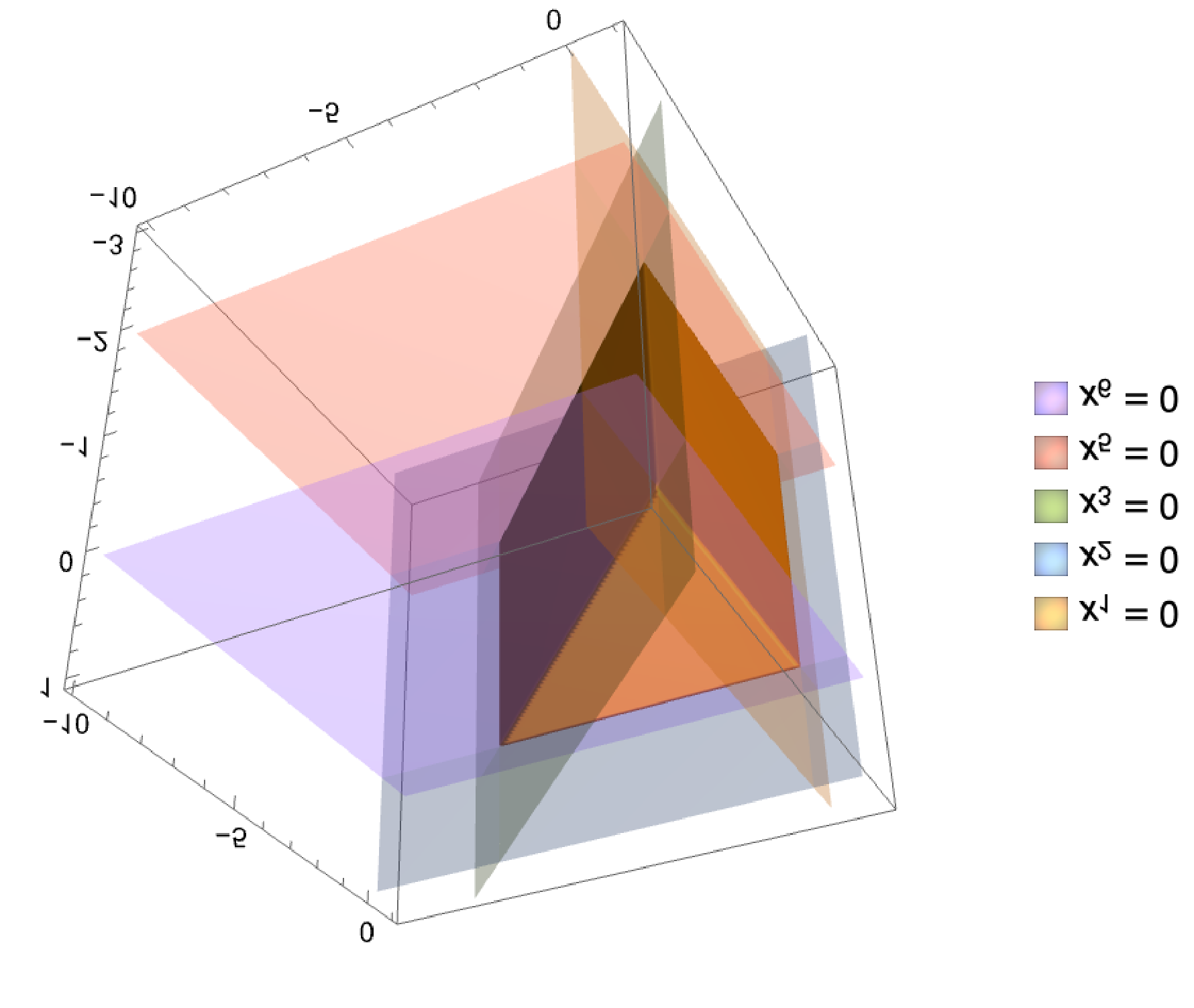
Fig 2 (page 18).
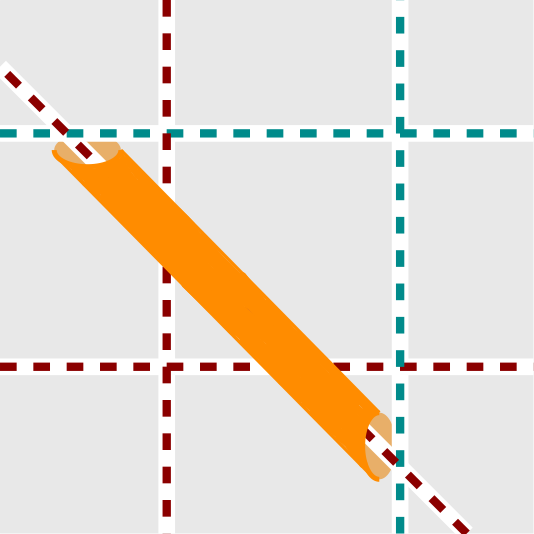
Fig 2: The Zonotopes for the 2-chain graph: Z
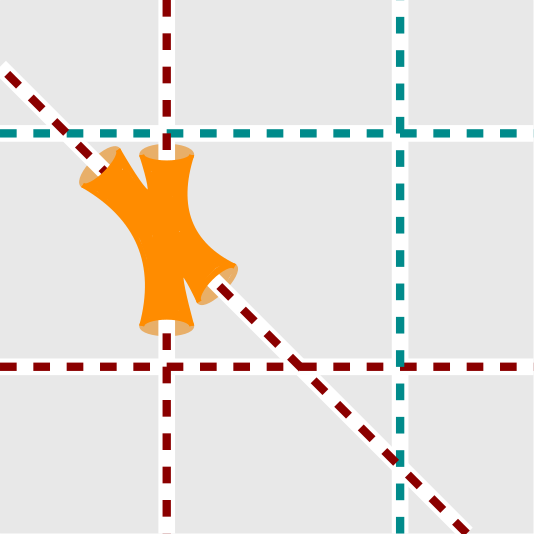
Fig 4 (page 21).
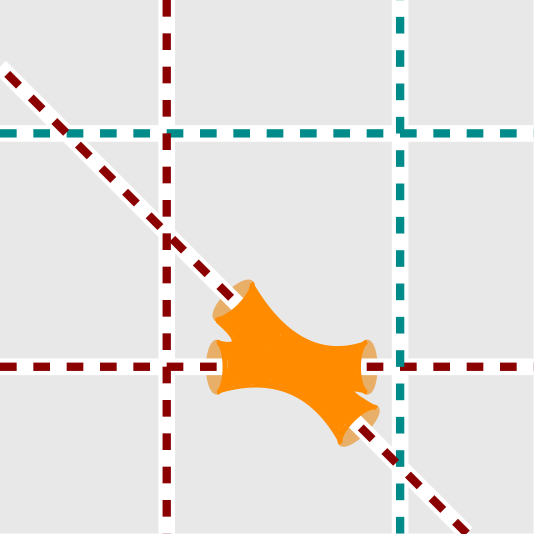
Fig 5 (page 21).
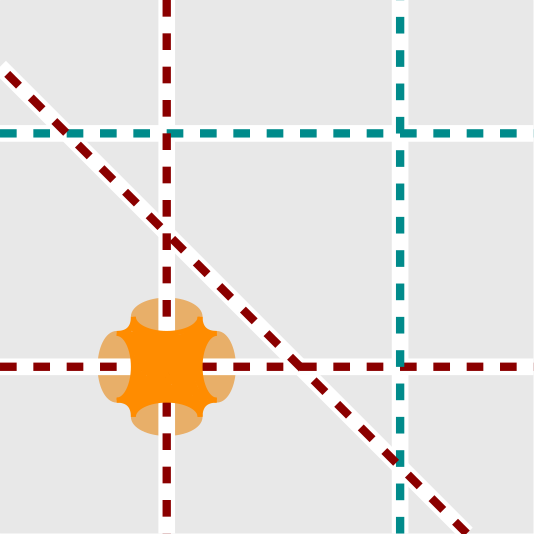
Fig 6 (page 21).
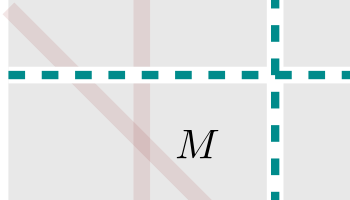
Fig 4: Cut stratification of the pair (M, B) in the context of the two-site chain graph.
Limitations
- The construction is presented primarily for conformally-coupled scalar theories with polynomial interactions; extension to more general cosmological settings or other matter contents is not addressed.
- The coaction relies on the assumption ε ∉ Q to ensure twisted cohomology structure; rational or more general cosmological parameters may complicate the twisted structure and require modifications.
- While the graphical coaction captures all loop orders in principle, explicit computations and examples beyond low loop order are limited; computational complexity for large graphs is not fully explored.
- The current work does not include a detailed adversarial or numerical stability analysis for approximate or noisy input, relevant for practical symbolic-numeric computations.
- Although a web application and Mathematica notebook are provided, no formal code release or benchmarks for computational efficiency and scalability are presented.
Open questions / follow-ons
- How can the graphical coaction framework be extended to accommodate more general interactions and matter content beyond conformally-coupled scalar theories?
- Can this partial/relative twisted (co)homology approach be generalized to handle rational or more complicated cosmological exponents ε, including resonant cases where exponents become integers?
- What are the computational limits of the graphical coaction algorithm for very large or complicated graphs, and are there approximations or heuristics to improve scalability?
- How might the coaction formalism and decorated graph combinatorics inform the discovery of new relations or simplifications among cosmological correlators beyond known special function expansions?
Why it matters for bot defense
While the paper is deeply theoretical and mathematical, its key contribution is a systematic and combinatorial decomposition of highly nontrivial integrals into simpler building blocks represented graphically. For bot-defense or CAPTCHA practitioners working with behavioral or interaction data modeled by complex probabilistic integrals or multi-step query chains, the coaction approach highlights the power of reducing complicated global functions to sums of localized, combinatorially tractable components. Insight into differential structures, discontinuities, and their graphical encodings could inspire novel decompositions of verification or challenge-response functions into modular analyzable pieces, potentially aiding interpretability or robustness testing.
Moreover, the treatment of degeneracies and partial twist structures through ordering conventions might inform how to handle redundant or degenerate signals within multi-dimensional feature spaces common in bot-detection. Although not directly applicable to current CAPTCHA/anti-bot algorithms, the formalism illustrates how sophisticated intersection theory and graph decorations capture analytic properties of complex integrals that arise from time-ordered processes — a concept parallel to understanding sequences of user interactions or multi-stage attacks. Researchers in bot-defense interested in the intersection of advanced algebraic methods with temporal interaction modeling might find conceptual inspiration here.
Cite
@article{arxiv2606_13627,
  title={ A Graphical Coaction for FRW Integrals from Partial/Relative Twisted (Co)homology },
  author={ Andrew J. McLeod and Andrzej Pokraka and Lecheng Ren },
  journal={arXiv preprint arXiv:2606.13627},
  year={ 2026 },
  url={https://arxiv.org/abs/2606.13627}
}