
Quantifying the Distribution of Biexciton Emission Efficiencies in Colloidal Quantum Shells
Source: arXiv:2606.12398 · Published 2026-06-10 · By Tjom Arens, Dulanjan Harankahage, Divesh Nazar, Mikhail Zamkov, Freddy T. Rabouw
TL;DR
This paper addresses the challenge of quantifying heterogeneity in biexciton emission efficiencies across large ensembles of colloidal quantum shells (CQSs). Multi-photon emission efficiency, particularly biexciton emission efficiency (η_BX), is critical for applications including high-power lighting, lasing, and single-photon sources. Prior single-particle approaches to measuring η_BX are slow and limited to small sample sizes, leaving population-level distributions largely unexplored. The authors introduce a novel high-throughput photon-correlation technique using a single-photon avalanche diode (SPAD) array configured to suppress interpixel crosstalk by projecting two spatially separated images of the same quantum shell sample onto distinct detector regions. Time gating further suppresses dark-count coincidences and distinguishes single emitters from unresolved clusters.
Applying this method to more than 1000 CQSs, the study reveals an approximately Gaussian distribution of biexciton emission efficiencies with mean η_BX ≈ 0.55 and intrinsic standard deviation ≈ 0.12 after excluding cluster contributions. This heterogeneity correlates positively with particle brightness, consistent with volume scaling of Auger recombination rates. The authors validate their frame-based SPAD-array approach against conventional time-tagged methods, showing near-identical η_BX values. Overall, this work establishes a scalable, artifact-free experimental framework to statistically characterize multi-photon emission heterogeneity in nanoparticle ensembles, unlocking detailed insights relevant to designing optical gain and single-photon sources.
Key findings
- Using a SPAD-array with spatially separated image projection suppresses crosstalk to effectively zero, eliminating artificial photon coincidences.
- Time gating reduces dark-count coincidences by a factor of 50, enabling high signal-to-background ratio fluorescence detection.
- More than 1000 quantum-shell emitters were measured in parallel with 20 million excitation cycles per field of view.
- The measured distribution of biexciton emission efficiencies (η_BX) for single CQSs is near-Gaussian with mean 0.55 and intrinsic standard deviation 0.12 after cluster removal.
- Clusters of quantum shells produce higher g(2)(0) values that can be identified and separated using delayed time gating (˜g(2)(0)) with a threshold of 0.4.
- Frame-based SPAD-array measurements yield biexciton efficiencies (η_BX = 0.54) consistent with conventional time-tagged photon counting (η_BX = 0.55) for the same emitter.
- A positive correlation is found between quantum shell brightness and average biexciton efficiency, consistent with volume scaling of Auger recombination.
- High-g(2)(0) tail of the distribution arises from unresolved clusters, confirmed by predicted cluster peak positions matching observed histogram features.
Methodology — deep read
Threat Model & Assumptions: The study focuses on accurately measuring the multi-photon emission characteristics (biexciton emission efficiency η_BX) of individual quantum shells in an ensemble to understand heterogeneity, not on adversarial threat scenarios. The key assumptions are that crosstalk and dark counts on SPAD arrays can produce artifacts; these must be suppressed for accurate g(2)(0) measurement. Particles may be unresolved clusters due to diffraction-limited optics.
Data: Samples of colloidal quantum shells are spin-coated on glass coverslips at high dilution (~1:20000) to achieve sparse individual emitters. The sample contains more than 1000 fluorescence emission spots identified in the detector images. Photon detections are acquired for tens of millions of excitation pulses per field of view during measurement.
Architecture / Experimental Setup: The apparatus combines a pulsed 405 nm laser for widefield excitation and a custom microscope. Emission from the sample is split by a 50:50 beamsplitter and imaged onto two widely separated regions (>200 pixels apart) of a 512×512-pixel SPAD array (SPAD512) to avoid crosstalk.
Each detector pixel registers presence or absence of one photon per frame (1-bit depth). The SPAD array records frames synchronized to laser pulses, with one frame per excitation cycle. Photon correlations g(2)(0) are computed across corresponding spots in the two regions, cross-correlating photons from the same emitter but detected spatially apart to exclude crosstalk.
Training Regime: While not training a model, the experimental regime includes tuning the detector integration window length and timing (time gating). An optimal 250 ns integration window captures most fluorescence while strongly reducing dark counts. A secondary delayed trigger integration starting 120 ns after the laser pulse collects time-gated data for distinguishing clusters.
Evaluation Protocol: For each emitter, zero-delay coincidence counts (same frame) between the two images are normalized by side-peak (different frame) coincidences to compute g(2)(0). A minimum threshold of >50 coincidence counts at side peaks filters low-count spots.
Clusters are identified by applying delayed time gating: shifting the integration start suppresses fast biexciton emission but leaves independent exciton emission in clusters relatively intact. The normalized ˜g(2)(0) under gated conditions is used, with a threshold of 0.4 to distinguish single emitters from clusters.
Distributions of g(2)(0) are compared for the entire set, cluster-like spots, and filtered singles. The filtered single-particle distribution is analyzed for mean and variance after subtracting measurement uncertainty.
- Reproducibility: The study uses custom scripts for acquisition and analysis (Python). Supporting Information details image recognition and emitter matching algorithms. The SPAD512 array is commercially available, but the exact dataset and code release status are not stated. Calibration and correction procedures are described to enhance reproducibility.
Concrete Example: A quantum shell imaged onto two distant SPAD array regions yields photon arrival frames synchronized to the pulsed laser. Coincidence histograms between the two sets of pixels corresponding to that emitter show a clear zero-delay peak relative to side peaks. The ratio g(2)(0) = 0.55 is computed by normalizing the zero-delay coincidence count to the average side-peak coincidences, indicating biexciton emission efficiency. Delayed gating reduces this ratio below 0.4, confirming the spot is a single particle rather than a cluster, enabling separation of heterogeneous particle populations for analysis.
Technical innovations
- Use of spatially separated dual imaging of the same sample onto distant SPAD-array regions to eliminate short-range detector crosstalk artifacts in photon-correlation measurements.
- Implementation of frame-based g(2)(0) estimation synchronized to pulsed excitation with optimized integration windows to balance fluorescence capture and dark count suppression.
- Application of delayed start time gating on detector integration frames to discriminate single emitters from unresolved clusters based on differences in biexciton–exciton emission timing.
- High-throughput simultaneous measurement of over 1000 individual quantum shells with low statistical uncertainty enabling characterization of biexciton efficiency distributions.
Datasets
- Colloidal quantum shell emission data — >1000 individual emitters — acquired via SPAD array in experimental setup described
Baselines vs proposed
- Conventional time-tagged two-detector setup: g(2)(0) = 0.55 vs frame-based SPAD-array method: g(2)(0) = 0.54 for the same emitter.
- Raw g(2)(0) histogram mean: 0.65 with SD 0.17 vs filtered single-emitters after time gating: mean 0.55 with intrinsic SD 0.12.
Figures from the paper
Figures are reproduced from the source paper for academic discussion. Original copyright: the paper authors. See arXiv:2606.12398.

Fig 2: Spatial separation suppresses detector crosstalk. (a) Schematic of detector

Fig 3: Frame-based g(2)(0) measurements. (a) Synchronization scheme for frame-based

Fig 1: Effect of the biexciton-efficiency distribution on ensemble gain. (a) The

Fig 4: Measured quantum-shell g(2)(0) distribution. (a,b) Intensity maps of the
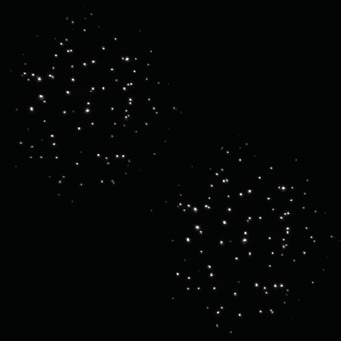
Fig 5 (page 5).

Fig 6 (page 5).

Fig 7 (page 5).

Fig 8 (page 5).
Limitations
- No direct electron microscopy or structural characterization to correlate particle size with optical brightness; brightness used only as proxy for size.
- Potential residual misclassification of clusters and single particles due to sample drift, blinking, and defocusing during sequential measurements.
- Integration window timing trade-offs may result in partial loss of emission signal or inclusion of background counts.
- No spectral information was acquired simultaneously to correlate emission energy with biexciton efficiency.
- Analysis assumes uniform experimental conditions across large fields of view; local variations could affect accuracy.
Open questions / follow-ons
- How do structural variations such as shell thickness, shape, and composition correlate quantitatively with biexciton emission efficiency on a per-particle basis?
- Can simultaneous spectral and photon-correlation measurements provide deeper insight into multi-exciton energetics and heterogeneity?
- What are the effects of emitter blinking and dipole orientation on brightness metrics used as proxies for nanocrystal size?
- Could the method be extended to other nanocrystal architectures or materials with different Auger recombination characteristics?
Why it matters for bot defense
While this work is primarily focused on characterizing quantum emitter heterogeneity, the methodological advances in high-throughput, artifact-free single-particle photon-correlation using SPAD arrays have conceptual parallels to bot-defense systems that require scalable, low-noise detection of correlated events. The spatial crosstalk suppression and time gating methods demonstrate effective noise-reduction techniques that can inspire improved sensor designs in CAPTCHA and anti-bot detection where distinguishing true vs spurious correlated signals is critical. Moreover, the statistical approach to resolving heterogeneous populations from noisy aggregate signals is relevant to discriminating genuine human activity patterns versus clustered bots. However, direct application requires adaptation to relevant signal modalities and adversarial threat assumptions in bot detection pipelines.
Cite
@article{arxiv2606_12398,
  title={ Quantifying the Distribution of Biexciton Emission Efficiencies in Colloidal Quantum Shells },
  author={ Tjom Arens and Dulanjan Harankahage and Divesh Nazar and Mikhail Zamkov and Freddy T. Rabouw },
  journal={arXiv preprint arXiv:2606.12398},
  year={ 2026 },
  url={https://arxiv.org/abs/2606.12398}
}