
Dark and Luminous Matter in the Coma Cluster: Probing Galaxy Cluster Assembly Through Filaments with Weak Lensing and Multiwavelength Observations
Source: arXiv:2606.12523 · Published 2026-06-10 · By K. HyeongHan, K. Finner, M. James Jee, W. Lee, Y. Jiménez-Teja, S. Cha et al.
TL;DR
This paper presents a comprehensive weak-lensing (WL) and multiwavelength analysis of the nearby, rich Coma galaxy cluster (Abell 1656, z=0.023), aiming to characterize its dark matter distribution and its connection to intracluster filaments (ICFs), galaxies, and the intracluster medium. Using wide-field (~12 deg^2) Subaru Hyper Suprime-Cam imaging with high source density (~38 arcmin^-2), the authors reconstruct a two-dimensional projected mass map leveraging a convolutional neural network-based WL mass reconstruction, surpassing traditional methods in accuracy and resolution. They fit one- and two-halo Navarro-Frenk-White (NFW) models, quantifying the cluster mass and substructure, and cross-correlate these with multiwavelength datasets including optical spectroscopy, eROSITA X-ray surface brightness, and LOFAR radio data.
Key results include a robust single-halo NFW mass estimate of M_200c = 8.2 ± 0.7 × 10^14 solar masses for the Coma cluster, consistent at large radii (R > 560 kpc) with X-ray hydrostatic mass but showing substantial hydrostatic bias in the core region. A two-halo NFW fit centered on the two brightest cluster galaxies reveals a ~1:8 minor merger between NGC 4874 (7.8 ± 0.6 × 10^14 M_sun) and the infalling NGC 4839 group (0.9 ± 0.2 × 10^14 M_sun). The WL signal spatially correlates strongly with X-ray brightness especially along the northern and western filament directions where shear-selected subhalos lie, confirming active accretion along cosmic web filaments. The cluster’s r-band mass-to-light ratio is roughly constant (∼250 M_sun/L_sun) inside R_200c but substantially higher (~1000 M_sun/L_sun) in the identified filaments, demonstrating strong dark matter dominance in the ICFs. These results illustrate how joint WL and multiwavelength observations can probe cluster assembly histories, filamentary dark matter content, and baryon-dark matter interplay in cosmic web environments.
Key findings
- Single-halo NFW fit yields M_200c = 8.2 ± 0.7 × 10^14 M_sun for Coma cluster, consistent with aperture mass densitometry and X-ray mass at R >= 20' (~560 kpc)
- Two-halo NFW fit centered on NGC 4874 and NGC 4839 gives masses 7.8 ± 0.6 and 0.9 ± 0.2 × 10^14 M_sun respectively, implying a ~1:8 minor merger event
- Substantial hydrostatic mass bias (b ≲ 0.5) is observed in cluster core from X-ray vs. WL comparison, indicating merger-induced deviation from equilibrium
- Positive spatial correlation detected between WL convergence and eROSITA X-ray surface brightness, strongest along intracluster filaments at ~110° (north) and ~340° (west)
- Shear-selected subhalos primarily lie along these filamentary directions, supporting filamentary accretion scenario
- The Coma cluster’s r-band mass-to-light ratio is radially constant at ~250 ± 66 M_sun/L_sun within R_200c, while northern and western ICFs show elevated M/L_r ≈ 1000 M_sun/L_sun, indicating stronger dark matter dominance in filaments
- WL mass map reveals multiple substructures and shear peaks (SNR > 3) consistent with optical groups, with contamination from unrelated foreground/background groups minimized by redshift filtering
- The cluster center defined at NGC 4874, coinciding with strongest WL convergence peak (5.6σ) and near X-ray/SZ centers, despite proximity of NGC 4889
Methodology — deep read
The authors conduct a deep weak gravitational lensing analysis to map the projected dark matter distribution of the Coma cluster and its connection to intracluster filaments and baryonic tracers. The threat model assumes the cluster and nearby large-scale structures lens background galaxies; contamination by unrelated foreground/background structures is mitigated by excluding groups outside z=0.01 to 0.04.
Data are archival Subaru Hyper Suprime-Cam (HSC) wide-field imaging (~12 deg^2) in g and r bands from 2016–2017, optimized for WL shape measurements by selecting only exposures with seeing better than 0.85 arcsec and excluding defective CCD regions. A stacked image with average seeing ~0.7 arcsec is used. Galaxy shapes are modeled using forward-model elliptical Gaussian convolved by spatially interpolated PSF derived from ~47 stars per chip via principal component analysis.
Source galaxies are selected by magnitude (23<r<26), ellipticity (<0.9), size cuts, and measurement noise threshold (σ_mea < 0.4), resulting in approx 38 galaxies per arcmin^2. Photometric redshift cuts remove contamination from cluster members and foreground/background groups.
Mass reconstruction is performed by a convolutional neural network (CNN) trained with 42,000 simulated convergence maps from the MassiveNuS cosmological simulations—these CNN inputs three channels (two ellipticity components and ellipticity measurement noise), producing 512x512 convergence maps at ~0.41 arcmin pixels. This method overcomes limitations of traditional Kaiser-Squires inversion (e.g. noise smoothing, reduced shear approximation, mass-sheet degeneracy). The CNN-predicted mass map is smoothed with a Gaussian kernel of 24.6 arcsec (~11.5 kpc) to match resolution.
Cluster center is identified by examining WL convergence peaks and multiwavelength centroids (X-ray, tSZ, galaxy density). Despite two bright central galaxies (NGC 4874 and NGC 4889), NGC 4874 is chosen as center since it coincides to within 3σ positional errors of the strongest convergence peak (5.6σ) and aligns better with X-ray and SZ peaks.
Two approaches are used for mass estimation: parametric NFW profile fits (single-halo and two-halo centered on the brightest galaxies) and aperture mass densitometry (model independent). The fits use tangential shear profiles averaged in annuli from 10' to 100'. The two-halo fit estimates masses of main cluster and infalling subcluster.
Evaluation involves cross-validation against multiwavelength data—X-ray surface brightness from eROSITA, radio continuum from LOFAR, and optical spectroscopic galaxy density maps. Spatial correlations between WL subhalos, X-ray structures, radio halos/relics, and ICF directions test the physical associations. Galaxy mass-to-light ratios are computed using r-band luminosities.
Bootstrap resampling (1,000 realizations) assesses positional uncertainties of mass peaks. Shear peaks detected with SNR > 2 serve as subhalo candidates. Known background and foreground groups are filtered using redshifts to avoid false detections. The noise contribution from uncorrelated LSS along the line of sight is evaluated and found negligible compared to shape noise.
The work does not mention public release of code or data, though it builds on previous related HSC analyses. Some datasets (e.g. galaxy spectroscopy) are drawn from multiple existing catalogues and merged for uniformity. The methodology is described sufficiently to reproduce mass maps given similar input data and CNN weights, but CNN details and training pipelines would need to be requested from authors if not publicly available.
In summary, the paper provides a pipeline integrating wide-field, deep imaging WL analysis with robust source selection and a novel CNN-based mass inversion, combined with multiwavelength cross-checks and parametric modelling to decipher cluster assembly and filamentary structure in Coma as an end-to-end worked example.
Technical innovations
- Use of a CNN trained on cosmological simulations to reconstruct high-fidelity wide-field convergence maps from galaxy shape catalogs, improving upon traditional Kaiser-Squires inversion.
- Combining single- and two-halo Navarro-Frenk-White parametric fitting centered on brightest cluster galaxies to quantify merger dynamics between main cluster and infalling substructure.
- Joint spatial correlation analysis between weak lensing mass map, multiwavelength X-ray surface brightness, and radio data to identify and confirm intracluster filaments (ICFs) associated with shear-selected subhalos.
- Application of high source density (~38 arcmin^-2) Subaru/HSC imaging with careful PSF modeling and shape measurement optimized for nearby cluster lensing despite low lensing efficiency.
Datasets
- Subaru Hyper Suprime-Cam imaging — ~12 deg^2 coverage — archival public but processed by authors
- eROSITA X-ray observations — Coma cluster field — archival public
- LOFAR DR2 radio continuum imaging — Coma cluster field — public data release
- Galaxy spectroscopic membership catalogs from Kang et al. (2025) and other compilations — combined internal/archival
- MassiveNuS cosmological simulation convergence maps (for CNN training) — 42,000 augmented maps — publicly available
Baselines vs proposed
- Single-halo NFW fit: M_200c = 8.2 ± 0.7 × 10^14 M_sun vs. prior SDSS DR5 WL mass estimates (Kubo et al. 2007) with larger uncertainties and higher values (~1.88 +0.65/-0.56 × 10^15 h^-1 M_sun)
- Two-halo NFW fit identifies minor merger with M_200c = 7.8 ± 0.6 and 0.9 ± 0.2 × 10^14 M_sun for main cluster and NGC 4839 vs. previous substructure characterizations lacking precise mass estimates
- CNN-based WL mass reconstruction achieves stronger centroid recovery and suppresses noise compared to Kaiser-Squires method (as validated on MassiveNuS simulations with ~0.7 slope correlation)
- Mass-to-light ratio (M/L_r) radial profile is ~250 ± 66 M_sun/L_sun within R_200c, whereas northern and western filaments show significantly higher M/L_r ~1000 M_sun/L_sun, quantifying dark matter dominance relative to prior qualitative statements
Figures from the paper
Figures are reproduced from the source paper for academic discussion. Original copyright: the paper authors. See arXiv:2606.12523.
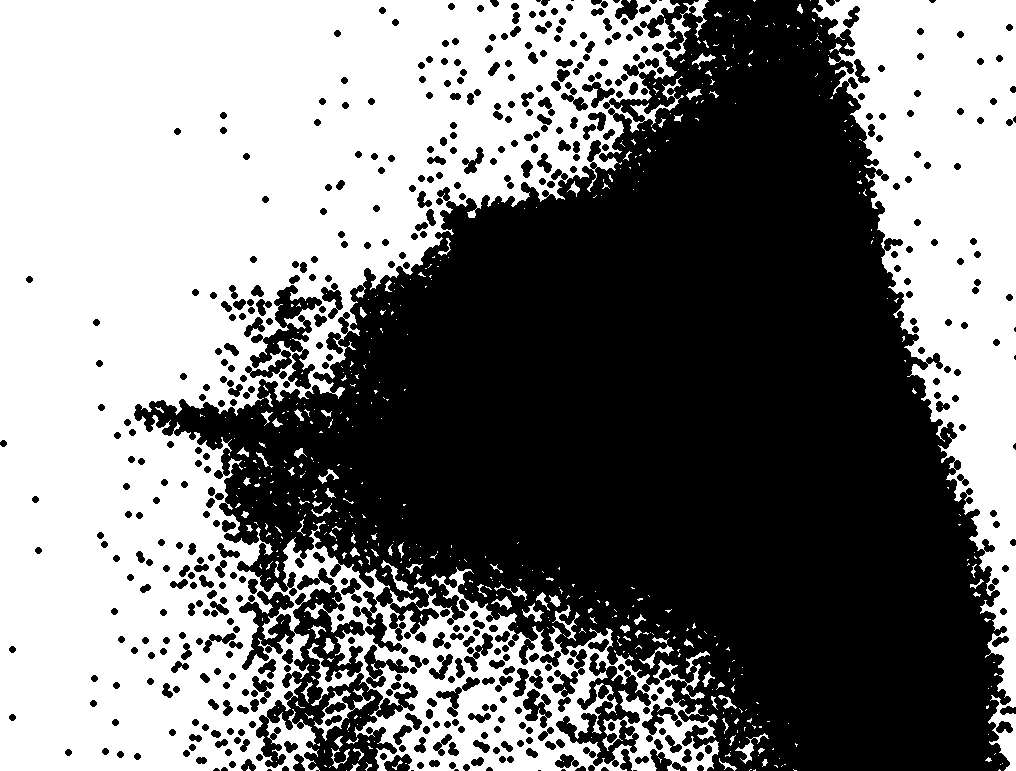
Fig 1: Color–magnitude diagram of the Coma cluster. Notable member
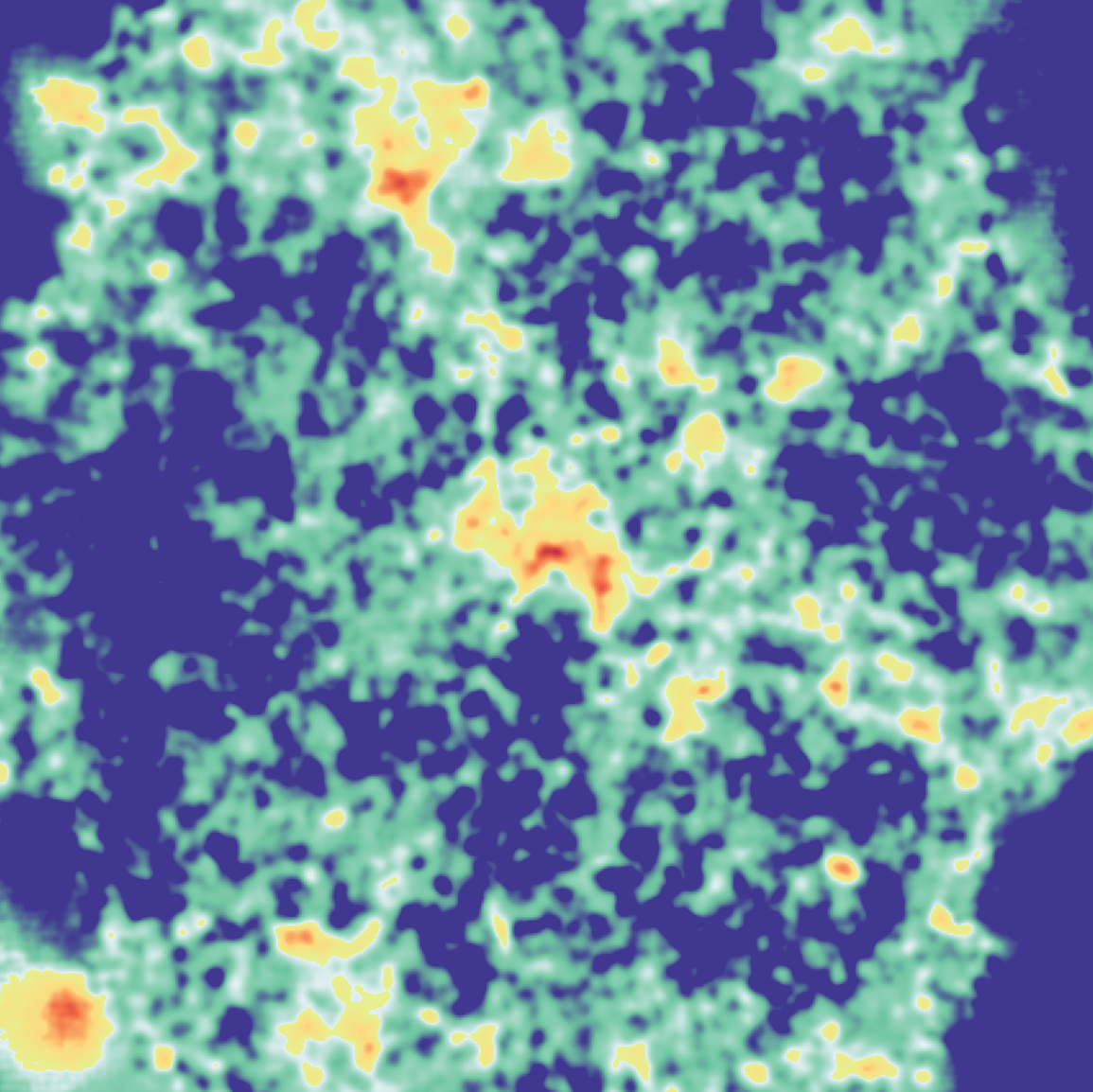
Fig 2: Two-dimensional mass distribution of the Coma cluster within a 2.8 Mpc-radius aperture centered on NGC 4874. The background is the
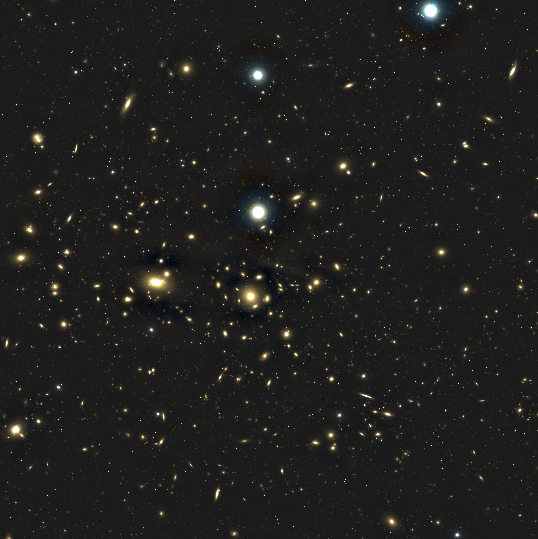
Fig 3: Central region of the Coma cluster. The background HSC
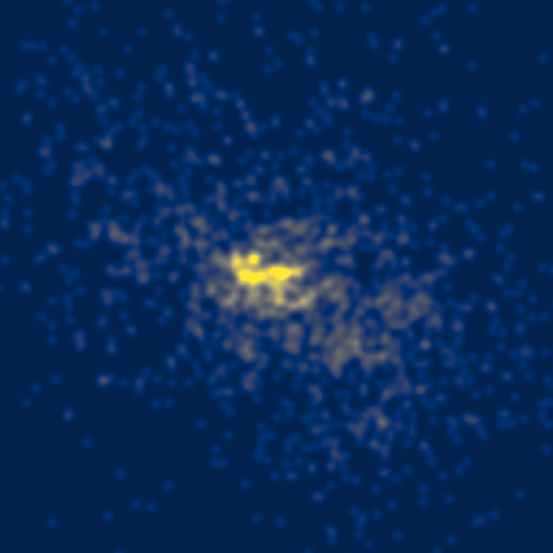
Fig 4: Mass distribution overlaid on multiwavelength observations within a radius of 2.8 Mpc centered at NGC 4874. The white contours represent
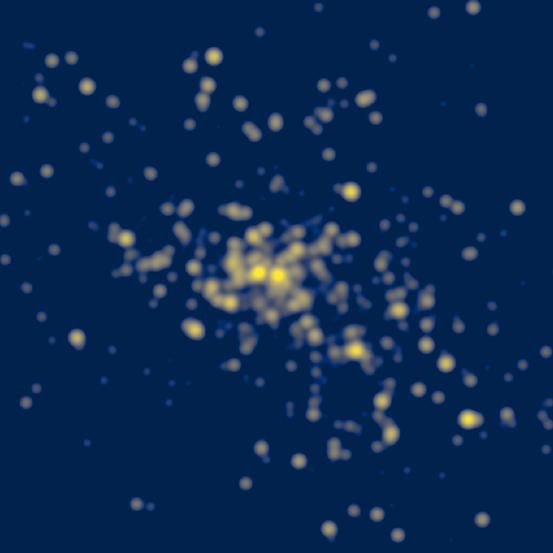
Fig 5: Comparison between the binned X-ray surface brightness (SB) and the binned weak-lensing (WL) signal, and their dependence on azimuthal
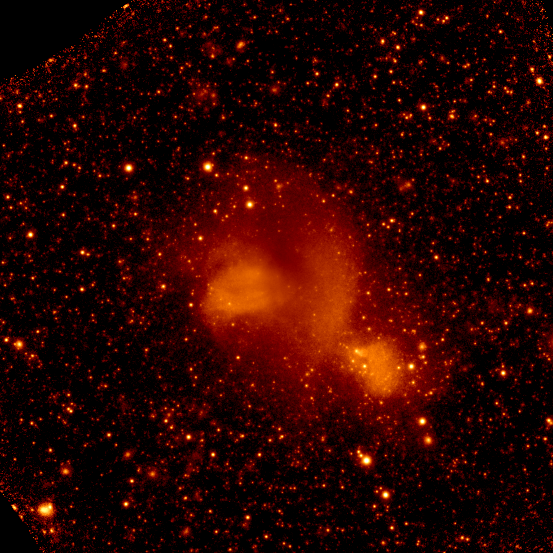
Fig 6: Reduced shear profiles of the Coma cluster. Top: Tangential
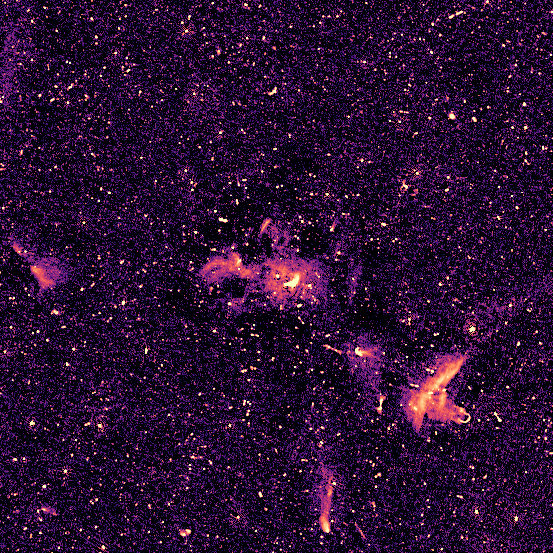
Fig 7 (page 7).
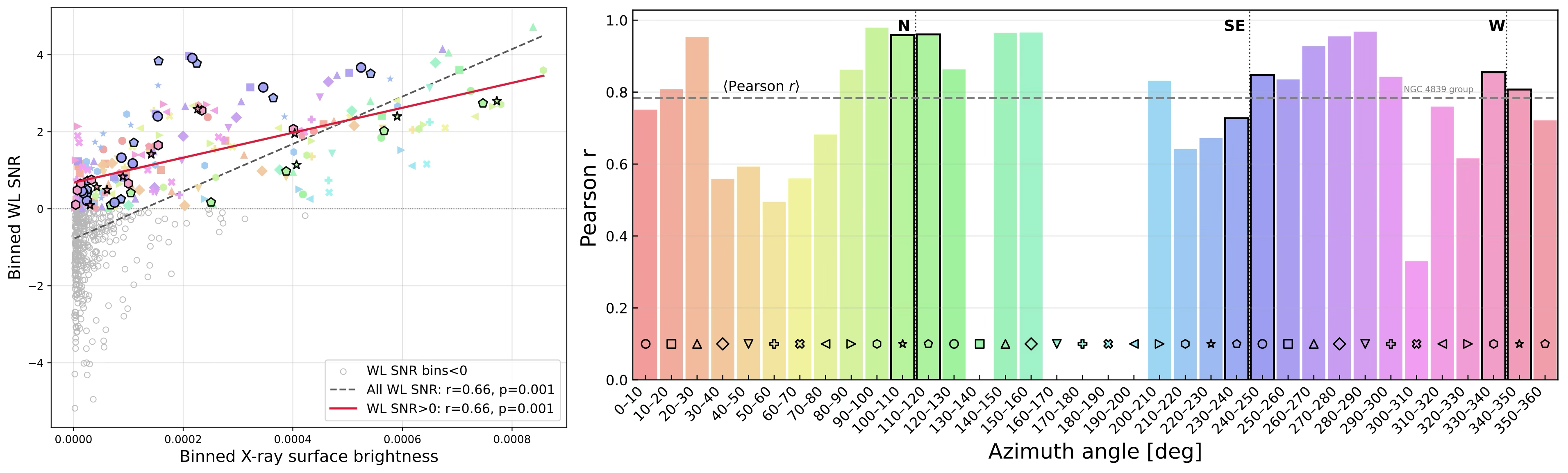
Fig 7: presents cumulative projected mass profiles from
Limitations
- Weak lensing of low-redshift cluster like Coma suffers from low lensing efficiency requiring extremely high-quality data and careful systematic control; residual systematics may remain despite CNN improvements.
- The CNN mass reconstruction resolution is limited by source galaxy density and smoothing kernel (~24.6 arcsec), limiting ability to resolve small-scale substructures.
- The two-halo NFW model assumes spherical symmetry and simplified merging geometry which may not capture full dynamical complexity of merging subclusters and filaments.
- Hydrostatic mass bias estimates are limited by assumptions in X-ray modeling, and uncertainties in gas physics during mergers may bias comparisons.
- Background/foreground structures identified from literature may be incomplete or uncertain, potentially contaminating shear peaks despite redshift filtering.
- Multiwavelength spectroscopic completeness is uneven, especially in the southeastern field, complicating interpretation of galaxy distributions and their correlation with dark matter.
- No explicit adversarial or systematic tests on faint galaxy shape measurement biases were performed specifically for these low redshift data.
Open questions / follow-ons
- How does the detailed three-dimensional geometry and dynamics of the filaments and merging subclusters influence the dark matter and baryonic distributions beyond parametric modeling?
- Can future deeper, higher resolution imaging and spectroscopy better resolve substructure and filament mass profiles to refine mass-to-light ratios and test dark matter models?
- What is the role of magnetic fields and cosmic rays traced by radio data in the physics of merger shocks and intracluster filaments, and how does that affect mass estimates?
- How do intracluster filaments contribute to galaxy evolution within clusters, specifically regarding gas accretion and star formation in filamentary environments?
Why it matters for bot defense
While this paper is not about bot defense or CAPTCHAs, the technical approach of combining high-resolution imaging data with advanced deep learning methods for reconstructing weak-lensing mass maps provides a useful example of how CNNs can be effectively applied to extract subtle signals in noisy, high-dimensional data. Bot-defense practitioners working on challenging signal extraction under adverse noise conditions may draw inspiration from the calibrated CNN inversion approach which surpasses classical inversion methods. Additionally, the emphasis on cross-wavelength data fusion for robust validation highlights the importance of integrating heterogeneous information sources for reliable detection and interpretation, a principle applicable to CAPTCHA system design and bot detection pipelines. The careful control of observational systematics and contamination by foreground/background structures also parallels challenges in filtering adversarial activity in bot detection. Overall, while domain quite different, the multi-faceted methodology combining simulation-trained CNNs, detailed error analysis, and multi-source cross-validation offers transferable lessons for bot defense research.
Cite
@article{arxiv2606_12523,
  title={ Dark and Luminous Matter in the Coma Cluster: Probing Galaxy Cluster Assembly Through Filaments with Weak Lensing and Multiwavelength Observations },
  author={ K. HyeongHan and K. Finner and M. James Jee and W. Lee and Y. Jiménez-Teja and S. Cha and W. Kang and H. S. Hwang and H. Cho and E. Churazov and I. Khabibullin and N. Lyskova and R. Sunyaev and A. M. Bykov },
  journal={arXiv preprint arXiv:2606.12523},
  year={ 2026 },
  url={https://arxiv.org/abs/2606.12523}
}